MagicSchool AI Review: The Teacher AI Platform, Tested

Here is the split that defines MagicSchool AI. In barely two years it reached more than six million teachers by nailing the one thing schools fear most about artificial intelligence — student-data privacy — while quietly shipping a real accuracy problem underneath. Both are true at once. So this review holds both. What the 80-plus tools actually do. What the free and paid plans cost. Where the output goes wrong, how solid the privacy really is, and how MagicSchool stacks up against Khanmigo, Brisk and plain ChatGPT. If you teach, the short answer is this: a strong tool you should never trust blindly.
What MagicSchool AI is and who it's for
MagicSchool AI, also written Magic School AI, does not work like a general chatbot dressed up for school. It is an AI assistant for teachers, built for the job. That matters in an edtech market stuffed with generic AI for schools that clearly never met a teacher. The founder is the tell. Adeel Khan taught, then ran a school in Denver, before he built this. The whole thing chases one goal: clawing back the unpaid hours that burn teachers out.
The scale is real. By its Series B in February 2025, MagicSchool reported more than six million educators and over 10,000 partner schools across 160 countries. The company has raised about $62.4 million total, including a $45 million Series B led by Valor Equity Partners. For an ed-tech tool that did not exist before 2023, that is fast.
The burnout angle is not marketing fluff. Roughly 44% of K-12 teachers report frequent burnout, and unpaid prep and grading are a big part of why. MagicSchool says it gives back up to ten hours a week. Whether you hit ten is debatable. What is not debatable is which jobs it targets: the tedious, repeatable workload, not the parts of teaching that need a human in the room.
Who is it for? Mostly K-12 classroom teachers, but also special-education staff, counselors, coaches and administrators. There is a separate student-facing side too, called MagicStudent. The common thread is that the platform assumes you are busy and do not want to learn prompt engineering. You pick a tool, fill a short form, and it writes the first draft. There is no blank box to stare at, which is exactly why teachers who bounced off ChatGPT stick with this instead.

How MagicSchool AI tools work in the classroom
The breadth is the product. Instead of one open prompt box, MagicSchool gives you more than 80 narrow tools, each tuned for a specific classroom job, from planning to grading to student engagement. For a teacher who does not want to coax a blank chatbot into the right answer, that structure is the whole appeal.
| Tool category | Example tools | What it saves |
|---|---|---|
| Planning | Lesson plan, unit plan, 5E science lesson | Hours of prep per week |
| Assessment | Quiz, multiple-choice, rubric generator | Drafting and grading time |
| Student support | IEP generator, text leveler, feedback | Heavy paperwork and differentiation |
| Communication | Parent email, report-card comments | Awkward drafting |
Planning and content tools
This is the bread and butter. Generate a lesson plan, build a rubric, draft a quiz, spin up a vocabulary list, all in seconds. The nice touches surprised me. A YouTube tool turns any clip into comprehension questions. A report-card comment writer drafts the lines teachers dread. An "AI-resistant assignment" tool even suggests ways to redesign a task so students cannot just paste it into ChatGPT. Most teachers open the lesson and assessment generators first, though, because that is where the week disappears. Output lands in an editable form, then exports to Google Docs or Word in one click.
Student support: IEPs and differentiation
Here is where MagicSchool earns real loyalty. The IEP generator and the text leveler handle the kind of work that eats evenings: rewriting a reading passage to three different levels, drafting individualized education program language, turning one assignment into a differentiated set. The goal is simple: tailor instruction for a whole class without rewriting everything by hand. A behavior-intervention suggester and a student-feedback tool round it out. Special-education teachers, going by what they post online, treat this as the killer feature, not a gimmick. The reason is obvious once you have written one. IEP paperwork is high-volume, formulaic writing, which is exactly what AI is good at. Even Khan singles out IEPs as a strong use case, while waving you off others.
Raina, MagicStudent and integrations
Raina is the built-in assistant, a chatbot that helps you choose and run tools when you are not sure which one fits. MagicStudent is the student-facing side, with AI-literacy activities and teacher monitoring baked in, so students learn to use AI under supervision rather than behind the teacher's back. The Chrome extension, rated 4.3 stars from about 30,000 users, puts the tools one click away inside Gmail, Google Classroom, Canvas, Schoology and Blackboard. No more switching tabs and copy-pasting. That sounds minor. It is not, once you live in those tools all day, and it is a big reason teachers stick around after the first try. There is a training side too: Level 1-3 certification courses and a responsible AI framework for teachers and students, so a school can roll the tools out without it turning into a free-for-all.
MagicSchool AI pricing: free vs Plus and schools
The free tier is generous in one way and stingy in another. You get all 80-plus tools, which sounds like everything. The catch is what is rationed: a limited Raina, and an output history capped at the last five generations, so anything you do not export is gone.
| Plan | Price | What you get |
|---|---|---|
| Free | $0 | All 80+ tools, limited Raina, last 5 outputs saved |
| Plus | $11.99/mo or $99.96/yr | Unlimited history, full Raina, export features |
| Enterprise | Custom (district pilots) | Admin controls, training, dedicated support |
At $99.96 a year for Plus, with a 15-day trial, the price is fair against rivals. The real decision is not whether $100 is worth it, but whether you will actually hit the free tier's history limit, and most daily users do within a week. If you only dip in to draft the occasional rubric, the free plan is genuinely enough; if MagicSchool becomes part of your daily routine, the export and history limits push you to pay fast.
Schools and districts are the other path, and where the money is. Enterprise plans add admin dashboards, usage analytics, training and a dedicated contact, plus an "innovator" program for early district pilots. Pricing is custom and negotiated per seat. Normal for ed-tech. For a single teacher, none of that matters. For a curriculum director rolling the tool across a building, the admin controls are the entire point of buying at the district level instead of letting staff sign up one by one.
The accuracy problem teachers should know
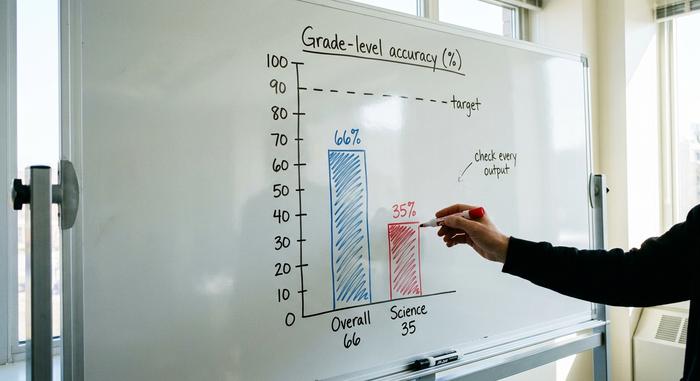
Now the part the marketing pages skip. MagicSchool is fast, but it is not reliably correct, and you do not have to take my word for it. An independent grade-level study put numbers on it. The platform's Informational Texts generator hit the right reading level only about 66% of the time overall. For science passages, just 35%. That is bad. To its credit, MagicSchool did not bury it. The company acknowledged the finding and retested across roughly 12,000 evaluations, reporting 70 to 100% accuracy on its student-facing tools after the fixes.
It gets more candid than that. Founder Adeel Khan has said publicly that the math computation outputs are unreliable, and the platform now flags math tools in-app as something to double-check. Think about that for a second: the founder is telling you not to trust part of his own product without checking. That is refreshing honesty, and also a warning.
MagicSchool AI's own framing is the "80/20" rule, where the platform drafts 80% and the teacher finishes the last 20%. In practice the 20% is not optional polish. It is fact-checking. A quiz with a wrong answer key or an off-grade reading passage does real damage in a classroom, so every output needs a human read before it reaches a student. This is also why some teachers on forums say they still reach for raw ChatGPT when they just need speed and will check the work anyway. The structured tools help most when the task is formulaic and the stakes of a small error are low. Used that way, MagicSchool saves real time. Used as autopilot, it will eventually embarrass you in front of a class.
Is MagicSchool AI safe? Privacy and FERPA
This is where MagicSchool clearly leads, and it is the reason districts approve it when they block other AI tools. The privacy stack is better than almost anything else in the category.
These are not self-declared badges. MagicSchool carries iKeepSafe FERPA and COPPA Safe Harbor certifications, holds SOC 2 Type II, earned a 95% Common Sense privacy rating, and signed the Student Data Privacy Consortium pledge. One line matters more than all the seals: its contracts forbid any underlying AI provider from training on student data. That is the clause a school lawyer hunts for. It closes the loophole districts fear most, the nightmare where a kid's essay quietly ends up in some model's training set.
It is not flawless. SOPPA and GDPR? Self-declared, not independently certified, so a district in Illinois or the EU should still run its own review before signing. One useful outside signal also went dark recently. Common Sense Media paused its product-review program in early 2026 and pulled the individual reviews, so the 95% refers to its privacy evaluation, not a current full rating. And privacy-safe is not the same as accurate, which is why the last section matters more, not less. A tool can guard a kid's data perfectly and still hand that kid a science passage written two grades too high. But on the specific question districts ask first, can we put this in front of children without leaking their data, MagicSchool has a stronger answer than most rivals, including raw ChatGPT, which no compliance office will sign off on for student use.
MagicSchool AI vs Khanmigo and other tools
So how does it stack up? MagicSchool wins on tool breadth and privacy, ties on price, and loses on two fronts: raw speed and free access.
| Tool | Best for | Price | Privacy / safety |
|---|---|---|---|
| MagicSchool | 80+ teacher tools, IEPs | Free / $99.96 yr | Strongest (FERPA, COPPA, SOC 2) |
| Khanmigo | Socratic tutoring | Free for teachers | Strong, Khan Academy |
| Brisk Teaching | In-Docs feedback | ~$99.99/yr | Good |
| ChatGPT | Raw speed, flexibility | Free / $20 mo | Not classroom-compliant |
Khanmigo, from Khan Academy, is free for teachers in 44 countries. But it leans Socratic and tutoring-first, so it fits student practice better than teacher prep. Brisk Teaching lives inside Google Docs and Chrome and shines at fast in-document feedback, at roughly the same $99.99 a year. Eduaide is the budget pick, around $72. And plenty of teachers just use ChatGPT, because it is faster and bends to anything, knowing full well it is not built for student data and will never pass a district review. So MagicSchool is not the only good option here. Just the safest broad one.
Here is the context. 60% of K-12 teachers used AI in the 2024-25 school year, per a Gallup and Walton Family Foundation survey, up from about 25% the year before. The AI-in-education market is tracking from roughly $10.6 billion in 2026 toward $42 billion by 2030. Whatever your take on it, this is not a fad teachers can wait out.
Who should use MagicSchool AI, and who skips it
So who is MagicSchool AI actually for? If you teach K-12, want safe, fast first drafts, and have no patience for prompt engineering, it is one of the easiest tools to adopt, and one of the few your district will wave through without a privacy fight. One rule, though. Treat every output as a draft, never a final, and check anything with numbers. Want a student tutoring bot instead? Khanmigo fits better. Want raw speed for your own non-student work? ChatGPT still wins. Try the free tier for a week, watch where the history limit bites, and decide whether $99.96 buys back enough of your evenings. For most teachers who just want time back without a privacy headache, it will.