What Is Algorand (ALGO)? The ALGO Price Paradox
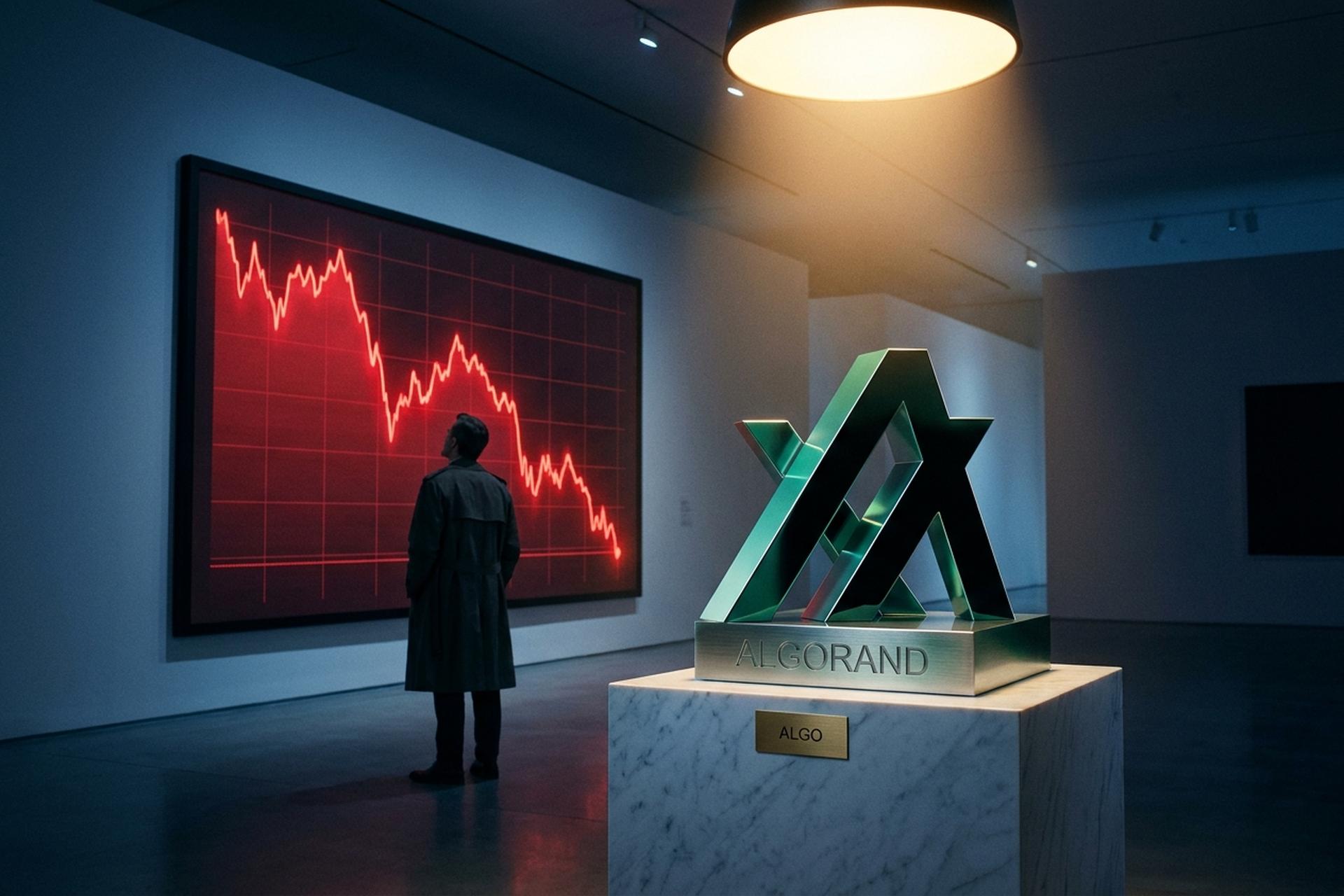
Few cryptocurrencies are as easy to admire and as painful to hold as Algorand.
The Algorand blockchain was designed by a Turing Award winner. It has run without a single second of downtime since 2019. It quietly powers tokenized funds, real estate, and government aid payments, and US regulators recently classified its token, ALGO, as a digital commodity. The technology works. Full stop.
So why does ALGO trade around nine cents, roughly 97 percent below its all-time high? That gap, between a near-flawless network and a near-dead price, is the real Algorand story, and most explainers tiptoe past it. This one will not. We will cover what Algorand is, who built it, how its pure proof-of-stake actually works, where it gets used in the real world, and why the ALGO price has been so brutal anyway.
What is Algorand and who is Silvio Micali
Most blockchains are born in a garage or a Discord server. Algorand was born in a lab. That difference shapes everything about it, for better and worse.
Silvio Micali and the academic origins
Algorand is the work of one stubborn cryptographer: Silvio Micali, a computer science professor at MIT. And he is no random crypto founder. Micali won the 2012 Turing Award, computing's version of a Nobel, for inventing ideas the whole field now takes for granted, including zero-knowledge proofs, decades before crypto made them a buzzword. In 2017 he set out to fix what he saw as sloppy engineering in existing chains: the way they kept trading away speed, or security, or decentralization to get the other two. He treated it as a research problem, not a startup pitch. That cuts both ways. It gave the chain bulletproof cryptography and real academic credibility. It also produced a network built to be correct, not one built to win the marketing war or the memecoin casino that actually moves crypto prices.
The blockchain trilemma, solved on paper
That research problem has a name: the blockchain trilemma. The claim is that a chain can usually nail only two of three goals, decentralization, scalability, and security, and has to give up the third. Bitcoin is secure and decentralized, but slow. Plenty of fast chains quietly centralize to keep their speed. Micali's bet was that the right math could deliver all three at once, no compromise. Algorand's blockchain protocol was built to make good on that bet, fast, secure, and scalable, and on paper, it mostly does.
Foundation, mainnet, and the ALGO launch
The Algorand mainnet, a public blockchain open to anyone, went live in June 2019 after a public testnet that April. The launch sale raised about $60 million through a Dutch auction. Two groups grew up around the project: Algorand Technologies, which writes the core software, and the non-profit Algorand Foundation, which looks after the ALGO token and the wider Algorand ecosystem. That split confused outsiders for years. In March 2026 the two finally merged into one US-based entity under chief executive Staci Warden.

How Algorand works: pure proof-of-stake
If you remember one thing about the technology, make it this. Algorand runs on Pure Proof-of-Stake, and the design is genuinely clever.
Cryptographic sortition and the secret lottery
Most proof-of-stake chains lean on a smallish set of known validators that take turns at block production. Algorand refuses to. For each block, it runs a secret lottery across every ALGO holder, weighted by how much they hold, using a verifiable random function. You do not even know you were picked until you have already done the work and proven it to the network. No fixed validator set to bribe. No committee to predict. No way to target the people securing the chain, because nobody knows who they are until it is over. Picture a national lottery that draws a fresh, anonymous jury for every single block, then sends it home before anyone can lean on it. Around 1,546 nodes take part today, with a Nakamoto coefficient of 12.
Instant finality, no forks, no downtime
Algorand consensus runs that lottery through a Byzantine agreement protocol that settles each new block in a single round. The results are striking. Blocks finalize in about 2.8 seconds, and once a block is confirmed, it is final. No exceptions. The Algorand network never forks, so you never wait around for confirmations to feel safe. It can handle close to 9,384 transactions per second in theory and, more tellingly, has not gone down once since mainnet launched in 2019. Average transaction fees sit around $0.00015.
ASAs, smart contracts, and a green chain
On top of that base, Algorand supports Algorand Standard Assets, a simple way to issue any token, stablecoin, or digital asset directly on layer one. Its smart contract engine runs decentralized applications, DeFi protocols, and atomic swaps, where two trades either both happen or neither does. The Algorand network is also a carbon-negative green blockchain, since pure proof of stake needs no energy-hungry mining. More than 51 million wallets have been created, and the network has processed over 3.59 billion transactions to date.
| Algorand at a glance | Detail |
|---|---|
| Consensus | Pure Proof-of-Stake (PPoS) |
| Block time | ~2.8 seconds |
| Finality | Instant, no forks |
| Max throughput | ~9,384 TPS |
| Average fee | ~$0.00015 |
| Downtime since 2019 | Zero |
| Energy | Carbon-negative |
| Max supply | 10 billion ALGO |
ALGO tokenomics: supply, staking, and rewards
ALGO, the native coin of Algorand, has a hard cap of 10 billion tokens, and unlike many young projects, almost all of them already exist. Around 8.92 billion are in circulation, close to 89 percent of the maximum, which is why the market cap and fully diluted value are nearly identical. There is very little hidden supply left to dump — but getting here meant years of steady unlocks that weighed on the price.
The bigger recent change is staking. For years, Algorand had no real protocol rewards for ordinary holders. That changed on January 23, 2025, when the network switched on consensus staking rewards. Now anyone running a participation node earns around 10 ALGO per block plus half of transaction fees, with no lockup and no slashing, at an estimated 4.7 to 6 percent yearly yield. The effect on decentralization was immediate: community validators went from holding 36.5 percent of stake to over 81 percent within a year, as more than 2 billion ALGO came online to secure the network. That shift matters more than the yield. A chain where the foundation holds most of the stake is only as decentralized as the foundation's goodwill; pushing four-fifths of the stake into community hands made Algorand far harder to capture.
| ALGO snapshot | Value (June 2026) |
|---|---|
| Price | ~$0.093 |
| Market cap | ~$827 million |
| Market cap rank | ~#76 |
| Circulating supply | ~8.92 billion ALGO |
| Max supply | 10 billion ALGO |
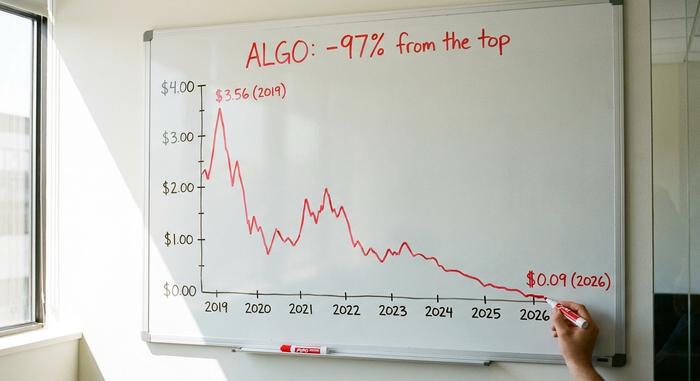
| All-time high | $3.56 (June 2019) |
| Down from ATH | ~97% |
Algorand in the real world: tokenization and CBDCs
Here is where Algorand quietly separates from the pack. While flashier chains chase memecoins, the network has spent years landing the unglamorous, real deals that actually use a blockchain.
Tokenization, real estate, and real-world assets
Algorand has become a serious home for tokenized real-world assets and other digital assets, with roughly $294 million of them on-chain by May 2026. It hosted one of the first tokenized money market funds back in June 2024. The real estate platform Lofty lets people buy fractional shares of US rental properties as tokens, growing to about $99 million in value and paying out over $4 million in rent. These are not demos. People earn real income through them. That is rarer than it sounds; most tokenized real-estate projects never get past the press release, while Lofty actually distributes rent on schedule.
Aid, copyright, and a commodity ruling
The use cases get more human, too. HesabPay used Algorand to deliver aid to more than a million recipients in Afghanistan, reportedly cutting delivery time by around 96 percent and cost by 60 percent compared with traditional channels. Italy's SIAE put millions of copyright records on the chain. There have been central bank digital currency pilots. And in March 2026, US regulators handed Algorand a quiet win, naming ALGO as one of 16 digital commodities under joint SEC and CFTC guidance, removing a legal cloud that hangs over many tokens. ALGO also reached Robinhood users in all 50 states that spring, and Japan's exchange association added it to the local Green List in April 2026, easing listings there. None of this is hype. It is the slow, boring kind of adoption that rarely moves a token price but quietly proves the technology in production.
Algorand price: why ALGO is down 97%
So why is the price a graveyard? ALGO hit its all-time high of $3.56 in June 2019, during the frenzy right after launch. Today it trades near $0.093, with a market cap around $827 million and a rank near #76. That is roughly a 97 percent decline, and it bottomed at about eight cents in March 2026.
The reasons are not really about the technology. First, supply: a 10 billion token schedule released coins steadily for years, a constant drip of sell pressure that demand never absorbed. Second, timing: the 2019 launch put the high right before a long bear market. Third, and most painfully, the market simply never paid for Algorand's adoption. Strong fundamentals do not automatically become a strong price — and ALGO is the clearest example in crypto of that hard truth. A $9.6 million wallet hack in early 2023 did not help sentiment either. The chain kept shipping; the chart kept sinking. For a contrarian, that disconnect is the whole appeal: rarely does a working, regulated, widely used network trade this far below its own past valuation. For everyone else, it is a years-long reminder that being right about technology and being right about price are two different bets.
How to buy and stake Algorand (ALGO)
It is easy to buy Algorand. ALGO trades on most major exchanges, including Binance, Coinbase, OKX, and Kraken, and as of 2026 it is available to Robinhood users across the United States. Buy it the way you would any altcoin, then move it to a wallet you control, such as Pera or Defly, or a hardware wallet like Ledger.
The more interesting option is staking. Because rewards went live in 2025, you can now earn yield simply by helping secure the network, with no lockup period and no risk of losing your stake to penalties. Running a participation node takes a little setup, but the result is real ALGO flowing to you for supporting the chain. For a long-term holder who believes the adoption story eventually matters, getting paid to wait is not the worst position to be in. If running a node sounds like too much work, several wallets and exchanges now offer one-click staking that handles the technical side for you, though you give up a sliver of the rewards for the convenience.
Is Algorand a good investment? An honest take
Here is the blunt version. The tech is excellent. The real-world usage is real, the kind most chains only pretend to have. And ALGO finally has legal clarity as a commodity. What it has never had is a price catalyst strong enough to beat its own supply, in a market that pays for stories over fundamentals. A quantum-resistant upgrade is penciled in for 2027 to 2028. Competition from Solana and newer chains is brutal. And for ALGO to reach the $10 some holders still dream about, it would need to climb roughly a hundredfold. Possible? In crypto, never say never. Likely soon? No. The likelier path is slow: if tokenization and payments keep growing and a busier fee market starts paying stakers, ALGO could re-rate gradually, without ever reliving its 2019 mania.
What Algorand's future on ALGO depends on
Algorand settled the technology argument years ago. The network is fast, green, reliable, and increasingly used by people who do not care about token prices at all. The open question is whether that real-world traction ever reconnects to ALGO itself. The staking relaunch, the regulatory clarity, and the steady tokenization wins all point in the right direction, but the market has ignored good Algorand news for years. So before you buy, ask yourself the only question that matters here: do you believe adoption eventually shows up in the price, or have you simply fallen for elegant engineering?