Toncoin to Gram: Inside the Telegram Blockchain
Most cryptocurrencies never get a second life. This one got two.
It started as Gram, Telegram's bid to hand crypto to hundreds of millions of chat users in one shot. U.S. regulators killed it in 2020. Done, finished, money returned. Then a handful of developers grabbed the leftover code, renamed the coin Toncoin, and kept the lights on themselves. Fast forward to June 2026 and the whole thing comes full circle: the coin takes back the name Gram, and Telegram is running the show again.
That loop tells you most of what you need to know. Toncoin is the native cryptocurrency of a layer-1 blockchain built to live inside the world's most popular messenger. Not a speed-record chaser. A messenger's money. Below, I dig into where it came from, how the TON blockchain works, what the token is really worth today, and why that rebrand matters more than any price chart.
From Gram to Toncoin and back to Gram again
The story starts with Telegram, the messaging app run by brothers Pavel and Nikolai Durov. Around 2018 they decided to build their own blockchain and bolt it onto the app. The idea was simple and huge at the same time: give every Telegram user a wallet — and crypto stops being a niche hobby.
The $1.7 billion ICO and the SEC fight
Telegram needed money, so it ran one of the biggest private token sales crypto had ever seen. The whitepaper called the system the Telegram Open Network. The coin was Gram. The 2018 sale hauled in around $1.7 billion from roughly 175 investors, almost all of them big funds. Nikolai Durov handled the engineering. Pavel handled the vision and the checkbook.
Then the SEC showed up, and everything changed. To the regulator, this was an unregistered securities offering, no debate. In October 2019, weeks before launch, it won an emergency order freezing Gram's distribution. Telegram fought back. It lost. A federal court sided with the SEC in early 2020, and that May the company gave up, returning more than $1.2 billion to investors and paying an $18.5 million penalty. One of the fattest war chests in crypto history, spent on a total defeat. Gram was dead.
How the community kept it alive
Or so it seemed. The code was open source, and that one detail saved the whole thing. A loose group of developers, later formalized as the non-profit TON Foundation, adopted the network and kept building. They renamed the coin Toncoin and the project The Open Network, reusing the TON initials. Telegram itself backed away to keep the SEC at arm's length. So the chain that finally launched belonged to the community, not to the company that had promised it to investors years earlier.
The 2026 return to Gram
For four years, Toncoin and Telegram kept a polite distance. In 2026 that ended fast. On May 4, Telegram moved back in and seized the TON Foundation's control of the validator set, taking the network into its own hands. The market reacted in hours: up 30 to 36 percent in a single day. Then came a community vote. It passed with 81.22 percent support to change the name back to Gram, and the rebrand went live on June 15, 2026. Six years on, the coin was Gram again, wearing the exact name the SEC had once buried.

How the TON blockchain actually works
Strip away the branding and TON is a layer-1 blockchain with a single obsession: scale. Most chains pick decentralization or speed and live with the trade-off. TON wanted both, at the size of a messaging app. The TON network was built for a billion chat users, so nearly every design choice bends toward that goal instead of crypto purism. Like Ethereum, it runs smart contracts, but it executes them on its own virtual machine and shuttles messages between contracts asynchronously, one at a time rather than all at once. Harder for developers to reason about? Definitely. That is the toll TON pays for spreading work across many chains at once.
Sharding and the "blockchain of blockchains"
The core trick is sharding. Picture one chain choking as every transaction lines up single file. TON refuses to do that. It splits the work across many parallel chains: a masterchain runs the show, workchains sit beneath it, and those can split again into shardchains when traffic spikes. When things calm down, the shards merge back. Developers call the result a "blockchain of blockchains." The point is simple. Add capacity on demand instead of jamming everything through one lane. That is the scalability problem older chains never cracked cleanly.
Proof-of-stake and validators
TON secures itself with proof-of-stake. No miners, no power-hungry rigs. Validators lock up Toncoin as collateral and take turns confirming blocks; misbehave and you forfeit part of your stake. By mid-2026 the network ran about 400 validators across six continents. Respectable. Still, that is a rounding error next to the hundreds of thousands securing Ethereum, and the gap says something honest about how decentralized TON really is.
Fees, speed, and a TPS reality check
Where TON genuinely delivers is cost and speed. A typical transaction runs about $0.0005. Block times dropped to roughly 400 milliseconds after the Catchain 2.0 upgrade. Those are real strengths for low-cost transaction processing. The "millions of transactions per second" boast is a different story. Nobody has confirmed it at mainnet scale, and real-world throughput sits closer to 25 to 52 transactions per second on an ordinary day. Cheap and quick, sure. Internet-scale, not yet.
Toncoin tokenomics: supply and the cap myth
Here is where a lot of explainers trip up. You will read, over and over, that Toncoin has a fixed supply capped at 5 billion coins. It does not. And if you hold the token, that gap matters.
There is no hard cap, full stop. New coins are minted continuously to pay validators, at an inflation rate around 0.6 percent a year. One source pegs it closer to 2 percent, so treat the precise figure as a moving target. The direction, though, is not in doubt: supply grows, it does not top out. That 5.2 billion "total" you see quoted is just today's number, not a ceiling. Bitcoin's 21 million cap lives in the code and cannot move. Toncoin's does not exist at all, because the network has to keep printing to pay the people securing it.
| Metric | Value (as of June 2026) |
|---|---|
| Circulating supply | ~2.69 billion TON |
| Total supply | ~5.20 billion TON |
| Maximum supply | No hard cap (uncapped) |
| Annual inflation | ~0.6% (validator rewards) |
| All-time high | $8.25 (June 15, 2024) |
| All-time low | $0.5194 (September 2021) |
Inside the TON crypto ecosystem and Telegram
Forget the sharding diagram for a moment — Toncoin's real edge is distribution. Plain and simple. Nothing else in crypto is wired straight into an app a billion people already open every day. Telegram crossed 1 billion monthly active users in March 2025. And in July 2025, around 87 million U.S. users woke up to find a TON wallet sitting inside the app they already used.
Mini-apps and the tap-to-earn boom
In 2024 that distribution boiled over into a full-blown craze. Telegram mini-apps, small web3 programs (essentially dApps, or decentralized applications) that run right inside a chat, went viral. Tap-to-earn games like Notcoin and Hamster Kombat hooked tens of millions of players who tapped their screens for tokens. Hamster Kombat alone bragged about hundreds of millions of players at its mid-2024 peak. Most had never opened a crypto wallet in their lives. Was a lot of it shallow and fleeting? Of course. But it was still the closest thing the industry has managed to real mainstream onboarding. Telegram has since leaned in with its own in-app currency, Telegram Stars, riding the same wallet rails and smudging the line between buying stickers and holding crypto. The takeaway stuck: the TON ecosystem grows through the app, not through DeFi dashboards.
Stablecoins and payments beat DeFi
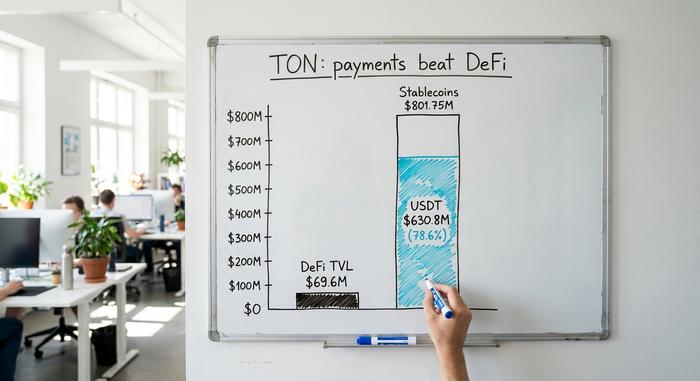
The numbers settle the argument. On-chain DeFi total value locked on TON sits near $69.6 million in mid-2026, down brutally from roughly $800 million at the 2024 peak, according to DeFiLlama. Stablecoins, though? About $801.75 million on the network, and USDT alone makes up $630.8 million of it, or 78.6 percent. Tether rolled out USDT on TON in 2024, and the supply blew past half a billion dollars within months, built specifically to move money inside Telegram. Put those two figures side by side and the verdict writes itself: people use TON to send dollars, not to chase yield. Services like TON DNS, TON Storage, and TON Proxy fill out the decentralized stack, but payments are the engine.
Toncoin price, market cap, and USD value
Time for a reality check on the Toncoin price, because the chart stings. The TON price today is nowhere near its old highs. On June 20, 2026, Gram traded near $1.61. Market cap, about $4.34 billion. Rank, roughly #24 among all cryptocurrencies, according to CoinGecko. That puts it some 80 percent under the $8.25 all-time high it hit in June 2024, back when tap-to-earn fever was peaking.
So what drives this thing? Telegram headlines. Not fundamentals. The biggest recent move, 30 to 36 percent in a day, hit on May 4, 2026, the moment Telegram said it was taking the network back. Zero new code shipped that day. Traders just re-priced the coin on the news that its billion-user parent had recommitted. Daily volume? Tens of millions of dollars, thin enough that one headline can jerk the price around. For a token this fused to one company, that is the rhythm to expect.
| Market metric | Value (June 20, 2026) |
|---|---|
| Price (USD) | ~$1.61 |
| Market cap | ~$4.34 billion |
| Market cap rank | #24 |
| All-time high | $8.25 (June 2024) |
| Down from ATH | ~80% |
| Biggest 24h move | +30–36% (May 4, 2026) |
How to buy and store Toncoin (Gram)
Buying Toncoin is easy. It trades on most major crypto exchanges, including Coinbase, Kraken, Binance, and Gate, against both dollars and stablecoins. Grab it like any other altcoin, then move it to a wallet you control. There is a smoother path, though, and it is the one Telegram is counting on: skip the exchange entirely and buy the coin straight inside the app's built-in wallet with a card, no separate trading account needed. Convenient? Very. It also means handing Telegram's payment partners your ID.
Storage is where TON gets fun. The easy option is the wallet baked into Telegram, which lets you hold and send Gram without ever leaving the chat. Want more control? Tonkeeper is a popular non-custodial wallet that keeps your keys on your own device. And if you would rather your coins earn their keep, stake them. Liquid staking through services like Tonstakers paid roughly 4 to 6 percent APY across 2026, briefly spiking toward 20 percent in May as demand surged around Telegram's return. Staking also helps secure the chain, so TON holders pocket yield for doing something useful.
The risks behind the Toncoin Gram rebrand
The rebrand cuts both ways. Handing control back to Telegram is the same arrangement the SEC objected to in 2020, when it argued Gram was a security tied to a single company. Putting that company back at the center revives the same regulatory question. There is also key-person risk: Pavel Durov was arrested in France in August 2024 and released on bail, a reminder that this network leans heavily on one person and one firm. A chain whose validators answer to a single company is faster to coordinate but easier to pressure — and regulators know exactly where to knock. Outside of stablecoin payments, real on-chain usage is thin, with DeFi TVL under $70 million. Toncoin's fate is welded to Telegram's, for better and worse.
What Toncoin's Gram era means for you
Toncoin, now Gram, is a bet on distribution rather than decentralization. If Telegram delivers smooth in-app crypto payments to a billion people, the token sits in a lane no competitor can easily reach. If regulators push back, or if the company stumbles, the single point of failure is impossible to miss. The technology is fast and cheap, the supply quietly inflates, and the price will keep tracking Telegram headlines more than any roadmap. So the question worth asking has little to do with whether the tech works. It does. The harder question is whether you trust Telegram to carry it. Settle that, and you have your answer on Gram.