Question AI Review: Is This Homework App Worth It?
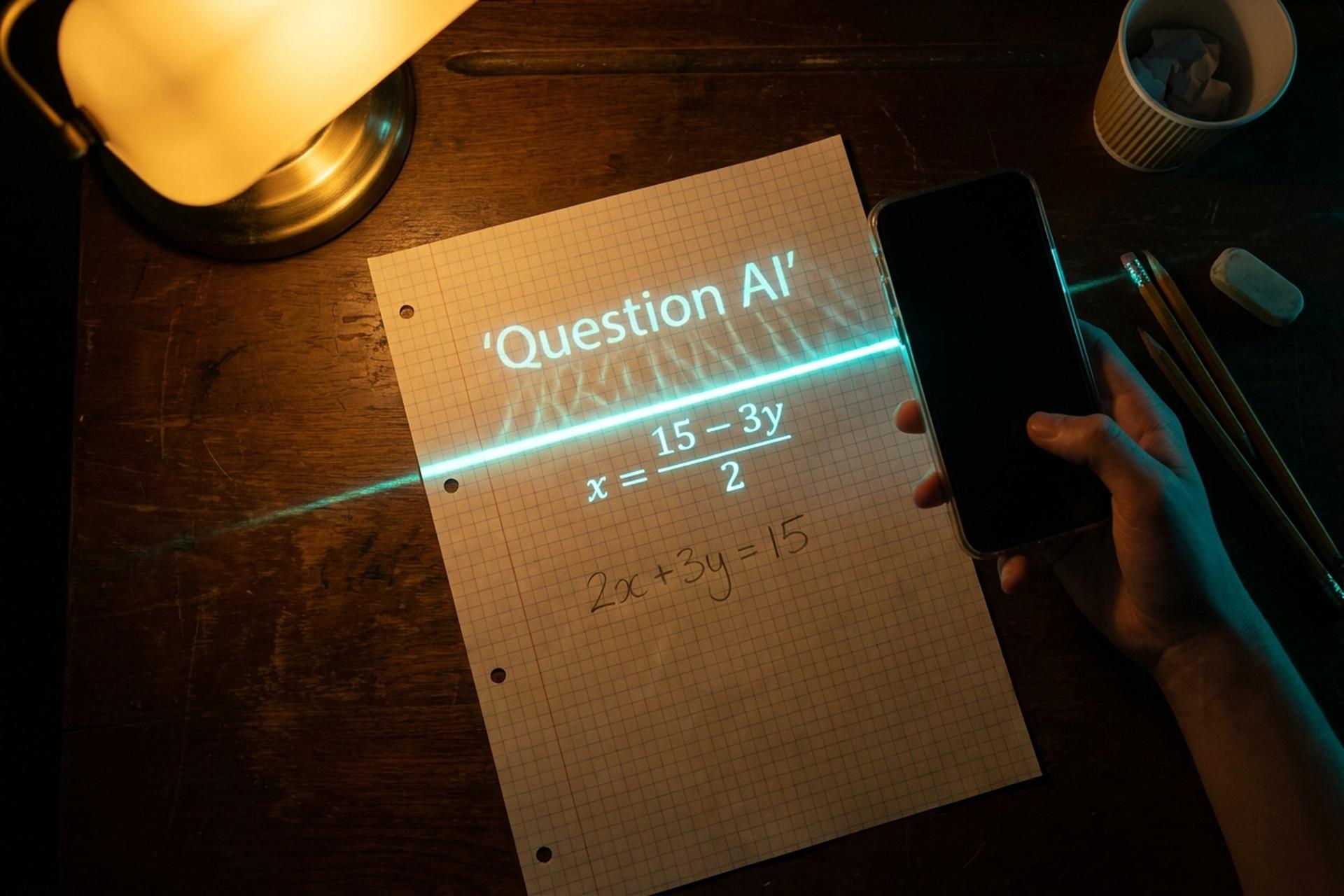
Point a phone camera at a math worksheet, wait two seconds, and an answer appears with steps already filled in. That is the entire promise of Question AI, and it is why the app went from nothing to roughly six million US downloads in about a year, according to TechCrunch. By April 2026 it had passed 27 million installs on Android alone, per the AppBrain tracker. Sensor Tower's mid-2024 report ranked it the top education app in the US and third among all AI apps, behind only ChatGPT and Copilot. Speed like that sells. The harder question is whether the answer that pops back is actually right, whether the app is safe for a teenager to use, and whether leaning on it teaches anything at all. This review digs into all three. I weighed the marketing claims against app-store reviews, the company's own corporate filings, and the wider research on AI in schools, and the picture turns out messier than the five-star ratings let on.
Question AI is an AI homework helper built around scanning rather than typing. You photograph a problem, the AI reads it, and you get a solution with an explanation. Below is the short version before we get into the detail.
| At a glance | Detail |
|---|---|
| Developer | Zuoyebang, via D3 Dimension Technology Pte. Ltd. (Singapore); App Store publisher "3HOUSE" |
| Platforms | iOS, Android, web, plus Chrome and Edge extensions |
| Price | Free tier; paid plans from about $4.90/month (annual) up to ~$11.99/month |
| App Store rating | 4.7 out of 5 (about 159K ratings) |
| Subjects | Math, science, history, English, business, and more |
| Languages | Translation across 140+ languages |
What Is Question AI and How Does It Work?
Question AI is a study app that turns a photo of a homework question into a written answer. It is less a chatbot you chat with and more a camera you point. The core loop never changes: scan, solve, explain. You can also type a question, upload a PDF, or just ask AI for a definition or a summary in the chat.
What most users never notice is who is behind it. The app is published through a Singapore company, D3 Dimension Technology, but its parent is Zuoyebang, one of China's largest education technology firms. That detail matters later when we get to privacy, so hold onto it.
From photo to answer: the scan-and-solve flow
The flow is built for a student in a hurry. Open the app, frame the problem, tap once. The algorithm reads the image, works out what kind of task it is, and returns a step-by-step solution within seconds. For printed algebra or a clean equation, it is fast, often under three seconds. The browser extension does the same trick on a screen: press a shortcut, grab a screenshot of a question on Canvas or Blackboard, and the answer slides in from a sidebar.
The app leans on large language models to analyze each question and write the explanation. That is its strength and its weakness at once. A model can explain a quadratic in plain language one moment and invent a confident, wrong step the next.
Who actually builds Question AI
Zuoyebang is not a startup. It raised about $2.93 billion across its funding history and was valued near $10 billion in 2020. The company already runs huge homework and tutoring products inside China, so Question AI is its export version, repackaged for students in the US, Indonesia, and beyond. Knowing the developer is a serious operator should raise your confidence in the engineering and lower it, slightly, on the privacy side.
Key Features: A Math Solver and AI Tutor
Strip away the marketing and Question AI is a math solver with a tutor mode wrapped around it. The math solver is the headline: photograph an equation and get the worked solution. The tutor mode goes a step further and reads the steps aloud, which helps if you learn better by ear than by eye.
Everything else is bolted on, and most of it works well enough. There is an AI chat for definitions and quick questions, a PDF reader that can analyze an uploaded document, a writing assistant with grammar checking, and a batch mode that handles several questions at once. The app even keeps simple learning analytics so you can see what you have been stuck on. The voice tutor and those analytics are the features that nudge Question AI from a cheat sheet toward something closer to a study aid, but only if a student actually slows down to use them that way.
The reach is wide. It runs on iOS, Android, and the web, and the Chrome and Edge extensions bring the same instant answers to any site you study on. For a single app, that is a lot of ground covered, even if no single feature is best in class.
Question AI Covers All Subjects, To a Point
The marketing line is that Question AI covers all subjects, and on paper it does: math, biology, history, social science, English, business, and physics, from algebra through calculus, geometry, and trigonometry. Ask it almost anything school-shaped and it will answer.
The reality is narrower. Question AI is math-first. Numbers, equations, and structured problems are where it shines, because those have a clean right answer the AI can check itself against. Humanities are weaker. Ask it to summarize a dense reading or weigh two sides of a history debate and the answers flatten out, losing the nuance a teacher actually wants. Treat the subject list as "can attempt", not "can ace".
How Accurate and Reliable Is Question AI?
This is the question the marketing pages skip, and the one that matters most. The honest answer: nobody has published an independent accuracy benchmark for Question AI. The company calls its answers precise. App Store reviewers are split, with five-star praise sitting right next to headlines like "the worst AI" and "I HATE this app". So how reliable is it, really?
What it gets right
On clean, printed math, Question AI is a powerful AI. Type or scan a standard algebra problem, a derivative, or a geometry question, and it returns accurate answers with step-by-step solutions that are easy to follow. For checking your own work, this is where the app earns its rating. You did the problem, you got a number, and you want a second opinion in two seconds. It delivers that.
Where it slips
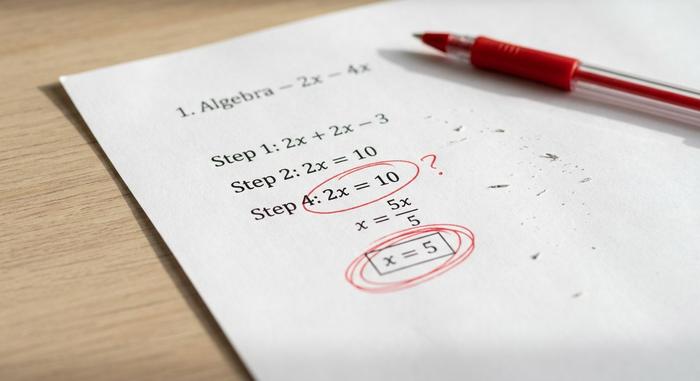
The cracks show on anything messy. Word problems that need real reading comprehension, multi-step proofs, and handwriting that the camera misreads all trip it up. Worse, when the AI is wrong, it is wrong with total confidence, producing a tidy chain of steps that looks right and is not. That failure mode, often called hallucination, is the real risk with any AI-powered homework tool. A wrong answer you can spot. A wrong answer dressed as a correct one, you copy.
How it stacks up on accuracy
Independent numbers are thin. One competitor review estimated Question AI handles basic content at roughly 70 to 80 percent accuracy, but that figure comes from a rival's blog, so treat it as a hint, not a fact. Against Photomath, which is math-only and Google-owned, Question AI is broader but not obviously more accurate on pure math. Against ChatGPT, it is faster for scanning a worksheet but no better at reasoning. The safe rule: trust it to check, not to decide. Think of it as a fast first pass. For anything that counts toward a grade, run the answer past your own reasoning, or a teacher, before you lean on it.
Pricing: How Free Is This AI Homework Helper?
Question AI markets itself as a free AI homework helper, and it is, up to a point. You get a limited run of free scans before the paywall arrives. After that, the free tier becomes a teaser for the subscription.
The paid plans depend on where you buy, which is easy to miss. On the website, the monthly plan runs $9.90 and caps you at 30 questions, while the annual plan works out to about $4.90 a month billed yearly and lifts that cap. Inside the iOS app the tiers differ, usually $6.99 to $11.99 a month, with a three-day trial dangled for $0.59, the kind of low number built to convert before you remember to cancel. Premium unlocks PDF solving, more detailed explanations, and what the app vaguely calls greater accuracy.
| Plan | Price (approx) | What you get |
|---|---|---|
| Free | $0 | Limited scans, basic answers |
| 3-day trial (in-app) | $0.59 | Full access, very short window |
| Monthly (web) | $9.90/month | About 30 questions per month |
| Annual (web) | ~$4.90/month billed yearly | Unlimited questions, all Plus features |
| In-app (iOS) | $6.99–$11.99/month | Varies by tier and region |
Prices shift by platform, country, and promotion, so check the website or App Store before you commit. And set a calendar reminder to cancel that trial.
Question AI vs Other Homework Solver Apps
The homework solver market reshuffled in early 2025. Gauth, the ByteDance-owned study app that led US education charts, suspended its US operations in January 2025 under the same law forcing a TikTok divestiture. That pulled a major rival off the field and handed apps like Question AI a clear lane to grow into. The money behind that scramble is real: Grand View Research valued the global AI-in-education market at $8.30 billion in 2025, on track for $32.27 billion by 2030, a 31.2% annual clip.
The other big names each pull in a different direction. Photomath, now owned by Google with more than 300 million lifetime downloads, is the math specialist and nothing else. ChatGPT is the generalist that can reason through an essay but was never built to scan a worksheet. Chegg offers human-checked answers but costs more and moves slower. Here is how Question AI stacks up against the field at a glance.
| Tool | Focus | Price (approx) | Best for | Watch out |
|---|---|---|---|---|
| Question AI | All subjects, math-first | Free + ~$8–12/mo | Fast scans across subjects | Hard-math accuracy, privacy |
| Gauth (ByteDance) | All subjects | Free + subscription | Large answer library | Suspended in the US since Jan 2025 |
| Photomath (Google) | Math only | Free + ~$9.99/mo | Best math step-by-step | Does only math |
| Socratic (Google) | All subjects | Free | Free, no account fuss | No longer actively updated |
| ChatGPT | General purpose | Free + $20/mo | Essays, reasoning, chat | Not made for scanning |
| Chegg | Textbook Q&A | ~$15.95/mo | Human-verified solutions | Pricier, slower |
Privacy: What the App Collects on Students
The review sites breeze past this part. Question AI is a study app aimed largely at minors, built by a Chinese education company through a Singapore entity. That combination puts it straight in the path of children's privacy law.
The app collects personal information and activity data. Its Chrome listing states the developer does not sell that data to third parties, which is reassuring as far as it goes. What is less clear is where the data lives, how long it is kept, and whether a student's scanned homework gets used to train future AI models. Those are not idle worries. In the US, the FTC's revised COPPA rule took effect on June 23, 2025, and it specifically requires fresh parental consent before a child's data is used to train AI. Any app serving K-12 students now has to answer that question directly.
None of this makes Question AI uniquely risky; most free study apps hoover up similar data. But the practical advice is simple. Do not upload anything that identifies you by name, school, or face. Use it for the math problem, not for your life story. If you are a parent, treat it the way you would any app that watches what your kid types.

Homework Help or High-Tech Cheating?
A scan-and-solve app like Question AI forces an awkward question: where does homework help end and cheating begin? The tool itself is neutral. The use is not.
The scale here is striking. By May 2025, a College Board survey found that 84 percent of US high schoolers were using AI for schoolwork, and other studies put the share who admit to breaking a school's AI policy near half. Teachers know. Schools are rewriting honor codes, switching to in-class writing, and leaning on detection tools that are themselves unreliable.
My take is boring but true. Used to check an answer you already worked out, or to see the steps you missed, Question AI is a fast and useful tutor. Used to produce work you then hand in as your own, it quietly hollows out the learning the homework was supposed to build. The app cannot tell the difference. Only the student can. That gap is exactly why schools cannot ban their way out of this, and why teaching students when to reach for the tool beats pretending it will disappear.
Should You Use Question AI? My Verdict
Question AI is a fast and convenient AI homework helper, and a mediocre teacher. It is at its best as a math solver and a second pair of eyes on a problem you have already attempted. It is at its worst when you trust it blindly on hard problems or treat it as a shortcut around thinking. Add real privacy questions for an app built for kids, and the case for caution gets stronger.
So use it the way you would use a calculator: a tool that checks your work, not one that does it for you. The students who get the most out of Question AI are the ones who least need it. What kind of user do you want to be?