Worldcoin (WLD): The Real Human Network in 2026

Eighteen million people have now stared into a chrome ball the size of a bowling ball and let it scan their eyes. That is the strange, slightly dystopian heart of Worldcoin. Its token, WLD, trades about 95% below its 2024 peak. Regulators in Spain, Germany, Brazil, Kenya, and South Korea have banned, fined, or suspended it. And yet the project just launched in the United States, crossed 18 million verified humans, and is about to cut its token supply growth. So which is it: a fading privacy nightmare, or the early plumbing for proving you are a real human online in a web flooded with AI bots? This guide covers what Worldcoin is, how the Orb works, the regulatory wall it keeps hitting, the WLD token, and whether any of it still matters in 2026.
What Is Worldcoin and the Real Human Network
Here is the thing most coverage gets wrong. Worldcoin is sold as a cryptocurrency, but the coin is almost a side effect. The real product is a digital identity system, a privacy-preserving way to prove that an online account belongs to a unique, living human and not a bot.
That bet comes from serious backers. Worldcoin was co-founded in 2019 by Sam Altman, the OpenAI CEO, alongside Alex Blania and Max Novendstern, through a company called Tools for Humanity. The logic is blunt: Altman helped unleash the AI that makes fake humans cheap and convincing, so he also wants to sell the tool that tells real people apart from them. The system has three parts. World ID is the anonymous "proof of human" credential. World App is the wallet and portal that holds it. And WLD is the token handed to people who verify. The pitch is a real human network, a global registry of people who have each proven they are one of a kind. There is an older idea baked in too: Altman has long argued that if AI automates away enough jobs, society will need universal basic income, and you cannot pay a UBI fairly without first knowing who is a real, unique person and who is a bot farming free money.
Proof of Human: How the Orb and World ID Work
The mechanics are worth understanding, because the entire privacy fight turns on one question: what does the Orb keep, and what does it throw away?
The Orb and the iris scan
Start with the hardware, since it's the part everyone has seen. The Orb is a polished chrome sphere about the size of a bowling ball, a camera tucked inside. You walk up, you look in, it photographs your irises. Those images become a long string of numbers, the IrisCode. Why eyes instead of a fingerprint or a face? Irises hold more randomness, and they barely shift over a lifetime, which makes them hard to fake or copy. The company's claim is that the raw photo never lingers: encrypted, pushed to your own phone, wiped from the Orb. In 2025 a smaller, cheaper Orb Mini turned up, with wider shipping slated for 2026.
World ID and zero-knowledge proofs
That IrisCode becomes your World ID. Think of it as a badge that says "one real human, verified" without saying which human. The trick is zero-knowledge cryptography. This human verification lets you prove to a website that you hold a valid World ID while revealing nothing else, not the biometric, not your name. Regulators were not sold at first. So in May 2024, under GDPR pressure, Tools for Humanity moved iris data into secure multi-party computation. In plain terms, the data gets split across separate servers so no single party ever holds a usable copy, and the old iris codes were deleted.
World App and World Chain
World App is the front door. It's a crypto wallet, holding WLD, bitcoin, ethereum, and USDC, and it carries your World ID around so you can flash "I'm human" at other apps. Under it runs World Chain, a decentralized Ethereum layer-2 on the OP Stack, live since October 17, 2024. The pitch there is simple favoritism: verified humans get priority blockspace and some free gas, a nudge to push bots to the back of the line. On paper the chain looks busy, 1.1 to 1.7 million transactions a day, with daily active addresses sitting around 16,700. Respectable for a network barely a year old. The DeFi side is thin, though, only about $33.6 million locked up, a rounding error next to Ethereum or Solana.
From Worldcoin to World: The 2024 Rebrand
In October 2024 the project renamed itself. "Worldcoin" became simply "World," and that was not a marketing whim. The new name dropped the "coin" on purpose. It signaled the pivot the team had been making for two years, away from "we are a cryptocurrency" and toward "we are an identity network that happens to have a token."
The rebrand came with hardware and features. A redesigned Orb shipped alongside a "Deep Face" tool meant to catch AI deepfakes, and a month earlier the company had launched Face Auth, a face-comparison feature pitched as a rival to Apple's Face ID. The mission got restated as three layers: a global proof of human, a wallet, and a network anyone can build on. Two organizations drive it, the nonprofit Worldcoin Foundation and the for-profit Tools for Humanity, which had grown to roughly 400 employees by 2025. The money behind it is real: Tools for Humanity raised a $115 million round in May 2023 led by Blockchain Capital, after an earlier raise valued the company at around $3 billion in 2022, with a16z and Khosla Ventures also on the cap table.
Worldcoin's Regulatory Bans and Privacy Fights
Here is what actually decides Worldcoin's fate. Not the cryptography. The law. Scanning irises from people across dozens of countries ran straight into the world's data-protection regimes, and the crashes never stopped. This is structural, baked into the business model, not a PR hiccup a press release can smooth over.
Europe pushes back
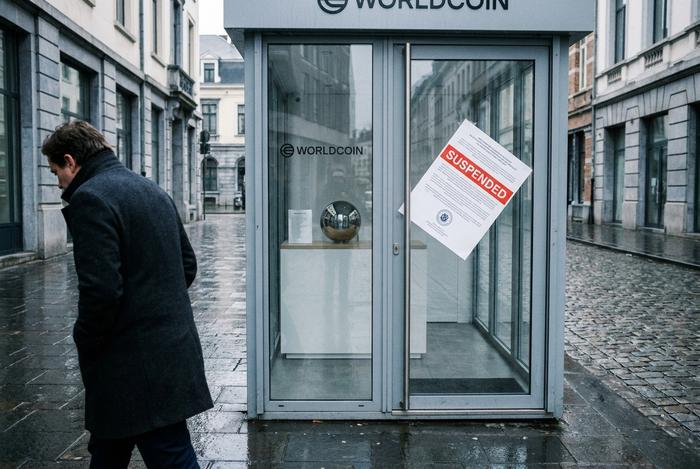
Europe hit back first, and hardest. Spain moved on March 6, 2024: its data watchdog, the AEPD, ordered Worldcoin to stop collecting biometric data on the spot, a precautionary GDPR block, no fine, just stop. Portugal followed within the same month. Then Germany raised the stakes. On December 19, 2024, the Bavarian regulator told the company to delete data outright and rebuild its handling to GDPR standard. France and the UK? Already digging since 2023.
Bans across the world and the privacy critique
Then the dominoes. Kenya suspended sign-ups, then ordered the data deleted. Brazil's ANPD banned the project flat out in January 2025 and dangled a daily fine if it dared restart. Indonesia pulled its permits in May 2025. South Korea's privacy commission fined the company about 1.1 billion won, close to $829,000, for mishandling biometrics. Hong Kong ruled it in breach of local privacy law. And underneath all of it sits the criticism an MIT Technology Review investigation made famous: consent. The earliest Orb operators clustered in lower-income neighborhoods, handing people tokens in exchange for their eyeballs, with disclosures critics called paper-thin. Build a growth engine on biometrics-for-cash in places with weak legal cover, and regulators come knocking.
| Country | Date | Action | Authority |
|---|---|---|---|
| Spain | Mar 2024 | Collection halted (no fine) | AEPD |
| Portugal | Mar 2024 | Temporary suspension | CNPD |
| Germany | Dec 2024 | Data-deletion order | Bavarian DPA |
| South Korea | 2024 | ~$829K fine | PIPC |
| Hong Kong | 2024 | Violation finding | PCPD |
| Brazil | Jan 2025 | Outright ban | ANPD |
| Indonesia | May 2025 | Permit suspension | Komdigi |
| Kenya | 2023–25 | Suspension + deletion | Govt / court |
WLD Tokenomics and the 2026 Emission Cut
WLD's problem fits in one word: supply. The WLD token is capped at 10 billion, but the way Worldcoin has structured those emissions has been brutal for the price.
Supply and distribution
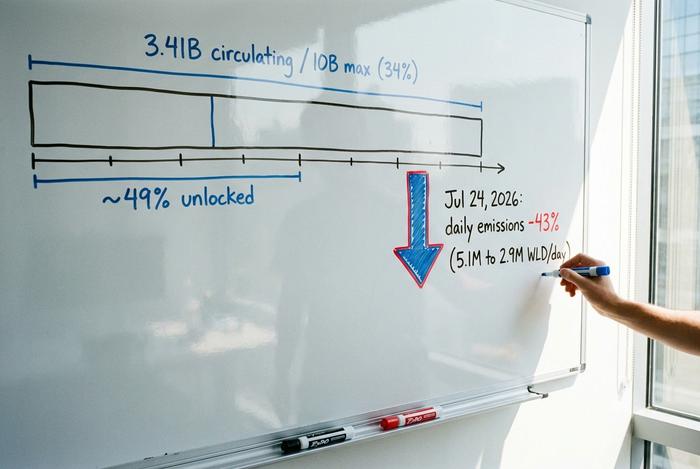
The cap is 10 billion WLD, locked for the first 15 years; after that, yearly inflation can tick up to 1.5%. So far, so reasonable. The catch is the pace. As of mid-2026 only about 3.41 billion are actually in circulation, around 34% of the cap, yet nearly half the total, roughly 49%, has already unlocked under the hood. Who gets it? Mostly the community: about 75% goes to users and the ecosystem, the other 25% to the team, investors, and a reserve. Verify with an Orb and you'd typically pocket a grant of around 25 WLD just for turning up.
The July 24, 2026 emission cut
Now the catalyst worth circling on a calendar. On July 24, 2026, scheduled daily emissions drop about 43%, from roughly 5.1 million WLD a day down to about 2.9 million. Fewer new coins hitting the market each day means less built-in selling, if demand holds up. And it has to. WLD trades near $0.60, about 95% below its all-time high of $11.74 from March 10, 2024, after bottoming near $0.23 in May 2026. The chart is a graveyard. The unlock flood is most of the reason why.
| WLD tokenomics (June 2026) | Figure |
|---|---|
| Price | ~$0.60 |
| Market cap | ~$2.05 billion |
| All-time high (Mar 2024) | $11.74 (down ~95%) |
| Circulating supply | ~3.41 billion |
| Max supply | 10 billion |
| Supply unlocked | ~49% |
| Daily emission cut (Jul 24, 2026) | ~43% lower |
Is Worldcoin Still Relevant in 2026?
Time for the honest verdict. There is real traction here, and there is a real wall, and they are pulling in opposite directions.
The traction is not fake. By April 2026 Worldcoin had verified about 18 million humans across 160 countries, and roughly 38 million people had downloaded World App. The company even claimed that, at the peak, someone new was signing up every 1.7 seconds through 2025. The US launch on May 1, 2025 was the real statement: Orbs in six cities, a Visa-backed World Card, a Tinder age-verification pilot, and a stated plan to put out 7,500 Orbs. But forget the raw user counts for a second. The integrations matter more. World ID is being wired into Tinder, Visa, Stripe, and the prediction market Kalshi, which is exactly the "prove you're human" plumbing the project promised from day one.
What keeps me on the fence is the gap between the story and the asterisks. "Users" is not the same as "verified humans," and the company quotes both. The token is down 95% and still dripping unlocks. And the regulatory map keeps lighting up red. A proof of personhood network only works if it is everywhere, and right now it is legally blocked in several of the largest markets it needs. Even friendly observers are split. Ethereum co-founder Vitalik Buterin has praised the idea of privacy-preserving proof of personhood while warning that one company controlling the Orbs is a real centralization risk. Others, like Twitter founder Jack Dorsey, have dismissed the whole approach outright.
| Worldcoin snapshot (2026) | Figure |
|---|---|
| Verified humans | ~18 million (160 countries) |
| World App users | ~38 million |
| US launch | May 1, 2025 (6 cities) |
| World Chain TVL | ~$33.6 million |
| WLD price vs ATH | ~95% below |
| Countries with regulatory action | 7+ |
How to Get Worldcoin and a World ID
Two routes, and they're nothing alike. Want the World ID and the free token grant? Download World App, track down a nearby Orb operator, and let the sphere scan your eyes; verification unlocks your World ID plus whatever WLD grant is on offer. Don't want a camera reading your irises? Skip it. You can just buy WLD on an exchange like Binance, OKX, or Coinbase for pure price exposure, no biometrics involved. One caveat: availability swings by country, so check your local rules first, especially in the US, where the rollout has been uneven.
Is Worldcoin Worth Watching Past 2026?
Worldcoin answered a question that is only getting sharper: as AI fills the internet with convincing fake people, how do you prove a human is human? Its answer, scan an iris and mint a private credential, is clever and deeply contentious in equal measure. The relevance call comes down to a race. Can World ID become standard plumbing inside real apps faster than data regulators can wall it off, and can the July emission cut steady a token that has lost almost everything? Neither is settled. If you are tracking this project, watch the integration announcements and the regulatory rulings, not the WLD price chart. That is where its future is actually being decided.