Portugal Crypto Tax 2026: Complete Guide to Rates, Rules & Exemptions

For years, Portugal held a quiet reputation as the friendliest spot in Europe for anyone active in the crypto space. No capital gains, no fuss, no paperwork for long-term holders. Then the 2023 State Budget arrived and rewrote the rules. Today, Portugal crypto tax looks very different from the "zero crypto tax" story that once drew thousands of investors to Lisbon and the Algarve. Crypto tax Portugal is now a real line on a real tax return. Yet even after the reform, Portugal continues to offer one of the most competitive frameworks in the European Union for crypto tax purposes, especially for patient investors willing to wait out the calendar.
This guide walks through how crypto is taxed in Portugal in 2026: the rates, the categories, the filing process, the 365-day rule that still makes the country stand out, and the common pitfalls that trip up new residents. Whether you already live in Portugal or are planning to move to Portugal, the goal is simple. It will give you a clear picture of what you owe, when, and how to stay on the right side of the Portuguese tax authorities. Anyone who wants to hold crypto for the long haul will find that Portugal stands out among crypto-friendly countries in the world for one reason in particular: the tax exemption for long-term holders has survived another budget cycle.
How Crypto Is Taxed in Portugal Under the 2023 Law
Until the end of 2022, Portugal treated private crypto gains as non-taxable. The logic traced back to a 2016 ruling by the Portuguese tax authority (Autoridade Tributária e Aduaneira, or AT), which said cryptocurrency was neither a currency nor a financial product. That made most private transactions invisible to personal income tax. It was unusual. It was also temporary. The interpretation ended with Lei n.º 24-D/2022, the State Budget Law that took effect on 1 January 2023 and still governs the framework in 2026. The 2026 State Budget, known locally as OE2026, was finalized in January 2026 and changed nothing about the crypto rules. A proposal from the Portuguese Communist Party to kill the 365-day exemption entirely was tabled during the OE2026 debate. It did not pass, which means the original carve-out survived another year.
What the 2023 law actually did was slot crypto into three buckets of the Portuguese personal income tax code (IRS), mostly under Article 10 for capital gains. The crypto tax rules that came out of that reform are what every resident now works with. Which bucket applies depends on what you do with the crypto, and this is exactly where new residents get confused.
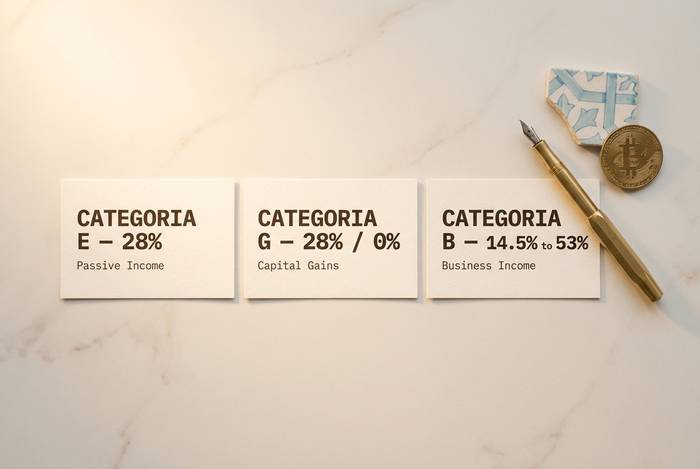
Category E handles capital income and passive income from crypto. Crypto staking rewards, lending yield, pooled rewards paid in fiat: all land here. Crypto after less active involvement — the kind you earn without trading — tends to sit in this bucket. Category G handles capital gains from selling crypto for fiat or goods. Most private investors spend nearly all their time in this bucket, and Category G refers to capital gains under Portuguese law. Category B is the self-employment track for active traders, miners, and validators who run their crypto like a business.
There is one more rule worth knowing upfront. Crypto-to-crypto swaps are generally not a taxable event in Portugal, as long as neither party is sitting in a blacklisted jurisdiction. You only trigger a capital gain when you exit into euros, dollars, goods, or services. A swap from BTC to ETH? Nothing happens for the tax office. That rule is why Portugal still feels generous next to most of its EU neighbors, where every swap is a realization event.
Portugal Crypto Tax Rates: Category E, G, and B Explained
The headline rate that most investors care about is 28%. It is the flat rate of 28 percent that applies to both Category E and Category G — passive crypto income and short-term capital gains. But the full picture is more detailed, and the right tax bracket matters more than the rate itself. A freelance developer paid in stablecoins faces a very different bill than a retiree cashing out Bitcoin they bought in 2018. Portugal’s crypto tax regime is one of the few in the EU that still makes this distinction meaningful.
| Category | What it covers | Rate in 2026 | Option to aggregate? |
|---|---|---|---|
| Category E | Passive yield, lending, staking paid in fiat | 28% flat | Yes, at progressive 14.5%–53% |
| Category G — short-term | Sale of crypto held less than 365 days | 28% flat | Yes, at progressive rates |
| Category G — long-term | Sale of crypto held 365 days or more | 0% (exempt) | N/A |
| Category B | Professional trading, mining, validation | 14.5%–53% progressive | Simplified regime available |
Category B is where the picture gets sharper. If the tax office decides your activity is professional rather than occasional, the gains no longer sit in the friendly 28% bucket. Instead, you pay Portuguese personal income tax at the regular IRS income tax brackets that match your total taxable income, from 14.5% on the first slice up to 53% including the solidarity surcharge on income above €250,000. A simplified regime is available below €200,000 in gross revenue, applying a coefficient of 0.15 to most crypto transactions and 0.95 to mining, which is how Portugal’s tax system reduces the effective tax burdens for smaller independent operators. This is one of the practical tax benefits that soften Category B for anyone running a small, compliant crypto operation rather than a full trading desk.
Corporate income tax is a separate story. A Portuguese company holding crypto pays corporate income tax (IRC) at 20% on the base rate in 2026, plus municipal and state surcharges that can push the effective rate higher for larger firms. Crypto held by a company does not benefit from the 365-day exemption, because that carve-out was written for private individuals.
The 365-Day Rule: When Crypto Tax-Free in Portugal Applies
The single rule worth memorizing is this: if you hold a crypto asset for 365 days or more before selling it, the resulting gain is exempt from capital gains tax in Portugal. Less than 365 days, and the 28% rate kicks in. Crypto tax free in Portugal is a concept that survives for this specific carve-out — nothing more, nothing less. This is the core of why Portugal still attracts long-term crypto investors even after the 2023 reform. Most European countries now tax every sale equally, regardless of holding period. Portugal keeps a clear reward for patience, and it is effectively the only meaningful crypto tax exemption left in the Portuguese tax regime.
One detail catches people out. The exemption only applies if the counterparty in the transaction is not located in a jurisdiction Portugal considers a tax haven. The Portuguese list of tax havens includes familiar names like the British Virgin Islands, the Isle of Man, and Panama. If you sell crypto through a platform domiciled in one of those jurisdictions, the exemption is lost and you end up paying the 28% rate even after holding more than 365 days. The exemption is also disabled if the asset qualifies as a security token rather than a standard crypto-asset under the MiCA-aligned definition Portugal adopted in 2023.
A binding ruling from the AT in October–November 2025 added an important nuance. If you convert a token into a stablecoin purely because there is no direct trading pair with euros, and you then move into fiat immediately, the technical swap does not reset the 365-day clock. The ruling, summarized by Lisbon-based firm LVP Advogados, treats the stablecoin leg as a pass-through rather than a realization event. That matters for anyone exiting an altcoin position through USDT or USDC to reach fiat liquidity.
The 365 days are counted using a FIFO (first in, first out) method. If you bought Bitcoin at several points across two years, the oldest lots are considered sold first. For anyone who dollar-cost-averages into crypto, this is generally favorable, because early purchases are the ones most likely to clear the one-year mark when it is time to realize gains.
Crypto held for less than 365 days is treated like short-term speculation. Gains if you hold crypto for shorter periods feed into Category G at the flat 28% rate, with the option to include them in your general taxable income at progressive rates if that works out cheaper. For people whose total Portuguese income is low, the aggregation option can actually bring the effective rate below 28%. Gains on crypto held short-term are where most of Portugal crypto tax revenue will come from, not long-term holders.
Taxable Events and Crypto Activities Under Portuguese Rules
Not every crypto transaction triggers a tax bill. Portuguese tax rules distinguish carefully between events that create a realized gain and events that do not. Understanding the line is essential before you file your first tax return as a Portugal resident.
Taxable events in the current framework include:
- Selling crypto for euros, US dollars, or another fiat currency.
- Using crypto to pay for goods or services (the value of the goods becomes the sale price).
- Receiving staking rewards paid in fiat or crypto (timing and category depend on how the reward is structured).
- Earning crypto through mining, validation, or professional trading activity.
- Moving tax residency outside Portugal while holding crypto, which triggers an exit tax on unrealized gains at 28%.
Non-taxable events include:
- Crypto-to-crypto trades (BTC to ETH, stablecoin swaps, token swaps on a DEX).
- Wallet-to-wallet transfers you control on both ends.
- Simply holding crypto, regardless of how much unrealized gain sits in your portfolio.
- Unique NFTs, which Portugal’s 2023 law explicitly excluded from the definition of taxable crypto assets, granting a de facto exemption.
The non-taxable status of crypto-to-crypto trades is unusual among European frameworks, and it materially changes how Portuguese investors rebalance portfolios. Moving from Ethereum to Solana is not a realization event here, only the eventual sale into fiat is. A reader used to the US or German system, where every swap is taxed, often finds this the single most surprising rule in Portuguese crypto taxation.
Will You Be Considered a Trader in Portugal?
This is the question that separates a calm 28% bill from a progressive nightmare that reaches 53%. The AT does not publish a formal checklist of what counts as professional activity, which leaves the judgment in the hands of individual tax inspectors and, ultimately, Portuguese courts. In practice, several signals push an investor toward Category B:
- Crypto trading is your primary source of income, not a side activity.
- You trade with high frequency, meaning daily or near-daily sales over long periods.
- You use professional tools, bots, or leverage.
- You operate through multiple exchanges in a structured way.
- You hold most assets for very short windows, showing clear intent to profit from short-term moves.
An investor who sells their holdings once or twice a year, even in large sizes, almost certainly stays in Category G. A developer running a small mining operation from a garage, by contrast, will usually fall under Category B whether they want to or not. If the line feels unclear for your situation, asking a certified tax professional before filing is far cheaper than arguing the point during a later audit.

How to Report Your Crypto Tax in Portugal (Modelo 3)
Reporting crypto in Portugal flows through the same income tax return every resident uses: Modelo 3. The window for filing your return runs from April 1 to June 30 of the year following the tax year. Returns are submitted online through the Portal das Finanças, the website operated by the Portuguese tax authorities. Paper tax forms are no longer accepted for most taxpayers. There is no separate crypto-only filing track. The same Modelo 3 that handles salaries and rental income also handles crypto in Portugal.
Each type of crypto income goes on a different annex. Anexo G handles Category G capital gains, with short-term sales (less than 365 days) in the main section and the reportable-but-exempt long-term sales in Anexo G1. Anexo E collects Category E passive income such as staking yield and lending interest. Anexo B is for Category B self-employment activity, under either the simplified or organized accounting regime. Foreign-sourced crypto income, typically from overseas exchanges, flows through Anexo J instead.
Long-term gains are exempt, but they are not invisible. Portugal still requires you to report them on Anexo G1 so the tax authority can verify that you actually held the asset for more than 365 days. Skipping this step is one of the most common mistakes new residents make. A missing declaration can trigger a follow-up request even when no tax is owed.
After submission, the tax office sends an assessment. If the assessment lands by July 31, payment is due by August 31. Assessments later in the year follow a rolling rule: the tax is due by the end of the month after the assessment date, with a final backstop of December 31 for anything processed by November 30. Records should be kept for ten years, matching the general IRS retention period. AT guidance published on 6 May 2025 consolidated these rules and confirmed that reporting is mandatory even when the long-term exemption reduces the actual liability to zero.
One 2026 change worth watching sits outside the Portuguese statute itself. The EU DAC8 directive (Directive 2023/2226) requires crypto-asset service providers to collect and report transaction data for all EU-resident clients. The transposition deadline was 31 December 2025. Portugal missed it, and in February 2026 the European Commission sent a formal notice to twelve Member States, including Portugal, giving them two months to finalize the local law. Once transposition closes, Portuguese residents who use foreign exchanges will see their activity flow directly into AT systems. The era of invisible crypto positions is ending quickly, and the first full reporting window runs from 1 January to 30 September 2027 for 2026 activity.
How to Minimize Your Crypto Taxes in Portugal Legally
The right tax strategy for a Portugal resident usually comes down to three levers: time, structure, and residency. Most of the real savings sit in the first one.
Holding longer than a year is the simplest and largest lever by a wide margin. A crypto investor who can wait out the 365-day clock shifts from a 28% liability to zero on the same trade. Consider a concrete example. An investor who buys 1 BTC at €30,000 on 15 February 2024 and sells on 20 March 2025 for €60,000 clears a 399-day holding window. The €30,000 gain is long-term and exempt. A separate 1 BTC bought on 15 February 2025 and sold 33 days later at €40,000 hits the 28% rate because the position never reached the 365-day threshold. Calendar planning helps too. Selling in January instead of December can add months of holding without affecting the investment thesis at all.
The aggregation option is worth checking if your total Portuguese income is low. Taxpayers with modest salaries or pensions can elect to add Category G short-term gains to their general taxable income instead of paying the flat 28%. For anyone in the lowest IRS brackets, the effective rate on short-term gains can drop below the flat rate, sometimes noticeably so.
Family donations are the cleanest part of the Portuguese tax code on this topic. Stamp duty of 10% applies to most crypto gifts, but transfers to a spouse, partner, or direct descendants are exempt. Donations under €500 are also exempt regardless of the recipient. This matters for estate planning more than day-to-day trading, though it is one of the few genuinely zero-tax moves still available.
Know the exit tax before you plan to leave. If you reside in Portugal and later move out, the law treats the holdings as if sold at market value on the day you leave and applies the 28% rate on the resulting unrealized gains. If you are no longer located in Portugal for tax purposes, you also risk foreign tax claims on the same position, which is why most cross-border investors need certified tax professionals rather than generic tax guidelines scraped off a forum.
The NHR regime is closed for new arrivals, and this is probably the biggest change anyone considering a move to Portugal needs to absorb. Portugal ended new applications to the Non-Habitual Resident program on 31 December 2023. A replacement regime called IFICI, sometimes branded as NHR 2.0, was regulated by Portaria n.º 352/2024/1 of 23 December 2024, retroactive to 1 January 2024. IFICI grants a 20% flat rate on Portuguese employment and business income for ten years, plus exemption on most foreign-source income, but eligibility is limited to highly-qualified professionals in science, R&D, innovation, startups, and exporters. Registration must happen by 15 January of the year after becoming a resident. For passive crypto investors, the new regime does not replicate the old NHR benefits. Anyone moving to Portugal in 2026 for tax reasons should build their plan around the 365-day rule, not around NHR.
Portugal Crypto Tax vs Other Crypto-Friendly Countries
Portugal is often compared with Germany, Malta, and a handful of other crypto-friendly countries. After the 2023 reform, the picture is more balanced than it used to be, but Portugal still holds its own on a few specific points. The table below puts the rules side by side for 2026.
| Country | Long-term (>1 year) | Short-term | Notes |
|---|---|---|---|
| Portugal | 0% | 28% flat | Crypto-to-crypto swaps tax-free |
| Germany | 0% | Up to 45% + solidarity | Same 1-year holding rule |
| Malta | 0% on private gains | Up to 35% for traders | "Blockchain Island" branding |
| Italy | 33% (from OE2026) | 33% | Rate raised from 26% in 2026 budget |
| Spain | 19%–28% | 19%–28% | Progressive on gains |
| France | 30% PFU | 30% PFU | Optional progressive regime |
| Switzerland | 0% for private investors | 0% | Wealth tax still applies |
What this table shows is that Portugal is no longer alone in offering a zero rate for long-term holders. Germany has the same rule, and Switzerland goes further for private individuals. What still differentiates Portugal is the flat 28% on short-term gains, lower than Germany’s top marginal income tax, combined with the non-taxable treatment of crypto-to-crypto swaps. For many active investors, that combination is more valuable than a headline zero rate. Portugal also has one advantage that is easy to overlook: a stable rulebook. The tax rules for crypto have not been rewritten since 2023, which is unusual in a space where most governments change their mind every budget cycle. Anyone who wants to calculate your crypto taxes in Portugal can do it against the same framework two years running.
Why Portugal Continues to Attract Crypto Investors in 2026
Ask anyone who moved to Lisbon in 2022 why they came, and the answer was usually the same: zero tax on crypto. Ask the same question today and you get a longer, less romantic answer. For the digital nomad crowd the weather still helps. So does the cost of living, which, even after three years of price inflation, still beats Paris, Amsterdam, and Berlin by a wide margin. English works almost everywhere in the tech-heavy bits of Lisbon and Porto, and Portuguese banks no longer panic when a client mentions Coinbase. In 2019 a crypto transfer could get your account frozen. In 2026 it usually does not. Those practical details are what make Portugal sticky for anyone who already had the tax reasons in mind.
The numbers back up the soft stuff. A 2025 Henley & Partners Crypto Wealth Report put Portuguese crypto ownership at roughly 43% of active investors, nearly double the EU average of 22%. Statista projects about 3.38 million crypto users in Portugal by 2025. Whether you trust the higher or lower end of those surveys, the country is no longer a niche destination for early adopters. It is mainstream enough that the tax office now publishes clarifications through formal bulletins rather than ignoring the topic.
The tax side still matters, of course. Even without NHR, a resident who holds crypto for more than 365 days pays zero on the gain. Few developed economies can say the same. Combine that with the non-taxable swap treatment, the clear Modelo 3 reporting path, and a generally pragmatic AT, and the country stays firmly on the shortlist for anyone holding digital assets through a cycle or two.
What Portugal offers is rarer than a tax giveaway. It is a stable, published rulebook. The 365-day rule is not a loophole, and it is not going away quietly. It was written into the 2023 reform as a deliberate policy choice, meant to encourage long-term investment rather than speculative churn. The PCP tried to kill it during the OE2026 debate and failed. Whether the rule survives the next election cycle depends on Portuguese politics, but for now, it remains one of the most predictable frameworks in the EU.