Gauth AI Review: Is the Homework Helper App Worth It?
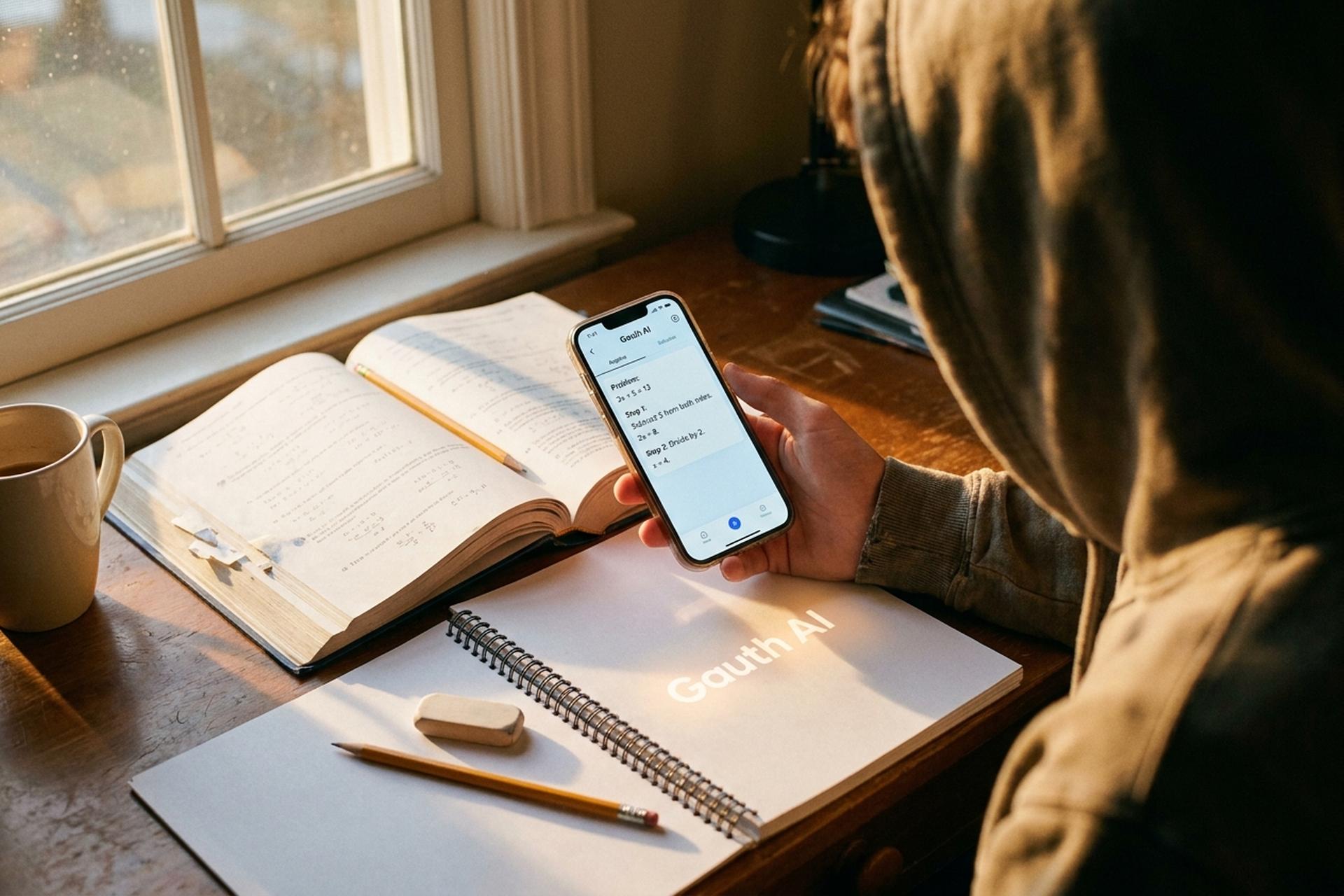
Most homework apps never make the news. Gauth did. For a few days in January 2025 it vanished from the US App Store, pulled offline alongside TikTok, then reappeared before most students noticed it was gone. The reason is the one fact that sets it apart from every rival: Gauth AI is owned by ByteDance, the Chinese company behind TikTok. That gives this homework helper a backstory none of its competitors can match, and a set of questions none of them have to answer. It also happens to be very good at its core job. Gauth holds a 4.8 rating from 1.4 million App Store reviews and spent six straight days as the top US education app in late 2025. So is it worth installing? That depends on what you want from it, and what you are willing to overlook.
Gauth AI is an AI homework helper that solves homework from a photo and explains the steps. Here is the short version before the detail.
| At a glance | Detail |
|---|---|
| Developer | GAUTHTECH PTE. LTD. (owned by ByteDance, TikTok's parent) |
| Platforms | iOS, Android, web, browser extension |
| Price | Free (~11 questions/day); Plus from $11.99/month; live-tutor tier ~$19.99/month |
| App Store rating | 4.8 out of 5 (1.4M ratings) |
| Subjects | Math, physics, chemistry, biology, plus essay and writing help |
| Standout feature | Live human tutors on demand |
What Is Gauth AI and How Does It Work?
Gauth AI started life as Gauthmath, a math-only solver, and grew into a general AI study companion. The core flow is simple: point your camera at a problem, and the app reads it, solves it, and lays out the steps. You can also type a question, upload a file, or chat with the AI for a definition or a push in the right direction. It draws on a library of more than 100 million previously solved questions, so common textbook problems often return an instant, clean match rather than a fresh guess.
What separates Gauth from most rivals is what sits behind the AI. When the model cannot crack a problem, you can hand it to a live human tutor. That fallback is rare in this category and it is the main reason some students stick with the app.
From photo to step-by-step solution
The scan is the heart of it. Frame a math problem, tap once, and a step-by-step solution appears, usually in a few seconds. For clean printed algebra or a standard equation, it is fast and the detailed explanations are easy to follow. The browser extension does the same on a laptop, so a question on a learning portal can be solved without reaching for your phone. You can crop the photo down to a single question, which matters when a worksheet crams five problems onto one page and you only want one of them solved.
AI study companion, live tutors, and DeepThinking
Beyond the solver, Gauth bundles a lot. There is an AI chat, a built-in calculator, a DeepThinking mode for harder reasoning, and a Study Converter that turns your notes into quizzes and flashcards. The headline extra is the live tutor: a real person with voice and a shared whiteboard for the problems the AI fumbles. It markets itself as a 24/7 study companion, and on features alone, that is fair. The Study Converter is the sleeper feature here. Drop in a page of lecture notes or an audio recording and it returns a quiz or a deck of flashcards, turning passive material into something you can test yourself on. Most rivals stop at answering questions; Gauth at least tries to push you toward studying them.
Who Owns Gauth? The ByteDance Question
This is the part that makes Gauth different from Question.AI or Photomath. The app is published by a Singapore entity, GAUTHTECH, but it belongs to ByteDance, the same company that owns TikTok. That link dragged a homework app into a national-security fight.
By early 2024 Gauth was already enormous, with reports citing hundreds of millions of users worldwide and the app pulling 1.5 million downloads in a single week that September, briefly the third most-downloaded app of any kind in the US. A product that big, owned by ByteDance, was never going to stay out of the crossfire. When the US sale-or-ban law on ByteDance apps took effect in January 2025, the Supreme Court having upheld it days earlier, Gauth disappeared from the US App Store on January 18 alongside TikTok. The outage was short. After a new executive order paused enforcement, the app was back within roughly three days. Students barely felt it, but the episode is a warning. The legal and data questions around ByteDance ownership did not go away when the app came back. They were postponed. Anyone relying on Gauth long term is betting that the politics stay quiet, and that is not a bet the app itself can guarantee.
Gauth Covers Every Subject, From Math to Physics
The subject range is genuinely wide. Gauth handles math problems from algebra through calculus and geometry, plus physics, chemistry, and biology, and it will take a swing at essays, grammar, and writing too. For a single app, that is a lot of ground. It also leans into exam season, with practice questions and final-exam prep that go beyond answering one-off homework problems.
The catch is the same one every AI solver runs into. Gauth is strongest where the answer is clean and structured, which means math and the hard sciences with clear inputs. Ask it for a nuanced reading of a poem or a balanced history argument and the output thins out. Treat the subject list as what it can attempt, not what it can ace.
How Accurate Is Gauth AI, Really?
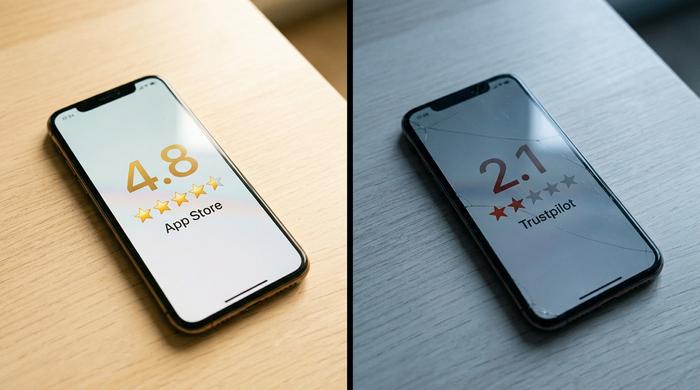
The marketing and the reviews stop agreeing here. Gauth AI's promotion points to a roughly 98% solve rate, and no independent test backs that number up. Solve rate is a slippery metric anyway. An app can return an answer to 98 of 100 problems and still be wrong on a quarter of them; coverage is not correctness, and the marketing blurs the two. The ratings split tells the real story better than any single figure.
The 4.8 vs 2.1 rating split
On the App Store, Gauth sits near 4.8 to 4.9 stars across more than a million reviews. On Trustpilot, the average is around 2.1. Both cannot be the whole truth. The App Store crowd rates the quick wins; the Trustpilot crowd tends to show up after a billing fight or a wrong answer on an exam. Read both before you trust either.
Where the AI gets it wrong
On standard K-12 and intro-college problems, Gauth is reliable. Push past that into advanced calculus, unusual notation, or a blurry photo, and accuracy drops. Worse, when the AI model is wrong it stays confident, producing a clean chain of steps that looks right and is not. That is the hallucination problem every AI homework tool shares, and it is the reason you check the answer instead of copying it. Photos are a common trigger. A skewed angle, a glare on the page, or messy handwriting, and the app will solve the wrong equation perfectly.
When the live tutor beats the AI
This is Gauth's hedge. For the problems the model botches, the live tutor is the safety net. A human can catch a misread diagram or a trick question the AI walks straight into. The tutor tier costs more, but for a student who needs to actually understand the material, it is the part of Gauth worth paying for.

Gauth Pricing, Subscriptions, and a Trap
Gauth is free to start, but the free tier is thin: around 11 questions a day with ads removed. Past that, you are into a subscription, and the pricing has a sting worth knowing about.
Plus runs about $11.99 a month or $99.99 a year and unlocks unlimited AI solutions. A separate tutor tier near $19.99 a month adds the live experts. There is a three-day trial that auto-renews, and that is where people get caught. One documented case had a user billed $323.73 across 27 months after a cancellation kept failing with a "network exception" error. Set a reminder, cancel early, and check your statement. Of the paid options, the tutor tier is the one most likely to justify its cost, since a live expert is hard to find free; the basic Plus plan competes with cheaper rivals doing much the same thing.
| Plan | Price (approx) | What you get |
|---|---|---|
| Free | $0 | ~11 questions/day, ad-free |
| 3-day trial | Free, then auto-renews | Full Plus access |
| Plus (monthly) | $11.99/month | Unlimited AI solutions, large answer library |
| Plus (annual) | $99.99/year | Same, cheaper per month |
| Tutor tier | ~$19.99/month | Plus, with live human experts |
Gauth AI vs Question.AI and Photomath
Stacked against rivals, Gauth's edge is breadth plus those live tutors. Question.AI matches it on subject range but has no human fallback. Photomath, owned by Google, does math only and does it well. ChatGPT can reason through an essay but was never built to scan a worksheet.
The interesting backdrop is the collapse of the old guard. Chegg, the textbook-answers incumbent, reported 2024 revenue of $617.6 million, down 14%, lost about a fifth of its subscribers, and cut a large share of staff in 2025 as free AI tools ate its business. The market is shifting from paid human Q&A to instant AI, and Gauth is one of the apps doing the eating. The download numbers back that up: in a recent stretch Gauth took about 1.61 million US installs, roughly 63% of its global total, and held the top US education spot for six consecutive days in October 2025.
| Tool | Owner | Focus | Live tutors | Price (approx) | Watch out |
|---|---|---|---|---|---|
| Gauth | ByteDance | All subjects, math-first | Yes | Free + $11.99/mo | ByteDance data/legal cloud, cancellation trap |
| Question.AI | Zuoyebang | All subjects | No | Free + ~$9.90/mo | Hard-math accuracy |
| Photomath | Math only | No | Free + ~$9.99/mo | Math only | |
| ChatGPT | OpenAI | General purpose | No | Free + $20/mo | Not built for scanning |
| Chegg | Chegg | Textbook Q&A | Human experts | ~$15.95/mo | Business shrinking fast |
Privacy: What Gauth Collects on Students
A homework app aimed at students collects a lot, and Gauth AI's ByteDance ownership makes that collection harder to wave away. ByteDance sits at the center of an ongoing US fight over how Chinese-owned apps handle American user data, and Gauth runs on that same corporate plumbing.
The app gathers personal information and activity data, as most free study apps do. The difference is who holds it and under what jurisdiction, and those answers are not fully settled. ByteDance has spent two years insisting that US user data is walled off from China; lawmakers remained unconvinced, which is the whole reason the divestiture law exists. Add the regulatory layer: the FTC's updated COPPA rule, in force since June 23, 2025, requires fresh parental consent before a child's data is used to train AI, and a K-12 app falls squarely inside that. None of this means your algebra photo is a national secret. It does mean the sensible move is to keep identifying details, your name, your school, your face, out of the app, and for parents to treat it like any tool that watches what a child types.
Homework Helper or a Way to Cheat?
A tool that hands over finished answers raises the obvious question. Wired has already framed apps like Gauth as cheating engines, and the worry is real. But the app itself does not care how you use it; that part is on the student in front of it.
The numbers show how normal this has become. By May 2025, 84% of US high schoolers were using AI for schoolwork, and close to half admit to using it in ways their school bans. Used to check an answer you worked out, or to see the step you missed, Gauth is a genuine study aid. Used to manufacture homework you hand in untouched, it quietly replaces the learning the work was meant to build. Gauth cannot tell the difference between those two students. Only the student can.
Should You Use Gauth AI? My Verdict
Gauth AI is the most complete app in its category: fast, broad, and the only major one with live human tutors behind the solver. It is also the one with the most baggage. The accuracy claims are unverified, the cancellation flow has burned people, and the owner is under a legal cloud that no homework app can resolve on its own.
So use it with your eyes open. Lean on it to check your work and to reach a real tutor when you are stuck, watch the billing like a hawk, and keep your personal data out of it. The best students treat Gauth as a second opinion, not a ghostwriter. Which one will you be?