The Crypto Wash Sale Rule: US vs the World in 2026

In the US, you can sell crypto at a loss, claim the tax deduction, and buy the same coin back five minutes later. It is perfectly legal. Try that move in London, Toronto, or Sydney and the deduction disappears. That single difference is what the crypto wash sale rule is really about, and it is one of the few places where American investors get a clear advantage over almost everyone else.
This guide compares how the wash sale rule, or its absence, treats crypto across five countries: the United States, the United Kingdom, Canada, Australia, and Ireland. We will start with what the rule does, why US crypto slips through it, how tax-loss harvesting works as a result, and then put the US side by side with the countries that already block the trick.
What the crypto wash sale rule actually means
The rule itself is simple. The reason crypto escapes it in the US is an accident of classification from 2014, not a deliberate gift to investors.
How a wash sale works for stocks
A wash sale happens when you sell a security at a loss and buy back the same or a "substantially identical" security shortly after. The wash sale rule, written into the US tax code, stops you from claiming that loss for tax purposes. It exists to block a hollow maneuver: dumping a stock on 31 December purely to book a loss, then buying it straight back on 2 January so your real position never changed. Congress wrote the rule into law back in 1921 for exactly this reason, long before digital assets existed.
Why US crypto is exempt
Here is the catch that benefits crypto holders. The rule applies only to "stock or securities". In 2014, the IRS decided that virtual currency is treated as property for federal tax purposes (IRS Notice 2014-21), the same category as gold or real estate, not as a security. Because Bitcoin is property and not a security, the wash sale rule does not apply to it. Nobody designed this as a crypto perk. It simply fell out of a classification choice made before most of today's tokens existed.
The 61-day window and cost-basis carryover
When the rule does bite, on stocks or crypto ETFs, the window is wide. It covers 30 days before the sale and 30 days after, a 61-day span counting the sale day itself. The disallowed loss is not gone forever; it gets added to the cost basis of the replacement shares, so you recover it whenever you finally sell for good. For direct crypto in the US, none of this currently applies. You sell, you claim, you rebuy.
How crypto tax-loss harvesting works in the US
The missing crypto wash sale rule turns every market crash into a tax tool. The technique is called tax-loss harvesting, and for US crypto holders it is unusually clean.
Sell, deduct, rebuy
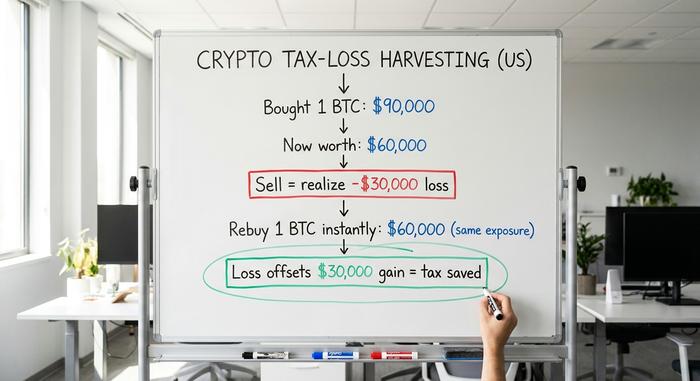
You sell crypto at a loss, lock in that capital loss, and buy the position back immediately so you keep your exposure. The harvested loss first offsets your capital gains. If your losses exceed your gains, you can deduct up to $3,000 against ordinary income each year, and carry any remainder forward to future years. For a stock investor, the wash sale rule would forbid the instant rebuy. For a crypto investor, it does not.
Picture a simple case. You bought one Bitcoin at $90,000 and it now trades at $60,000. Sell it and you realize a $30,000 capital loss, then rebuy a Bitcoin seconds later for roughly the same $60,000. Your position is unchanged, but you now hold a $30,000 loss to set against gains elsewhere. If you sold an altcoin earlier in the year for a $30,000 profit, the harvested loss wipes out the tax on that gain entirely. A stock trader running the identical round-trip would have the loss disallowed and would gain nothing.
The economic substance catch
This is where I would slow down. "Legal" is not the same as "bulletproof". The IRS can still challenge transactions that have no purpose beyond tax avoidance under the economic substance doctrine. If you sell and rebuy the identical coin in the same minute, thousands of times, purely to manufacture losses, you are giving an auditor a clean story to tell. Most practitioners treat a real, market-exposed gap, even a short one, as far safer than a mechanical round-trip. The doctrine has rarely been tested against crypto harvesting in court, which is precisely why caution beats cleverness here. An untested defense can still lose.
Where crypto ETFs are different
One important exception trips people up. Spot Bitcoin and Ether ETFs are securities, not property. That means the wash sale rule does apply to them in full. Sell an ETF at a loss and rebuy it inside the 61-day window and the loss is disallowed, exactly as with any stock. The exemption protects direct crypto, not the wrapped, exchange-traded version.
Wash sale rules for crypto around the world
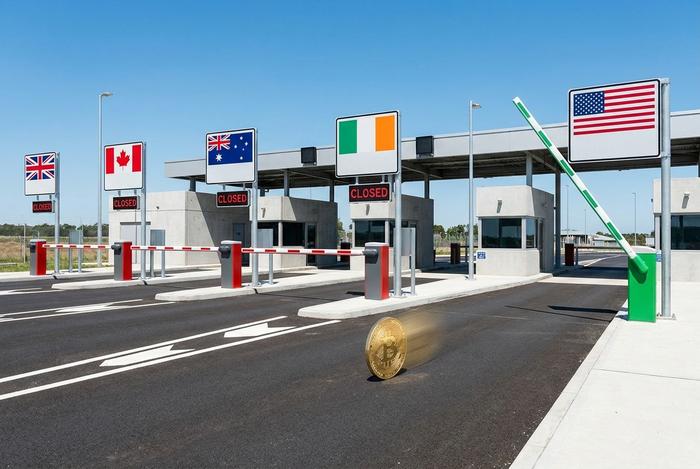
Now the part competitors leave out. The US is the outlier. The UK, Canada, Australia, and Ireland all already block crypto loss-and-rebuy, each through a different legal mechanism.
| Country | Rule name | Window | Applies to crypto? |
|---|---|---|---|
| United States | Wash sale rule (IRC §1091) | 61 days (30 before + 30 after) | No (crypto is property) |
| United Kingdom | Same-day + 30-day "bed and breakfasting" | 30 days after the sale | Yes |
| Canada | Superficial loss rule | 61 days (30 before + 30 after) | Yes |
| Australia | Part IVA anti-avoidance (TA 2008/7) | No fixed window (purpose test) | Yes |
| Ireland | Four-week rule | 28 days | Yes |
United Kingdom: bed and breakfasting
The UK has the most detailed system. HMRC matches a disposal first against any crypto of the same type bought on the same day, then against anything bought in the next 30 days, the so-called bed-and-breakfasting rule. Only what is left falls into the Section 104 pool, a running average cost of your holding. The practical effect is that a sell-and-rebuy within 30 days is matched to the rebuy, so the loss you hoped to bank simply does not arise. The Section 104 pool then quietly averages your remaining cost, which also means the UK does not let you cherry-pick which specific coins you sold. Compared with the US free-for-all, it is a tightly closed system, and HMRC spells the crypto treatment out directly in its Cryptoassets Manual rather than leaving it to guesswork.
Canada: the superficial loss rule
Canada calls its version the superficial loss rule. If you sell at a loss and you, or an affiliated person such as a spouse, buy the same property within 30 days before or after, the loss is denied. The denied amount is added to the cost base of the repurchased asset instead. The Canada Revenue Agency confirmed in 2024 that this applies to crypto, which it treats as a commodity. The window mirrors the US one at 61 days, but unlike the US, it actually catches crypto. In practice, a Canadian who sells Ether at a C$5,000 loss and rebuys within the month cannot claim that loss now; it rolls into the cost base and waits until a genuine future sale.
Australia and Ireland
Australia takes a looser, intent-based approach. There is no fixed day count. Instead the Tax Office can strike down a "wash sale" under the Part IVA general anti-avoidance rule if the dominant purpose of the sale and quick rebuy was a tax benefit. Ireland is stricter and more mechanical, with a four-week rule that disallows a loss when you reacquire the same asset within 28 days. The lesson across all four countries is the same. Whether the trigger is a fixed 28 or 30-day clock or a broad purpose test, the loss-and-rebuy shortcut that US investors enjoy is simply closed off.
Will the IRS close the crypto loophole?
Lawmakers have tried to kill the crypto wash sale rule exemption since 2021, and they keep failing. The threat is real but not imminent, and any new rule would almost certainly apply going forward rather than to past trades.
The 2021 Build Back Better bill included a provision to extend the wash sale rule to digital assets. It passed the House and died in the Senate. The Treasury kept the idea alive in its annual budget proposals; its 2024 plan estimated that applying the wash sale rule to digital assets would raise about $23.5 billion over ten years, and the 2025 version bundled several digital-asset measures worth more than $42 billion combined. In July 2025, Senator Cynthia Lummis introduced a bill to rewrite the rule to cover digital assets, scored by Congress at roughly $600 million net. Each attempt has stalled for similar reasons: crypto tax provisions keep getting folded into larger spending fights, and the industry argues that a framework built for securities sits awkwardly on something the same government calls property. As of 2026, none of these has become law. The loophole is still open, but it has a target on its back. If a rule does pass, expect it to apply to future trades only, which means today's harvesting is unlikely to be clawed back later.
Crypto tax and capital gains rates by country
A point worth stressing: no wash sale rule does not mean cheapest. The headline capital gains rate usually matters far more to your final bill than whether you can rebuy quickly.
| Country | Crypto capital gains treatment | Wash-sale equivalent |
|---|---|---|
| United States | 0/15/20% long-term; short-term at income rates | No (for direct crypto) |
| United Kingdom | 18% or 24%; £3,000 annual exempt amount | Yes |
| Canada | 50% of the gain taxed at your marginal rate | Yes |
| Australia | 50% discount if held over 12 months | Yes |
| Ireland | 33% flat rate | Yes |
The UK raised its rates to 18% and 24% in late 2024 and shrank the tax-free allowance to £3,000. Canada kept its 50% inclusion rate after a proposed increase to two-thirds was cancelled in 2025. Ireland's flat 33% is among the heaviest here. The US combines a generous long-term rate with the crypto wash sale rule exemption, which is a rare double advantage.
Using the crypto rule without crossing the IRS
The loophole is legal, but lazy execution invites trouble. A few habits keep harvested losses defensible. Document a genuine reason for each sale beyond the tax saving. Do not sell to a spouse or related party expecting to claim the loss; that gets disallowed on its own. Avoid purely mechanical, instant rebuys repeated at scale, which look exactly like the abuse the economic substance doctrine targets. And watch your paperwork: the new Form 1099-DA, phased in from 2025, includes a box for wash-sale losses disallowed, so reporting around digital assets is getting tighter even before the law changes. None of this is a reason to avoid harvesting. It is a reason to do it like an investor with a real strategy, not a trader gaming a form.
The bottom line on the crypto wash sale rule
The American crypto wash sale loophole is real, valuable, and live right now. It is also a policy accident born from a 2014 decision to call crypto property, and it is living on borrowed time as Congress circles it. If you trade from the US, the freedom to harvest losses and rebuy is a genuine edge worth using carefully. If you trade from the UK, Canada, Australia, or Ireland, assume a rule already applies and plan your timing around it. So the real question is not whether the crypto wash sale rule applies to you. It is which country's version you are playing against, and how long the American exception has left.