What Is Avalanche (AVAX)? How the Three-Chain Blockchain Works and How to Use It
The first time I bridged assets to Avalanche's C-Chain in 2021, I was confused for about ten minutes. Three chains? X-Chain, C-Chain, P-Chain? Why does one blockchain need three separate networks? It felt over-engineered. Then I ran a few transactions and the speed hit me. Sub-second finality. Fees in fractions of a cent. Smart contracts that worked exactly like Ethereum because the C-Chain literally runs an Ethereum Virtual Machine. The three-chain architecture stopped feeling weird and started feeling like the answer to a question most other blockchains hadn't thought to ask: what if different types of blockchain tasks ran on different, purpose-built chains instead of cramming everything onto one?
Avalanche launched in September 2020. The team behind it, Ava Labs, is led by Emin Gun Sirer, a Cornell professor who published blockchain research back when most people still thought Bitcoin was fake internet money. Gun Sirer isn't a startup bro who read a whitepaper and decided to build a chain. He'd been working on distributed consensus problems for over a decade before Avalanche existed. That academic rigor shows in the design, for better and worse: the architecture is genuinely clever but the learning curve is steeper than Solana or even Ethereum.
The platform grew fast during the 2021 bull run. AVAX price surged 3,300%. Daily transactions jumped 470%. Mastercard selected Ava Labs for their crypto program. Deloitte built disaster relief payment tools on it. JPMorgan and Apollo tested tokenized funds on Avalanche subnets. Then the bear market hit and the hype evaporated. But the building didn't stop. The Avalanche9000 upgrade, subnets evolving into full-scale L1 chains, and institutional pilots have quietly made this one of the more architecturally interesting platforms in the space.
Here's the full picture: what makes Avalanche different, how the three-chain system actually works in practice, how to set it up and use it, and where it sits in the competitive landscape against Ethereum and Solana.
The three chains: why Avalanche has X-Chain, C-Chain, and P-Chain
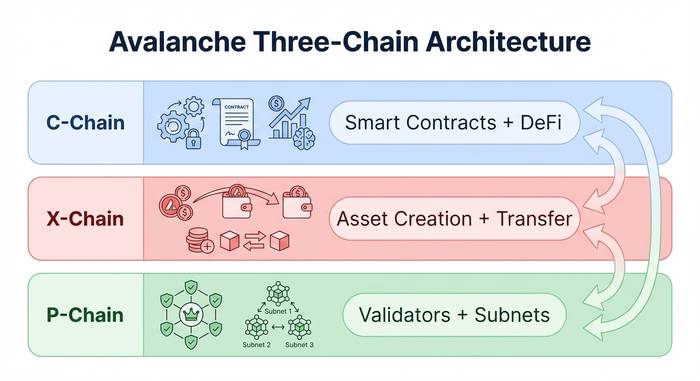
Here's what confused me initially. Most blockchains run as a single chain doing everything. Ethereum processes smart contracts, token transfers, and validator coordination on the same network. Solana runs everything through a single execution environment. Avalanche took a different approach and split the workload across three specialized chains that run simultaneously.
C-Chain (Contract Chain) is where you'll spend most of your time. It runs the Ethereum Virtual Machine, which means any Solidity smart contract that works on Ethereum works on C-Chain without changes. DeFi protocols, NFT marketplaces, token launches, all of it deploys here. When people say "I'm using Avalanche," they almost always mean C-Chain. MetaMask connects to it natively. The experience is identical to using Ethereum except transactions confirm in under two seconds and cost a few cents instead of several dollars.
X-Chain (Exchange Chain) handles asset creation and transfer. If you want to mint a new token or transfer AVAX between wallets at maximum speed, X-Chain is the layer that processes it. It uses a DAG-based (directed acyclic graph) consensus model that's different from C-Chain's linear block structure. Most regular users don't interact with X-Chain directly because wallets and apps abstract it away.
P-Chain (Platform Chain) coordinates validators and manages subnets. When someone creates a new subnet (now called an Avalanche L1), P-Chain handles the registration. When validators stake their AVAX, P-Chain tracks the staking. It's the meta layer that keeps the whole ecosystem organized. Developers building custom blockchains interact with P-Chain. Regular users rarely see it.
What this means for you as a user: C-Chain doesn't slow down when P-Chain processes a subnet registration. X-Chain transfers don't compete for block space with DeFi smart contracts. Each chain carries its own workload without affecting the others. Ethereum doesn't have this. When an NFT mint floods the network, your simple USDC transfer pays the same inflated gas. On Avalanche, those workloads wouldn't even be on the same chain.
In practice, wallets handle the cross-chain movement in the background. I've been using Core wallet for about a year and I barely think about which chain my AVAX is on. The wallet moves it automatically when I stake (P-Chain) or trade (C-Chain). It's only confusing when you're withdrawing from an exchange and the interface asks you to pick a chain. Pick C-Chain. Always. Unless you know specifically why you need X-Chain or P-Chain.
How Avalanche consensus works (without the academic jargon)
The consensus mechanism is where Gun Sirer's academic background shows up most clearly, and it's the part that made me actually respect the project beyond the price action.
Most blockchains reach agreement the same way a committee does. Everyone sits in a metaphorical room, proposes, debates, votes. Works fine with a few people. Gets slow when you add hundreds. Ethereum's validator process takes 12 seconds per slot because coordinating a million participants is hard.
Avalanche consensus works more like gossip in a school cafeteria. A validator gets a transaction. Instead of announcing it to everyone, it randomly asks a handful of other validators: "Hey, you think this is legit?" If most say yes, the validator leans toward yes. Asks another random handful. Same answer. After a few rounds of random polling, the entire network has converged on the same conclusion without anyone ever organizing a formal vote. The math behind why this works reliably is genuinely interesting (look up "snowball sampling" if you're curious) but the outcome is what matters for users: sub-two-second finality and 4,500 TPS on C-Chain.
1,200+ validators run the primary network. Staking minimum is 2,000 AVAX, which at $20-40 per AVAX means you need $40,000-80,000 to run a node. That's high. Ethereum lets you stake 32 ETH (~$60-100K) but also has Lido for any amount. Avalanche has delegation: put in 25 AVAX, pick a validator, earn a share of their 8-10% APR. Not the most accessible setup for small holders but workable if you're committed enough to learn the Core wallet.
How to use Avalanche: practical guide
Getting started with Avalanche is straightforward if you've used any EVM chain before.
Setting up your wallet. Add Avalanche C-Chain to MetaMask. Network name: Avalanche C-Chain. RPC URL: https://api.avax.network/ext/bc/C/rpc. Chain ID: 43114. Currency: AVAX. Or skip the manual setup and use the Core wallet (built by Ava Labs specifically for Avalanche), which handles all three chains natively and includes built-in bridging.
Getting AVAX onto the network. Buy AVAX on any major exchange (Coinbase, Binance, Kraken). Withdraw to your C-Chain address. Make sure you select the Avalanche C-Chain network during withdrawal, not X-Chain or P-Chain. Sending AVAX to the wrong chain is a common mistake that's recoverable but annoying. Alternatively, use the Avalanche Bridge to move assets from Ethereum to C-Chain directly.
Using DeFi on Avalanche. The ecosystem has the standard DeFi suite. Trader Joe is the largest DEX (Avalanche's answer to Uniswap). Aave and Benqi handle lending and borrowing. GMX runs on Avalanche alongside Arbitrum. Pangolin is another DEX that was one of the earliest Avalanche-native protocols. Connect your wallet to any of these, approve the token, and trade. The experience is identical to Ethereum DeFi except the transactions confirm faster and cost less.
Staking AVAX. If you have 25+ AVAX, you can delegate to a validator through the Core wallet or through liquid staking protocols like sAVAX (Benqi). Delegation locks your AVAX for a minimum of two weeks. The yield is typically 8-10% APR. Liquid staking through sAVAX lets you earn staking yield while keeping your AVAX usable in DeFi, same concept as Lido's stETH on Ethereum.
Subnets and Avalanche L1s: the scaling strategy
Subnets were Avalanche's original scaling vision and they've evolved significantly. The idea: instead of every transaction running on the main C-Chain, projects can launch their own custom blockchain (a subnet) that's secured by a dedicated set of validators. Each subnet has its own rules: custom gas tokens, custom throughput settings, custom privacy features, custom virtual machines.
Gaming picked this up first. Shrapnel, which markets itself as a AAA-quality shooter built on blockchain, runs its own subnet. DeFi Kingdoms moved to one. But the institutional angle is what I find more interesting long-term. JPMorgan and Apollo Global tested a tokenized fund project on an Avalanche subnet with Ava Labs. That's not a crypto-native experiment. That's TradFi giants building private, compliant chains that still connect to a public network. If I had to bet on what drives AVAX value over the next five years, it's that use case, not DeFi.
The Avalanche9000 upgrade (Etna, deployed late 2025) reduced the cost of launching a subnet by 99.7%, from roughly 2,000 AVAX ($40,000+) to a small continuous fee. It also rebranded subnets as "Avalanche L1s" and removed the requirement that subnet validators also validate the primary network. This made it dramatically cheaper and simpler to launch a custom chain on Avalanche.
Ava Labs committed $290 million through the "Avalanche Multiverse" incentive program to fund subnet development. The long-term vision: Avalanche becomes a network of hundreds or thousands of interconnected L1 chains, each optimized for a specific use case, all interoperable through the platform.
AVAX tokenomics and the burn mechanism
AVAX has a capped supply of 720 million tokens. Unlike ETH (which has no cap) or SOL (which inflates indefinitely toward 1.5%), AVAX is deflationary by design: all transaction fees on C-Chain are burned. Every swap, every smart contract call, every NFT mint removes AVAX from circulation permanently.
| Metric | AVAX |
|---|---|
| Max supply | 720 million |
| Circulating supply | ~430 million (early 2026) |
| Staking yield | 8-10% APR |
| Fee mechanism | 100% burned |
| Validator minimum | 2,000 AVAX |
| Delegation minimum | 25 AVAX |
The burn rate depends on network activity. During high-volume periods, millions of AVAX get burned monthly. During quiet periods, burns slow down. The net effect: AVAX supply shrinks over time as long as the network is used. Combined with staking locking up ~60% of circulating supply, the effective liquid supply of AVAX is significantly lower than the headline circulating number.
Avalanche vs Ethereum vs Solana: where it sits
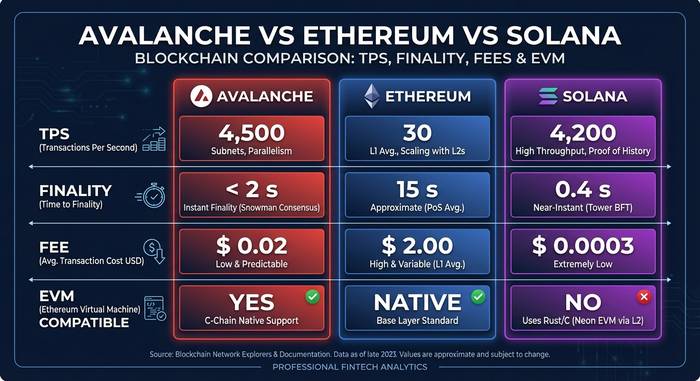
| Feature | Avalanche C-Chain | Ethereum | Solana |
|---|---|---|---|
| TPS | ~4,500 | 15-30 (mainnet) | 400-4,200 |
| Finality | <2 seconds | ~12-15 seconds | ~400ms |
| Avg transaction fee | $0.01-0.05 | $0.50-5+ | ~$0.00025 |
| EVM compatible | Yes (native) | Yes (it IS the EVM) | No (Rust/SVM) |
| Validators | 1,200+ | 1,000,000+ | 1,400+ |
| DeFi TVL | ~$1-2 billion | $50+ billion | ~$9.5 billion |
| Custom chains | Subnets / L1s | Rollups (L2s) | No native equivalent |
Where does Avalanche actually fit? I think of it as the EVM chain for people who want speed without leaving the Ethereum tool ecosystem. If you write Solidity and you want sub-second finality, Avalanche is the path of least resistance. You don't have to learn Rust like Solana demands. You don't have to deal with Ethereum's gas spikes. Your existing code deploys as-is.
The flipside is that Avalanche doesn't dominate any single metric the way Ethereum dominates TVL or Solana dominates raw throughput. It's the jack of all trades. That positioning works for developers who want a reliable middle ground. It works less well for marketing because "we're pretty good at everything" doesn't fit on a billboard the way "fastest blockchain" does.
The subnet story is where the real long-term potential lives. If Avalanche becomes the default platform for institutions launching compliant, custom blockchains, that's a use case neither Ethereum nor Solana serves as well. The JPMorgan and Apollo experiments point in that direction. Whether it materializes at scale depends on whether institutions actually move past the pilot phase, which in traditional finance can take years.