Sidra Chain: What the EVM Network Is and Whether to Connect
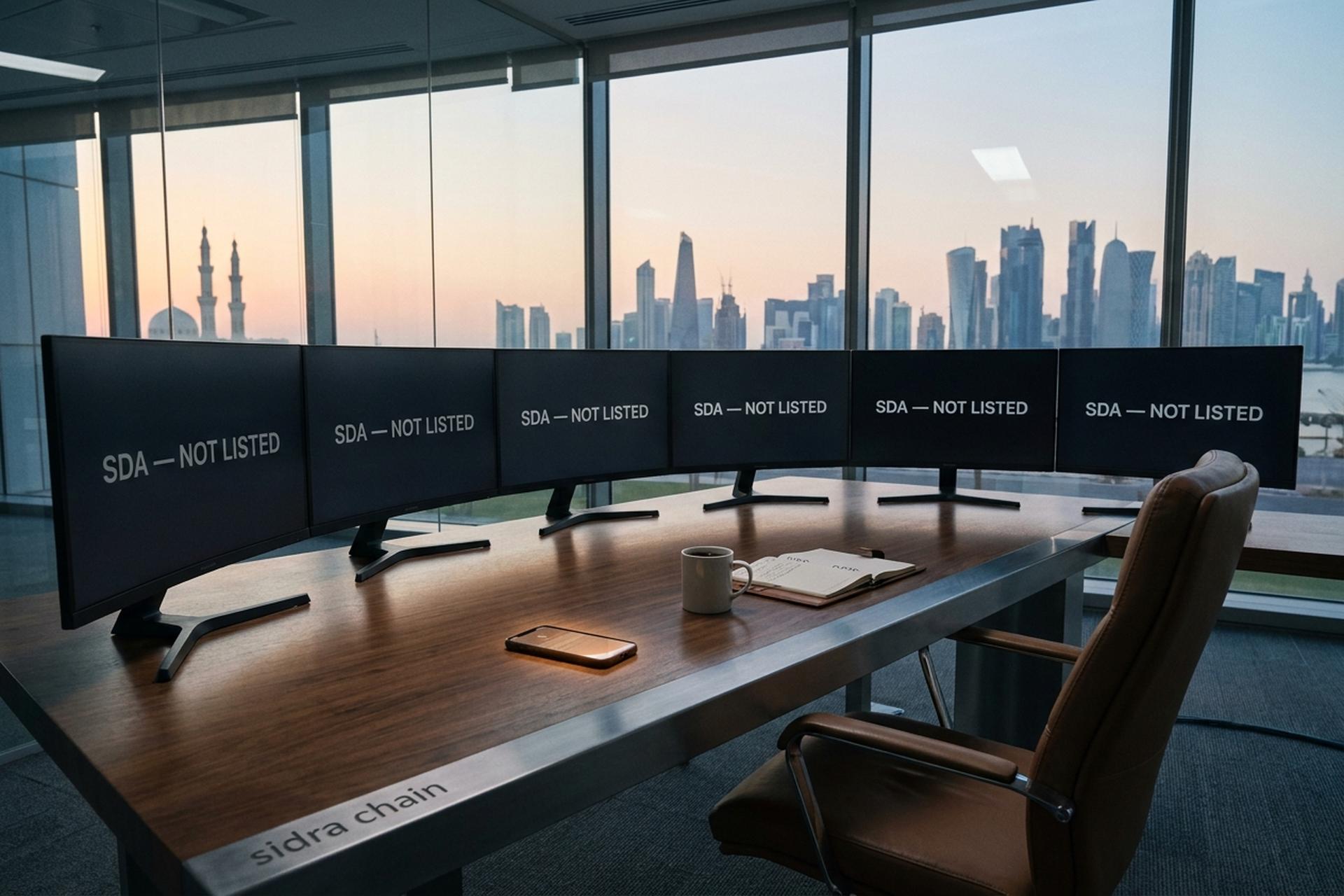
If you searched "sidra chain" hoping to find a buy button, the short answer is that there isn't one. As of mid-2026, the SDA token does not trade on CoinGecko, CoinMarketCap, Binance, Coinbase, or any other public exchange, and the only "listing" Sidra has reported in the past year was explicitly described by its own team as a demo rather than a live market. That single fact frames everything else worth knowing about the project. Sidra is a real blockchain. Its mainnet is live, its founder is Qatari, and more than a million people have downloaded its mobile mining app. It is also a long-running pre-launch ecosystem. Users hand over identity documents now, and trust that a tradable asset will arrive later. This guide walks through what Sidra Chain actually is, who runs it, and what its Sharia-compliance claim does and does not mean. It also covers where the SDA token stands and how the user experience compares with Pi Network, which finished a similar journey in early 2025 with a result worth sitting with for a few minutes.
What Sidra Chain Actually Is: Architecture and Origins
Sidra Chain is a public, EVM-compatible blockchain whose mainnet has been operational since October 2023, according to coverage on Gate.com and Bitrue. It is registered on ChainList under ChainID 97453 (0x17cad), and its public block explorer sits at ledger.sidrachain.com. Those three pieces of evidence matter, because they distinguish Sidra from the long tail of crypto projects whose only product is a marketing site; Sidra has a working chain that wallets such as MetaMask can connect to through a custom RPC.
What the chain actually does under the hood is harder to verify than the project's marketing implies. Secondary write-ups disagree on the consensus mechanism. Bitrue and Zipmex describe Sidra as a proof-of-work fork in the Ethereum lineage; Gate.com refers to a custom mechanism it calls "Proof-of-Compliance," in which validators are expected to enforce Sharia and KYC rules at the protocol layer. The official whitepaper PDF was not retrievable during research for this article (the sidrabank.com host refused the connection), so neither claim can be confirmed from primary documentation at the time of writing. For readers used to the public visibility of Ethereum or Solana specs, the gap is notable.
The chain is EVM-compatible, which means smart contracts written in Solidity can be deployed without rewriting, and developer tooling such as Hardhat or Foundry can target Sidra with minimal changes. For developers used to other blockchain platforms, that lowers the cost of porting dapps and other decentralized applications across networks. Sidra advertises this Web3 access as one of its main selling points to builders, alongside what it calls protocol-level riba and gharar screening: the idea that lending pools, derivatives, or asset classes prohibited under Islamic finance would not be permitted to run on the network at all. Whether that screening exists in deployed code or only in pitch decks is, again, not independently audited.
Two self-reported headline numbers travel through every Sidra write-up online: 12.9 million on-chain transactions across the network, with each transaction supposedly belonging to one of 737,000 verified users. Both figures originate in Sidra's own communications and are repeated by Zipmex, Bitrue, and others without independent block-explorer audit. The transactions almost certainly exist. Whether they reflect organic economic activity or a closed-loop mining-and-reward ecosystem is a different question. The same caveat applies to the user count. KYC submissions and active wallets are not the same thing.
The Sidra ecosystem extends beyond the chain itself. Sidra Start is the project's incubation arm. KYCPORT is its in-house identity-verification service. Sidra Bank is the consumer-facing brand that promises eventual digital-asset banking products. The architecture is closer to one integrated platform under one corporate roof than to the loose, permissionless validator sets of larger public chains. That is not unusual for new networks, but it does mean that "decentralized" deserves quotation marks here until the validator set, token distribution, and governance are independently visible.
Who Is Behind Sidra Chain? The Al-Jefairi Question
Every secondary source that names a founder points to Mohammed Al-Jefairi, described as a Qatari entrepreneur with prior senior roles at Huawei Qatar and Ooredoo Qatar and an MBA from HEC Paris. That attribution rests on a single Bitrue blog post, repeated downstream; it does not appear on sidrachain.com's About page in any structured, verifiable form. A common online misspelling, "Alsehli," surfaces in search suggestions, and the variance is itself a small data point about how thin the project's leadership disclosure is. Healthy networks publish their core contributors with photos, GitHub handles, and linked talks. Sidra publishes neither a public team page with names nor a public GitHub organization tied to the chain's source code.
The corporate trail is similarly minimal. Sidrachain.com was registered through GoDaddy on 12 January 2022, according to ScamAdviser's archived WHOIS data, with the registrant information hidden behind a privacy service. Zipmex's 2026 write-up references recognition from "Qatar's Digital Assets Lab," but that designation is not corroborated on the Qatar Financial Centre or Qatar Central Bank websites. Treat the institutional-recognition language as marketing for now.
The Sharia-Compliance Claim and Its Missing Service
The thing Sidra leans on most heavily is its claim to be "the first fully Sharia-compliant blockchain." For Muslim users searching for halal exposure to crypto, that promise is the entire pitch. It is also where the gap between marketing and verifiable proof is widest.
Real Sharia compliance in finance is not a self-declaration. It requires a named Sharia advisory board of recognised scholars. It requires a published fatwa specific to the product. In mature institutions, it also requires a certificate from AAOIFI, the body that audits Islamic financial firms. Sidra's public materials disclose none of these. There is no named scholar board, no AAOIFI certificate, and no published fatwa specific to the chain or the SDA token. Zipmex's coverage stated plainly in early 2026 that "formal fatwa certification, as of early 2026, is still developing." For a service whose entire brand rests on that certification, the absence is significant.
A useful comparison is HAQQ Network, the EVM chain behind Islamic Coin. HAQQ publishes the names of its Shariah Oversight Board on its main site. The scholars' credentials and the issued fatwa are open to anyone who wants to verify the basis of compliance. Sidra has not matched that level of transparency. A reader cannot, today, audit the claim that the network screens haram activity at the protocol layer.
Sidra does describe, in its own language, what it calls "protocol-level" compliance. The smart contract logic is meant to block riba (interest), gharar (excess uncertainty), and listings in haram sectors such as alcohol or gambling. The idea is real. Academic work on Sharia screening by code has been published. Whether Sidra's deployed code actually enforces that idea is an open question. So is whether qualified scholars have ever reviewed the rules. For privacy-conscious or trust-sensitive users, that ambiguity is the issue, not the marketing copy. The honest framing is that Sharia compliance on Sidra is a self-declared design goal with a plausible technical basis, not a third-party-audited service.
Sidra Chain's SDA Token: Supply and Listing Status
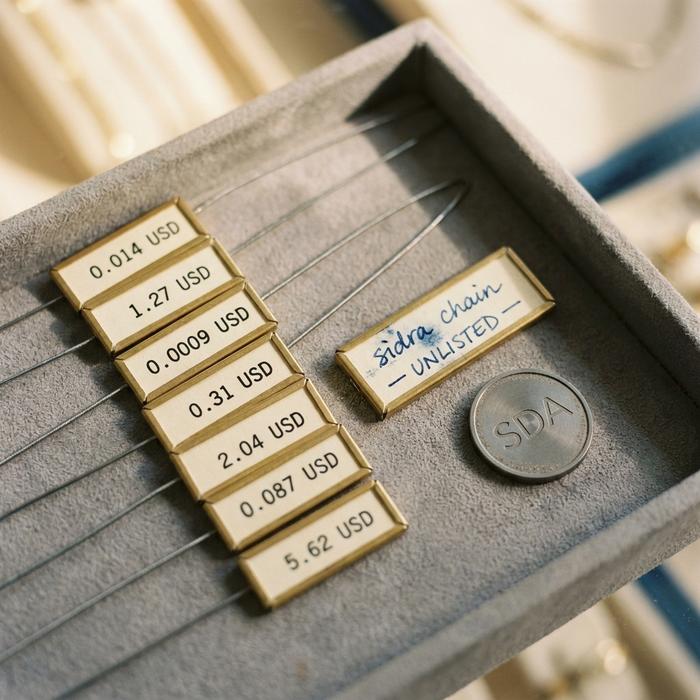
The most-asked question about Sidra is the simplest. Where can I buy SDA? As of May 2026, the answer is nowhere public. The token has no listing on CoinGecko or CoinMarketCap under its own name. The "SDChain (SDA)" page that surfaces on CMC searches points to a different project at sdchain.io. We confirmed this by comparing the contract addresses and team. Bitrue's own listing-update post from 2025 says SDA is "not listed on any public crypto exchange. The only confirmed activation is for demo purposes."
The copycat problem is worse than most casual searchers realise. Tokens named "SIDRA" have appeared on Base, BNB Chain, and Core DAO. Third parties built them with no link to Sidra Chain itself. They show up on Bitget swap pages, Coinbase price pages, and DEX aggregators. A user typing the project name into a wallet's token search can easily end up looking at the wrong token. This is not Sidra's fault directly, but it is a tax on the project's brand that retail users pay.
Tokenomics are similarly underdocumented for something that has been live for two and a half years. The single circulating-supply figure online, roughly 780 million SDA per BSC News, is self-reported. No max supply, founder allocation, or vesting schedule is publicly disclosed in any source we could retrieve. For comparison, Ethereum, Solana, and even much smaller networks publish their issuance schedules and treasury wallets as a matter of basic transparency. Sidra does not.
The following table summarises the listing-status picture as a single reference point.
| Venue | SDA listing status (May 2026) | Notes |
|---|---|---|
| CoinGecko | Not listed | No page under Sidra Chain identity |
| CoinMarketCap | Not listed | SDChain page refers to unrelated sdchain.io |
| Binance | Not listed | No spot or futures market |
| Coinbase | Not listed | Price-page entries refer to copycats |
| Bitget | Not listed | Swap entries are unrelated Base/BNB tokens |
| Bitrue | Not listed | "Demo activation" only, per their 2025 blog |
| Decentralized exchanges | Not listed | No verified pool for the official chain's token |
If the table looks repetitive, that is the point. Two and a half years after mainnet, the asset still does not have a market. Whatever the SDA balance in a Sidra wallet shows the day a reader logs in, it is, today, a closed-system credit rather than a tradable cryptocurrency.
Mining Sidra Chain on Mobile: KYC and the Pi Parallel
The way most people participate in Sidra is not by deploying smart contracts; it is by opening the Sidra Bank mobile app, completing identity verification through KYCPORT, and tapping a button once a day to accrue SDA as a daily digital asset reward. The Google Play page shows more than one million installs and an aggregate 3.8-star rating across roughly 34,700 reviews. The model is not novel. It is the same one Pi Network used to build a user base of more than 60 million signups over six years.
The parallel is worth dwelling on, because Pi's outcome gives the Sidra ecosystem a real reference point rather than a hypothetical one. Pi opened its mainnet in the first quarter of 2025 and listed the PI token on a handful of exchanges shortly afterward. According to BSC News, the price fell roughly 80 percent from above $3 to around $0.54 within months of free trading becoming available, as years of accumulated mining rewards finally met a public market and supply overwhelmed demand. Sidra is roughly one stage earlier on the same curve: still pre-listing, still asking users to mine and verify and wait.
| Dimension | Sidra Chain | Pi Network |
|---|---|---|
| Mobile-mining model | Yes, daily check-in | Yes, daily check-in |
| Mandatory KYC | Yes (KYCPORT) | Yes (Pi KYC) |
| Mainnet status | Live since Oct 2023; pre-public-listing | Open mainnet from Q1 2025 |
| Public CEX listing | None as of May 2026 | Multiple, post-Q1 2025 |
| Differentiator | Sharia-compliance framing, EVM stack | Stellar-based, mass-market positioning |
| Token outcome | Unknown — still pre-market | About –80% from peak to current free-trading price |
This does not predict the SDA price. It does, however, set realistic expectations. A user who is mining Sidra in 2026 is doing roughly what a user mining Pi in 2022 was doing.
Risks, Complaints, and User Service Issues to Watch
No major regulator — the U.S. SEC, the UK's FCA, Singapore's MAS, or Dubai's DFSA — has issued a public warning naming Sidra Chain as of May 2026. Absence of regulator action is not the same as endorsement, but it does mean Sidra cannot honestly be called a flagged scam. What does exist, and is worth weighing, is the consumer-complaint trail.
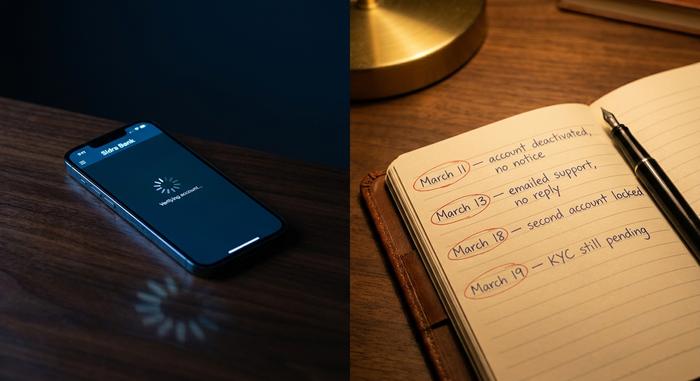
The English-language Sikayetvar page for Sidra Chain hosts 139 complaints and 26 customer reviews, and the patterns are concrete. Multiple users described accounts deactivated without notice on specific dates in March 2026 — the 11th, 13th, 18th, and 19th. One user from Rwanda reported the theft of more than 1,000 SDA tokens from a compromised account, with the support workflow unable to assist after the fact. KYC submissions sitting "rejected" or "pending" for periods extending past a year appear repeatedly. Two-factor authentication lock-outs lasting weeks or months are mentioned by enough users that Bitrue — a relatively friendly source that runs an entire blog series about the project — described "persistent technical dysfunctions" in its 2025 review.
The privacy and security dimension matters too. Mining Sidra requires biometric KYC plus government ID, and KYCPORT data sits with a private Qatari operator whose breach history, retention policy, and downstream data-sharing arrangements are not publicly documented in the same depth a regulated financial institution would publish. For users in jurisdictions with weaker data-protection enforcement, this is a real cost paid up front for a hypothetical future return. I keep coming back to that asymmetry — the data is concrete and given today, the return is conditional and arrives, if at all, years later.
Should You Connect to Sidra Chain or Wait?
The decision splits cleanly. If the goal is to invest in SDA at today's price, there is no decision to make — there is no market. If the goal is to mine SDA in case the token eventually lists, the real cost is not battery life. It is the KYC data, the privacy exposure to a thinly documented operator, and several years of attention with no guarantee of a tradable asset at the end. Pi Network's –80% post-launch chart is the visible floor for what that wait can produce when it ends well enough to produce a market at all. If the appeal is specifically Sharia-compliant exposure to digital assets, the honest move is to wait for a named scholar board and a published fatwa, both of which Sidra has not delivered as of mid-2026. A user can always connect to the network and join later; nothing about waiting closes that door.