Bitcoin Cash: A Practical Guide to BCH Payments and How to Accept Them With Plisio
True story from 2021. Tried to buy a VPN with Bitcoin. Five dollar monthly plan. BTC network fee that day: fourteen dollars. Confirmation time: forty minutes. I sat there watching three confirmations tick by, knowing I'd spent triple the product price on a network fee, and wondered what exactly Satoshi had in mind when he wrote "peer-to-peer electronic cash" in the whitepaper. That receipt radicalized me into learning about Bitcoin Cash.
BCH came out of a fight. And I mean a real one, with personal attacks on Twitter, competing Medium essays, subreddit bans, and conference shouting matches. The debate: should Bitcoin's blocks be bigger? "Small blockers" said no. Keep blocks at 1 MB, build Lightning Network on top, handle scaling off-chain. "Big blockers" said that's insane, just increase the block limit, it's the obvious fix. Years of arguing led nowhere. So in 2017 the big-block faction forked the chain. Block limit went from 1 MB to 8 MB (and later to 32 MB). Fees collapsed to fractions of a penny overnight. Throughput: 100-200 transactions per second, compared to Bitcoin's 3-7.
Has BCH actually become the daily-use digital cash its creators promised? Depends on where you look. What I can tell you is this: if you run a business and want to accept crypto without watching a third of every small payment vanish into miner fees, BCH is one of the most practical coins for it. This guide covers how this decentralized cryptocurrency works for payments in practice and walks through the full setup with Plisio, a crypto payment gateway I've dug into in detail for this piece. Bitcoin Cash price, transaction speed, scalability, merchant tools, all of it.
What Bitcoin Cash is and why it exists
Quick origin story. August 2017. Block 478,558. Bitcoin underwent a hard fork, a fork of Bitcoin that split the chain in two. If you had BTC in your wallet that day, congrats, you now also had the same amount of BCH in a parallel universe. Everything up to that block was shared history. After that, two separate roads. One road kept the small blocks. The other road said "make them bigger, who cares, let's move."
Roger Ver, the early Bitcoin investor people call "Bitcoin Jesus," became BCH's loudest voice. His argument: Satoshi's whitepaper described "peer-to-peer electronic cash." Bitcoin had become a speculative asset where fees made a $5 coffee purchase absurd. Bitcoin Cash was supposed to be the version that actually worked for buying things.
The BCH community has had its own drama since. Bitcoin SV forked off in 2018 with Craig Wright wanting 128 MB blocks. Bitcoin Cash ABC split in 2020 over how to fund development. The main BCH chain continued under the Bitcoin Cash Node implementation. Three forks in three years. The crypto version of a family that can't get through Thanksgiving without someone storming out.
BCH vs BTC: the numbers that matter for payments
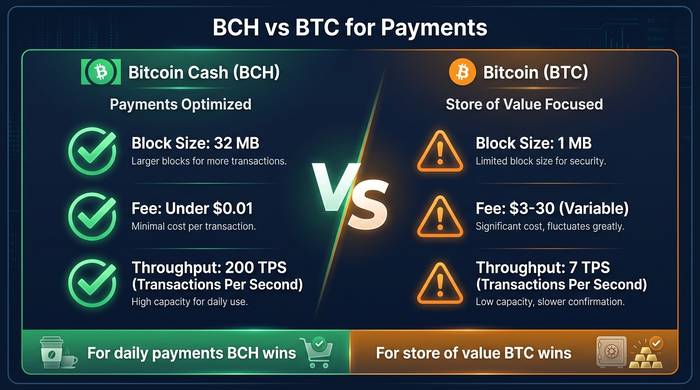
If you're a merchant thinking about taking BCH, the comparison with Bitcoin boils down to fees, speed, and how many transactions the network can handle without choking.
| Specification | Bitcoin (BTC) | Bitcoin Cash (BCH) |
|---|---|---|
| Block size | 1 MB (with SegWit ~4 MB effective) | 32 MB |
| Transactions per second | 3-7 | 100-200 |
| Average transaction fee | $1-5 (spikes to $30+ during congestion) | Less than $0.01 |
| Block time | ~10 minutes | ~10 minutes |
| Total supply | 21 million | 21 million |
| Consensus | Proof of Work | Proof of Work |
| Smart contracts | Limited (Taproot) | CashScript support |
| Privacy features | Basic | CashShuffle, CashFusion |
Both chains produce a block every ten minutes or so. But BCH crams 32x more data into each block, so the network barely ever gets backed up. During the 2024 bull run Bitcoin fees spiked past $50 on the worst days. BCH stayed under a penny the whole time. If you're processing two hundred small orders a day, that gap eats you alive on BTC and costs you almost nothing on BCH.
April 2024 halving cut both chains' block reward to 3.125 coins. Same 21 million supply cap. Identical monetary policy on paper. The argument between them was never about inflation or scarcity. It was always about block space and what you can fit inside it.
How to accept Bitcoin Cash payments: the Plisio payment gateway
Alright, you want BCH on your checkout page. Two roads. You could run your own Bitcoin Cash node, generate fresh addresses per invoice, monitor the mempool, handle confirmations, deal with reorgs. Free. Also a massive pain, especially if you're running a store and not a node-ops team.
Or you use a payment gateway. I spent time digging into Plisio for this article because their setup hits an interesting sweet spot: 0.5% per transaction, no monthly costs, no setup fees, no identity verification to start, and support for BCH alongside 15+ other cryptocurrencies and digital currency tokens (BTC, ETH, LTC, DOGE, USDT, USDC, XMR, DASH, ZEC, TRX, SHIB, and more).
Here's what you're actually getting under the hood.
The payment flow
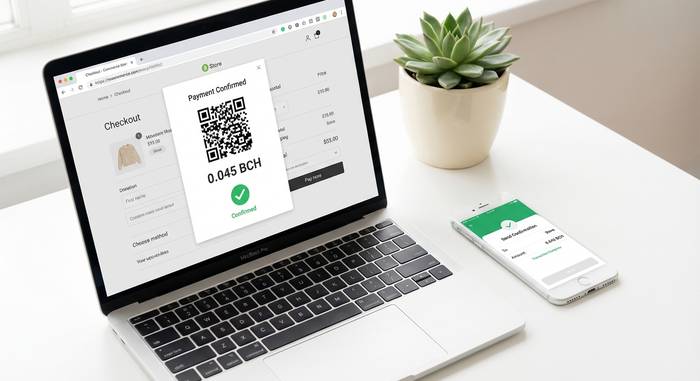
Customer clicks "pay with crypto" on your site. Plisio generates a fresh invoice with the exact BCH amount calculated from the current exchange rate (you set your prices in dollars, euros, whatever you normally use). The customer opens their BCH wallet, scans the QR code or copies the address, sends the coins. Plisio watches the blockchain for that specific transaction, confirms it, and fires a callback to your server. For small amounts, some merchants accept zero-confirmation (instant). For bigger orders, one or two confirmations take maybe ten minutes. The customer sees a green checkmark and moves on. You see the payment in your dashboard.
API and developer tools
The API is RESTful, GET-only, authenticated with a secret key. Base URL: `https://api.plisio.net/api/v1`. If you've worked with Stripe or PayPal's API, the mental model is similar but simpler. Create invoices, check balances, trigger withdrawals, batch mass payouts, pull transaction history, estimate network fees before sending. JSON in, JSON out.
What I appreciated when looking through the docs: they maintain server-side libraries in PHP, Python, Node.js, Java, C#, Ruby, and Laravel. Front-end devs get React and Vue components. There's an Android SDK for mobile. Even a Telegram bot if you want payment notifications in your team chat. Swagger docs are public. I clicked through them and the endpoints are documented well enough that a mid-level dev could integrate BCH payments in an afternoon.
E-commerce plugins
Don't want to touch code? Plisio ships plugins for 18 platforms. I counted: WooCommerce, Magento, PrestaShop, OpenCart, Shopware, BigCommerce, X-Cart, Zen Cart, Ecwid, CS-Cart, WHMCS, Easy Digital Downloads, XenForo, VirtueMart, osCommerce, Blesta, Botble, Zender. The WooCommerce one, which is probably what most small merchants care about, installs in maybe five minutes. Plugin page, upload, paste API key, check the box next to BCH, save. Customers see a "pay with crypto" button at checkout.
Wallet and fund management
Plisio gives you a built-in crypto wallet. Incoming BCH payments land there. You can let them sit, pull them out to your own wallet, or use mass payouts to distribute to multiple addresses at once. That mass payout feature pools up to 1,000 transactions into one batch, cutting network fees by up to 80% according to Plisio. Handy for affiliate commissions, supplier payments, or paying contractors in crypto.
One thing to know before you sign up: Plisio is crypto-to-crypto only. No bank withdrawals. No fiat settlement. If you need dollars in your bank account, you withdraw BCH from Plisio to an exchange like Coinbase or Kraken and sell there yourself. Some merchants actually like this. They convert when the BCH price is favorable, not at the moment of sale. Others see it as friction they'd prefer someone else handle. Know which type you are before committing.
White label and donation pages
White label mode is worth knowing about if brand consistency matters to you. Your payment page, your colors, your logo. The customer never sees "Plisio" anywhere. No redirect to a third-party domain. This is the kind of thing enterprise clients ask for and most cheap gateways don't offer.
Separately, they built out donation pages. I've seen streamers and open source projects use these. Set up a page, pick your accepted coins, share the link. Plisio hooks into Twitch, YouTube, TikTok, Twitter, Instagram, and Facebook natively. A Twitch streamer I follow switched from PayPal tips to Plisio BCH donations and said the fees dropped from 2.9% to 0.5% overnight. Anecdotal, but the math checks out.
Plisio fees vs the competition
| Gateway | Transaction fee | Supported coins | Fiat conversion | KYC required |
|---|---|---|---|---|
| Plisio | 0.5% | 15+ | No (crypto only) | No |
| BitPay | 1% | 15+ | Yes (bank settlement) | Yes |
| CoinGate | 1% | 70+ | Yes | Yes |
| NOWPayments | 0.5% | 200+ | No | Optional |
| BTCPay Server | 0% (self-hosted) | BTC + a few others | No | No |
Plisio's main advantage is the combination of low fees, no KYC, and broad integration support. BTCPay Server is free but requires you to host your own infrastructure. BitPay and CoinGate offer fiat settlement but charge double the fee and require identity verification. NOWPayments is the closest competitor in terms of fee structure and flexibility.
BCH in practice: who uses it and why
In terms of real-world merchant adoption, BCH has had some bright spots mixed with a lot of "it's complicated." The BCH community ran serious adoption campaigns in St. Kitts and Nevis in the Caribbean, where banking fees are painful and an alternative payment rail has obvious appeal. North Queensland in Australia tried a "Bitcoin Cash City" thing where dozens of shops started accepting BCH. I've talked to people who actually used it for groceries and coffee there. It works, at a local scale, when the community puts energy behind it.
Globally though, most crypto payment volume still goes through BTC and stablecoins. USDT and USDC dominate for anyone who wants to avoid price swings. BCH lives in a specific niche: small transactions where the fee math matters. Tipping, micropayments, a $12 purchase where a $0.002 BCH fee makes sense and a $3 BTC fee doesn't. Subscriptions in the $5-50 per month range.
Smart merchants don't frame this as "BCH or BTC." They accept both, plus stablecoins, through the same gateway. Plisio's checkout lets the customer pick their preferred coin. You as the merchant don't need to decide ahead of time. Offer BCH for its fees, BTC for the name recognition, USDT for anyone who hates volatility. Same integration, same dashboard, same 0.5% fee.
What to watch: BCH limitations and risks
I want to be fair about what's not great with BCH, because building a payment setup around a coin without understanding the risks is how people get surprised.
Hash rate is way lower than Bitcoin's. That means less mining power protecting the network. In theory, a 51% attack is cheaper to pull off on BCH than on BTC. In practice it hasn't happened, but the math is there and it makes security people uncomfortable.
The ecosystem is thin. Fewer wallets support BCH natively. Fewer exchanges have deep BCH order books. CashScript exists for smart contracts but the dev community is maybe 1% of Ethereum's Solidity ecosystem. If you run into a BCH-specific bug, there are fewer people who can help you.
Price moves. The Bitcoin Cash price sits in the $300-400 range in early 2026 across Bitcoin Cash markets and major cryptocurrencies exchanges, and a 10% swing in a week is normal. If you accept BCH on Monday and don't convert until Friday, the value could be meaningfully different. Plisio shows you the fiat-equivalent at the time of payment, but if you hold BCH in the wallet hoping it goes up, you're speculating, not just processing payments.
The name is still a mess. "Bitcoin Cash" sounds too much like "Bitcoin." New people buy BCH when they meant to buy BTC. Merchants put the wrong logo on their site. Eight years in and I still see confusion in support threads every single week. Roger Ver calls the name an asset. BTC maximalists call it intentional confusion. I think they're both right, which is part of what makes this corner of crypto so exhausting.