What is Aave? The DeFi lending protocol that crossed $1 trillion in loans

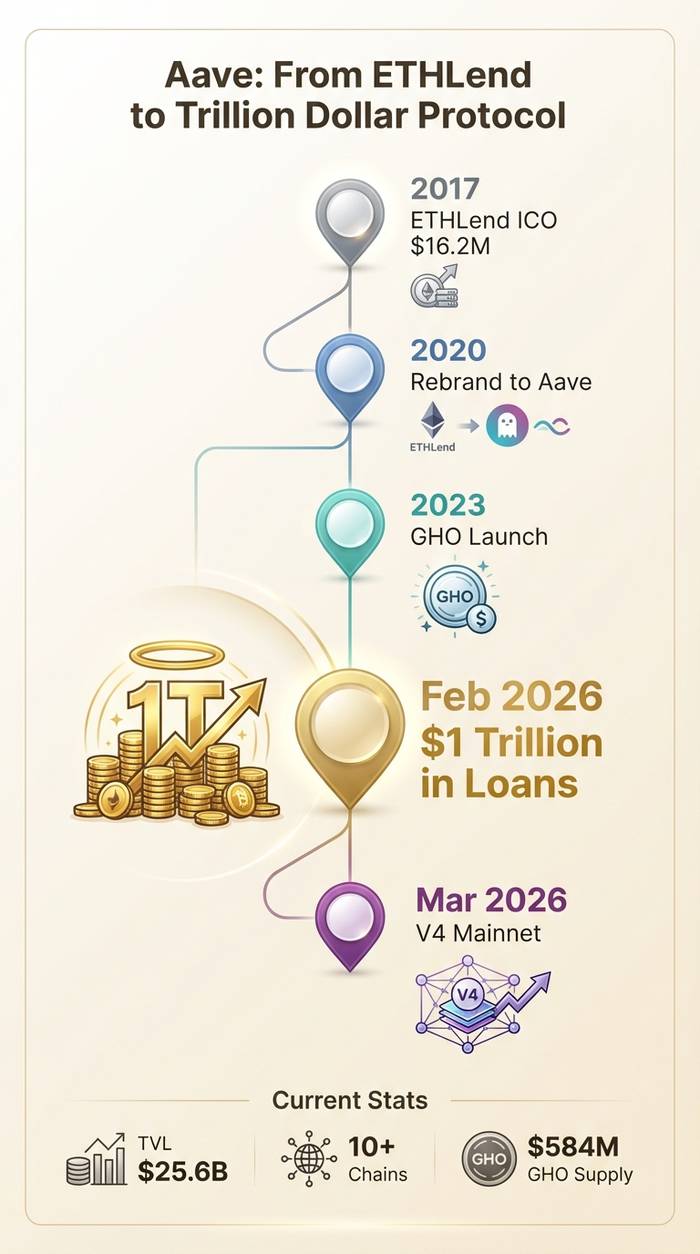
In February 2026, Aave crossed $1 trillion in cumulative loan originations. One trillion dollars, processed entirely by smart contracts, without a single bank involved. No credit checks. No loan officers. No three-week approval process. Just code, collateral, and math.
Aave is the largest DeFi lending protocol by every metric that matters. $25.6 billion in total value locked. $2.07 billion in cumulative fees generated. Deployed across Ethereum, Arbitrum, Base, Avalanche, and seven other chains. When people talk about DeFi lending, they are usually talking about Aave, even if they do not realize it.
The protocol just launched V4 on Ethereum mainnet on March 30, 2026. Its GHO stablecoin grew 1,400% in a year. Its institutional arm, Horizon, hit $1 billion in real-world asset TVL. And it handled $1.1 billion in liquidations during 2025 without a single dollar of bad debt.
This article covers how Aave works, what changed with V4, why GHO matters, how Aave compares to Morpho and Compound, and whether the AAVE token is capturing any of this value.
How Aave works
Aave is a lending protocol. You can be a lender or a borrower. Both sides interact with the same pool of assets through smart contracts.
As a lender, you deposit crypto into Aave. ETH, USDC, WBTC, DAI, whatever the protocol supports on that chain. Your deposit goes into a liquidity pool. Borrowers draw from that pool. In return for lending your assets, you earn interest. The rate floats: when borrowing demand is high, your yield goes up. When it is low, yield drops. You get aTokens that represent your deposit plus accrued interest. Hold aUSDC and it grows in your wallet automatically.
As a borrower, you put up collateral and borrow against it. Want to borrow USDC? Deposit ETH worth more than what you borrow. The ratio between your collateral and your loan is the loan-to-value, or LTV. If your collateral value drops too close to your loan value, the protocol liquidates part of your position to keep the system solvent. Aave processed $1.1 billion in liquidations in 2025 across 100,000 events. Zero bad debt. The math works.
The protocol also runs flash loans. Borrow any amount of crypto with zero collateral, use it within a single transaction block, and repay before the block finalizes. If you do not repay, the whole transaction reverts as if it never happened. Flash loans processed $7.5 billion through Aave in 2025. Arbitrageurs, liquidation bots, and DeFi developers use them as a core building block.
Aave runs on 10+ chains: Ethereum ($20.65B supplied), Arbitrum ($786M), Base ($730M), Mantle ($578M), Avalanche ($407M), BSC ($188M), Polygon ($169M), Gnosis, Optimism, and more. V4 also introduced Plasma, a new market with $1.55 billion in TVL already.
Aave V4: what changed on March 30, 2026
V4 is not a minor upgrade. It rebuilds how Aave's markets work from the ground up.
The core change is the hub-and-spoke architecture. Previously, every market on every chain was independent. V4 creates centralized liquidity hubs connected to specialized spoke markets. Each spoke can have different risk parameters, different collateral types, and different user bases without fragmenting the main liquidity. A real-world asset market and a DeFi-native market can share the same pool of USDC while running completely different risk rules.
Fixed-rate loans became possible with this design. In V3 and earlier, all Aave rates were variable, adjusting every block based on pool utilization. V4's hub-and-spoke model lets the protocol offer fixed rates on certain spokes, which matters for institutional borrowers who need predictable costs.
The token accounting changed. V4 uses ERC-4626 share-based accounting instead of rebasing aTokens. In plain terms: your deposit is represented as shares of a vault rather than tokens that constantly change in quantity. This is cleaner for integrations, tax reporting, and composability with other DeFi protocols.
A Position Manager automates strategies. Set up rules for automatic borrowing, repayments, and collateral management based on market conditions. This is the beginning of Aave becoming not just a lending pool but an active financial management layer.
The liquidation system got smarter with health-targeted configurations. Instead of liquidating a fixed percentage of collateral, V4 targets the specific health factor needed to bring a position back to safety. Less collateral gets sold. Borrowers keep more of their positions.
GHO: Aave's stablecoin that grew 1,400%
GHO is Aave's native stablecoin. It is minted by borrowers who lock collateral in the Aave protocol. When you borrow GHO, it is created out of the collateral you deposited. When you repay, the GHO gets burned. The supply expands and contracts based on borrowing demand.
At the start of 2025, GHO supply was about $35 million. By the end of 2025, it hit $527 million. That is a 1,400% increase in 12 months. As of April 2026, 584 million GHO are in circulation with a market cap of $583 million. The peg has held at $0.9996.
54% of all GHO is staked in sGHO (Savings GHO), Aave's savings product where holders earn yield on their stablecoins. GHO generates about $14 million in annualized revenue for the Aave DAO.
GHO is deployed on Ethereum, Arbitrum, Base, and Avalanche. In V4, GHO becomes the core settlement asset for the hub-and-spoke architecture. That means GHO is not just another stablecoin competing with USDC and DAI. It is the lubricant that makes Aave's multi-market system work internally.
| GHO snapshot | Value |
|---|---|
| Circulating supply | 584 million GHO |
| Market cap | $583.8 million |
| Start of 2025 supply | ~$35 million |
| End of 2025 supply | $527 million |
| Growth (2025) | 1,400% |
| Price / peg | $0.9996 |
| Staked in sGHO | 54% of supply |
| Annualized revenue | $14 million+ |
Aave Horizon: DeFi meets Wall Street
Horizon launched in August 2025 as Aave's institutional arm for real-world asset lending. Traditional finance institutions deposit tokenized assets, things like US Treasury funds, corporate bonds, and structured credit, as collateral on Aave and borrow stablecoins against them.
Net deposits hit $550 million within months. By February 2026, Horizon crossed $1 billion in RWA total value locked, ahead of schedule. The borrowable assets include USDC, Ripple's RLUSD, and GHO. The collateral side features Superstate's USTB and USCC (tokenized Treasuries), Centrifuge's institutional products, and Circle's yield fund.
The partner list reads like a crypto-TradFi crossover event: Circle, Ripple, VanEck, WisdomTree, Securitize, Ant Digital Technologies, Chainlink. These are not DeFi-native teams. These are multi-billion-dollar financial companies using Aave infrastructure to lend and borrow against tokenized real-world assets.
Horizon is Aave's answer to the question: where does DeFi go after it maxes out crypto-native users? The answer is institutions, and they need things DeFi did not have before: fixed rates, compliance frameworks, and familiar asset types. V4 and Horizon together make that possible.
Aave vs Morpho vs Compound
| Metric | Aave V3/V4 | Morpho | Compound V3 |
|---|---|---|---|
| TVL | $25.6B | $5.8-10B+ | $2.08B |
| Market share (DeFi lending debt) | 56.5% | Growing fast | ~5% |
| Cumulative loans | $1 trillion+ | Growing | Not disclosed |
| Chains | 10+ | Ethereum, Base | Ethereum, Polygon, Arbitrum, Base |
| Stablecoin | GHO ($584M supply) | None | None |
| Institutional product | Horizon ($1B RWA TVL) | Apollo partnership | Compound Treasury |
| Innovation | Hub-and-spoke V4, fixed rates | Modular vaults, shared liquidity | Conservative, battle-tested |
| Fee model | Interest spread, GHO revenue | Vault performance fees | Interest spread |
Aave dominates by scale. 56.5% of all DeFi lending debt. $1 trillion processed. No other lending protocol is close on cumulative volume.
Morpho is the challenger everyone watches. It grew from nothing to $5.8-10 billion TVL by building modular vaults where a single pool of capital can back multiple strategies simultaneously. Apollo Global Management partnered with Morpho. The Ethereum Foundation deployed 3,400 ETH into Morpho vaults. Societe Generale uses it. Morpho is not trying to replace Aave head-on. It is building a different kind of lending infrastructure that sits alongside Aave and sometimes on top of it.
Compound is the original. V3 is solid, audited to death, and institutional-grade in its conservatism. It has $2.08 billion in TVL and does not chase the latest features. For borrowers who want the most battle-tested smart contracts in DeFi, Compound is still a valid choice. But it has not innovated at Aave's pace.
The AAVE token
AAVE is the governance token. 16 million max supply, 15.16 million circulating. Price in April 2026: about $95, down from an all-time high of $661 in May 2021. Market cap: $1.44 billion.
The token took a meaningful step toward value capture in 2025. The Aave DAO activated a fee switch that directs protocol revenue toward AAVE buybacks. This was the change the community had demanded for years: instead of revenue sitting in the DAO treasury, some of it flows to buying AAVE off the market. The 2025 net revenue was $141.8 million, up 57% from 2024.
| AAVE token snapshot | Value |
|---|---|
| Price (Apr 2026) | ~$95 |
| Market cap | $1.44 billion |
| All-time high | $661.69 (May 2021) |
| Max supply | 16 million |
| Circulating | 15.16 million |
| 2025 net revenue | $141.8 million (+57% YoY) |
| Annualized fees | ~$550M-$1B |
| Governance | Token-weighted voting |