What is Starknet (STRK): Ethereum’s ZK-rollup built for unlimited scale
Starknet was supposed to be the future of Ethereum scaling. The math was elegant, the team was credentialed (Eli Ben-Sasson literally co-invented the STARK proof system), and the $280 million in funding from Sequoia, Paradigm, and others suggested serious conviction. Then the STRK token launched in February 2024 at around $1.80 and has done nothing but fall since. By April 2026, it trades near $0.03. A 98% drawdown.
So what happened? And does the technology still matter even if the token price doesn't reflect it?
The short answer: yes. Starknet's technology is arguably the most advanced ZK-rollup in production. It runs on STARK proofs (not SNARKs), uses its own programming language (Cairo), and recently shipped native privacy features and Bitcoin DeFi integration that no other L2 has. TVL nearly doubled over the past six months. The network processes hundreds of thousands of transactions daily. The disconnect between tech progress and token performance is one of the more frustrating situations in crypto right now.
How Starknet works: STARK proofs and the Cairo language
Starknet is a Layer 2 validity rollup on Ethereum. That means it processes transactions off-chain, generates a mathematical proof that those transactions are valid, and posts that proof to Ethereum for verification. The difference between Starknet and optimistic rollups like Arbitrum or Base is in the proof type: Starknet uses zero-knowledge proofs (specifically STARKs), which are verified cryptographically rather than relying on a challenge period.
STARK stands for Scalable Transparent Arguments of Knowledge. In plain terms: "scalable" means proofs stay fast even when the data gets big. "Transparent" means the system doesn't need a secret setup step. SNARK-based systems originally needed a trusted ceremony where a few people generated secret data and then destroyed it. If anyone kept a copy, the whole system could be faked. STARKs skip that entirely. They're also built to resist quantum computers, which most experts think will eventually break older cryptographic methods.
Here's the practical flow: you submit a transaction on Starknet. A sequencer orders and executes it. A prover generates a STARK proof covering that batch of transactions. The proof gets verified by a smart contract on Ethereum mainnet. Once verified, the transactions are considered final with Ethereum's security backing them.
The other big differentiator is Cairo, Starknet's native programming language. Unlike Arbitrum and Optimism, which run standard Solidity code on the EVM, Starknet uses Cairo, a language built specifically for writing provable programs. Code written in Cairo can be mathematically verified, which enables the STARK proof system to work efficiently.
Here's the trade-off that defines Starknet's entire struggle: Cairo is not Solidity. If you're a developer who's been writing Ethereum smart contracts for years, moving to Starknet means learning a new language from scratch. On Arbitrum or Base, you change one line in your config file and deploy the same code. On Starknet, you rewrite everything in Cairo. The result is that most developers don't bother, and Starknet's app ecosystem is much smaller than its EVM rivals. StarkWare knows this is a problem and has been working on better tooling, but closing the gap takes time that the market hasn't been patient enough to give.
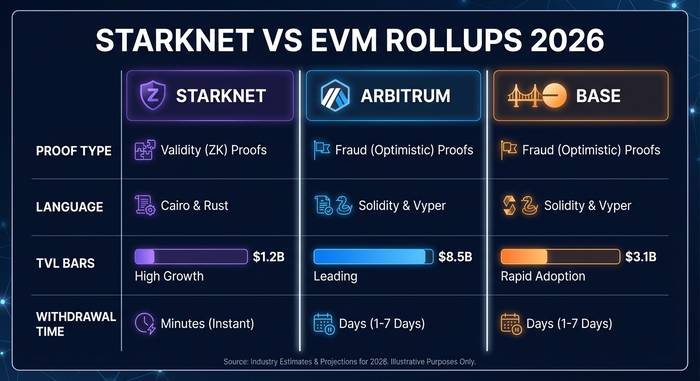
| Feature | Starknet | Arbitrum | Base |
|---|---|---|---|
| Proof type | STARK (validity proof) | Optimistic (fraud proof) | Optimistic (fraud proof) |
| Language | Cairo | Solidity (EVM) | Solidity (EVM) |
| Withdrawal time | Minutes (once proof verified) | 7 days (challenge period) | 7 days (challenge period) |
| Quantum resistant | Yes | No | No |
| Trusted setup | None required | N/A | N/A |
| Mainnet launch | Nov 2022 | Aug 2022 | Aug 2023 |
The Starknet ecosystem in 2026: what the numbers show
Token price tells one story. Network activity tells another.
| Metric | Value | Source |
|---|---|---|
| TVL | ~$530 million | DeFiLlama (Apr 2026) |
| TVL 6-month growth | Nearly doubled (from ~$155M to $310M+) | Starknet blog |
| Daily transactions | 200,000-500,000 | L2Beat |
| Daily active users | ~41,000 | L2Beat |
| Cumulative transactions | 283 million | L2Beat |
| Max TPS recorded | 992 | L2Beat |
| STRK staked | 23%+ of circulating supply | CoinGecko |
The DeFi scene is growing, and growing fast for a chain most people wrote off. Extended, a derivatives protocol, went from zero to number one on Starknet by TVL in a single month after its August 2025 launch. It crossed $100 million locked and was doing around $1 billion in daily trading volume. That's real usage, not airdrop farming.
Vesu runs the leading lending market, with over $50 million in TVL and active programs that let people borrow against BTC as collateral. JediSwap and other DEXs handle token swaps. The full DeFi stack exists on Starknet. It's small next to Arbitrum's $16 billion, sure. But the growth rate tells you that people who actually try the chain tend to stick around.
What I find interesting is the type of builder showing up on Starknet. Because Cairo is hard, the people who choose to build there tend to be doing things you can't do on an EVM chain. Privacy tokens. Provable gaming. On-chain machine learning verification. It's attracting a niche but technically deep community, the kind of builders who made Ethereum special in 2016-2017 before the mainstream arrived.
What stands out: over 23% of the STRK circulating supply is staked, which suggests that token holders who remain are committed rather than speculating. That level of staking conviction is unusual for a token that's dropped 98%.
The STRK token: price, staking, and why it keeps falling
The Starknet token (STRK) launched in February 2024 via an airdrop to early users and stakers. Initial trading opened around $1.80. By April 2026, it sits at roughly $0.03 with a market cap near $190 million and a fully diluted valuation of about $334 million.
Why the decline? Several factors:
Massive unlock schedule. A huge portion of STRK supply was allocated to early investors and the team with vesting schedules. As tokens unlock and hit the market, selling pressure increases. This is standard for VC-backed crypto projects, but the magnitude has been painful.
Low fee revenue. Starknet generates about $6,000 in daily fees as of early 2026. That's not enough to create meaningful token demand through buybacks or burns. Compare that to Base, which generates hundreds of thousands in daily fees.
L2 competition. The Layer 2 market consolidated around three winners in 2025-2026: Arbitrum, Base, and Optimism. ZK rollups (Starknet, zkSync, Scroll, Linea) have struggled to capture comparable market share despite technically superior proof systems.
Cairo barrier. Developers overwhelmingly prefer EVM-compatible chains. Learning Cairo is an investment that most teams don't make when they can deploy the same Solidity code on Arbitrum with a few clicks.
For token holders, the picture is grim on price but mixed on fundamentals. Staking yields provide some return, and if Starknet's technology adoption grows (particularly around privacy features and Bitcoin DeFi), the token could re-rate. But "could" is doing a lot of heavy lifting in that sentence.
What makes Starknet different from other L2s
Beyond the STARK proof system and Cairo, Starknet has shipped features that genuinely differentiate it:
Native privacy (STRK20 standard). In March 2026, Starknet launched a privacy framework that allows any ERC-20 token on the network to have shielded balances and confidential transfers. This uses zero-knowledge proofs to hide transaction amounts while maintaining full DeFi composability. No other major L2 offers this at the protocol level. It's essentially building Zcash-style privacy into a general-purpose Ethereum scaling solution.
Bitcoin DeFi. Starknet has been integrating Bitcoin through bridged BTC, allowing users to use bitcoin as collateral for lending and borrowing on Starknet's DeFi protocols. This taps into a massive asset ($1.3 trillion bitcoin market cap) that mostly sits idle. Vesu's BTC collateral program is an early example.
Account abstraction native. Unlike EVM chains where account abstraction is bolted on, Starknet was designed with native account abstraction from launch. Every account is a smart contract account, which enables features like social recovery, gas payment in any token, and session keys for gaming. This makes the user experience more flexible than on L2s that still rely on externally owned accounts (EOAs).
Parallel execution. Most blockchains process transactions one at a time, like a single checkout lane at a grocery store. Starknet is building toward running many transactions at the same time, like opening 10 lanes. If this ships as planned, Starknet could handle far more volume than chains that process things in order. The EVM wasn't designed for this. Cairo was.
Provable computation. This is the deep tech angle that matters for the long run. Any computation done in Cairo can be mathematically verified. That's useful beyond crypto: you could prove that an AI model produced a specific output, or that a financial calculation was done correctly, without revealing the input data. It's early, but this capability is what makes Starknet interesting to researchers and institutions, not just DeFi degens.
StarkWare: the company behind Starknet
StarkWare Industries was founded in 2018 by Eli Ben-Sasson, Uri Kolodny, Alessandro Chiesa, and Michael Riabzev. Ben-Sasson is a cryptographer and co-inventor of STARK proofs, which gives the project rare credibility among ZK researchers. The company is headquartered in Netanya, Israel.
StarkWare raised over $280 million across multiple rounds from investors including Sequoia Capital, Paradigm, Three Arrows Capital (before its collapse), Vitalik Buterin, and the Ethereum Foundation. Before Starknet, the team built StarkEx, a scaling engine used by dYdX (before it moved to Cosmos), Sorare, and Immutable X. StarkEx processed over $1 trillion in cumulative trading volume, proving the underlying technology works at scale.
The setup here is the same as most L2 projects: a for-profit company built the tech and holds a big chunk of the tokens. A separate foundation hands out grants and runs community programs. The sequencer, the computer that orders transactions, is still run by StarkWare alone. That makes Starknet as centralized as every other major L2 at the infrastructure level. Plans to decentralize the sequencer are on the roadmap but haven't shipped yet. If StarkWare's sequencer goes down, the network stops. That's a fact worth knowing before you deposit funds.
On the funding side, $280 million is a massive war chest. Even with the token price collapse, StarkWare the company is well-capitalized and has been hiring, not laying off. Eli Ben-Sasson remains active in the ZK research community. The team hasn't quit, which matters because ZK development is a long game that requires sustained investment in very hard math.
Should you use or invest in Starknet
Starknet occupies an awkward position in 2026. The technology is best-in-class for ZK rollups. The STARK proof system is more robust and future-proof than SNARK alternatives. Native privacy and account abstraction set it apart from every EVM-compatible L2. But the developer ecosystem is smaller, the token price has cratered, and daily fee revenue is a rounding error.
For developers: if you're building something that needs privacy, account abstraction, or provable computation, Starknet is worth the Cairo learning curve. If you're building a standard DeFi or NFT app and want maximum user distribution, Arbitrum or Base are easier paths.
For token holders and investors: STRK at $0.03 is cheap relative to what the team raised ($280M) and what the tech can do. But cheap and undervalued aren't the same thing. The staking rate is a good sign. TVL growth is a good sign. Fee revenue near zero is a terrible sign. Massive ongoing token unlocks are a terrible sign. This is not a safe bet. It's a bet on ZK technology winning the long game while EVM chains win the short game. If you're wrong, you hold a bag that keeps getting heavier.
I wouldn't put money here that I couldn't afford to watch go to zero. But I also wouldn't write it off. The tech is genuinely ahead of the field. The question is whether being ahead technically matters when being behind on adoption.
For users: Starknet wallet options include Argent X and Braavos, both designed for Cairo-based accounts. Bridging from Ethereum is straightforward through the official Starknet bridge or third-party services like Orbiter. Transaction fees are low (typically $0.01-0.10), and the privacy features launching in 2026 offer something no other L2 can match.