Solana ETF Boom: Spot ETFs, SOLZ, and the New Crypto Frontier
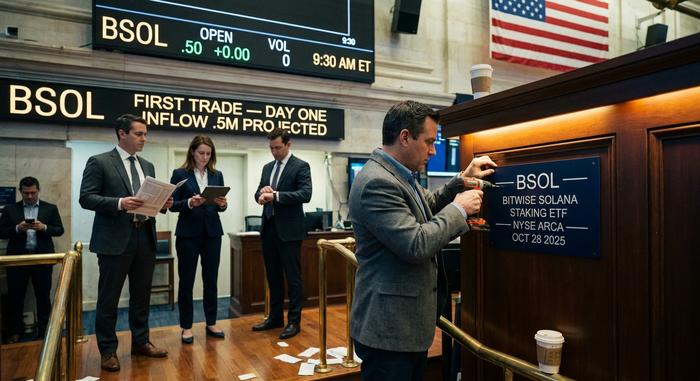
For most of crypto's history, getting exposure to Solana meant opening a Coinbase account, learning what a seed phrase is, and crossing your fingers that you typed the wallet address correctly. On October 28, 2025, that quietly changed. A spot Solana ETF began trading on NYSE Arca under the ticker BSOL, and Grayscale's GSOL uplisted to the same exchange the next day. Bitwise's BSOL pulled in $69.5 million in day-one inflows on $56 million of trading volume, the largest US ETF debut of 2025, and Solana joined Bitcoin and Ethereum as the third digital asset wrapped in a US-listed exchange-traded fund.
That headline undersells what happened. By mid-April 2026, US spot Solana ETFs hold more than $1 billion in cumulative assets, weekly inflows are running near $35 million through late April, and Goldman Sachs disclosed a $108 million SOL ETF position in its Q1 2026 13F, the largest institutional SOL allocation ever attached to a major bank. JPMorgan models total Solana ETF inflows reaching $6 billion. The launches also crossed a line regulators had held for years: every spot Solana ETF goes live with native staking yield baked into the wrapper, something the first wave of Ethereum ETFs in 2024 was forbidden to offer.
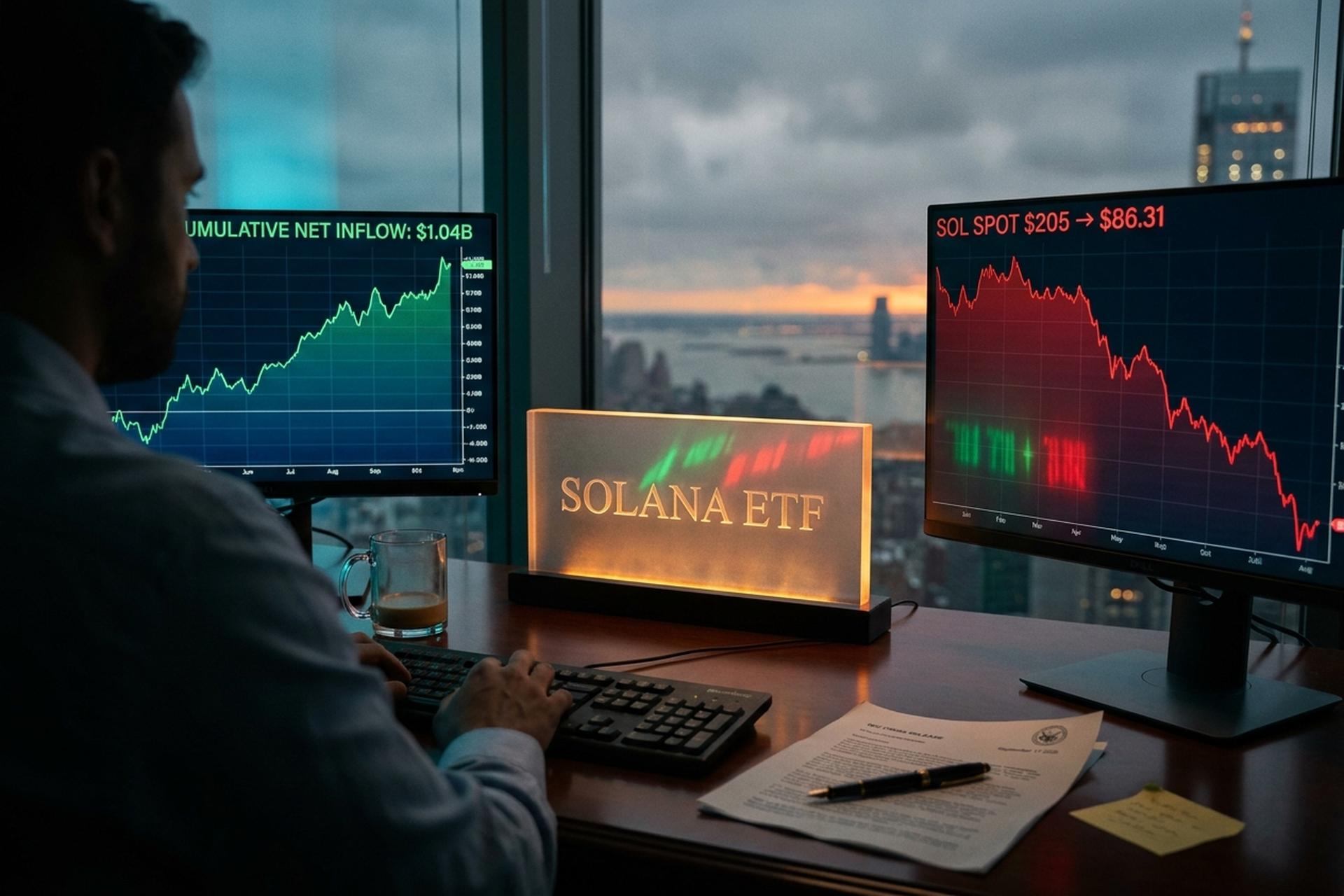
There is a paradox sitting under the inflow data. SOL traded at $205 the day before BSOL launched. By April 25, 2026 it sits near $86.31, a 58% drawdown from the pre-launch peak, even as the ETFs kept attracting net buyers. The launch did not cause the price weakness, but it also did not save it. This article unpacks how the Solana ETF arrived, what each fund actually does, how staking flows from a validator to your brokerage account, and why so much money kept arriving while the price of Solana was halving.
The spot Solana ETF launch that reshaped the crypto market
The path from rejection to approval took roughly eighteen months. In early 2024, the SEC under former Chair Gary Gensler had effectively closed the door on altcoin ETFs, citing concerns about manipulation and insufficient regulated futures markets. Solana looked like an extreme test case: it had no CME futures product yet, a history of network outages, and ongoing litigation that flirted with calling SOL a security.
Three things broke the deadlock. The first was political. The November 2024 election produced a new SEC leadership team that made digital asset rules a stated priority. The second was structural. On July 2, 2025, REX-Osprey launched the SOL + Staking ETF, ticker SSK, on Cboe BZX. SSK uses the Investment Company Act of 1940 with a Cayman Islands subsidiary that holds the staked SOL, a structure that bypasses the standard 19(b) review path required for a traditional spot 1933 Act ETF. SSK pulled in $12 million on day one and crossed $100 million in just 12 trading days, proving institutional appetite was real before the conventional spot ETFs arrived.
The third was procedural. On September 17, 2025, the SEC approved generic listing standards for commodity-based trust shares, including digital assets, through SEC press release 2025-121. That single rule cut approval timelines from up to 240 days under Section 19(b) to roughly 75 days for any qualifying token. Solana qualified through the CME SOL futures contracts that had launched earlier in the year. Commissioner Caroline Crenshaw issued a dissent, calling the move "passing the buck" on individual product review, but the rule passed. By late October, the floodgates were open. Bitwise's BSOL listed on NYSE Arca on October 28, 2025; Grayscale's GSOL uplisted October 29; Fidelity's FSOL and VanEck's VSOL launched November 17; Canary's SOLC and 21Shares' TSOL arrived November 18-19; Franklin's SOEZ debuted December 3, 2025; and Invesco Galaxy's QSOL listed December 15. BlackRock, conspicuously, sat the round out, telling reporters in August it had no plans to file.
The market read the launch as more than a product event. SOL had touched an all-time high of $294 in early 2025 before sliding back into a $150-$205 range through the summer and fall. Spot ETF inflows, even at modest size, signaled that institutional money now had a compliant lane into the asset. Year-end price targets from sell-side analysts settled around $130 to $150, with Firedancer mainnet activation cited as the next catalyst.

How a Solana ETF works: holding, NAV, and market price
The mechanics are simpler than the regulatory drama suggests. A spot Solana ETF is a fund that buys and physically holds SOL on behalf of shareholders. The issuer instructs a qualified custodian, usually Coinbase Custody, sometimes BitGo, Gemini, or Anchorage Digital, to hold the actual Solana tokens in cold storage on the Solana blockchain. Each ETF share represents a fractional claim on those tokens, minus management fees, similar to how a commodity ETF holds physical gold rather than the gold-mining stocks that mutual funds typically buy.
The fund's net asset value, or NAV, is calculated once a day and equals the total dollar value of SOL held, divided by the number of outstanding shares. If a Solana ETF holds 10 million SOL at a price of $90 and has 60 million shares outstanding, NAV per share is $15. The number is published daily by the issuer.
Market price is a separate animal. Once the ETF lists on an exchange, its shares trade like any other stock, with a live bid and offer that responds to supply and demand. NAV and market price tend to move together because authorized participants, large broker-dealers approved by the issuer, can create or redeem shares in big lots whenever the two diverge. If market price runs above NAV, an authorized participant delivers SOL to the custodian, receives new ETF shares, and sells them on the exchange, pocketing the spread until the gap closes. If market price falls below NAV, the trade runs in reverse. This arbitrage is what keeps a spot ETF tightly tethered to the underlying digital asset.
A few products break that pattern. Grayscale's GSOL, before its uplist, traded as the Grayscale Solana Trust on OTCQX with limited daily share creation, and it routinely traded at premiums or discounts of 20% or more to NAV. Conversion to an open-ended ETF on NYSE Arca largely eliminated that gap, though small frictions remain.
Spot Solana ETFs vs futures: SOLZ, SOLT and strategy funds
Not every Solana ETF holds SOL. Volatility Shares launched the first US Solana products in March 2025, but neither one owns the token directly. SOLZ, the firm's 1x Solana ETF, gets exposure through CME-style futures contracts and total return swaps, routed through a Cayman Islands subsidiary so the fund can keep its regulated investment company status. The expense ratio is 0.95% during a fee waiver that ends March 20, 2026, after which it climbs to 1.15%.
SOLT runs the same plumbing with 2x daily leverage. The fund rebalances every day to maintain that target, which means longer holding periods produce returns that diverge meaningfully from simply doubling SOLZ. In a flat market, daily rebalancing leaks value through compounding decay. In a strongly trending market, it amplifies. The 1.85% expense ratio reflects the operational cost of running a leveraged crypto futures strategy.
ProShares Ultra Solana, ticker SLON, took a similar route at 2.14%, while Amplify launched SOLM in November 2025 as a covered-call income strategy that targets roughly 36% annualized option premium income by selling weekly out-of-the-money calls on Solana exposure. None of these are pure spot Solana ETFs; they are strategy products built around SOL as an underlier. Investors choosing between them should pay attention to expense ratios, fee waivers, and whether the wrapper actually owns the token they think they are buying.
| Product | Ticker | Issuer | Type | Expense ratio | Launch |
|---|---|---|---|---|---|
| Bitwise Solana Staking ETF | BSOL | Bitwise | Spot, staked | 0.20%* | Oct 28, 2025 |
| Grayscale Solana Staking ETF | GSOL | Grayscale | Spot, staked | 0.35% | Oct 29, 2025 |
| Fidelity Solana Fund | FSOL | Fidelity | Spot, staked | 0.25%** | Nov 17, 2025 |
| VanEck Solana ETF | VSOL | VanEck | Spot, staked | 0.30%* | Nov 17, 2025 |
| Canary Marinade Solana ETF | SOLC | Canary | Spot, staked | n/a | Nov 18, 2025 |
| 21Shares Solana ETF | TSOL | 21Shares | Spot, staked | 0.21% | Nov 19, 2025 |
| Franklin Solana ETF | SOEZ | Franklin Templeton | Spot, staked | 0.19%** | Dec 3, 2025 |
| Invesco Galaxy Solana ETP | QSOL | Invesco / Galaxy | Spot | n/a | Dec 15, 2025 |
| REX-Osprey SOL + Staking ETF | SSK | REX-Osprey | 1940 Act, staked | 1.40% | Jul 2, 2025 |
| Volatility Shares Solana ETF | SOLZ | Volatility Shares | 1x futures | 0.95% (waiver) | Mar 2025 |
| Volatility Shares 2x Solana | SOLT | Volatility Shares | 2x leveraged futures | 1.85% | Mar 2025 |
| ProShares Ultra Solana | SLON | ProShares | 2x leveraged futures | 2.14% | 2025 |
| Amplify Solana 3% Income | SOLM | Amplify | Covered call | 0.75% | Nov 4, 2025 |
\ 0% for first three months on first $1B in assets. \ Waived until May 18, 2026. \ Fully waived on first $1B until February 17, 2026. \** Waived on first $5B until May 31, 2026.
Solana staking ETFs: how yields reach investors
The single biggest policy shift hidden in the 2025 launches is that Solana ETFs come with staking enabled. Bitcoin ETFs do not stake, because Bitcoin uses proof-of-work. Ethereum ETFs in 2024 were not allowed to stake, even though Ethereum's proof-of-stake design supports it, because the SEC at the time treated staking-as-a-service as an unregistered securities offering. That position changed in May 2025, when SEC staff guidance clarified that "Protocol Staking Activities" do not, by themselves, involve the offer and sale of securities. Solana's design made it the obvious test case.
Solana's staking model is simpler than most. There are no slashing penalties for ordinary downtime, deactivation is near-instant rather than locked for weeks, and validators distribute rewards every epoch, roughly every two days. When BSOL launched, Bitwise reported a 7.1% trailing 90-day staking reward rate on staked SOL, with 100% of holdings staked through Bitwise Onchain Solutions, infrastructure powered by Helius, which manages over 13 million staked SOL across the network. Grayscale's GSOL, by contrast, currently passes through 6.74% gross and 5.15% net to investors after a 5% sponsor staking fee, which dropped from a punitive 23% on November 5, 2025 once the second-wave funds had set the market price for staking pass-throughs.
For investors, the practical effect is that the staking yield offsets, partly or entirely, the management fee. Canadian Solana ETFs, which launched April 16, 2025 on the TSX, were the first to demonstrate the math. 3iQ's SOLQ, Purpose's SOLL, CI Galaxy's SOLX, and Evolve's SOLA all went live the same day, six months ahead of the US wave. TD Securities noted that staking rewards after fees and expenses could be large enough to cover the management fee, producing positive carry for shareholders. 3iQ ended up the largest Canadian product, gathering C$90 million in its first two trading days. SOLC, the Canary Marinade Solana ETF, even names its staking partner in its ticker; Marinade is one of Solana's largest liquid staking protocols, and its presence in an ETF ticker signals how openly liquid staking tokens are competing for institutional flow.
There is a hidden mechanic worth flagging. When staking rewards return to the fund, they are reinvested in the holding rather than paid out as a dividend. That means the SOL-per-share ratio drifts upward over time. A reader on r/solana asked whether one GSOL share, currently worth a fraction of a SOL, would represent more SOL next year if staking rewards accrue back into the fund. The answer is yes, slightly, after fees. Investors should look at total return rather than only the dividend or staking fee line item to understand performance.
The best Solana ETF lineup: fees, issuers, and tickers
Picking the best Solana ETF depends on what an investor cares about. Investors who optimize for expense ratio after waivers will land on Franklin's SOEZ at 0.19%, which also has the most aggressive waiver of the bunch (no fees on the first $5 billion until May 31, 2026). Investors who weight brand and a clean staking pitch tend to choose Bitwise's BSOL at 0.20%, which has the first-mover narrative and the largest AUM in the category. Investors who want maximum staking exposure with a non-traditional structure go to REX-Osprey's SSK, the 1940 Act fund that stakes 100% of holdings, even though its 1.40% expense ratio is the highest in the lineup.
Custody splits roughly along brand lines. Coinbase Custody dominates the US wave: BSOL, GSOL, SOEZ, TSOL, QSOL, and OSOL all use Coinbase. VanEck's VSOL splits custody between Gemini and Coinbase. Canary's SOLC uses BitGo. REX-Osprey's SSK uses Anchorage Digital, the only OCC-chartered crypto bank, which fits its more cautious 1940 Act structure.
A second pricing battle is now playing out around staking yield rather than expense ratio. Two ETFs at 0.20% can produce different net returns for shareholders depending on staking participation rate, validator selection, and how aggressively the issuer reinvests rewards. The Reddit threads where retail investors compare BSOL to GSOL have started arguing about validator concentration and MEV capture rather than basis points. A year ago, those conversations did not exist in the ETF wrapper.
Solana ETF as a digital asset: risks and rewards compared
Holding a Solana ETF is not the same as owning SOL. The differences matter enough that the SEC requires every prospectus to spell them out.
Volatility comes first. SOL trades with the price volatility typical of mid-cap crypto. In 2025 the value of Solana ranged from roughly $115 to $294, then drifted down through Q1 2026. ETF shares inherit that movement directly. Daily moves of 5 to 10% are common, weekly moves of 20% have happened more than once since launch, and the extreme volatility of crypto markets is not muted by the ETF wrapper. A 1940 Act prospectus is not a hedge.
Custody risk is the second issue. A spot Solana ETF concentrates billions of dollars of SOL with a small number of custodians. Coinbase has never had a publicly disclosed loss event of institutional crypto, but the concentration creates a single point of failure that direct holders avoid. Gemini, BitGo, and Anchorage are all qualified custodians, but the same point applies. Self-custody trades operational responsibility for counterparty risk; an ETF reverses the trade.
Validator and slashing risk apply to the staking layer. Solana's staking design has no slashing penalty for ordinary downtime or double signing, which lowers the operational risk meaningfully compared to Ethereum. Validators can still go offline or perform poorly, which lowers staking yield, but the binary "lose your SOL" outcome that hangs over Ethereum ETFs is not a feature here. The bigger structural concern is concentration. The number of active validators on the Solana network dropped roughly 68% to 797 by November 2025, and the top three (Helius, Binance Staking, and Galaxy) now control more than 26% of delegated SOL between them. About 88% of staked SOL runs the Jito-Solana client, a single-client dependency that worries protocol researchers. ETF issuers delegating multi-billion-dollar tranches will pull this ratio further, not flatter, since rewards from staking flow back to whichever validators they delegate to.
Tax treatment is the quiet advantage. Buying and selling SOL directly creates a wallet-to-wallet trail and exposes investors to specific lot accounting under IRS rules. ETF shares are taxed like any other security, with cost basis tracked by the broker. For US investors holding through traditional brokerage or retirement accounts, the simplicity is real.
ETFs and liquidity: national best bid and national best offer
Most retail investors will never see the term, but every Solana ETF prospectus mentions the national best bid and national best offer, the regulated U.S. price reference that defines fair execution for US-listed securities. The bid and national best offer set the tightest spread available across all exchanges at any moment. ETFs are required to trade at or near this benchmark to qualify for normal listing.
The reason this matters for a Solana ETF is liquidity. Bitcoin spot ETFs in 2024 saw daily volumes over $4 billion within their first three months. Ethereum spot ETFs took longer to reach that level. Solana's wave is younger, but BSOL's $69.5 million day-one inflow and a 21-day opening inflow streak (one day longer than the first BTC and ETH ETF runs) signaled that the structural demand was real. Cumulative spot Solana ETF AUM crossed $1 billion by mid-March 2026 and continues to grow on roughly $35 million in weekly net inflows through April.
| Asset | First spot ETF launch | First-year cumulative inflows |
|---|---|---|
| Bitcoin (IBIT, FBTC, others) | January 11, 2024 | ~$36.2B |
| Ethereum (ETHA, FETH, others) | July 23, 2024 | ~$8.64B |
| Solana (BSOL, GSOL, others) | October 28, 2025 | ~$1B+ at month 6, $1.5-6B projected by month 12 |
For active traders, tight NBBO spreads on a Solana ETF means execution close to fair value. For long-term holders, it means the next time SOL has a violent move, redemptions and creations will keep the ETF price near the underlying token price within seconds rather than minutes. A digital asset wrapper that trades at reliable spreads is the difference between a regulated product and a curiosity.
What the Solana ETF means for crypto markets in 2026
Four shifts are visible already. Institutional flows arrived faster than skeptics expected: Bloomberg Intelligence data shows 49% of Solana ETF assets sit with identifiable institutional investors, including hedge funds, registered investment advisers, and crypto-native funds. The Goldman Sachs disclosure of a $108 million SOL ETF position matters less for the dollar amount and more because it now appears in a 13F filing, the same regulatory paperwork that tracks every other equity holding. SOL has crossed a line from "alternative asset" to a thing that shows up next to Microsoft on the institutional page.
Fees are compressing fast. The cheapest Bitcoin ETF launched in 2024 at 0.19%, which became the floor. Solana ETFs hit the same number on day one with Franklin's SOEZ. Most issuers waived fees entirely on launch tranches up to $1-5 billion in assets, but those waivers begin expiring in February through May 2026. When they do, expense ratios will normalize and fee competition will switch from headline numbers to staking pass-through quality. Any future altcoin ETF for XRP, Litecoin, or others under SEC review will have to clear the same bar.
The staking template now exists. Solana proved that an ETF can stake the underlying digital asset, distribute rewards inside the wrapper, and still satisfy SEC disclosure rules. Ethereum ETFs are amending prospectuses to add staking. Liquid staking protocols, including Marinade, Jito, and Lido, are openly courting ETF mandates. The line between passive ETF holder and active validator delegator is blurring, and crypto regulators in Europe, Singapore, and Hong Kong are watching the SEC's experiment to inform their own rulemaking.
The fourth shift is the awkward one for crypto bulls: ETF inflows are not a price catalyst on their own. SOL fell from $205 to $86.31 in roughly six months despite a 21-day opening inflow streak that beat Bitcoin and Ethereum at the same stage. ETF demand turns out to be a stabilizer, not an engine. It cushions selling pressure but cannot offset macro liquidity tightening or a broader crypto bear leg. For investors evaluating exposure to Solana in 2026, the question is no longer whether to hold SOL through a wallet or an ETF. The question is which Solana ETF, at what fee, with which custodian, and how much of the staking yield actually reaches their account.