Altcoins, coins, and tokens: What’s the difference?
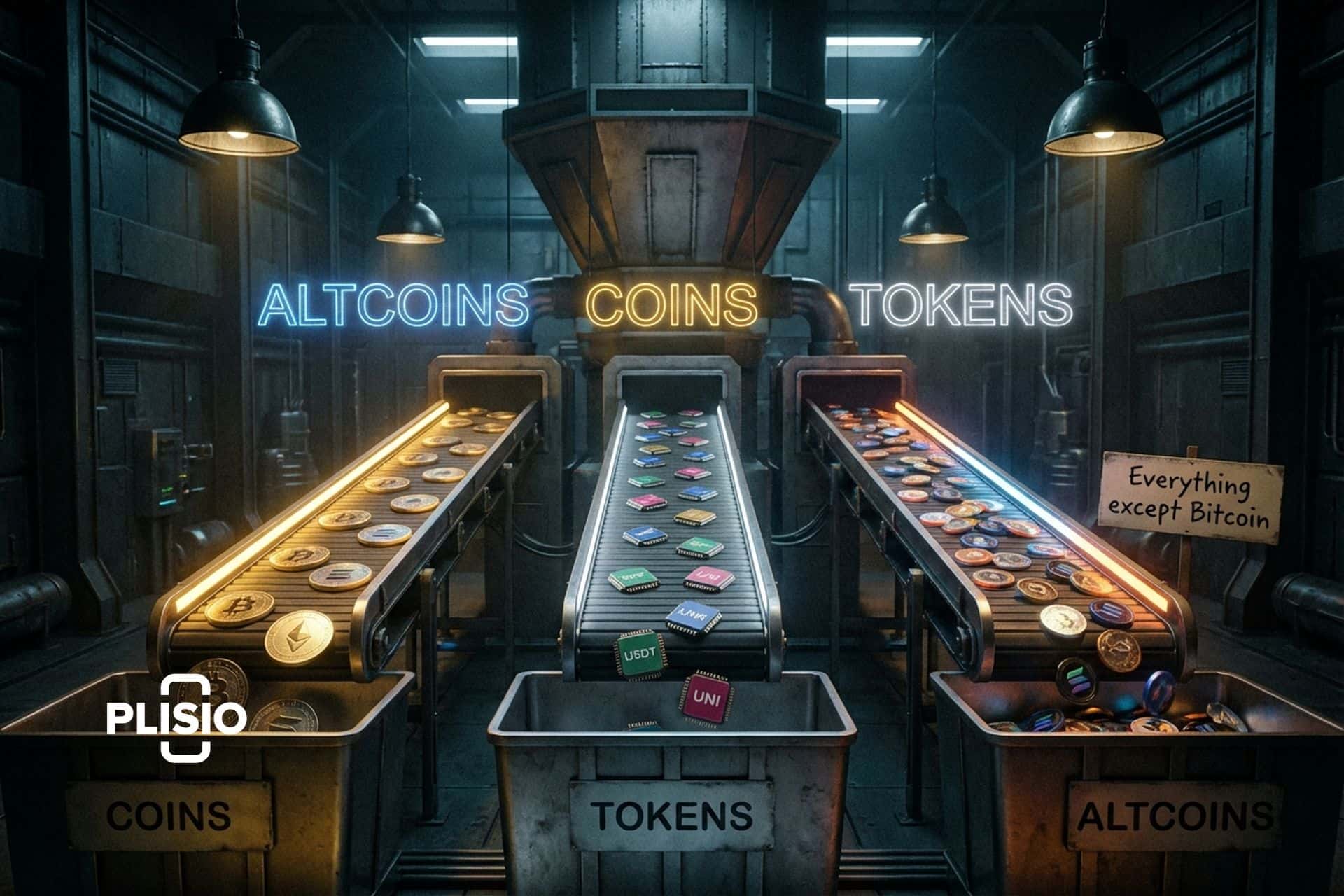
Over 120 million crypto tokens have been created. Most are dead. About 10,000 are actively traded. Only a few dozen have real value, real users, and real reasons to exist. When people talk about the crypto market, they throw around words like "coins," "tokens," and "altcoins" as if they mean the same thing. They do not. The difference is not just jargon. It affects how the asset works, where it lives, and what you can do with it.
This is the breakdown: what each term actually means, how the use cases differ, and which digital assets actually matter in 2026.
Coins vs tokens: the actual difference
People mix these up constantly, so let me make it plain.
A coin has its own blockchain. Bitcoin lives on the Bitcoin blockchain. ETH lives on Ethereum. SOL lives on Solana. BNB lives on BNB Chain. Each one powers its own network. You pay fees in it, validators earn it, and without it the chain stops working. Building a new coin means building an entire blockchain from the ground up. That takes years and serious engineering.
A token borrows somebody else's blockchain. USDT, LINK, UNI, SHIB, PEPE — they all sit on Ethereum (and sometimes Solana, BSC, or several chains at once). No network of their own. They pay rent in ETH gas. And here is the thing that explains why millions of them exist: you can deploy a new token with a single smart contract in an afternoon. Some people do it in under an hour. Copy an existing contract, change the name, hit deploy. Done. That is how we ended up with 120 million of them.
I like to think of it this way. A coin is a house on its own plot of land. A token is a unit in someone else's apartment building. The apartment can be worth a lot. But you do not own the plumbing.
Here is a quick reference:
| Coins | Tokens | |
|---|---|---|
| Own blockchain | Yes | No (runs on another chain) |
| Examples | BTC, ETH, SOL, BNB, ADA | USDT, LINK, UNI, SHIB, AAVE |
| Main use | Network fees, staking, payments | Utility, governance, access, DeFi |
| How to create | Build a whole blockchain | Deploy a smart contract |
| Difficulty | High (years of development) | Low (hours to days) |
What is an altcoin
Altcoin is short for "alternative coin." It means every cryptocurrency that is not Bitcoin. That is it. Ethereum is an altcoin. XRP (the cryptocurrency behind Ripple) is an altcoin. Dogecoin is an altcoin. Even a meme token launched five minutes ago on Solana counts.
The term started in 2011 when Litecoin and Namecoin appeared as the first alternatives to BTC. At the time, Bitcoin was the only game in town, so everything else got lumped together as "alts." The label stuck, even though today's altcoins range from $263 billion Ethereum to tokens worth less than a gas fee.
In March 2026, Bitcoin dominance sits around 57-58%, meaning BTC holds about $1.39 trillion of the total $2.4 trillion cryptocurrency market. The rest — $1 trillion plus in value — is the altcoin universe. That includes everything from digital assets with billions in liquidity to tokens nobody has traded in months.
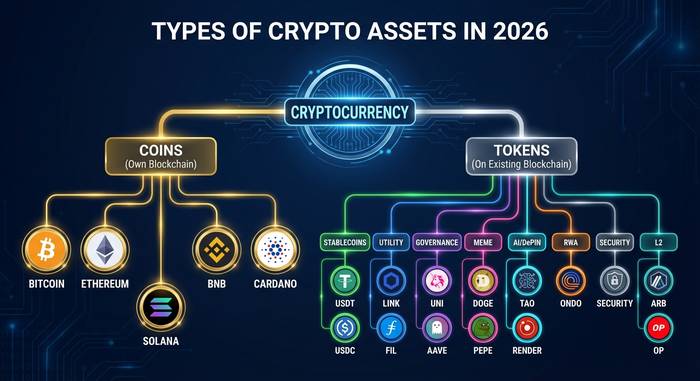
Types of altcoins and crypto tokens in 2026
Not all altcoins are trying to be a currency. Honestly, most are not even trying to be money. The market has split into very specific categories, and knowing which type you are looking at saves you from buying something that does not do what you think it does.
Stablecoins
Every crypto trader knows the feeling: you sell your ETH, you do not want to cash out to your bank (too slow, too many fees), so you swap to USDT and sit. That is what stablecoins are for. They stay pegged to $1 while everything else around them flies up or crashes down.
USDT is the biggest at around $143 billion. USDC sits at $40 billion. DAI is the decentralized one, minted against crypto collateral through MakerDAO. All of them are tokens, not coins. They ride on Ethereum, Tron, Solana. No blockchain of their own. Nobody buys stablecoins hoping they will moon. You buy them to park value, avoid fiat off-ramp fees, and reduce volatility while you figure out your next move.
Utility tokens
You need ETH to do anything on Ethereum. Every swap, every NFT mint, every smart contract call costs gas, and gas is paid in the native currency. SOL does the same job on Solana. These are utility tokens in the most literal sense: the network does not work without them.
But utility goes deeper than just paying fees. LINK powers Chainlink, the oracle network that feeds prices and data into smart contracts. In Q1 2026, Chainlink settled $7 billion in cross-chain transfers for clients including BlackRock and Swift. Filecoin (FIL) sells decentralized storage space. The Graph (GRT) indexes blockchain data so apps can search it. These crypto tokens have value because something breaks if you remove them. Their use cases are baked into how the infrastructure works.
Governance tokens
Own UNI? You get to vote on how Uniswap runs. Own AAVE? You help set the rules for the biggest lending protocol in DeFi. COMP, CRV, MKR — same deal. These crypto tokens do not just sit in your wallet. They give you a seat at the table.
And sometimes the votes actually matter. In February 2026, Uniswap holders approved expanding protocol fees across all v3 pools on 9 chains. That directly affects how much money the protocol makes and where it goes. Now, do most holders bother to vote? No. Turnout is embarrassingly low. But the power is there if you want it.
Meme coins
Look, I will be straight with you. Meme coins are gambling with extra steps. Dogecoin started in 2013 as a literal joke, and it somehow still carries a $14 billion market cap because the internet decided the dog was funny enough to keep throwing money at. SHIB sits at $3.4 billion. PEPE at $1.4 billion. BONK at $1.75 billion. None of them do anything. They just... exist, and people trade them.
The numbers tell the real story though. Meme coins or tokens as a whole hit $150.6 billion in December 2024, driven by pure volatility and euphoria. By March 2026 that number was $31 billion. Seventy-five percent wiped out. The TRUMP token? Launched in January 2025 at $74. By March 2026 it was sitting at $3. That is a 94.5% loss. Anyone who bought at the top and held got destroyed. This is what meme coins do. The fun part is brief. The pain part lasts.
AI and DePIN tokens
This is where I personally find things most interesting. AI model training costs a fortune in GPU compute. Some projects are trying to decentralize that. Bittensor (TAO, $3.4 billion) runs a network where anyone can contribute computing power to train AI models. Render (RENDER, $1.3 billion) does the same for GPU rendering, used by both AI companies and 3D studios. FET ($1.85 billion) merged three separate AI projects (Fetch.ai, Ocean Protocol, SingularityNET) into one entity called the Artificial Superintelligence Alliance. Wild name. Real product.
Then there is DePIN — Decentralized Physical Infrastructure Networks. Sounds academic, but the idea is practical. Helium (HNT) runs a wireless network using hotspots that regular people set up in their homes. Akash (AKT) rents out idle server capacity as decentralized cloud compute. The total DePIN market cap is around $9 billion. Still small, but AI demand is driving it, and Q1 2026 saw a flood of new model releases pushing GPU token prices up.
RWA tokens
This one still surprises people. You can buy a piece of a US Treasury bond as a token on Ethereum. BlackRock, the largest asset manager on earth, has a $1.9 billion tokenized money market fund called BUIDL. On a blockchain. That sentence would have sounded like science fiction three years ago.
Ondo Finance (ONDO, $1.27 billion market cap) is the biggest player in tokenized Treasuries and equities. Centrifuge moves private credit deals on-chain. The total RWA market passed $12 billion in March 2026. The prediction: $600 billion by 2030. Even if that number is off by half, it is a massive shift in how financial instruments get issued and traded.
Layer 2 tokens
Ethereum is expensive. A swap on mainnet can cost $5-20 in gas, which kills liquidity for smaller trades. Layer 2 networks fix that by batching transactions off-chain and posting compressed proofs back to the Ethereum blockchain. Arbitrum (ARB), Optimism (OP), and Polygon (POL) are the tokens that power these L2 chains. Combined market cap: about $7.5 billion. The value locked in their DeFi ecosystems is much higher than that. Base, built by Coinbase, is the interesting one: massive adoption but no token at all.
Security tokens
Here is where crypto meets securities law. A security token is exactly what it sounds like: a real security (stock, bond, fund share) turned into a blockchain token. The SEC made it crystal clear in January 2026: tokenized or not, a security is a security. Same rules apply. Same KYC. Same reporting.
Securitize runs BlackRock's BUIDL fund. tZERO operates a regulated exchange for digital securities. INX is SEC-registered. This corner of the market is small but institutional money is pushing it forward. If you want to trade tokenized Apple shares at 2 AM on a Sunday, security tokens are how that eventually happens.
Top altcoins by market cap in March 2026
| # | Altcoin | Ticker | Price | Market cap |
|---|---|---|---|---|
| 1 | Ethereum | ETH | ~$2,177 | ~$263B |
| 2 | BNB | BNB | ~$635 | ~$95B |
| 3 | XRP | XRP | ~$1.33 | ~$81.5B |
| 4 | Solana | SOL | ~$83 | ~$47.5B |
| 5 | TRON | TRX | ~$0.317 | ~$29.5B |
| 6 | Dogecoin | DOGE | ~$0.09 | ~$14B |
| 7 | Cardano | ADA | ~$0.245 | ~$9B |
| 8 | Hyperliquid | HYPE | ~$38.40 | ~$9B |
| 9 | Toncoin | TON | — | ~$8.5B |
| 10 | Chainlink | LINK | — | ~$7.5B |
Stablecoins like USDT and USDC excluded. Prices change daily; these are March 2026 snapshots.
What is altcoin season
You will hear this term thrown around on Twitter every time some random token pumps 40%. "Alt season is here!" Usually it is not.
Real altcoin season means 75% of the top 100 altcoins beat BTC over 90 days. That is the Altcoin Season Index threshold. Right now (March 2026) the index sits between 27 and 48. That is Bitcoin Season, not alt season. BTC dominance is at 57-58%. Money moved out of smaller coins and tokens and back into Bitcoin after the nasty correction that took BTC from $126,000 to the $67-74K range. Alts got hammered worse. They always do.
Is alt season coming? I have no idea. Nobody does, despite what your favorite YouTuber claims. The crypto market moves in cycles, not on schedules. The pattern from past cycles says altcoin season shows up after Bitcoin stabilizes and early holders start moving profits into smaller bets. We could be months away. We could be a year away. The only honest answer is: watch the index, not the hype.