What Is Altcoin Season? Understanding Altseason, Crypto Cycles, and When Altcoins Outperform Bitcoin
January 2021. Bitcoin owned about 70% of the total crypto market. By June that number was 38%. In between, tokens nobody had ever Googled before were casually doing 500% in a week. SHIB went from zero to $40 billion in market cap. Solana ran from a buck fifty to $260. Somebody paid for a FLOKI billboard in central London. If you were in crypto during that stretch, April through June 2021, you either made absurd money or watched other people make absurd money. Either way, you remember it.
That was altcoin season, a period when altcoins across the board outpace Bitcoin. Or altseason, if you want the slang. And no, it's not just random chaos. There's a pattern here, one that has repeated in different forms since crypto markets got big enough to have cycles. I've tracked these rotations across three full bull runs now, and the signals are more consistent than most people realize. Understanding altcoin season matters because by the time everyone agrees "it's altseason," you're usually closer to the top than the bottom.
What altcoin season actually means
So what qualifies? Altcoin season is when altcoins broadly outperform Bitcoin, not one random coin pumping on a Monday but the whole market rotating from BTC into everything else. Alt season means most of the top 50 digital assets are beating BTC returns over a meaningful window. When altcoin prices across the board climb faster than Bitcoin does, that's the thing.
The standard measurement is the Altcoin Season Index. Blockchain Center built the original version, CoinMarketCap runs one too. It works like this: take the top 50 altcoins (no stablecoins), check the last 90 days, count how many outperformed Bitcoin. If 75% or more did, congratulations, you're in altseason. Below 25%, it's Bitcoin season. Middle ground is just noise.
Where's the index right now? About 27-35 as of March 2026. Bitcoin dominance sits at 56-58%. Around 40% of altcoins are beating BTC over 60 days. So no, we're not in altseason and we're not particularly close. But here's the thing I keep telling people: the time to study altcoin season is when nobody cares about it. Once the index crosses 75, half the easy money has already been made.
Why altcoin seasons happen: BTC dominance and capital rotation
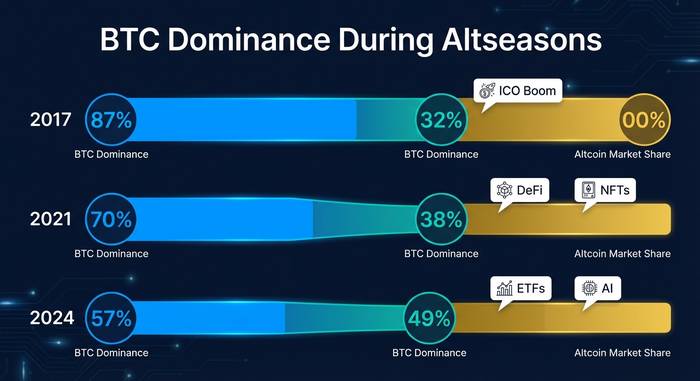
One number explains most of it: Bitcoin dominance. That's BTC's market cap divided by the total crypto market cap, expressed as a percentage. When it's high (55%+), money is parked in Bitcoin. When it drops below 50%, sometimes to 38% or even 32%, money is spreading out across altcoins. That flow is the mechanism behind every altseason.
I've watched this play out three times now and the sequence is almost boringly predictable in hindsight:
First, Bitcoin rips. New money enters through BTC because it's what people know, it's what has ETFs, it's what CNBC covers. Then Bitcoin stalls. People who bought at lower prices take profit. That profit doesn't leave crypto. It rotates into the altcoin market. First into Ethereum. Then into large caps like Solana, Cardano, XRP. Then into mid caps. Then into absolute garbage memecoins. Then everything crashes 80-95% and BTC dominance climbs right back up.
KuCoin's research arm calls this a four-phase liquidity flow model. Phase one is Bitcoin dominance. Phase two is Ethereum momentum. Phase three is the large cap altcoin rally. Phase four is full blown altseason, which is both where the biggest gains happen and where most people get wrecked because they showed up at phase four thinking it was phase two.
A history of past altcoin seasons: what happened and when
No two altseasons look the same, but they tend to show up 6-18 months after a Bitcoin halving. Here's how the big ones went down.
| Period | BTC dominance (start → low) | What drove it | Notable winners |
|---|---|---|---|
| Q1-Q2 2017 | 87% → 37% | ICO boom, Ethereum smart contracts | ETH (9,000%+), XRP, ADA, EOS |
| Q1 2021 | 70% → 38% | DeFi Summer aftermath, NFTs, memecoins | SOL ($1.50→$260), SHIB (43M%+), AVAX, LUNA |
| Q4 2024 | ~57% → ~49% | Spot BTC ETF liquidity, AI token hype, memecoin mania | AI tokens, GameFi, SOL ecosystem |
2017 was all ICOs. Ethereum's smart contracts had just made it possible for any project with a PDF whitepaper to raise $30 million in a weekend. Thousands of tokens launched. BTC dominance went from 87% to the low 30s. If you bought ETH at $8 and held through the altseason peak you were up 9,000%+. ETH, ADA, XRP, those projects survived. Most of the ICO tokens didn't. Then the SEC came knocking about unregistered securities, the bubble blew up, and crypto entered a two-year nuclear winter.
2021 was messier. Multiple narratives stacked on top of each other: DeFi protocols from 2020 maturing, NFTs suddenly being everywhere, Doge and SHIB going viral, and the Terra/LUNA ecosystem offering 20% "stable" yields that were anything but. Total crypto market cap crossed $3 trillion. BTC dominance bottomed at 38% as rising altcoin market share ate into Bitcoin's lead. Then Terra vaporized in May 2022 and took the entire market with it. Fourteen months of pain followed.
Late 2024 played out differently. Bitcoin led with the spot ETF approval story. Altcoin sectors like AI tokens, restaking protocols, and Solana ecosystem memecoins rallied alongside BTC, not after it. The index touched 78 in December 2024, briefly confirming altseason. But BTC dominance only dipped to about 49%. The capital rotation was shallower than previous cycles. By early 2025 everything had pulled back and the index was back to neutral.
How to read the altcoin season index and other indicators
The Altcoin Season Index is useful but it lags. Ninety days of lookback means the index confirms a trend that's been running for weeks already. It tells you what market regime you're in, not what to buy or when. I treat it as a thermometer, not a trading signal.
What actually helps me read the room, roughly in order of how much I trust them:
BTC dominance direction. Not the number itself, the trend. If dominance has been dropping for two or three straight weeks, that matters more than whether it's 54% or 52% today. Sustained drops under 50% preceded every major altcoin rally in history.
ETH/BTC pair. Ethereum usually moves before the rest. If ETH is gaining ground against BTC, rotation has started even if nobody's calling it yet. In early 2025 ETH was up 23% against Bitcoin. Solana was up 31%. Those numbers were screaming "capital is moving" while the Altcoin Season Index still hadn't crossed 50.
How much money is parked in stablecoins. Stablecoin dominance near 10% (where it is now, early 2026) means there's a lot of dry powder sitting on the sidelines. When that dominance starts dropping it usually means cash is flowing back into risk. Altcoins benefit from that more than BTC does because they're further out on the risk curve.
Vibes, basically. New wallet creation spiking on Solana or Base. DEX volume jumping on altcoin pairs. Crypto Twitter pivoting from "$BTC to 200k" posts to "what's the next 100x" posts. Soft signals, sure. But they're often two weeks ahead of the hard data.
What triggers the start of an altcoin season
Bull markets don't automatically produce altseasons. You need several things to line up at once, and they don't always cooperate.
Bitcoin's price needs to hit new highs and then cool off. That's the pattern. BTC sprints to an all-time high, then rests, and the profit takers start looking for the next play. Altcoins are where the higher returns live, so that's where the money goes. BTC's current ATH is $126,000, set early 2025. As of March 2026 it's pulled back about 44%.
You need a narrative. ICOs in 2017. DeFi and NFTs in 2021. AI tokens and restaking in late 2024. "Number go up" isn't enough to start an altcoin rally. There has to be a story that gets people excited enough to push past the fear and start buying things they don't fully understand. FOMO (fear of missing out) doesn't ignite on its own. It needs fuel.
Regulation has to cooperate, or at least not actively interfere. The 2024 rally was partly powered by spot Bitcoin ETF approvals. Looking at what's ahead: the CLARITY Act supposedly has 72% passage odds, and altcoin ETF applications for SOL, ADA, and XRP are working through the pipeline. Those could be catalysts for the next altcoin season.
And macro has to be friendly. When central banks are cutting rates and liquidity is loose, money flows into risk. Crypto, especially volatile altcoins, sits at the far edge of the risk spectrum. Every investor in this space understands that. The Fed is expected to start cutting in late 2026, and that timing could matter a lot.

How long altcoin seasons last and how they end
The hot phase of past altcoin seasons has lasted two to five months. The 2017 run burned bright for about four months before the ICO crackdown killed it. 2021 went longer, maybe six months across multiple waves (January through May), because different narratives took turns carrying the baton. DeFi faded, NFTs picked up. NFTs faded, memecoins picked up.
How do they end? Same way every time and nobody ever learns. Leverage gets insane. Tokens with no product, no code, and no users hit billion dollar valuations. Your Uber driver asks you about altcoins. Then something pops the bubble. Could be external (regulation, rate hikes, a recession scare) or internal (Terra imploding, a major exchange going down). Altcoins dump 80-95% from their highs. BTC dominance ticks right back up.
| Phase | What happens | Duration | Altcoin index |
|---|---|---|---|
| Buildup | BTC rallies, early rotation into ETH | 2-6 months | 25-50 |
| Acceleration | Large caps outperform BTC, narratives take hold | 1-3 months | 50-75 |
| Peak altseason | Broad altcoin rally, memecoins go crazy, 75%+ outperform BTC | 1-3 months | 75-100 |
| Crash | Euphoria pops, altcoins drop 80-95%, BTC dominance rises | 1-6 months | Drops below 25 |
The pattern is consistent enough that you can plan around it, but inconsistent enough that you can't set your watch by it. The 2021 altseason lasted longer than most because multiple narratives (DeFi, NFTs, memecoins) took turns keeping the momentum going. A one-narrative altseason tends to be shorter and more violent in both directions.
Will altseason happen in 2026?
Honest answer: I have no idea. Neither does anyone else, and if they claim they do, check if they're selling you a course.
What I can tell you is what the setup looks like. BTC dominance is high at 56-58%. Index reads 27-35. That's Bitcoin season by any definition. But the pieces for a rotation are there. Altcoin ETF applications for SOL, ADA, XRP moving through the process. Fed rate cuts expected in late 2026. The CLARITY Act potentially bringing regulatory clarity. Bitcoin already hit $126k and corrected by 44%, which matches the BTC-first-then-alts playbook from every previous cycle.
My read: the setup is forming but the trigger hasn't fired. Possibility, not certainty. If you want to be ready for the next altcoin season, the time to research projects and buy altcoins at lower prices is now, while nobody on your timeline is posting rocket emojis. Not after.