Best Cryptocurrencies for Long-Term Investment
Holding a cryptocurrency for five or ten years is a different game from trading it. The charts look the same, but the logic is not. Short-term traders care about where the next candle closes. Long-term holders care about whether a network will still matter in 2030. That test kills most coins. Of the thousands of cryptocurrencies that have existed, only a small group qualifies as best long-term cryptocurrencies and a serious long-term investment option. Many cryptocurrencies look like safe bets on a monthly chart and disappear by the next cycle.
This guide is for readers who want the second list, not the first. We walk through the framework to pick a long-term crypto, the macro setup for 2026, a ranked shortlist of the 10 best cryptocurrencies to invest in and to buy for long-term holds, and the risks that could break the thesis. It works whether you are researching best crypto to invest for the first time, adding to an existing crypto portfolio, or evaluating the crypto industry as a digital currency asset class. No shilling. No price predictions pulled from the ceiling. The numbers below are April 2026 snapshots from CoinGecko, DefiLlama, and project filings.
Picking the Best Long-Term Cryptocurrencies: Framework
If you own a coin for five years, whatever story you are told today has to survive two bear markets and at least one regulatory cycle. Most short-term noise stops mattering. A short checklist does most of the work.
Network effect first. Daily active addresses. Total value locked (TVL). Stablecoin settlement volume. A coin can have a clever white paper and still have zero real users. The only moat that lasts in crypto is the one users dig for you. Blockchains with strong decentralized applications (dapps) tend to survive across cycles. The whole point of blockchain technology is to decentralize trust. Chains that never quite decentralize end up competing with regulated banks on the banks' terms. That is a losing game.
Then developer activity. GitHub commits per month. Number of core contributors. Number of independent client implementations. A project with one codebase and three maintainers is fragile. Bitcoin, Ethereum, and Solana all have multiple independent teams. Most top-100 coins do not. Consensus mechanism matters too (PoW, PoS, DPoS, or something newer). It tells you how decentralized the validator set really is.
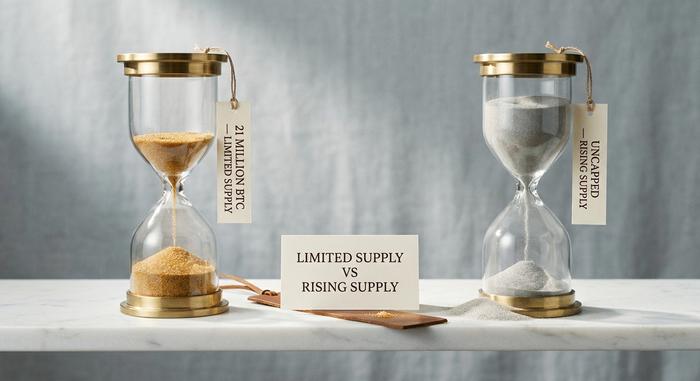
Look at tokenomics. A limited supply beats a rising supply every time. Burning mechanisms (Ethereum's fee burn, the BNB quarterly burn) make a token deflationary in practice. Emission schedules matter: a coin with 30% of supply unlocking to insiders over the next two years is pre-selling the price you are about to pay. Market capitalization gives you scale. Circulating supply tells you how much of it is actually out there today.
Real-world utility is next. Does the network generate fees? How much? Ethereum and Solana both print more than a billion dollars a year in on-chain revenue from transaction fees. Many "promising" chains print less than a million. Revenue alone is not the whole story. But zero revenue is a red flag. For anything merchant-facing, low transaction fees and real-time settlement matter more than any marketing claim.
Liquidity closes the frame. Can you buy $100,000 in one order without moving the price? Is the coin listed on Coinbase, Binance, Kraken, and at least one EU-regulated venue? Spot ETF coverage is a strong liquidity signal for US-based holders. Bitcoin since 2024, Ether since mid-2024, and a batch of altcoins added through 2025 and 2026.
Finally, regulation. MiCA went fully live across the EU on 30 December 2024. In the U.S., the SEC settled with Ripple in August 2025. A coin with clear regulatory status is cheaper to custody, cleaner to tax, and easier to hold through another cycle. You can buy and sell these crypto assets on regulated cryptocurrency exchanges without worrying about a surprise enforcement action landing on your exchange account. For merchants and long-term holders, that clarity is often worth more than a few extra basis points of yield.
The Crypto Market in 2026: Cycles and Macro Setup
The best long-term cryptocurrencies are not picked from a single month's chart. They are filtered by how a full cycle treats them. Crypto runs in roughly four-year cycles. April 2024 brought the fourth Bitcoin halving. 2025 ended with a blow-off top. Then came the drawdown that carried into 2026. By April 2026, total crypto market cap sat at $2.5–$2.63 trillion. That is down around 20.4% quarter-on-quarter per CoinGecko. Bitcoin dominance hovered near 57%.
Bitcoin itself was in the $74,500–$76,000 band in mid-to-late April 2026, after the KelpDAO bridge hack on 20 April drained roughly $1.4B from DeFi. Ethereum traded $2,350–$2,415. Roughly the same dollar price as 2021, despite five years of upgrades. That one stings. Solana sat at $83–$85 after giving back most of an early-April peak near $182. Treat any of these numbers as a snapshot, not a quote. Most popular cryptocurrencies still move with BTC, which means the macro setup tends to drag the whole crypto market in one direction.
Two bigger shifts also matter for 2026. First, spot ETFs. Bitcoin ETFs launched in January 2024. Ether ETFs in July. Solana, XRP, and Avalanche followed through 2025 and early 2026. US Bitcoin ETF AUM cleared $96.5 billion by April. BlackRock's IBIT alone crossed 800,000 BTC. That money is almost all buy-and-hold. Over long windows, it smooths volatility.
Second, MiCA. The EU framework is live, and the grandfathering hard deadline falls on 1 July 2026. Stablecoin issuers, exchanges, and custodians now either carry a full license or they shut European operations. Over 78% of European stablecoins were MiCA-compliant by April 2026. DAC8 tax reporting kicked in on 1 January 2026. More bureaucratic in the short run. Clearer long term.
Top 10 Best Long-Term Cryptocurrencies to Invest in 2026
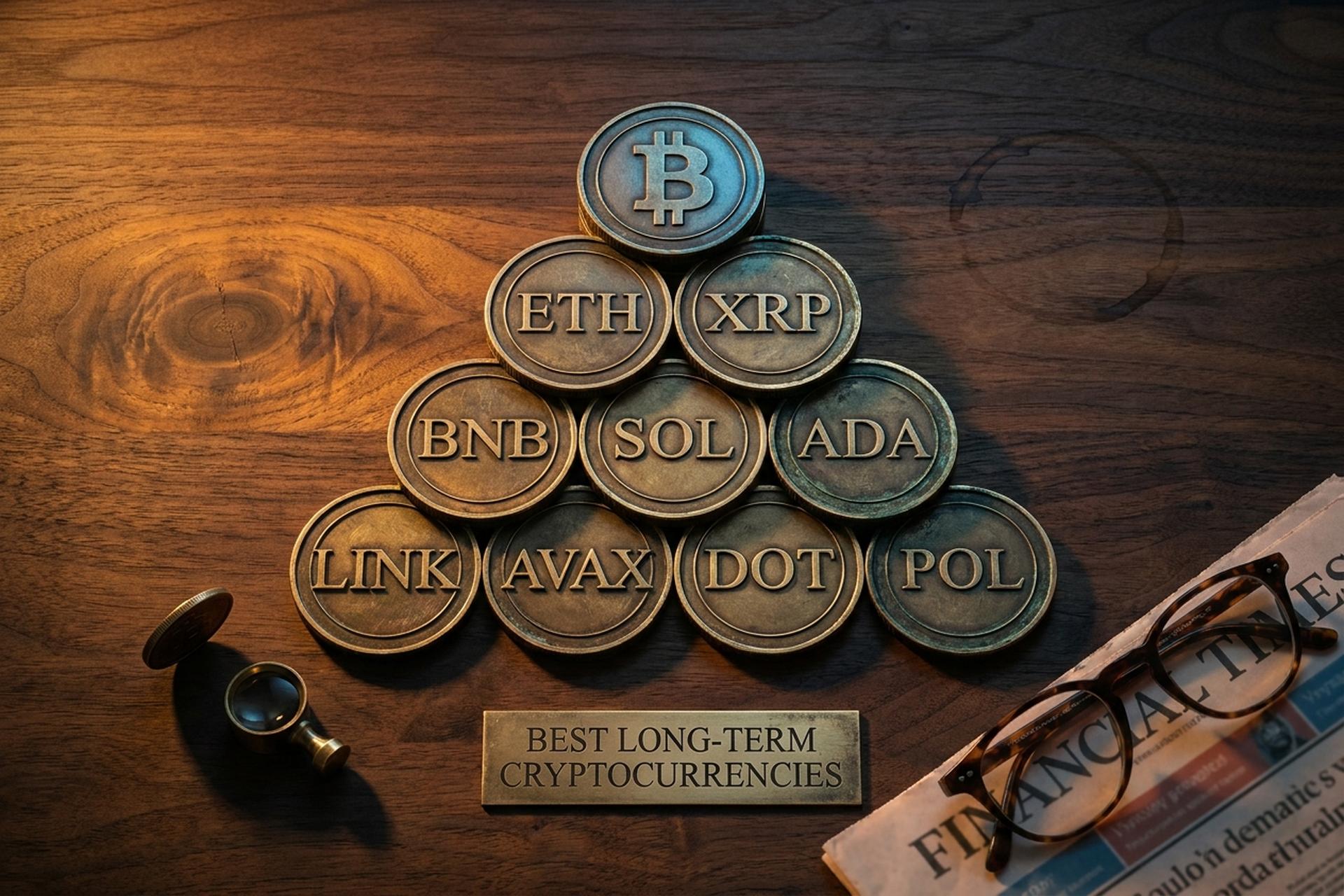
Here is the ranked shortlist of the top 10 cryptocurrencies worth considering as crypto coins for long-term investment, curated to help you choose the best picks for your own risk profile. Order is roughly by the strength of the long-term case, not by market cap. Every entry has a one-line thesis and the numbers that back it. A quick note: meme coin cycles can briefly push some tokens into the top-100, but they are not on this list — a meme coin's story rarely survives a single bear market.
| # | Coin | Ticker | Price (Apr 2026) | Market cap | Core thesis |
|---|---|---|---|---|---|
| 1 | Bitcoin | BTC | $74.5K–$76K | ~$1.50T | Store of value, ETF flows, fixed 21M supply |
| 2 | Ethereum | ETH | $2,350–$2,415 | ~$383B | Smart contract layer, fee burn, L2 scaling |
| 3 | XRP | XRP | $1.40–$1.50 | ~$87.9B | Cross-border settlement, SEC settled, spot ETFs |
| 4 | BNB | BNB | $587–$689 | $82–$99B | Binance moat, chain TVL, BNB quarterly burn |
| 5 | Solana | SOL | $83–$85 | ~$48.8B | Speed, DEX revenue leader, Firedancer client |
| 6 | Cardano | ADA | $0.24–$0.70 | ~$8.95B | Peer-reviewed, Hydra L2, low fees |
| 7 | Chainlink | LINK | $8.78–$9.52 | ~$6.5B | Oracle standard, CCIP, SWIFT pilots |
| 8 | Avalanche | AVAX | ~$9.13 | ~$3.9B | L1s (ex-subnets), institutional tokenization |
| 9 | Polkadot | DOT | ~$1.24 | ~$2.13B | JAM rollout, new 2.1B DOT supply cap |
| 10 | Polygon | POL | ~$0.09 | ~$960M | AggLayer, Gigagas roadmap, payments rails |
Bitcoin (BTC)
Bitcoin is the first cryptocurrency, the biggest cryptocurrency by every measure, and the reason anyone else is talking about this asset class. Supply is capped at 21 million coins. Roughly 20.02 million BTC were in circulation by April 2026, meaning more than 93% of all BTC has already been mined. The 2024 halving cut issuance to 3.125 BTC per block, and the next halving (2028) will drop it to 1.5625. Scarcity is not a marketing claim here; it is enforced in code. BTC remains the most well-known cryptocurrency on the planet.
The long-term case leans on three points. First, cumulative US spot Bitcoin ETF AUM reached around $96.5 billion by April 2026, with BlackRock's IBIT passing 800,000 BTC on its own. Second, corporate treasuries keep buying: Strategy (formerly MicroStrategy) holds 815,061 BTC after a 34,164-BTC buy on 20 April 2026 for $2.54 billion. Third, hashrate runs near 1 ZH/s, which reflects the cost an attacker would need to match to rewrite the chain.
Bear case: miner profitability is thin after the halving (roughly 400,000 machines went offline in China in late 2025). Quantum-computing research advanced in 2026: Google's Q1 paper suggested a 500,000-qubit machine could crack an exposed key in around nine minutes, with a practical threat window 2029-2032 per Bernstein. Roughly 1.7 million BTC sit in legacy addresses with exposed public keys; protocol-level quantum-resistance work is underway but contentious.
Ethereum (ETH)
Ethereum's is the obvious second pick: it is the largest smart contract platform by any meaningful metric, and ETH is the best cryptocurrency to invest in if your thesis is programmable money. A sample of major crypto products built on Ethereum (Uniswap, Aave, stablecoins, most tokenized real-world assets) shows how wide the footprint already is. DeFi TVL on Ethereum alone was $46-$55 billion in April 2026, about 68% of all DeFi. Ether is a yield-bearing asset for stakers: native staking APY runs 2.8-3.5% with around 30% of supply staked across 2.24 million total validators. The EIP-1559 burn mechanism turns every transaction into a small deflationary pressure on supply.
The Pectra upgrade went live on 7 May 2025. It bundled 11 EIPs, introduced smart-account UX (EIP-7702), doubled L2 blob throughput, and raised the max validator stake to 2,048 ETH. Layer 2 solutions like Arbitrum, Optimism, Base, and zkSync now do the bulk of everyday transactions, with L1 acting as settlement. Cumulative spot Ether ETF AUM reached about $11.6 billion in April 2026, and BlackRock's ETHB — the first US spot ETH staking ETF — launched on 12 March 2026, distributing roughly 82% of gross staking rewards to holders each month. Around 60% of tokenized real-world assets sit on Ethereum or its L2s.
Bear case: L2 economics siphon fees from L1, which weakens the burn. Competition from Solana and newer L1s is real. ETH ETF AUM retreated from an $18-19 billion peak to the $11-13 billion range. Staking centralization (Lido still the largest staker) is an unresolved governance risk.
Solana (SOL)
Solana is the highest-throughput major L1 in production. Production transactions per second ran around 5,500 in April 2026, with Firedancer (the Jump Crypto client) stress-tested at more than a million TPS — well into the thousands of transactions per second needed for mainstream checkout traffic — ahead of an H2 2026 mainnet deadline. On-chain revenue hit $2.85 billion over 2025, driven by $17 trillion in DEX volume, 200 billion transactions, and 98 million monthly active users. Firedancer will be Solana's second independent validator client, which reduces single-client risk.
Spot SOL ETFs crossed $1 billion combined AUM by April 2026 (Bitwise's BSOL alone holds around $620M), with Goldman Sachs confirmed as a holder. Wrapped XRP (wXRP) went live on Solana via Hex Trust and LayerZero on 18 April 2026, pulling XRP liquidity into Solana DeFi. Solana is also the chain several fintechs — Shopify, Stripe, Visa stablecoin pilots — use for on-chain settlement. That is a merchant-relevant angle: Solana offers transaction speeds and low fees that checkout flows need, and crypto payment gateways including Plisio route a growing share of USDC and USDT flow over Solana because sub-cent fees and ~400ms finality fit checkout flows.
Bear case: revenue fell 93% from its January 2026 peak as the memecoin cycle cooled, showing how cyclical Solana's fee base is. Historical outages also keep some institutions cautious even as reliability has improved.
XRP
XRP is the native asset of the XRP Ledger, built for cross-border payments. The SEC's multi-year case ended with a settlement in August 2025 that removed the regulatory overhang. The SEC/CFTC joint framework published in March 2026 classified XRP as a digital commodity alongside BTC and ETH. Seven spot XRP ETFs are in final SEC review, with combined futures-based product AUM already above $1 billion and weekly inflows reaching $119.6M in early April 2026.
The long-term case rests on payment rails. RippleNet connects 300+ institutions across 55+ countries; ODL corridors moved more than $15 billion in monthly cross-border settlement in 2025 and now cover roughly 80% of major remittance corridors. SWIFT named 30 Ripple-connected banks in its new payment framework in April 2026. XRP has a 100-billion-token maximum supply, 61.57B circulating, with scheduled releases from escrow. Settlement on the XRPL is 3-5 seconds at about $0.0002 per transaction.
Bear case: on-chain XRP transaction counts fell around 94% year-on-year even as RippleNet volumes grew, because the token itself is optional inside RippleNet. Competition from bank-issued stablecoins and CBDCs on the same use case is rising.
BNB
BNB is the token of the BNB Chain ecosystem and Binance's broader product surface. BNB Chain is a major smart contract chain by active addresses. BNB holders get exchange fee discounts on Binance and exposure to the quarterly auto-burn, which has been running since 2017. The 35th burn completed in April 2026 destroyed 1.57 million BNB worth roughly $1.02 billion, pushing the circulating supply closer to the 100M-token long-term target (currently around 134.79M). BNB Chain TVL reached about $6.8 billion and its DEX volumes hit roughly $1.8 billion per day in Q1 2026, with BSC TVL up 27% year-on-year.
Binance remains the largest crypto exchange by spot and derivatives volume in 2026, despite its 2023 US settlement. That gives BNB a captive utility that few other tokens match.
Bear case: BNB is off its October 2025 all-time high of $1,369.99 by around 57%. Binance's regulatory situation in multiple jurisdictions is ongoing, and the chain's validator set is more centralized than peers'. A deterioration at the exchange level hits BNB directly.
Chainlink (LINK)
Chainlink is the dominant oracle network, with roughly 70% market share in the oracle sector (69.9% in RWA specifically), and the de facto cross-chain messaging layer through CCIP. CCIP has been live with SWIFT since November 2025; JPMorgan and UBS ran $150-trillion-settlement-market pilots on Chainlink in Q1 2026, and the ADI Foundation picked CCIP to bridge $240 billion in institutional assets. CCIP processed $18 billion in Q1 2026 alone, up 62% year-on-year.
LINK tokenomics are the weak spot: emissions from a non-circulating pool can dilute holders. The community staking pool (45 million LINK, about 8% of supply) offers roughly 4.75% reward rate. The long-term case is strong if tokenization and RWA continue to grow, because Chainlink is the plumbing. Standard Chartered targets a $15 LINK price by late 2026.
Bear case: revenue capture to the LINK token is indirect — dominant market share has not yet translated into a market cap that reflects the usage. Oracle competition from Pyth and native chain oracles keeps rising.
Cardano (ADA)
Cardano emphasizes peer-reviewed research and formal methods. It has a 45 billion ADA max supply with around 36 billion circulating, more than 63% of which is staked across 3,000+ pools. Native staking APY runs 2.8-4.5% with no lock-up and no slashing. Hydra, the L2 solution, targets 111,000+ TPS, and 735 GitHub commits to Hydra and Leios over one April 2026 weekend show that dev activity is still alive. A $71 million treasury spend was approved to fund Hydra and Leios delivery through late 2026.
Cardano's ecosystem is smaller than Ethereum's or Solana's, but it has strong retail adoption in parts of Africa and Asia. ADA has one of the lowest electricity footprints of any top-10 chain.
Bear case: DeFi TVL on Cardano is still a fraction of Ethereum's. Revenue and dApp count lag rivals. Price quotes across sources varied widely in April 2026 (from roughly $0.24 on CoinMarketCap up to $0.70 on other trackers), which itself reflects thin liquidity at some venues.
Avalanche (AVAX)
Avalanche's "subnet" architecture (rebranded to Avalanche L1s under the Avalanche9000 and Etna upgrades) lets institutions spin up their own EVM-compatible chains anchored to Avalanche's validator set. That is a direct fit for tokenization of traditional assets. JPMorgan's Onyx unit and Franklin Templeton run Avalanche subnets. AVAX itself is capped at 720 million tokens (about 431.8M circulating) and has a fee burn. Native staking APY runs 7-10%.
Institutional wrappers arrived in 2026: Bitwise's BAVA spot ETF launched on NYSE Arca on 15 April 2026 with $2.5M first-day volume, and CME AVAX futures were scheduled for 4 May 2026. DeFi Kingdoms and Dexalot L1s have periodically surpassed the Avalanche C-Chain in gas use, which validates the app-chain thesis.
Bear case: subnet adoption is uneven, and the L1 ecosystem is fragmented — each subnet is its own economic zone with its own incentives. AVAX emissions are relatively high.
Polkadot (DOT)
Polkadot went through a major tokenomics overhaul on 14 March 2026. Supply was capped at 2.1 billion DOT, and emissions were cut by 53.6% (inflation fell from roughly 7% to 3.1%). The JAM (Join-Accumulate Machine) upgrade is in progress, with 43 independent teams competing for a 10M DOT prize pool. Staking APY runs up to around 15% on third-party platforms (lower at the protocol level post-overhaul). Over 65 parachains are active, and monthly active developers sit at 450-500. The first US spot DOT ETF is a 2026 catalyst to watch.
Polkadot is the long-shot entry on this list. The thesis is that modular blockchain designs win the next decade and DOT sits at the top of that tree. The counter-thesis is that modularity was a 2022 narrative and the ecosystem has lost momentum — DOT has bled relative to peers for years, and JAM delivery is the key risk.
Polygon (POL)
Polygon completed its MATIC-to-POL 1:1 migration as part of the Polygon 2.0 roadmap. POL is hyperproductive: the same token secures Polygon PoS, the zkEVM, and CDK-based chains at the same time. The Giugliano hardfork landed at block 85,268,500 on 8 April 2026 and cut finality by about two seconds. sPOL liquid staking launched on 14 April 2026, unlocking roughly 3.6 billion staked POL (around $330 million) for DeFi use. The Gigagas roadmap targets 100,000 TPS. Polygon has the strongest enterprise partnerships in the space: Stripe runs USDC payouts on Polygon, and Mastercard, Starbucks, Reddit, Nike, and Flipkart have all run live products on Polygon.
The token sits around $960 million market cap in April 2026, low given the footprint. Bear case: the zk-rollup competitive set (zkSync, Starknet, Scroll) is crowded, POL emissions add roughly 2% annual inflation, and per-token value capture is tied to ambitious roadmap execution.

Bitcoin vs Ethereum: Which Is Better Long-Term?
New investors keep asking which to pick. There is no single answer. There is a framework.
Pick Bitcoin if your thesis is monetary. You want a hard-capped, politically neutral settlement asset that central banks and pension funds can slot into a traditional portfolio. BTC absorbs macro flows more than crypto-native news.
Pick Ethereum if your thesis is platform. You want exposure to fees, applications, and the infrastructure of a global smart contract economy. ETH is more volatile. It also has a direct economic feedback loop (fees, burns, staking) that Bitcoin lacks.
Most long-term portfolios hold both. A simple starting allocation: 60% BTC, 25% ETH, 15% everything else. Tweak by conviction and investment goals. The point is diversification across theses, not across tickers. A 5-10% stablecoin sleeve is also common as dry powder for the next drawdown.
DeFi, Oracles, and Smart Contract Layer Picks
Past the top two, the useful clusters in 2026 are smart contract L1s (Solana, Avalanche, Polkadot, Cardano), execution-layer infrastructure (Polygon, Arbitrum, Optimism), and middleware (Chainlink, The Graph). These crypto projects sit inside the broader decentralized finance (DeFi) stack that moves stablecoins, lending, trading, and tokenized real-world assets.
DeFi TVL dropped $13.21 billion in 48 hours after the KelpDAO bridge hack on 20 April 2026. It sat below $80 billion after. Ethereum still accounted for 68% of what was left. BNB Chain and Solana were next. Tron, Avalanche, and newer L1s split the rest. Liquid-staking tokens (Lido's stETH, Rocket Pool's rETH, Jito's JitoSOL) had become de facto base money for DeFi. Then rsETH became the ugly reminder that wrapped assets carry their own bridge risk.
Takeaway for long-term holders: what matters is real usage, not branding. Chains that generate fees, secure stablecoin float, and host sticky applications justify their token value. Chains with zero paying users do not. Same screen works for picking which crypto to buy from the hundreds of cryptocurrencies available: identify the paying users. If you cannot, skip it.
Risks for Crypto Investors: What Can Go Wrong
Every long-term crypto thesis has a bear case. The honest way to invest in cryptocurrency is to list the risks and assign probabilities, not pretend they do not exist. Investing in crypto pays long-term only when you can stay in the position through a cycle where the news flow is terrible.
Regulation is the first. MiCA is largely supportive but raises compliance costs. The US is in a patchwork phase where SEC, CFTC, and Treasury (FinCEN) all claim jurisdiction on parts of the asset class. A hostile executive order or a court loss on tokenization could reprice the market.
Centralization risks are second. Lido controls close to 30% of staked ETH. A handful of ETF issuers (BlackRock, Fidelity, Grayscale) now hold more Bitcoin than any single exchange. If one entity breaks, a lot breaks with it.
Token unlocks and insider concentration matter. Look up a coin's unlock schedule on Token Unlocks or CryptoRank before you buy. A coin with 30% of supply unlocking in 18 months is priced for dilution that has not happened yet.
Quantum computing has moved from "long-shot" to "planned." Google research in Q1 2026 suggested a 500,000-qubit machine could crack an exposed Bitcoin key in roughly nine minutes. The realistic window is 2029-2032 per Bernstein. About 1.7 million BTC sit in the most-exposed legacy addresses. A Bitcoin dev "quantum tripwire" proposal that would freeze vulnerable coins if an attack is proven is under active debate. Post-quantum signatures exist; deployment will be slow and contentious.
Finally, operational risk. Self-custody means you accept responsibility for keys. Exchange custody means you accept counterparty risk. Both are fine; neither is free. April 2026 alone saw more than $606 million in DeFi exploits, with KelpDAO's $292M bridge hack leading the list. "Cold wallet" is not the same as "safe," and "bridged" is not the same as "backed by the original asset."
Building a Long-Term Crypto Portfolio with DCA
Holding long-term is unglamorous. That is the point. A boring, disciplined crypto investment plan beats a clever one you abandon in the first drawdown.
Dollar-cost averaging (DCA) means buying a fixed dollar amount on a fixed schedule. Weekly or monthly, and you ignore the price. Every major exchange now offers auto-DCA for Bitcoin and Ethereum. Several will do it for the full top-10. The historical numbers are blunt. $10 a week into BTC from 2019 to 2024 returned over 200%. Contrarian DCA from 2018 to 2025 beat buy-and-hold by about 99 percentage points. There is one rule worth taping to your monitor. Never invest more than you can afford to lose.
Self-custody starts to matter after your stack passes a few thousand dollars. A hardware wallet is the baseline. Ledger Nano, Trezor Safe 3 or Safe 5, BitBox02, Coldcard. Modern Ledger and Trezor Safe devices use EAL6+ Secure Elements. Trezor firmware is open-source. Ledger supports the widest set of coins. Write your seed on steel, never paper. Store in two physical locations that are not the same building. Run a small test recovery before you move the real stack.
Rebalance once a year. Not weekly. A 60/25/15 split from last spring may sit at 70/20/10 after a BTC rally. Rebalancing takes some profit and brings you back to the risk you signed up for. Keep a short ledger of every cryptocurrency investment with cost basis. Treat cryptocurrency investments like any other long-term position. Not as a game.
Crypto Tax Basics for Long-Term Cryptocurrency Holders
Tax is where many long-term holders lose the most value. The rules are jurisdiction-specific; the principle is universal: buying and holding is generally not taxed, selling or spending is.
In the US, long-term capital gains (held over one year) are taxed at 0%, 15%, or 20% depending on income. Short-term gains are taxed as ordinary income. Starting the 2025 tax year, exchanges issue Form 1099-DA, which means the IRS automatically sees your disposals. Under-reporting is not a strategy.
In the EU, DAC8 data reporting kicked in on 1 January 2026. Exchanges share your transaction data with your home-country tax authority. Rates vary across major jurisdictions, and the difference between them is large enough to affect where serious holders decide to live:
| Jurisdiction | Long-term crypto gains rate | Notable rule |
|---|---|---|
| United States | 0% / 15% / 20% (income-dependent) | Form 1099-DA from 2025 tax year |
| Germany | 0% if held > 1 year | Otherwise taxed as income |
| Poland | 19% flat (PIT-38) | Crypto-to-crypto is non-taxable |
| Italy | 26% flat on gains over €2,000/yr | Small allowance at the bottom |
| France | 30% flat (occasional) / progressive (pro) | PFU regime for retail |
| UK | 10% / 20% (CGT) | £3,000 annual exempt amount |
| Portugal | 28% flat (held < 1 year) / 0% (held ≥ 1 year) | Long-term favored |
Track cost basis. CoinLedger, Koinly, CoinTracker, and Blockpit export tax-ready reports and integrate with most exchanges. For stackers adding to a position over years, cost-basis accounting is the difference between owing $5,000 and $20,000 at sale.
Where to Buy: Best Crypto Exchange Options 2026
Your crypto exchange matters more for custody and security than for the exact fee you pay. Not all cryptocurrencies could even be listed on every venue. MiCA-era Europe is especially picky. For a U.S. or EU long-term holder in 2026, here are the cryptocurrency exchanges where you can comfortably find the best cryptocurrencies to buy. Short notes on each.
- Coinbase — strongest US regulatory posture. Publicly listed since 2021. Offers ETH, SOL, ADA staking inside the app.
- Kraken — around since 2011. Publishes proof-of-reserves. Deep liquidity on majors. Favorite of OGs.
- Binance — biggest global spot and derivatives venue. US customers get routed to Binance.US.
- Bitstamp — EU-regulated. Robinhood bought it in 2024. Suits conservative holders who want a bank-like feel.
- Gemini — NY-regulated. ETH staking. Earn program is still paused, but spot trading works fine.
After you buy, move coins off the exchange. Do not treat an exchange as a long-term wallet. Boring rule. It has saved more portfolios than anything else. Free crypto promotions (airdrops, sign-up bonuses) are nice extras. They are never a reason to leave a serious balance on a counterparty.