Relay Bridge: Fast Crosschain Crypto Infrastructure

For a few brutal months in 2022, crypto bridges were the most dangerous place to keep money on-chain. Hackers drained close to $2 billion from them, more than two-thirds of everything stolen that year. The reason was almost always the same: the bridge locked thousands of users' funds in one big contract, and one big contract is one big target. The Relay bridge belongs to a newer wave of designs that tries to remove that target entirely. This guide walks through what the Relay bridge is, how to use it to move tokens across chains, whether it is actually safe, and how it stacks up against rivals like Across and Stargate.
What the Relay bridge is and how it works
Start with what the Relay bridge is not. It is not a vault that locks your tokens on one chain and prints a wrapped IOU on another. Relay, built by the team behind Reservoir and launched in 2024, is an intent-based bridge. You say what you want to end up with, and someone with money already sitting on the destination chain hands it to you in seconds. The mechanics happen behind the scenes. Reservoir made its name building NFT and token trading infrastructure, so Relay grew out of a team that already moved liquidity for a living. That heritage shows in how the bridge treats moving value as a routing problem, not a locking problem. At heart it is a bet that crosschain interoperability should feel normal, not fragile.
The intent model: you state the outcome
In an intent model, you do not micromanage the steps. You express an outcome ("I want 100 USDC on Base, paying from my ETH on Arbitrum"), and the system finds someone to make it happen. That someone is a solver, and they already hold balances across the chains Relay supports. Because the solver fronts you the money instantly and settles up with the protocol afterward, you do not wait for slow cross-chain confirmations. Relay says it connects more than 85 blockchains this way, which is a wide net for a single bridge.
What relayers and the solver network actually do
The relayer is the engine. It watches your request, prices it, and fills it from its own inventory on the destination chain. Your funds sit in a non-custodial contract Relay calls the Depository, so the solver gets paid only after the conditions are met. Right now Relay runs with a single main relayer handling liquidity and execution, which keeps things fast but concentrates trust. The roadmap is a permissionless network where many relayers stake collateral, compete to fill orders, and lose their stake if they misbehave. Until that ships, this is the most important thing to understand about the bridge.
The Depository is what keeps this honest. Because your tokens never leave a contract you can inspect until the solver delivers, a misbehaving relayer cannot simply run off with deposits. The worst it can do is fail to fill your order, in which case you are refunded. That is a very different risk profile from handing a bridge custody of a pooled treasury and hoping its keys never leak.

How to use the Relay bridge to swap across chains
Here is the good news for anyone who has wrestled with old bridges. Using the Relay bridge feels less like a five-step ritual and more like a normal token swap. You connect, you choose, you confirm, and the assets show up.
Bridging step by step
Open the Relay app and connect your wallet. Pick the source chain and the token you are sending, then the destination chain and what you want to receive. Relay returns a quote: the amount out, the fee, and the estimated time. If it looks right, you confirm in your wallet and sign once. That is it. There are no wrapped tokens to unwrap later and no separate "claim" step on the far side. Relay also does more than swaps; the same rails power crosschain payments, gas top-ups so you land on a new chain with enough to transact, and deposit addresses for apps.
A concrete example helps. Say you are on Arbitrum holding ETH, but the mint you want is on Base. The old way meant bridging ETH, waiting for confirmations, then swapping into the right token once it arrived — three steps and a lot of staring at a loading spinner. With Relay you tell it the end state and it delivers usable funds on Base in one shot. The chain-hopping collapses into a single signature, and you never touch a wrapped token.
Fees and speed
This is where Relay makes its loudest claims, so treat the numbers as the company's own marketing until independently verified. Relay says transfers under $1,000 settle in seconds, that its fees run "80% or more" below traditional bridges, and that it holds 99.9% uptime across its networks, a nod to the reliability that payment apps demand. The speed is believable for an intent model, since a solver fronting inventory does not wait on bridge confirmations. The fee comparison is harder to pin down because Relay does not publish an exact basis-point schedule.
| Metric | Relay (self-reported) | Traditional lock-and-mint bridge |
|---|---|---|
| Settlement time | Seconds (under $1,000) | Minutes, sometimes hours |
| Steps for the user | One signature | Lock, wait, claim |
| Wrapped tokens | None | Usually yes |
| Fee claim | Up to 80%+ cheaper | Higher, plus gas on both sides |
| Chains supported | 85+ | Varies, often few |
Is the Relay bridge safe? Security and the relayer model
Bridges have the worst safety record in crypto, so this question deserves a real answer, not a marketing one. The short version: Relay's design removes the specific weakness that caused the famous disasters, but it introduces a different trust question you should weigh.
Why the old bridges got drained
The 2022 wave was not bad luck. Lock-and-mint bridges pool everyone's deposits in one contract and then mint wrapped tokens against that pool. Break the contract or forge the messages that authorize a mint, and you can walk away with the whole pool. That is exactly what happened. The Ronin bridge lost around $625 million in March 2022, the BNB bridge about $570 million that October, and Wormhole roughly $325 million in February. Smaller hits at Nomad and Harmony pushed the year's bridge losses near $2 billion, which Chainalysis pegged at about 69% of all crypto stolen in 2022.
How Relay shrinks the attack surface
Relay does not keep a giant honeypot. Your funds sit in the non-custodial Depository and release to a solver only when the deal completes, so there is no pooled treasury for an attacker to crack open. There are no wrapped tokens to counterfeit either, which kills the forged-mint attack that sank Wormhole. The protocol adds contract audits, a bug bounty, and MEV protection on top. None of that makes it unhackable, but it does mean a single broken contract cannot vaporize everyone's deposits at once. It also changes who is exposed. In a lock-and-mint hack, every depositor loses together because their funds share one pool. In Relay's model, a failure is scoped to a single in-flight order rather than the whole treasury, which is a structurally smaller blast radius.
The risks that still remain
The honest caveat is the relayer. With one main relayer filling orders today, you are trusting that operator to stay online, price fairly, and not get compromised. A solver going down means delays, not stolen funds, because the Depository holds your assets, but it is still a centralization point that the planned bonded, slashable relayer network is meant to fix. Until that network is live, treat the Relay bridge as fast and well-designed, not yet trustless. In practice that means doing what you would with any bridge: send a small test transfer first, confirm the funds arrive, and only then move real size. The Depository limits the downside, but good habits cost nothing.
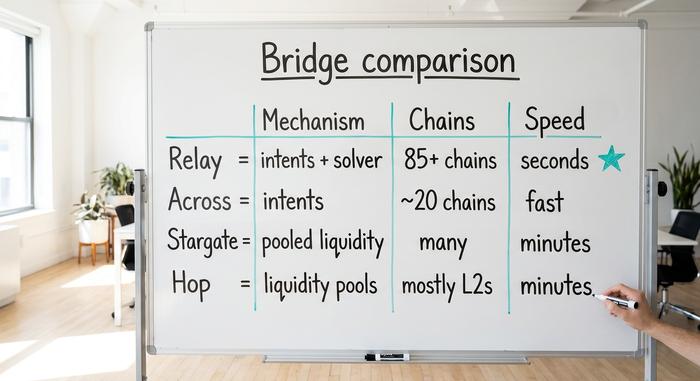
Relay bridge vs Across, Stargate, and Hop
Relay is not the only intent-style bridge, and it helps to see where it sits. Across runs a similar relayer-and-intents model and has processed more than $27.5 billion in cumulative volume as of mid-2025, but it focuses on a narrower set of major chains. Stargate, built on LayerZero, uses pooled liquidity and a messaging layer rather than solvers. Hop relies on liquidity pools and a bonder system, mostly for Ethereum rollups. Native bridges are the safest in theory but often the slowest in practice.
| Bridge | Mechanism | Chains | Custody of your funds |
|---|---|---|---|
| Relay | Intents + solver network | 85+ | Non-custodial Depository |
| Across | Intents + relayers | ~20 major chains | Non-custodial |
| Stargate | Pooled liquidity + LayerZero | Many | Pool-based |
| Hop | Liquidity pools + bonders | Mostly L2s | Pool-based |
Relay's pitch is breadth. If you bounce assets across many chains and care about speed and a swap-like experience, the Relay bridge is hard to beat on coverage. If you only ever move funds between two big chains, a more focused bridge may serve you just as well. One practical edge: because Relay aggregates across so many chains, it often finds a route when a single-purpose bridge has none, which matters the moment you step off the handful of blue-chip networks everyone already supports.
The Relay ecosystem: App, API, and Relay Chain
Relay is not really trying to be a website you visit. It wants to be infrastructure other apps build on. The product comes in layers: the App most users see, the API that wallets and exchanges plug into, and the underlying protocol. That payments-grade, onchain-economy ambition is why investors keep writing checks. Reservoir raised a $14 million Series A, and in February 2026 Relay closed a $17 million Series B led by Archetype and Union Square Ventures to fund Relay Chain, a dedicated chain meant to settle crosschain activity and push toward fiat on-ramp and multichain payments.
The bet behind Relay Chain is that crosschain settlement should not depend on the security of whichever chains you happen to be bridging between. A purpose-built settlement layer, if it works, lets wallets and exchanges use the Relay bridge as a payments rail without each one rebuilding the plumbing from scratch. That is the line between a consumer crosschain bridge you visit and payments-grade infrastructure that quietly runs inside other apps, and it is the gap Relay is trying to close. It is Relay's take on what the industry calls chain abstraction: hiding the seams between chains so the onchain economy feels like one place instead of fifty.
The growth story is real but self-reported. Relay claims more than $20 billion in cumulative volume and over 100 million transactions, which lacks independent on-chain confirmation. The one outside data point comes from USV, which noted Relay was clearing more than $500 million a month back in early 2025. Strong, but worth keeping in the "company says" column until a third party verifies it.
Is the Relay bridge worth using in 2026?
For many people, yes. I keep reaching for it in one situation in particular: hopping assets across a lot of chains without the usual friction. The Relay bridge makes the most sense if you regularly move assets across a lot of chains and want bridging to feel like a one-click swap instead of a chore. The breadth of 85-plus networks and the near-instant settlement are genuinely useful, and the non-custodial design avoids the worst failure mode of older bridges. If you are a security purist, the current single-relayer setup is a fair reason to wait for the trustless network, or to keep transfer sizes modest. Match the tool to your risk appetite. And remember that no bridge, Relay included, is a place to store value. It is a road, not a garage; move your assets across, then park them in a wallet or protocol you actually control.
The Relay bridge verdict for crosschain users
The Relay bridge is a clean answer to a problem that cost crypto billions: it moves your tokens across chains in seconds without locking them in a contract that becomes a target. The trade is a trust assumption about its relayer that the team is still working to decentralize. So the real question is not whether Relay is fast — it clearly is — but whether you are comfortable with who fills your order today. If you are, the Relay bridge is one of the smoothest ways to go multichain right now. Watch for the trustless relayer network, because that is the upgrade that turns a good bridge into a hard-to-argue-with one.