PancakeSwap (CAKE): the decentralized finance platform where users earn, trade, and farm
Most people outside crypto have never heard of PancakeSwap. And honestly, the name does not help. It sounds like a breakfast app, not a financial protocol that handled $2.3 trillion in trades last year. Yet here we are. PancakeSwap grabbed nearly 38% of the global DEX market share in 2025, quietly outdoing platforms with far bigger marketing budgets.
So what is going on with this rabbit-themed decentralized exchange? Is the CAKE token worth a second look in 2026? I have spent the last few weeks digging into the numbers, and there is more happening here than most people realize.
What is PancakeSwap and how does this decentralized exchange work?
At its simplest, PancakeSwap lets you swap one crypto token for another without a middleman. You do not create an account. Nobody asks for your ID. Just connect your wallet (MetaMask, Trust Wallet, whatever you prefer), pick the tokens, confirm the trade, and you are done.
The project went live in September 2020 on BNB Chain, which used to be called Binance Smart Chain. Originally, it was pretty much a copy-paste of Uniswap, but adapted to run on BNB's faster and cheaper blockchain. That was years ago, though. The platform has changed a lot since then.
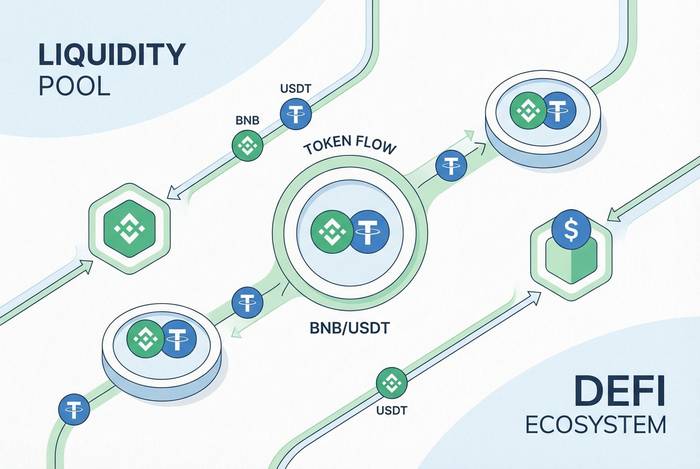
Here is the clever part. PancakeSwap does not use order books like Coinbase or Binance. Instead, it runs on an automated market maker model (AMM for short). Picture a giant vending machine. People fill it with pairs of tokens, say BNB and USDT. When you want to trade, you put one token in, and the smart contract spits out the other based on a math formula. The people who filled the machine? They are the liquidity providers, and they collect a cut of every trading fee generated by the pool.
Trades settle in seconds. There is no waiting. No middleman approving anything. Everything runs on-chain and stays fully decentralized.
PancakeSwap TVL and DEX volume: how the platform ranks in 2026
Let me get right to the numbers, because they paint a clear picture. PancakeSwap currently holds around $1.5 billion in total value locked across all its supported chains. That TVL number moves around depending on market mood, but it keeps PancakeSwap comfortably in the top five DeFi protocols worldwide.
Here is a side-by-side look at how the big DEX platforms stack up right now:
| Metric | PancakeSwap | Uniswap | SushiSwap |
|---|---|---|---|
| TVL (April 2026) | ~$1.5B | ~$5.2B | ~$350M |
| Chains supported | 10+ | 12+ | 25+ |
| 24h trading volume | ~$150M | ~$1.2B | ~$30M |
| Trading fee range | 0.01% - 1% | 0.01% - 1% | 0.3% |
| Native token | CAKE | UNI | SUSHI |
| KYC required | No | No | No |
What stands out? PancakeSwap's DEX volume is smaller than Uniswap's on any given day, but it dominates BNB Chain completely. Nobody else comes close on that network. And the broader trend is encouraging. DEX platforms captured 13.6% of all spot trading volume in January 2026. A couple of years back, that figure barely hit single digits. PancakeSwap was a driving force behind that shift.
The CAKE token: price, market cap, and what it actually does
CAKE is the coin that powers everything on PancakeSwap. Technically, it is a BEP-20 token living on BNB Chain, though bridged copies exist on Ethereum and elsewhere. As I write this in April 2026, a single CAKE goes for roughly $1.43, putting the total market cap somewhere around $470 million.
Worth noting: CAKE peaked at $44.18 back in April 2021. That is a 96% drop from the top. Ouch. But this is not unique to PancakeSwap. Nearly every DeFi token got crushed in the 2022 bear market, and most still have not recovered to their highs despite growing user numbers.
| CAKE Token Metric | Value (April 2026) |
|---|---|
| Price (CAKE to USD) | ~$1.43 |
| Market cap | ~$470M |
| Circulating supply | ~328M CAKE |
| Total supply | ~341M CAKE |
| 24h trading volume | ~$24M |
| All-time high | $44.18 (April 2021) |
| Revenue (annualized) | ~$141.6M |
So what do you actually do with cake tokens? A few things. You vote on governance proposals. You stake them in Syrup Pools to earn rewards. And depending on how you lock your CAKE, you get different perks:
- vCAKE gives you voting power. The longer you lock, the louder your voice in governance
- bCAKE boosts your farming yields, so you earn more from liquidity pools
- iCAKE decides your allocation in Initial Farm Offerings, where new projects launch their tokens
Basically, the more CAKE you lock and the longer you commit, the better the deal gets. It is designed to reward patience.
How users earn on PancakeSwap: yield farming, staking, and liquidity pools
People come to PancakeSwap for the swaps, but they stay for the earning tools. Seriously, there are multiple ways to put your crypto to work here, and each one suits a different level of risk tolerance.
Providing liquidity
This is the backbone of the whole operation. You pick a token pair like BNB/USDT and deposit both into a liquidity pool. In return, you get LP tokens showing your share. Every time somebody trades using your pool, a slice of the trading fees goes to you.
Sounds great, right? There is a catch, though. Impermanent loss. If one token in your pair shoots up or crashes compared to the other, you can end up worse off than if you had just held both coins in your wallet. This trips up a lot of beginners, so make sure you read up on it first.
Yield farming
Got LP tokens from providing liquidity? You can stake those in PancakeSwap's farms and earn bonus CAKE on top of the trading fees you are already collecting. APRs vary a lot. Some pairs pay well, others not so much. And remember, a 200% APR means nothing if CAKE's price drops 80%. The yield is only as good as the token it is paid in.
CAKE staking in Syrup Pools
If farming sounds too complicated, Syrup Pools are the simpler option. Deposit CAKE, collect rewards over time. There is an auto-compounding pool that reinvests your earnings without you lifting a finger. Or you can use the manual pool if you like to time your moves yourself.
From v2 to Infinity: PancakeSwap's protocol evolution
One thing I respect about this project is that the team keeps shipping upgrades. They have not sat still since launch.
V2 came out in 2021 and gave the platform its standard AMM setup. Basic swaps, straightforward pools. It still works fine for simple trades.
V3 landed in April 2023 and borrowed the concentrated liquidity concept from Uniswap. Instead of spreading your money across every possible price, you pick a specific price range where your liquidity sits. This makes your capital work harder and can bump up your returns significantly. V3 also introduced StableSwap for trading between stablecoins with minimal slippage.
Infinity dropped in April 2025. Originally called V4, it got rebranded because the changes were that significant. The headline feature is "Hooks," customizable code snippets that developers plug into pools. Think of them like browser extensions but for liquidity pools. They unlock things like dynamic fees, limit orders, custom price oracles, and automated position management. Gas costs also fell sharply. Pool creation got 99% cheaper, and regular swaps cost about half what they used to.
Multichain expansion: PancakeSwap beyond BNB Chain
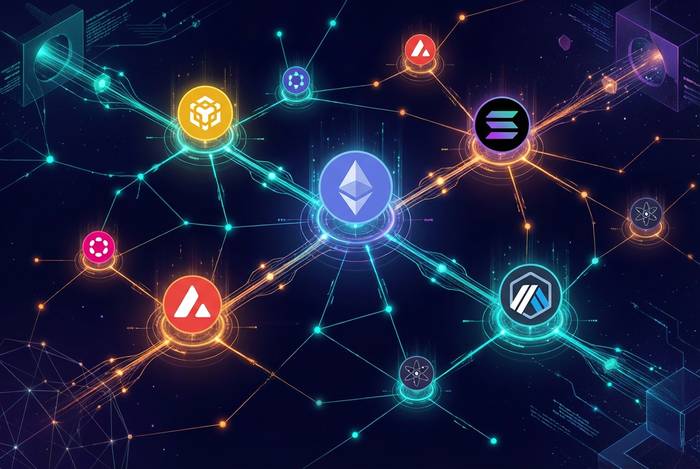
PancakeSwap was BNB Chain only for its first couple of years. That changed fast. Now it runs on more than 10 chains: Ethereum, Base, zkSync Era, Arbitrum, Polygon, and since July 2025, Solana too.
Going multichain makes strategic sense. Users get to access tokens across different networks, and the platform is not stuck depending on a single ecosystem. But honestly, it has also made things more confusing for regular users. Each blockchain has its own gas token, its own wallet quirks, its own fee levels. If you accidentally send tokens to the wrong chain, that money might be gone for good. The user experience still has room for improvement here.
Even with those rough edges, the multichain push has paid off. PancakeSwap now fights for DEX volume on Ethereum rollups and even non-EVM networks. Nobody would have predicted that four years ago.
The PancakeSwap community and governance model
Governance happens on-chain. If you hold vCAKE (that is CAKE you have locked up), you can vote on proposals. More locked tokens plus a longer lock period equals more voting weight.
This gives loyal token holders, not casual traders, a seat at the table. Proposals cover everything from fee adjustments to new farm listings. The anonymous team still steers day-to-day development, sure. But major protocol decisions go through the PancakeSwap community first.
And the community has actually influenced real outcomes. The migration from v3 to Infinity, the Solana expansion, changes to CAKE emission schedules: all of these had community input. Is it perfect decentralization? Probably not. The founding team still holds outsized influence. But for DeFi, this level of participation is above average.
Extra features: lottery, NFTs, IFOs, and prediction markets
PancakeSwap also packs in a bunch of features beyond basic trading. Some of them are genuinely useful. Others lean more toward entertainment.
Lottery. You buy tickets with CAKE and hope for a winning combination. Prize pools can get pretty big. It is gambling, plain and simple, and you should treat it that way.
Non-fungible tokens (NFTs). There is a built-in NFT marketplace for buying and selling collectibles. It is not going to dethrone OpenSea, but for the BNB Chain crowd, it works well enough.
Initial Farm Offerings (IFOs). New projects launch their tokens through PancakeSwap. You commit CAKE or LP tokens and get early access to new coins at a fixed price. Your iCAKE balance determines how much you can allocate.
Prediction markets. Bet on whether BNB or CAKE goes up or down in a short time window. These function like binary options and move fast. High risk, high reward type stuff.
All of this makes PancakeSwap feel like a DeFi playground rather than just a swap tool. The gamified approach clearly helps retention. But do not lose sight of the fact that lottery tickets and prediction bets involve real money and real losses.
Is PancakeSwap safe? Risks and limitations to consider
No DeFi platform is bulletproof, and PancakeSwap has its own set of issues worth knowing about.
Impermanent loss bites more people than any hack ever could. If you are providing liquidity and do not fully grasp how IL works, step back and learn before putting money in. Even in a rising market, volatile token pairs can eat into your returns.
Smart contract bugs. Multiple audits have been completed, yes. But audits catch known patterns, not everything. The Infinity Hooks system opens the door for third-party code that may not have been reviewed as thoroughly.
The anonymous team question. Nobody knows who built PancakeSwap. For some, that is a feature: censorship resistance and all that. For others, it is unsettling. In traditional finance, anonymity would be a dealbreaker.
Regulations are murky. There is no KYC on PancakeSwap. That makes it accessible, but also puts it on shaky ground with regulators worldwide. US users can access the platform, but the legal landscape around DeFi keeps shifting.
CAKE price decline. Farming rewards mean little if the token you earn keeps losing value. CAKE is down 96% from its all-time high. That does not mean it cannot recover, but it is a reminder to look at total returns rather than chasing flashy APR numbers.
PancakeSwap vs Uniswap: choosing the right DEX platform for your needs
This comparison comes up all the time. My honest take? There is no single winner. It depends entirely on what you need.
Uniswap is king on Ethereum and its L2 networks. Deeper liquidity for ERC-20 tokens, bigger developer ecosystem, more institutional attention. If Ethereum is your home base, Uniswap makes more sense.
PancakeSwap owns BNB Chain. Lower fees, faster confirmations, and way more features packed into one place: farming, lottery, predictions, NFTs. For BEP-20 token trading and DeFi-native users who want everything under one roof, PancakeSwap delivers.
Both platforms run concentrated liquidity now. Both are multichain. Both charge similar trading fees. In 2026, what really separates them is vibe and ecosystem focus. PancakeSwap leans into gamification. Uniswap keeps things minimal and clean. Pick whichever matches how you like to use DeFi.