Best UK Crypto Exchanges in 2026: Top Platforms Guide

The UK crypto crowd is smaller than it was a year ago, but the people who are still here are holding more. The FCA's latest consumer research shows about 8% of UK adults held crypto in 2025, down from 12% in 2024, while the average stake per holder climbed to roughly £1,800. Fewer tourists, more residents. That single shift tells you everything about why picking the best crypto exchanges in the UK matters in 2026: the people who stayed are serious, and they want a crypto platform that will still be here next tax year.
Picking the best crypto exchange in the UK in 2026 is not the same job it was in 2021. The Financial Conduct Authority has tightened the gate: only 51 firms have cleared the FCA crypto register out of 368 applications since 2020, according to CoinDesk. HMRC is paying closer attention too, issuing 65,000 nudge letters to suspected under-reporting crypto investors in the 2024/25 tax year, more than double the year before, according to data obtained by UHY Hacker Young. Against that backdrop, "which exchange is cheapest?" is the wrong first question. The right one is: which trading platform will let a UK resident buy Bitcoin with a Faster Payments transfer, keep their crypto assets safe, and hand them a clean tax export when HMRC asks.
This buyer's guide covers the top crypto exchanges that still serve UK residents in 2026, how trading fees and GBP deposits actually stack up on each trading platform, and the traps that get British buyers in trouble. No hype, no affiliate ranking games. Just what works, what it costs, and what to check before you send any money to any UK crypto exchange.
UK crypto exchange market heading into 2026
The UK is, quietly, one of the biggest crypto markets in the world. Chainalysis's 2025 Geography of Crypto Report puts the UK as Western Europe's largest centralised-exchange market, receiving $273.2 billion in crypto value between July 2024 and June 2025, up from $217 billion the previous period. That is a genuinely large flow of money, and it happens almost entirely through a handful of platforms that have managed to stay on the right side of UK regulators.
The regulatory framework tightened in two big steps. On 1 September 2023, the UK Travel Rule came into force, requiring exchanges to share sender and recipient data on crypto transfers, with enhanced data collection above the €1,000 threshold. On 8 October 2023, the FCA's Financial Promotions regime kicked in. Within the first quarter, the FCA issued 450 public alerts against illegal crypto promotions aimed at UK users, according to The Block. A week into the new regime, Binance halted onboarding of new UK customers on 16 October 2023 after its FCA-authorised promotions approver lost its permissions.
Two years later the dust has settled, and the 2026 picture for UK investors looks like this:
| Regulatory shift | Date in force | What it changed for UK users |
|---|---|---|
| FCA crypto register (AML gateway) | Since Jan 2020 | All crypto firms serving UK users need registration |
| UK Travel Rule | 1 Sep 2023 | Exchanges share identity data on crypto transfers |
| Financial Promotions regime | 8 Oct 2023 | Crypto ads need an FCA-authorised approver |
| CGT allowance cut to £3,000 | 6 Apr 2024 | More small sales are now taxable |
| CGT rates raised to 18% / 24% | 30 Oct 2024 | Higher tax bill on disposals above the allowance |
| Cryptoasset Reporting Framework (CARF) | Jan 2026 | Exchanges share customer data directly with HMRC |
Two things to read from that table. First, the compliance bar is now permanent. If a platform in the UK has not adjusted, it is either ignoring UK law or has already left. Second, your exchange is increasingly talking to HMRC on your behalf whether you ask it to or not, and any gains on crypto investments are subject to capital gains tax above the £3,000 allowance.

FCA rules every crypto exchange in the UK must meet
The FCA does not "license" crypto exchanges the way it licenses a bank. What it runs is an anti-money-laundering register for cryptoasset firms. To get on it, a firm has to show it can identify customers, trace funds, file suspicious activity reports and survive ongoing supervision. Out of 368 applications since 2020, only 51 had cleared the gate by April 2025, according to CoinDesk. Historically more than 85% of applicants were rejected or withdrew. The rate has improved: Humphreys Law, citing FCA figures, reports the approval rate rose to roughly 45% in the year to April 2025 and average processing time fell from 17 months to about 5 months. When BlackRock secured its own FCA crypto registration in April 2025, it was treated as a signal that serious institutional players were finally getting through.
What the register does not cover is just as important. FCA registration does not mean your crypto holdings are protected by the Financial Services Compensation Scheme. FSCS protection does not apply to crypto assets, full stop. It does not mean the FCA has blessed the tokens listed. It does not mean the platform is safe from hacks. It means the firm has passed a money-laundering test and signed up to ongoing supervision, a necessary condition, not a sufficient one.
Practical consequence: when you shortlist the best crypto exchange in the UK for your needs, the first filter is to open the FCA Financial Services Register and check that the exact legal entity you are depositing with is registered with the FCA under the "cryptoasset firm" schedule. If it is not, walk away. Exchanges are required to hold that registration to serve UK residents legally, and most of the pain stories in UK crypto start with buyers ignoring that check.
How to approach choosing the best crypto exchange
Choosing an exchange, or more precisely choosing the best crypto exchange for your actual habits, is really a five-variable trade-off. Nobody wins on all five. The trick is knowing which trade-offs you can live with, especially if your goal is to buy and sell crypto regularly rather than hold once and forget.
Regulation is the first variable, and it is non-negotiable in 2026. FCA register status, Travel Rule compliance and an authorised promotions approver have all become table stakes. If a platform ticks none of these, it is outside the scope of this guide.
GBP rails are the second variable, and they matter more than most buyers think. Faster Payments support, card deposits, withdrawal routes back to a UK bank account: if your money cannot leave the exchange cheaply, the headline trading fees are a distraction.
Fees are the third. The important ones are maker/taker spot fees, spreads on instant buy, card fees, conversion fees on GBP pairs and any inactivity fee. The best advertised fee often hides inside a 1-2% spread.
Assets and features are the fourth variable. How many coins, how deep the GBP pairs, whether staking is available, whether advanced order types and decent API access are free. Most UK buyers never need 400 coins. Fifty serious ones matter more.
Security and accountability are the fifth. Look at cold storage share, proof of reserves, independent audits, the insurance fund, history of incidents and how the firm responds when things go wrong. A platform that has been hacked and paid users back honestly is often a better bet than one with no track record at all.
The most common mistake UK beginners make is optimising for variable four and ignoring variable two. They pick the platform with the longest coin list, then discover they cannot get GBP in without a 3.99% card fee or out without a wire to a foreign bank. The second most common mistake is ignoring variable one. If you have ever caught yourself thinking "it is probably fine, everyone uses it", that is the moment to check the FCA register instead.
The best crypto exchange options for UK crypto buyers
Nine names show up again and again when UK crypto investors compare top crypto exchanges in 2026. This list of the 10 best picks, with one honourable mention, is built from the FCA register, current fee schedules and published feature sets. Every leading crypto platform listed is available to UK customers, supports GBP deposits through at least one rail, and is registered or passported for AML compliance in the UK as of early 2026. Many crypto services advertise in the UK, but only the ones on this table are genuinely available to UK buyers on the FCA-registered basis the law requires.
| Exchange | FCA status | Spot trading fees (entry tier) | GBP deposit options | Best for |
|---|---|---|---|---|
| Kraken | FCA-registered (Payward Ltd) | 0.16% maker / 0.26% taker | Faster Payments, SWIFT | Lowest fees, security record |
| Coinbase | FCA-registered (CB Payments Ltd) | 0.40% maker / 0.60% taker | Faster Payments, card, PayPal | Ease of use, pension-size holdings |
| Bitstamp | FCA-registered | 0.30% maker / 0.40% taker | Faster Payments, SEPA, SWIFT | Long track record, reliability |
| Gemini | FCA-registered | 0% maker / 0.40% taker | Faster Payments, card | Compliance-first buyers |
| Bitpanda | BaFin + FCA register | 1.49% spread on spot | SEPA, card, Apple Pay | Widest asset list (600+) |
| Crypto.com | FCA-registered | ~1% spread on app, 0.25% on Exchange | Faster Payments, card | All-in-one app, Visa card |
| Uphold | FCA-registered | 0.8%-1.2% spread | Faster Payments, card | Multi-asset trading (crypto, gold, stocks) |
| eToro | FCA-registered | ~1% spread (incl. conversion) | Debit/credit card, bank transfer | Social and copy trading |
| Revolut | E-money institution | 1.49% standard, 0% promo | In-app GBP | Casual buyers already inside Revolut |
Three things worth flagging about that table. Kraken and Bitstamp post the lowest transparent maker/taker fees of the group; they are the default picks for anyone placing orders larger than £1,000 at a time. Revolut is a convenience, not really a crypto platform: you cannot withdraw your coins off the app in any useful way. Bitpanda supports one of the longest lists of tokens, around 600, but the single-swap pricing hides a wider spread than a true order book gives you.
For UK readers specifically, the filter that matters most is GBP on Faster Payments. Everything outside that circle adds friction. Coinbase, Kraken, Bitstamp and Gemini all settle free GBP deposits by Faster Payments typically within minutes and charge £0 on the deposit itself, according to Koinly's coverage of Faster Payments for UK crypto. UK banks generally treat these rails as normal transfers once the exchange is registered with the FCA. Instant card deposits are a trap: Coinbase's instant-buy card route costs 3.99%, which alone is worse than any spot trading fee you will meet anywhere else. It is the easiest way to buy crypto fast and the most expensive way to buy and sell cryptocurrencies on repeat.
Cryptocurrency exchange fees, GBP deposits and limits
Fees are where most of the money you invest quietly leaks out. Read them like a contract, not a marketing page. A cryptocurrency exchange in the UK typically stacks fees in three layers: the fee to move GBP in, the fee to execute the trade, and the fee to move coins or GBP out. Exchanges charge a different mix in each layer, and a "zero trading fee" pitch that hides inside layer one or layer three is worse than a visible 0.25% taker fee.
Typical 2026 GBP deposit economics on the top UK-friendly platforms look like this:
| Funding method | Common fee | Speed | Notes |
|---|---|---|---|
| Faster Payments (bank transfer) | £0 | Minutes to hours | Default on Coinbase, Kraken, Bitstamp, Gemini |
| Debit/credit card instant buy | 1.5%-4% | Instant | Coinbase UK card fee is 3.99% |
| Apple Pay / Google Pay | 1.5%-3% | Instant | Usually routed as card |
| PayPal (where supported) | 2.5%-4% | Instant | Coinbase, a handful of others |
| SEPA (from EUR account) | €0-€1 | 1 business day | Good if you already hold EUR |
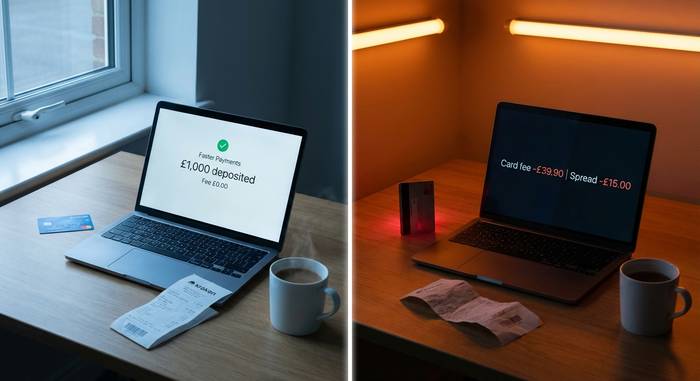
A realistic British buyer example: deposit £1,000 by Faster Payments to Kraken, trade GBP/BTC at the 0.26% taker fee, and withdraw the Bitcoin to self-custody. Total fees on the buy: £2.60. Do exactly the same trade on Coinbase's "Buy Now" card route and you are looking at roughly £39.90 for the card fee plus around £15 on the spread, more than twenty times the Kraken route. Same coin. Different door.
Spot-check this every time you move meaningful amounts. Low fees trap you if you never leave; withdrawal fees on the way out are where the hidden losses usually sit. Any exchange that quietly charges £10-£25 on a GBP wire out is gaming the table.
Best crypto exchanges for beginners in the UK
Exchanges for beginners need to do three boring things well: make the first deposit painless, make the first trade clear, and keep the first mistake from being expensive. Complexity is optional; clarity is not.
For a UK beginner who is opening their first crypto account in 2026, the list shrinks to a handful of strong picks among UK exchanges. Coinbase remains the fastest way to get from a British bank account to owning Bitcoin, Ethereum or any of 200-plus popular crypto tokens. The interface is genuinely simple, verification through UK ID and a selfie is usually done inside half an hour, and GBP deposits by Faster Payments are free. The catch is pricing: the default instant-buy route marks the trade up with a visible spread plus card fees. Any beginner who stays on Coinbase should immediately switch to the Advanced Trade interface. It has the same account, the same security, and fees that drop to around 0.40%/0.60% on GBP pairs, along with more advanced trading features for anyone who wants them later.
eToro is the pick for anyone who wants to learn by watching. The copy-trading feature lets you mirror a real portfolio one-for-one with a GBP ceiling of your choice, which is the least painful way to see how position sizing works without reading a book on it. The platform is FCA-registered and supports GBP deposits directly. Fees show up as a spread of roughly 1% on a typical crypto order, not a visible trading commission.
Crypto.com and Uphold round out the beginner picks. Crypto.com is built around a mobile app, Visa card rewards and simple one-tap buying. Uphold lets you hold crypto alongside precious metals and US stocks inside one account, which is useful if you are not sure you want to commit everything to digital assets yet. Both are FCA-registered, both support GBP deposits, and both are forgiving interfaces for someone whose main goal is not to trade actively but to own some crypto and understand what they own.
What a UK beginner should avoid: any platform that asks for a bank wire to a foreign country to deposit GBP, any instant buy charging over 2%, and any promotion that looks too good because it quietly locks your funds for 30 days.
Bitcoin, Coinbase and serious crypto trading in the UK
For active trading in the UK, not just buying Bitcoin once, the calculus changes. Spread does not matter on a single £100 purchase; on a dozen trades a month it eats alpha. Maker/taker fees matter. API quality matters. Order book depth matters.
Kraken Pro is the usual winner for experienced UK traders. The exchange has been running since 2011, has never suffered a publicly confirmed exchange-level breach, and publishes proof-of-reserves audits. GBP pairs are deep. Advanced order types are free. Stablecoin routes exist if you want to park between trades. For anyone moving more than £5,000 a month through crypto, the gap between Kraken Pro at 0.16%/0.26% and a 1% spread-based app is the difference between a hobby and an actual strategy. This exchange since its launch has built a reputation for treating advanced trading features as a default rather than a paid upgrade.
Coinbase Advanced Trade is the second venue UK power users gravitate toward. Published fees run around 0.40%/0.60% on the entry tier and fall with volume. It sits inside the same account you use for long-term holdings, which makes tax export at the end of the UK tax year less painful. The same platform you use to dip a toe when learning scales up into something approaching a professional terminal when you need it.
Bitstamp deserves a specific mention here. It was the first European exchange to win its UK registration under the current regime, runs GBP/USD/EUR pairs with low entry-tier fees of roughly 0.30%/0.40%, and survived a 2015 hot-wallet hack by reimbursing users and rebuilding. That history matters. Trading in the UK is less about picking the cheapest venue this quarter and more about picking one that will still be around for the next four tax years. A clean regulatory file and a real incident response in the past both belong on the decision table.
Two practical rules for serious UK trading. Never trade your savings on any crypto platform that cannot give you a clean, HMRC-ready transaction history. And never chase an exotic alt on an unregulated venue you would not trust with your last £500. The saving on the fee will not cover the legal headache later.
Crypto app picks and how to trade crypto on mobile
Most UK crypto trading in 2026 happens on phones, not desktops. That is partly why fees on a crypto app usually look higher than on the web version of the same exchange: mobile users tolerate worse pricing because they never stop to check. Coinbase, Kraken, Crypto.com and Revolut all push their friendliest mobile surfaces at new users and gently route them toward the higher-margin buttons.
A few things are worth knowing if you want to trade crypto from your phone without leaking money. One, almost every major exchange has both a simple "Buy" surface and a pro-trading surface inside the same app. Coinbase has Advanced Trade, Kraken has Kraken Pro, Crypto.com has the Exchange view. The fee difference between the two is often 0.5 percentage points or more. Two, saved payment cards inside an app are convenient but expensive, the 3.99% card fee does not vanish just because you tapped a saved tile. Three, biometric login is not a substitute for two-factor authentication. Use an authenticator app, not SMS, for any UK crypto account holding more than a few hundred pounds.
There are a lot of UK-compatible crypto apps in the store. The ones to actually trust in 2026 are the apps published by UK exchanges that are registered with the FCA, not the shiny new ones promoted on TikTok. Many exchanges that look plausible in the app store do not actually offer crypto services to UK residents legally, they are available to UK users in theory but not regulated by the FCA in practice. If you cannot find the legal entity behind the app on the FCA register, your money should not go into it.
Risks of unregulated crypto platform use and scams
If one number should change how you think about UK crypto this year, it is this: £649 million was lost to investment fraud in the UK in 2024, and crypto was involved in 66% of reported cases, according to City of London Police. That is a 16% year-on-year rise in the crypto share. The mean victim was not an obvious mark, it was someone who saw an ad that looked legitimate, clicked through, and handed money to a regulated-looking interface that was not regulated at all.
Two patterns dominate. The first is the fake exchange. A slick frontend shows a balance that grows every week, withdrawal is always available "after one more deposit for verification," and the whole thing disappears around day 45. The second is the clone. A real crypto exchange's branding is copied onto a near-identical domain, and customer support actually replies, helpfully, until you try to take your money out. Neither survives a five-minute check against the UK financial register at the FCA.
The FCA's Financial Promotions regime was built to reduce exactly this. Since October 2023 every crypto firm advertising to UK residents has needed an FCA-authorised approver for its promotions. A regulated platform will say so in its small print and will typically name the approving firm. An unregulated one will not. Crypto.com, Kraken, Coinbase and the other names above all clear this bar; so do many of the smaller FCA-registered firms that rarely make headline lists.
A short defensive checklist that works: search the firm name on the FCA register before depositing, never act on a cold call about a crypto opportunity, turn on withdrawal whitelisting so your coins can only leave to addresses you control, and keep long-term holdings in self-custody once they exceed the value of your exchange account's insurance. The answer to "is my crypto exchange safe" is almost always in what you do, not what they say.