SushiSwap: How to Use the DEX, SUSHI Token Data, and Why It Still Exists After the Chef Nomi Drama
SushiSwap shouldn't exist. The story of how it survived is one of the wilder things I've seen in DeFi.
August 2020. A pseudonymous developer calling himself "Chef Nomi" copy-pastes Uniswap's entire open-source codebase, adds a governance token (SUSHI), and launches what the community immediately labeled a "vampire attack." The pitch: deposit your Uniswap LP tokens into SushiSwap, earn SUSHI rewards on top of your existing fees, and when migration happens, your liquidity moves from Uniswap to Sushi. Over $1 billion in LP tokens moved within days. Uniswap was bleeding liquidity to its own fork.
Then Chef Nomi dumped. Sold $14 million in SUSHI from the developer fund. Token crashed. Community went nuclear. Every crypto media outlet ran the rug pull story. Project looked dead.
What happened next is the part that surprises people. Sam Bankman-Fried (this was pre-FTX collapse, when SBF was still the industry's golden boy) took control of the multisig keys, organized a community vote for a proper liquidity migration, and stabilized the protocol. Chef Nomi returned the $14 million weeks later with an apology. And SushiSwap kept running. Four years later the protocol runs on 30+ chains, processes hundreds of millions in trading volume, and has a product suite that includes lending, cross-chain swaps, and a yield farming incentive program that keeps attracting new token projects. The zombie that refused to die.
I've used SushiSwap on and off since 2021, mostly on Arbitrum where the gas is cheap. It's not the biggest DEX anymore and it probably never will be again. But it does several things well enough that it keeps showing up in my DeFi rotation, and the data tells an interesting story about what happens to a protocol that starts as a meme and has to earn legitimacy the hard way.
How SushiSwap works: the AMM model
If you've used Uniswap, you already know how SushiSwap works. Same AMM model. Same x * y = k formula. Same basic experience: connect wallet, pick tokens, swap. The code is literally forked from the same codebase.
You want ETH for USDC. Connect MetaMask (or Trust Wallet, or whatever). Pick the pair. Enter the amount. The swap runs against a liquidity pool, a smart contract holding both tokens, and the price is set by the ratio between them. Deep pool means low slippage. Thin pool means you're paying for it. I swap on SushiSwap mostly on Arbitrum because the gas is a few cents and the liquidity on the pairs I care about is usually deep enough.
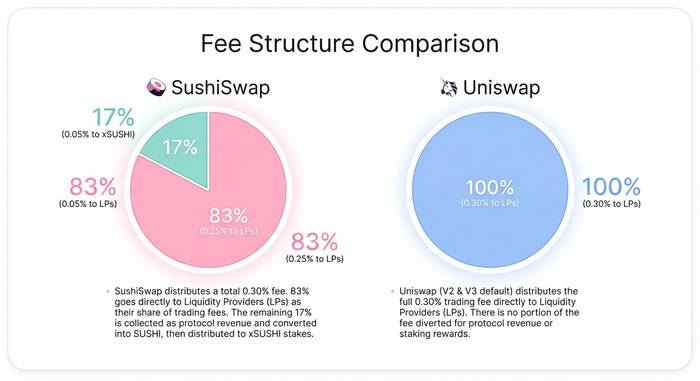
The fee structure is where SushiSwap made its first meaningful differentiation. Both platforms charge 0.3% per swap. But Uniswap sends the entire 0.3% to liquidity providers. SushiSwap splits it: 0.25% goes to LPs and 0.05% goes to SUSHI token stakers through a mechanism called the SushiBar. Stake your SUSHI, receive xSUSHI, and earn a cut of every trade on the platform. That 0.05% fee redirect was the original reason SushiSwap attracted users. It gave token holders a direct claim on protocol revenue, something Uniswap didn't offer until much later with its own fee switch.
How to use SushiSwap: practical walkthrough
Getting started takes about two minutes if you already have a wallet and some crypto.
Step 1: Connect your wallet. Go to sushi.com. Click "Connect Wallet" in the top right. SushiSwap supports MetaMask, WalletConnect, Coinbase Wallet, and most major options. Pick your network: Ethereum, Arbitrum, Polygon, Avalanche, BSC, Fantom, or any of the 30+ supported chains.
Step 2: Swap tokens. Click "Swap" in the navigation. Select the token you're selling (top field) and the token you're buying (bottom field). Enter the amount. The interface shows you the exchange rate, price impact, minimum received after slippage, and the LP fee. If everything looks right, click "Swap" and confirm the transaction in your wallet.
After that you can go deeper. The "Pool" section is where you deposit token pairs to earn fees. I have a small ETH/USDC position on Arbitrum that earns a cut of the 0.25% every time someone trades that pair. Nothing life-changing in dollar terms but the APR beats my savings account by a long shot.
SushiBar is where xSUSHI staking happens. Deposit SUSHI, get xSUSHI back. The ratio between xSUSHI and SUSHI slowly increases as fees accumulate. When you unstake later you get back more SUSHI than you put in. I tried this for three months. The yield was modest but real and it compounds automatically.
SushiXSwap handles cross-chain swaps. Moving USDC from Ethereum to Arbitrum without opening a separate bridge app. I've used it a dozen times and it works, though the routing fees vary enough that I always compare with Across or Stargate before committing.
SushiSwap by the numbers: TVL, volume, and market position
Let me be honest about where SushiSwap stands in 2026. It's not where it was in 2021.
During DeFi Summer and the 2021 bull run, SushiSwap's TVL peaked above $5 billion. It was a top-3 DEX by volume. SUSHI traded above $20. The protocol felt like a legitimate Uniswap competitor that might eventually surpass it.
That didn't happen. Uniswap launched v3 with concentrated liquidity in May 2021, which was a technical leap SushiSwap couldn't match immediately. New competitors appeared: Curve dominated stablecoins, PancakeSwap took BSC, Trader Joe captured Avalanche. SushiSwap's TVL dropped to under $500 million by late 2022, and SUSHI fell below $1.
As of early 2026, SushiSwap's position looks like this:
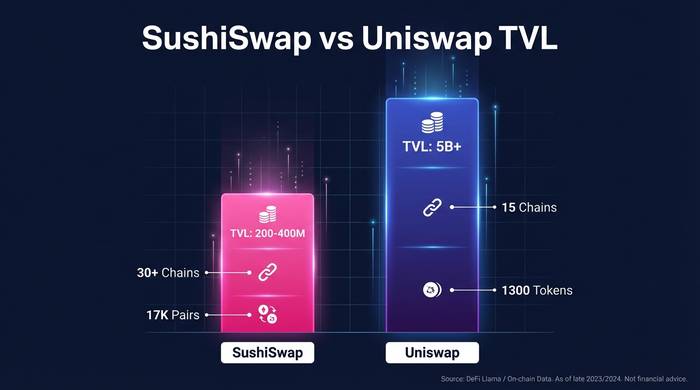
| Metric | SushiSwap | Uniswap (for comparison) |
|---|---|---|
| TVL | ~$200-400M (varies by chain) | ~$5B+ |
| Supported chains | 30+ | ~15 |
| Token pairs available | 17,000+ | 1,300+ unique tokens |
| Swap fee | 0.3% (0.25% LP + 0.05% xSUSHI) | 0.3% (variable by pool) |
| SUSHI price | ~$0.50-1.00 | UNI ~$5-8 |
| SUSHI market cap | ~$130-260M | UNI ~$3-5B |
The numbers tell a clear story: SushiSwap is a fraction of Uniswap's size. But it's still alive, still processing trades, and still generating fees for liquidity providers. On smaller chains and L2s where Uniswap's presence is lighter, SushiSwap sometimes has better liquidity for specific pairs. The 30+ chain deployment is wider than any other major DEX, which matters for users who trade on niche chains.
The SUSHI token: tokenomics, staking, and honest assessment
SUSHI is an ERC-20 governance and revenue-sharing token with a maximum supply of 250 million. About 10% of block-generated tokens go to a development fund. The rest distributes to liquidity providers and stakers.
The revenue sharing mechanism through xSUSHI is the token's strongest feature. When you stake SUSHI, you earn a portion of the 0.05% fee from every swap on every chain SushiSwap runs on. That's passive income tied to protocol usage. When volume is high, xSUSHI holders do well. When volume drops, so does the yield.
The honest assessment: SUSHI has been a poor investment for most holders. The token peaked at $23 in March 2021 and has spent most of the time since below $2. Dilution from ongoing emissions, reduced TVL, and competition from Uniswap and newer DEXs have kept sustained price pressure on the token. The xSUSHI yield helps offset this for stakers but hasn't been enough to counter the price decline for holders who bought above $5.
For governance, SUSHI holders vote on proposals through the SushiSwap DAO. Proposals cover everything from fee adjustments to new chain deployments to treasury spending. Participation is moderate, similar to most DeFi governance, meaning a relatively small group of active token holders makes most of the decisions.
SushiSwap's product suite: beyond basic swaps
SushiSwap has expanded well beyond token swapping. Some of these products work well. Others are experimental.
SushiXSwap is the cross-chain swap aggregator. It routes trades across multiple chains and bridges, abstracting the complexity of moving tokens between networks. In my experience it works smoothly for common routes (Ethereum to Arbitrum, Polygon to Ethereum) but can be slow or expensive for exotic chains. Still better than manually bridging and swapping separately.
Kashi is the lending and borrowing platform built on BentoBox. Kashi uses isolated lending markets, meaning a problem in one market doesn't cascade into others. Each lending pair has its own risk profile. This is more conservative than protocols like Aave where everything shares a single risk pool, but it also means less capital efficiency.
BentoBox is a vault that underpins Kashi and other SushiSwap products. Tokens deposited in BentoBox can be used across multiple applications simultaneously. Your USDC can serve as lending collateral in Kashi while also flash-loanable by developers, generating additional yield. The concept is clever but real-world usage hasn't matched the pitch. Most DeFi users still deposit tokens directly into individual protocols rather than routing through BentoBox. Good idea, limited traction, at least so far.
Onsen is SushiSwap's incentive program for new token pairs. Projects that want liquidity for their token can apply to Onsen, and if approved, LPs who provide liquidity for that pair receive bonus SUSHI rewards on top of normal trading fees. It's a bootstrapping tool that gives SushiSwap access to newer tokens before they appear on Uniswap.
SushiSwap vs Uniswap: the comparison that defines SushiSwap's position
People ask me this every week. Here's the honest version.
Uniswap is bigger. 10-20x more TVL. 1,300+ tokens vs SushiSwap's 300+. Better brand. Uniswap Labs raised $165 million and has actual engagement with the SEC. The v4 hook system is technical innovation that SushiSwap hasn't matched. If you're doing a $50,000 ETH/USDC swap on Ethereum mainnet, you'd be crazy not to use Uniswap because the depth is deeper and the slippage is lower.
SushiSwap is wider. 30+ chains vs about 15 for Uniswap. The fee sharing through xSUSHI gives token holders a direct cut of revenue, which Uniswap only started doing in late 2025 with their fee switch. Onsen bootstraps liquidity for newer tokens that haven't made it to Uniswap yet. Kashi's isolated lending markets are architecturally safer than single-pool designs.
What I actually do: Uniswap for big trades on major pairs. SushiSwap on Arbitrum and Polygon for smaller swaps where both have comparable liquidity. Check both on a DEX aggregator like 1inch before every trade. Loyalty to a specific DEX is leaving money on the table. Use the one that quotes you the better price right now, today, for the specific trade you're about to make.
Risks of using SushiSwap
SushiSwap carries the standard DeFi risks plus some specific ones.
Smart contract risk exists on every DEX but SushiSwap's multi-chain deployment means more code surface area to audit. A bug on one chain could affect funds there even if the Ethereum deployment is fine. The protocol has been audited but audits are not guarantees.
Impermanent loss hits LPs the same way it does on any AMM. Providing liquidity in a volatile pair means you could end up with less value than just holding the tokens. This is not a SushiSwap-specific problem but new LPs sometimes don't realize it.
SUSHI token exposure through xSUSHI staking means your fee income is denominated in a token that has lost 95%+ from the all-time high. The staking yield is real but if SUSHI continues declining, the fee income may not compensate for capital loss. I've watched people stake SUSHI at $5 and earn 8% in fees while the token dropped 80%. The math doesn't work out well in that scenario.
Governance centralization is the quiet risk nobody talks about. The multisig holders control upgrades and treasury spending. Yes, there's a DAO. Yes, there are votes. But in practice a small group of active participants makes most decisions. This is true across almost all DeFi governance, not just SushiSwap, but it's worth being honest about rather than pretending the protocol is purely community-run.