What is a DeFi degen: the psychology, the losses, and why millions keep aping in anyway

In November 2024, the total memecoin market cap hit $150 billion. Five months later, it had cratered to $53 billion. Somewhere in between, a 23-year-old on Crypto Twitter posted a screenshot showing he'd turned $2,000 into $340,000 on a dog-themed token in three days. Replies split about 50/50 between people calling him a legend and people asking "wen rug?" Seven days later the token had given back 97% and the guy's account was gone. Deleted, probably, though some people in the replies said he just went private because the death threats started.
That's degen culture in one paragraph: eye-watering gains for the few, catastrophic losses for the many, and a community that celebrates both with equal enthusiasm. The word "degen," short for degenerate, started as an insult. Now it's a badge of honor in crypto circles, claimed proudly by traders who know the odds are against them and show up anyway.
But behind the memes and the bravado, there's an actual behavioral pattern worth understanding. Degen trading isn't just reckless gambling dressed up in blockchain jargon. It's a specific set of strategies, psychological traps, and community dynamics that produce consistent outcomes: a handful of people get rich, and the majority lose money. This article pulls apart how degen culture works, who participates, what the numbers actually say about outcomes, and whether there's a way to engage with DeFi without lighting your portfolio on fire.
What "degen" actually means in decentralized finance
The word comes from "degenerate gambler," borrowed from poker culture where it describes someone who bets recklessly despite knowing the odds. In crypto and specifically in decentralized finance, a degen is a person who throws money into unaudited smart contracts, brand-new tokens with no track record, and yield farming pools offering absurd returns, fully aware that most of these will fail or turn out to be scams.
Here's what separates a degen from a regular crypto investor: a regular investor might buy bitcoin or ethereum on Coinbase and hold. A degen, on the other hand, is the person scrolling Dexscreener at 2 AM, finding a token called FLOKI2000INU that launched 14 minutes ago on Raydium, and throwing $500 at it because the chart is going parabolic and the Telegram group has 4,000 members already even though the contract isn't verified, there's no audit, the team is anonymous, and the liquidity pool is advertising 8,000% APY that will last approximately until the creator presses the drain button. They know it might be a scam. The bet isn't "this is a good project." The bet is "I can get in and out before the creators pull the liquidity." Sometimes that bet works. More often it doesn't. But the dopamine hit from the times it does work keeps them coming back for the fifty times it doesn't.
What makes this whole ecosystem possible is that decentralized finance runs on open, permissionless smart contracts. Nobody needs a license to launch a token on Uniswap or Raydium. Nobody from the SEC or any other regulator reviews the smart contract before it goes live. Nobody at an exchange approves the listing because there's no exchange involved, just a liquidity pool anyone can create. That openness is what made DeFi revolutionary and what makes it a hunting ground for scammers in equal measure. Degens are the people who walk willingly into that gray zone because the upside of catching the next 100x outweighs their fear of losing another $300.
Some terminology that comes up constantly in degen circles:
| Term | What it means |
|---|---|
| Aping in | Buying a token immediately without research, driven by FOMO |
| Rugged | Lost money because a project's developers drained the liquidity |
| Farming | Providing liquidity to a DeFi protocol in exchange for yield |
| APY/APR | Annual yield percentage, often absurdly high in new protocols |
| Degen play | A high-risk trade that everyone acknowledges might go to zero |
| NGMI | "Not gonna make it" — used for bad trades or paper hands |
| Touch grass | Ironic advice to take a break from charts and go outside |
The psychology of why degens trade the way they do
I spent three months lurking in degen Telegram groups and Discord servers back in 2024, just watching how people talk, what they post, and how they react when a trade goes wrong. What caught me off guard wasn't the stupidity or the recklessness. It was the self-awareness. These people aren't clueless. A guy who just aped $800 into a token called BUTTCOIN knows exactly what he's doing. He'll tell you the odds are against him. He'll tell you he lost money last week on something equally dumb. And then he'll do it again, because the psychological machinery driving the behavior is remarkably powerful and not easy to override even when you can name it.
Survivorship bias on steroids. Crypto social media is a highlight reel. The guy who turned $500 into $50,000 posts his gains. The 500 people who lost everything on the same token don't post anything. When your feed is a constant stream of screenshots showing 100x returns, your brain starts to believe that's the normal outcome. It's not. But the signal-to-noise ratio on platforms like X and Telegram is so skewed toward winners that your risk perception gets warped.
The lottery ticket math. Put $200 into a memecoin. If it dies, you're out $200. If it catches fire and does a 100x, you're sitting on $20,000 from a dinner-tab-sized bet. On its face, this isn't even irrational; asymmetric bets with defined downside and unlimited upside are how venture capital works too. Where the rationality breaks down is that degens don't make one careful bet per quarter like a VC fund. They make fifty in a month, each one on a token where the base rate of going to zero is something like 95%. Fifty lottery tickets at $200 each costs $10,000. One of them might 100x. But the expected value of the whole basket is still deeply, mathematically negative.
The tribe effect. This is the part that outsiders miss entirely. Degen culture isn't just about money, and for a lot of participants it's barely about money at all. It's a social identity with its own language ("ape," "NGMI," "touch grass"), its own rituals (posting screenshots of gains, roasting each other's blown accounts), and its own hierarchy (early wallets > late buyers, diamond hands > paper hands). Walking away from trading means walking away from a community where you have status and belonging. Admitting you've been losing means admitting it publicly in a group that valorizes winning. The social pressure to keep going, keep posting, keep aping into the next thing is intense in a way that nobody who hasn't sat in these Discords at 2 AM would understand.
The slot machine that never closes. Behavioral psychologists have known for decades that variable reward schedules, where the payoff is unpredictable but occasionally huge, are the most addictive reinforcement pattern humans can encounter. Crypto markets run 24 hours a day, 365 days a year, and a memecoin genuinely can 10x while you're sleeping. That's a variable reward schedule running at global scale with real money attached. Every time you refresh Dexscreener and see a green candle on something you almost bought, the regret circuits fire and push you toward pulling the trigger next time. It's not a metaphor when people compare this to a casino. It's the same neuroscience, just running on a phone instead of behind neon lights in Las Vegas.
The "house money" effect. After a big win, degens tend to treat their gains as free money and take even bigger risks. If you 5x'd on one token, losing it all on the next feels like breaking even, not losing, even though the money was real the moment it was in your wallet.
Degen strategies: yield farming, aping, and leverage
Degen behavior in DeFi manifests through several concrete strategies. Understanding them helps explain both the appeal and the danger.
Yield farming and liquidity pools
This is where DeFi degen culture was born. In 2020's "DeFi Summer," protocols like Compound and Yearn Finance started offering yields for providing liquidity to decentralized exchanges and lending platforms. Early participants earned extraordinary returns because the tokens they received as rewards were appreciating in value alongside the yields themselves.
Degen yield farming takes this to the extreme. A new protocol launches, offers 5,000% APY on its liquidity pool, and degens pile in. The APY is real for about 72 hours, then the token the APY is paid in crashes to zero, the developers drain the pool, or so many people join that the yield dilutes to nothing. The ones who got in first and got out fast made money. Everyone else provided exit liquidity for the early birds.
The math of yield farming risk is brutal. According to various DeFi analytics estimates, a significant majority of new yield farm tokens lose 90%+ of their value within the first month. The triple-digit APYs look incredible until you realize they're denominated in a token that's collapsing. Earning 5,000% APY in a token that drops 99% means you still lost 95% of your capital.
Aping into memecoins
The purest form of degen behavior. A new token launches on Pump.fun (Solana) or via a stealth launch on Ethereum. Within minutes, degens are buying based on nothing more than the token name, the Telegram activity, and whether a known degen influencer mentioned it. No whitepaper. No audit. No product. Just vibes and a chart that's going up.
Pump.fun, the Solana memecoin launchpad, generated over $500 million in revenue by mid-2025. It creates roughly 80% of all new tokens deployed on Solana on any given day. The vast majority of these tokens go to zero within hours or days. But the few that catch a narrative wave and get listed on centralized exchanges produce the 100x screenshots that keep the cycle going.
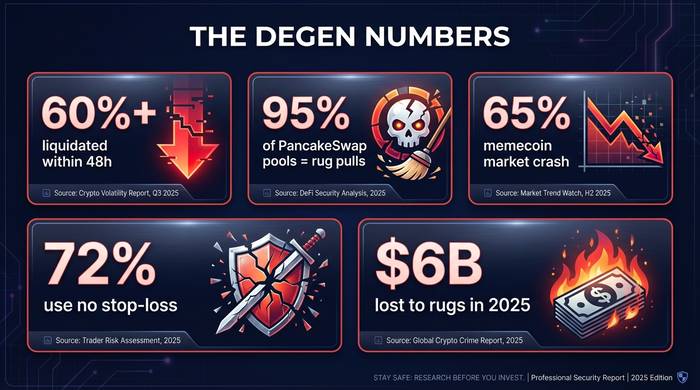
The memecoin market peaked at $150.6 billion in total market cap in December 2024. By mid-2025, it had fallen to about $53 billion, a 65% drawdown. Pump.fun's own graduated token trading volume collapsed from $46.4 billion in January 2025 to $5.1 billion by November. The retail degen crowd that powered the boom moved on or went broke.
Leveraged trading
The most dangerous degen activity. Platforms like dYdX, GMX, and Hyperliquid allow traders to open positions with 10x, 50x, or even 100x leverage. That means a 1% price move against you at 100x wipes out your entire position.
A 2023 Kaiko Research report found that over 60% of traders using 20x or more leverage were liquidated within 48 hours. Let that sink in. More than half the people making highly leveraged bets lost everything within two days.
The most famous degen leverage story of 2025 was James Wynn, a trader who became a crypto Twitter celebrity for his massive Bitcoin long positions. One of his trades swung from an $82 million unrealized profit to a final loss of $13.2 million. He kept trading. The community loved it. The cycle continued.
The numbers: how much money degens actually lose
Hard data on overall degen losses is scarce because most of it happens on-chain in thousands of small transactions. But the available statistics paint a consistent picture.
| Metric | Data | Source |
|---|---|---|
| Leveraged traders liquidated (>20x) within 48 hours | 60%+ | Kaiko Research, 2023 |
| Retail traders using >10x leverage without stop-losses | 72% | RiseIn / industry surveys |
| Memecoin market cap: peak to trough (Dec 2024 → mid-2025) | $150B → $53B (-65%) | CoinGecko |
| Pump.fun token volume collapse (Jan → Nov 2025) | $46.4B → $5.1B (-89%) | CoinGecko / DLNews |
| DEGEN token decline from ATH | -96% | CoinGecko |
| Rug pull losses in 2025 | ~$6 billion | DappRadar |
| Percentage of PancakeSwap pools that are rug pulls | ~95% | Chainalysis |
Every row in that table points in the same direction. The house wins. The people who make money in degen markets are the ones who arrive first, have better information (or better bots), and sell without hesitation while the Telegram chat is still celebrating new highs. Everyone else provides exit liquidity, which is a polite DeFi way of saying they're the bag holders whose money went into someone else's wallet. In a non-polite way: if you can't identify who the sucker at the table is, you're the sucker.

Is there a responsible way to degen?
I wrestled with whether to include this section because it risks sounding like "here's how to gamble responsibly at the casino." But the reality is that people are going to degen regardless of what any article says, so practical risk management is better than pretending the behavior doesn't exist.
Size your bets as if they're going to zero. Because most of them will. The 2% rule from traditional trading applies doubly here: never put more than 2% of your portfolio into any single degen play. If you have $10,000 in crypto, that's $200 per bet. If it goes to zero, you've lost 2%. If it 50x's, you've gained $10,000. That's the math that makes asymmetric bets survivable.
Take profits aggressively. The number one reason degens lose is that they ride winners all the way back down. If a token 5x's, take out your initial investment. Now you're playing with house money for real, and the worst case is breaking even. The degen instinct says "but what if it 10x's from here?" Most of the time, it doesn't.
Do the minimum due diligence. Even 60 seconds of checking can save you. Run the contract through Token Sniffer. Check if liquidity is locked. Look at the holder distribution. If the top wallet holds 40% of supply, that's a sell button waiting to be pressed. You don't need a PhD in smart contract security; you just need to not skip the basics that separate a real token from a honeypot.
Set hard limits on time and money. Treat degen trading like a gambling budget. Decide before you start: "I'm putting $500 into memecoins this month, and when it's gone, it's gone." The biggest losses come from chasing: losing $200, then throwing in $500 to "make it back," then $1,000. The chase is where portfolios go to die.
Recognize when it stops being fun. I know people who started degen trading as a $500 side hobby and ended up checking charts at 3 AM every night, snapping at their partners, losing sleep over a $200 memecoin position. If your mood rises and falls with your degen portfolio, if you're borrowing money or skipping rent to ape into the next token, if you feel physically anxious when you're away from the charts, you've crossed from entertainment into a problem and you should take it seriously. Crypto addiction is real, documented, and growing alongside the market. Organizations like Gambling Therapy (gamblingtherapy.org) offer free, confidential support.
One more piece of context that I think matters here: the whole degen ecosystem is designed to keep you playing. The 24/7 markets, the Telegram alpha calls at midnight, the screenshots of winners that make you feel like you're missing out, the community that celebrates "diamond hands" and mocks anyone who sells. It's an environment engineered, whether intentionally or not, to override the rational part of your brain that says "this is enough for today." Understanding that design doesn't make you immune to it, but it does give you a slightly better chance of stepping back before the damage gets too real.