Is Bitcoin Halal or Haram in 2026? Islamic Finance Guide
No single fatwa answers "is Bitcoin halal" for every Muslim. Some of the most respected scholars alive have ruled opposite each other on this question. Mufti Taqi Usmani is the loudest Hanafi voice today. He calls Bitcoin an "imaginary number" and treats it as haram. Mufti Muhammad Abu-Bakar at Blossom Finance reached the opposite call in 2018. He deemed Bitcoin permissible as a medium of exchange. Malaysia's Shariah Advisory Council, the Fiqh Council of North America, and the Sharia Review Bureau in Bahrain have all issued halal rulings. Egypt's Grand Mufti Shawky Allam, Turkey's Diyanet, and Indonesia's MUI moved the other way.
That spread is not a dodge. It is the real answer to whether Bitcoin meets the criteria for permissibility of Bitcoin in Islamic law. Islamic finance is a living legal tradition. It does not deliver one verdict for every new instrument. What you can get is a framework. Three core bans: riba, gharar, maysir. One threshold question: does Bitcoin qualify as mal (wealth)? Plus a set of conditions that turn a halal investment into a forbidden one. This guide walks through the framework. Where the leading fatwa bodies stand in 2026. Which activities most scholars call haram. How a Muslim investor can buy and hold Bitcoin without crossing clear shariah lines.
The question is not academic. The Global Islamic Fintech Report 2025/26, from DinarStandard and Elipses, puts the Islamic fintech market at USD 198 billion in 2024/25. On track for USD 341 billion by 2029 at an 11.5% CAGR. More than 1.9 billion Muslims live in jurisdictions where Islamic finance principles shape economic behavior. Chainalysis's 2024 Global Adoption Index ranks Indonesia third in crypto adoption, Pakistan ninth, Turkey eleventh. All three are Muslim-majority countries. The UAE tops the global ownership table at roughly 25.3% per Triple-A 2024. The stakes are real. They are also growing fast.
Is Bitcoin halal? Short answer and scholar split
The short answer: there is no universal ruling, and the most honest response is "it depends on how you use it and which scholar you follow." The question "is Bitcoin halal or haram" has received at least three distinct verdicts from respected authorities, and all of them are still valid within their own schools of thought.
A working summary of the major positions:
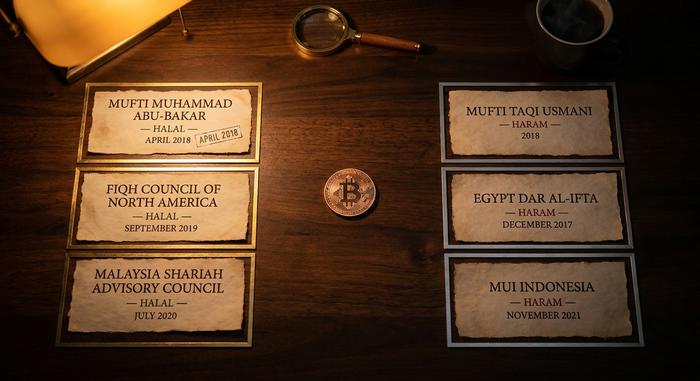
| Authority / scholar | Position | Year / source |
|---|---|---|
| Mufti Muhammad Abu-Bakar (Blossom Finance) | Bitcoin halal as Islamic money except where banned locally | April 2018 whitepaper |
| Mufti Faraz Adam (Amanah Advisors, Darul Fiqh) | Bitcoin meets the criteria for currency; zakat obligatory | August 2021 |
| Malaysia Shariah Advisory Council | Digital assets recognized as property (mal); trading permitted | July 2020 |
| Fiqh Council of North America | Bitcoin permissible, treated as fiat for Shariah purposes | September 2019 |
| Sharia Review Bureau (Bahrain) | Bitcoin investment permissible; CoinMENA certified Shariah-compliant | 2018 / January 2021 |
| Muhammadiyah (Majelis Tarjih) | Crypto mubah as digital asset; haram as payment; margin/futures haram | March 4, 2026 |
| Mufti Taqi Usmani | Cryptocurrency not permissible, "imaginary number" | 2018 speech, position unchanged 2026 |
| Egypt Dar al-Ifta (Grand Mufti Shawky Allam) | Haram, speculative and akin to gambling | December 2017 |
| Turkey Diyanet (Presidency of Religious Affairs) | Bitcoin not compatible with Islam at this time | November 24, 2017 |
| Saudi Standing Committee | Virtual currencies illegal in the Kingdom | 2018 |
| Syrian Islamic Council | Crypto haram pending centralized oversight | November 2019 |
| Indonesia MUI (7th Ijtima Ulama) | Crypto-as-currency haram; crypto-as-commodity haram unless meets sil'ah conditions | November 11, 2021 |
| LBM Nahdlatul Ulama (East Java) | Crypto haram due to speculation and fraud risk | October 24, 2021 |
| Sheikh Assim al-Hakeem | Haram, lacks hand-to-hand exchange | 2018 |
Two things stand out. First, the halal-leaning scholars generally treat Bitcoin as a currency or asset that people willingly exchange; the haram-leaning scholars generally treat it as non-mal, speculative, or akin to gambling. Second, almost every scholar agrees that short-term speculative trading, leveraged futures, and overtly fraudulent crypto projects are haram regardless of how you classify Bitcoin itself.
Bitcoin, cryptocurrency, and blockchain basics
Before judging whether a thing is halal, Islamic legal reasoning asks what the thing actually is. Scholars argue that Bitcoin is a peer-to-peer digital currency running on a decentralized public ledger called a blockchain. Cryptocurrency is a digital representation of value. Digital currencies like Bitcoin and Ethereum are the best-known instances in the wider cryptocurrency market. No central authority. New coins come from mining. Transactions get validated by nodes running the protocol. Supply capped at 21 million. Ethereum and other cryptocurrencies extend that model with smart contracts and tokens that represent assets, governance rights, or access to on-chain services.
Blockchain technology by itself is religiously neutral. Its transparency and immutability often get cited as aligning with Islamic principles of fairness and disclosure. What matters for the halal status question is how people use the technology. A Bitcoin held as a long-term store of value is a different question from a memecoin bought on 100x leverage, even though both live on a blockchain. Many Islamic scholars argue the contract and intent matter more than the underlying rails.
Understanding that distinction is the first honest step in any Islamic perspective on crypto. Bitcoin is not one product. Bitcoin and cryptocurrency together cover a spectrum from utility tokens to outright gambling instruments. The shariah analysis has to follow the object, not the label. The question of whether cryptocurrency transactions are permissible in Islam depends heavily on the underlying mechanics of each specific transaction.
Islamic finance principles: riba, gharar, maysir
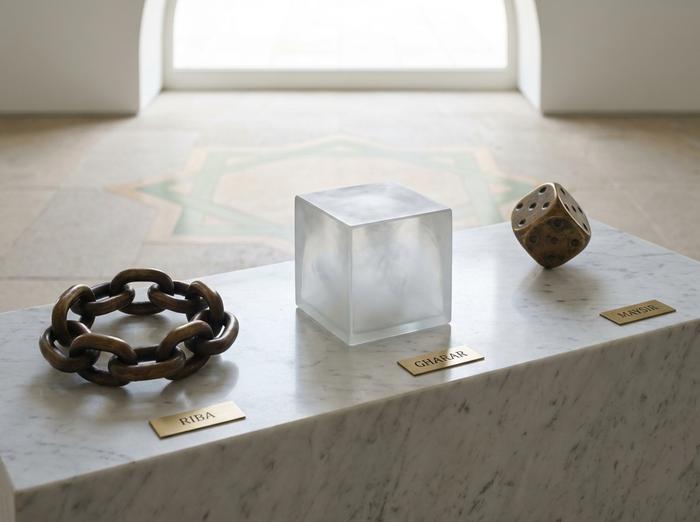
Islamic finance rests on a short list of bans. They cover every transaction, crypto included. Three of them run the Bitcoin halal debate.
Riba (interest or usury). The Quran bans riba outright. Under modern Islamic finance rules, any contract with a fixed return on a loan triggers riba. It does not matter if the venture succeeds or fails. In crypto, riba shows up in lending platforms, certain staking designs, and DeFi yield protocols. Each pays fixed rates.
Gharar (excessive uncertainty). A trade with too much unknown information fails the gharar test. So does an asset that cannot be clearly specified. Bitcoin's price swings alone do not automatically trigger gharar. The real question is whether the object and the terms are clearly defined. Leveraged crypto derivatives fail gharar cleanly. A spot purchase of Bitcoin on a regulated exchange is a closer call.
Maysir (gambling, also called qimar). Any transaction whose outcome rests on pure chance, with no productive value, is maysir. Short-term trading that just tries to guess the next candle lands akin to gambling. Long-term investment in a working asset with real utility usually does not. This is where many scholars draw the biggest line. Futures trading and margin trading get classified as haram by almost every halal-leaning body for the same reason.
Two more concepts shape the debate. Mal is the Arabic term for property or wealth. Whether Bitcoin counts as mal is the threshold question for most Islamic scholars. Only mal can be legally owned, traded, or inherited under shariah law. Zakat is the 2.5% annual wealth charity. If Bitcoin is mal, zakat on Bitcoin is due. Same rule as cash or gold.
The table below maps each principle to specific crypto activities most often discussed in Islamic finance circles.
| Islamic finance principle | Typical crypto activity | Usual ruling |
|---|---|---|
| Riba (interest / usury) | Fixed-APY lending protocols, crypto credit cards with interest | Haram |
| Gharar (excessive uncertainty) | Anonymous-counterparty derivatives, unaudited smart contracts | Haram or avoidance |
| Maysir (gambling) | Pure speculation, memecoin pumps, betting dApps | Haram |
| Mal (wealth / property) | Holding BTC/ETH as investment on regulated exchanges | Halal under conditions |
| Ujrah (service fee) | Ethereum staking validator rewards | Typically halal |
| Hibah (gift) | Airdrops of halal-compliant tokens | Halal |
Three scholarly stances on crypto halal or haram
Most 2024-2026 Islamic perspective writing breaks the debate into three positions. Each has serious jurists behind it.
Stance 1: Bitcoin is not mal and so not lawful to trade. This view treats Bitcoin as an imaginary number. A lack of intrinsic value. A speculative high-risk investment that fails the shariah tests for wealth. Scholars here include Mufti Taqi Usmani and Sheikh Shawky Allam, both considered haram authorities on the issue. Turkey's Diyanet issued a 2017 statement along the same lines. Indonesia's MUI did the same in November 2021 for crypto-as-currency. The permissibility of cryptocurrency in this view is basically zero.
Stance 2: Bitcoin is a digital asset, permissible under conditions. This is the majority view among Western-trained Islamic finance scholars who adhere to Islamic finance principles while engaging with modern instruments. Bitcoin counts as mal because people treat it as a store of value. Ownership is respected. Zakat applies. The stance accepts spot Bitcoin purchases deemed halal when the project, the investor's intent, and the trading style all fit Islamic finance scholars' criteria. Mufti Muhammad Abu-Bakar, Mufti Faraz Adam, and Ziyaad Mahomed (HSBC Amanah Malaysia) sit here. Many Islamic scholars argue from this position.
Stance 3: Bitcoin is an established digital currency, halal with minor qualifications. The most permissive view. It aligns with Islamic finance rules around customary money. Bitcoin serves as medium of exchange, unit of account, and store of value in practice. Peer-to-peer exchange has shariah precedent. Malaysia's Shariah Advisory Council and the Fiqh Council of North America broadly land here.
None of the three stances approves leveraged day trading. None approves investments in companies or projects whose core use case is gambling or fraud. The disagreement is about Bitcoin's fundamental status, not about bad actors.
Scholars who say Bitcoin is halal
The halal-leaning body of work has grown steadily since 2018. The key positions in 2026:
Mufti Muhammad Abu-Bakar (former shariah advisor at Blossom Finance) issued a 22-page paper on April 10, 2018 concluding that Bitcoin "does qualify as Islamic money, except where it is banned by a local government." The paper argued that Bitcoin has taqawwum (desirability), thamaniyyah (monetary character), and customary acceptance as fulus. It was widely distributed and drew fresh Muslim retail interest into crypto markets.
Mufti Faraz Adam of Amanah Advisors and the Darul Fiqh publication argued in an August 2021 Shariah interpretation that Bitcoin is in the ruling of a currency as long as people use and exchange it, and that zakat is therefore due on Bitcoin holdings. Mufti Faraz Adam has since built a halal-crypto screening framework used by several Islamic fintech platforms.
Fiqh Council of North America issued a September 2, 2019 ruling drafted by Dr. Yasir Qadhi and Dr. Abdulbari Mashal declaring that "Bitcoins shall be treated with the same Islamic rulings that apply to all fiat currencies." The ruling permits spot exchange only and confirms that zakat applies.
Malaysia Shariah Advisory Council of the Securities Commission resolved in July 2020 that digital assets are recognized as property (mal) from a shariah perspective. Malaysia became the first national regulatory body to do so explicitly, opening the door to regulated Islamic crypto products.
Sharia Review Bureau in Bahrain declared Bitcoin investment shariah-compliant in 2018 and subsequently certified CoinMENA exchange as shariah-compliant in January 2021.
Muhammadiyah, Indonesia's second-largest Islamic organization, issued a March 4, 2026 fatwa through its Majelis Tarjih dan Tajdid permitting crypto as a digital financial asset under conditions that align with Islamic finance. The same fatwa treats crypto as haram for payment use, and treats margin and futures trading as riba-tainted and haram. This makes Muhammadiyah's reading more shariah compliant than a blanket haram approach, while still conflicting with Islamic norms in several specific use cases.
The common thread: Bitcoin has real-world utility, measurable market value, and a functioning user base. Those three facts meet the shariah bar for property, which opens the door to Bitcoin being permissible in Islam under conditions. Scholars who adhere to Islamic positions flag deviations, not the technology itself.
Scholars who say Bitcoin is haram
The haram side is equally serious. In South Asia and parts of the Middle East, it is the dominant reading.
Mufti Taqi Usmani is the loudest voice here. Former AAOIFI Shariah Board chair. Senior Hanafi jurist. One of the most cited names in modern Islamic finance. He argues Bitcoin has no real value. No recognized issuer. Pure speculation. His 2018 line still gets quoted: Bitcoin is "just an imaginary number." That view has not changed through 2026.
Egypt's Dar al-Ifta, under Grand Mufti Sheikh Shawky Allam, issued the first big haram fatwa in December 2017. The reasons were blunt. Fraud risk. No oversight. Gambling-like speculation. Risk of terror financing. All four still show up in haram arguments.
Turkey's Diyanet did the same on November 24, 2017. Bitcoin, they said, is not compatible with Islam "at this time." Those last three words matter. The door was left open. Through April 2026, no revision has come.
Saudi Arabia took a government-first path. The Saudi Standing Committee ruled in 2018 that virtual currencies are illegal in the Kingdom. The senior scholars' council has not issued a collective fatwa on crypto. Individual scholars have spoken.
Indonesia's MUI put out the most detailed haram ruling of the post-2020 wave. The November 11, 2021 fatwa (7th Ijtima Ulama Fatwa Commission) declared crypto-as-currency haram on gharar and dharar grounds. It left a narrow crypto-as-commodity door open if sil'ah conditions are met. LBM Nahdlatul Ulama (East Java) had already ruled the same way on October 24, 2021.
Syria's SIC declared crypto haram in November 2019. The ruling could flip if shariah oversight gets built in later.
Sheikh Assim al-Hakeem argues on classical grounds. Bitcoin fails the hand-to-hand exchange rule for currencies. So it is non-compliant in its current form, utility claims aside.
Pull it all together. The haram camp reads the same way in every region. Bitcoin cannot be anchored to a tangible asset. No recognized sovereign currency behind it. Price detached from real value. Speculative use dominates real utility. All of that pushes Bitcoin into the gharar and maysir zones. The output is haram. Hard stop, in their view.
Is Bitcoin and cryptocurrency mal (wealth)?
Most of the Bitcoin halal debate comes down to one shariah question. Does Bitcoin qualify as mal? If yes, it can be owned, moved, and inherited under Islamic law. Zakat applies. If no, none of those contracts work at all.
Classical Hanafi jurisprudence defines mal as something humans desire, can store, and can benefit from. That definition has two parts. Taqawwum is the desirability side. Thamaniyyah is the monetary side. Mufti Faraz Adam argued in 2021 that Bitcoin has both. He also pointed to tamawwul, the social willingness to treat a thing as wealth, as enough to establish mal without physical form.
The opposite camp rejects that read. Bitcoin lacks intrinsic utility. It has no issuer. It can vanish if the network is abandoned. The view tracks classical Hanafi skepticism of fiat currency when it first emerged.
In 2024-2026, the practical reality is clear. Bitcoin has survived 16 years. It carries a market cap that rivals major sovereign currencies. Hundreds of millions of people treat it as wealth. Most scholars working in jurisdictions where crypto is legal now accept the mal label in some form. That shift flips the default answer to "is Bitcoin halal" from "no, cannot be owned at all" to "yes, with conditions."
Is Ethereum halal? Smart contracts and staking
Ethereum adds variables Bitcoin does not have. The network supports smart contracts. It powers DeFi. Since September 2022 it runs on proof-of-stake. Each feature creates its own shariah question.
Holding ETH as an investment follows the same three-stance split as Bitcoin. Most halal-leaning scholars accept ETH as a digital asset with utility. The haram camp uses the same "not mal, too speculative" argument.
Ethereum staking is where views diverge. One camp treats staking rewards as ujrah. A fee earned for a service (validating transactions). That reading makes staking halal by analogy to asset leasing. The other camp treats staking as fixed-rate yield on a loan, which pulls it toward riba. Liquid staking protocols like Lido add extra layers. Cautious scholars flag those more often.
Smart contract platforms also create gharar risk when the contract logic is opaque or can be upgraded without notice. Islamic finance scholars now want audited, transparent contracts as a base condition for any shariah-compliant DeFi product.
Crypto halal investment: practical checklist
A Muslim investor who wants to engage with Bitcoin and crypto can stay within shariah boundaries by running a checklist. The points below reflect current consensus on compliance with Islamic finance principles among halal-leaning scholars. They echo AAOIFI-style rules applied to crypto assets and financial instruments. Quick to follow, hard to cheat.
Ask five questions before every purchase:
1. Does this coin or project have real-world utility, or is its only purpose speculation? Pure meme coins and rug pulls fail this test. A responsible investment has a use case you can explain in one sentence.
2. Does the underlying business or protocol generate income from halal activities? Crypto projects tied to online gambling, porn, or alcohol are out. Crypto coins built on haram businesses fail even if the token itself is structurally clean.
3. Does the contract or token structure involve riba or hidden fixed yields? Interest-bearing lending platforms fail. Fiat currencies pay interest; shariah-compliant alternatives use profit-sharing.
4. Is the trade a spot purchase (halal by default for most halal-leaning scholars) or a margin or futures position (generally haram)? Spot trading is the default safe path; day trading and derivatives are not.
5. Is your allocation responsible and not a lottery ticket? Most Islamic finance scholars recommend treating crypto as a small, disciplined slice of a diversified portfolio. Reducing the risk of over-allocation is as much a shariah concern as it is a financial one.
Regulated exchanges with shariah certification make compliance easier and are the cleanest path for Muslims who want adherence to Islamic finance principles without becoming full-time scholars themselves. Muslim investors who consult vetted scholars and adhere to Islamic finance principles by default find these platforms the lowest-friction route into crypto. CoinMENA received Sharia Review Bureau certification in January 2021. In September 2024, Bybit launched the first shariah-compliant Islamic Account on a major global exchange, offering spot trading across 75 cryptocurrencies with CryptoHalal and ZICO Shariah Advisory oversight. Wahed Invest serves 400,000+ users globally with a shariah-screened portfolio. Fasset secured a Labuan license in October 2025 to launch the first stablecoin-powered Islamic digital bank. Islamic Coin (ISLM) received a formal 2023 fatwa from a board led by AAOIFI member Sheikh Nizam Yaquby. None of these replace personal due diligence. They reduce the starting friction.
Is day trading crypto halal from Islamic perspective?
The cleanest area of agreement across all three scholarly stances is that pure day trading of cryptocurrencies is considered haram. The reasoning is straightforward. Day trading relies almost entirely on short-term price movements that resemble maysir, and involves intent to capture speculative gains rather than partake in real economic activity in global financial markets. Add leverage, and the gharar problem compounds. The trading is halal or haram decision really turns on intent and mechanism.
Islamic finance scholars who otherwise allow Bitcoin investment still draw a firm line at high-frequency speculative trading. Mufti Faraz Adam, Blossom Finance advisors, and most of the halal-leaning camp reject day trading as non-compliant even for coins they consider mal. Spot trading for long-term holding, paired with zakat compliance, is the accepted alternative and a channel for ethical financial practices.
Margin trading, options, and perpetual futures land in the same camp for the same reasons. The combination of leverage, ambiguous contract terms, excessive risk, and pure-speculation intent is a direct gharar and maysir problem. Scholars from both ends of the halal-haram spectrum converge on this point. Futures trading is treated as forbidden in Islam by every halal-leaning body that has spoken on it.
NFTs, DeFi, and shariah compliance concerns
Beyond Bitcoin and Ethereum, the wider crypto ecosystem keeps throwing new shariah questions at scholars. The main ones worth naming:
NFTs: Indonesia's MUI issued a 2022 ruling making NFTs conditionally halal, so long as the depicted content itself is not haram (no images of haram activities, no music tied to non-compliant genres). Mufti Faraz Adam has echoed this reading in his 2023-2024 writings. The object of the NFT and the chain of ownership both have to clear shariah tests.
DeFi lending and borrowing: protocols paying fixed yields on deposits, or charging interest on loans, effectively fail riba by definition. Shariah-compliant lending uses profit-sharing (mudarabah) or joint venture (musharakah) structures instead. Hard to express in most current DeFi primitives. A growing class of sharia-compliant DeFi projects like MRHB DeFi and Marhaba Protocol tries to implement riba-free alternatives, a cleaner way for Muslims to earn passive income within Islamic limits.
Stablecoins: asset-backed stablecoins (USDC-style) sidestep the volatility argument neatly. They can still trigger riba if the issuer earns interest on underlying reserves and does not share it fairly with holders. Algorithmic stablecoins face bigger gharar issues and mostly get flagged.
Airdrops and mining: airdrops are usually treated as gifts (hibah) and are halal to receive as long as the underlying project is shariah-compliant. Mining is treated as a service (ijarah of computational work) and is halal if the mined coin is halal.
Zakat on Bitcoin: how to calculate and pay
If Bitcoin is mal, zakat applies. The standard rate is 2.5% of wealth above the nisab held for one lunar year. The nisab is pegged to the value of 85 grams of gold or 595 grams of silver, whichever is lower. In 2026, that works out to roughly USD 5,000-7,000 based on metal prices.
The math is simple. Take the market value of your Bitcoin on your zakat anniversary. Subtract outstanding debts. Compute 2.5% of the remainder. Pay in fiat or in Bitcoin. Whichever is easier.
Scholars debate one detail. Does crypto held for investment trigger zakat as currency (on the full holding) or as trade goods (only on net profit, in some readings)? The majority view in halal-leaning jurisprudence treats long-term crypto as currency. The 2.5% rate applies to the total. Day traders face a different math because their holding periods are short.
Several shariah-compliant platforms now offer automated zakat calculators for Bitcoin and other digital assets. The numbers are only as good as the coin prices they pull in. Verify against a market data source you trust. None of this is investment advice. Scholars still recommend consulting a specialist before acting on the principles and scholarly guidance in any explainer.