What is regenerative finance (ReFi)?
KlimaDAO launched in October 2021 with a simple pitch: buy carbon credits, lock them in a treasury, and use DeFi mechanics to drive the price of carbon up. The KLIMA token hit $4,950. The treasury swelled to over $1 billion in market cap. More than 20 million tokenized carbon credits sat in the protocol's vaults. People called it the future of climate finance.
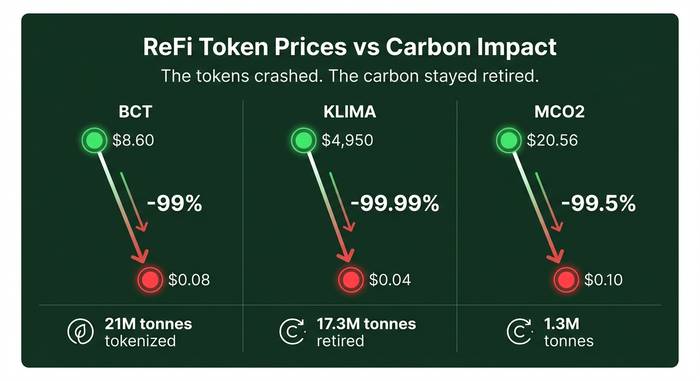
By April 2026, KLIMA trades at $0.04. That is a 99.99% drop. The DAO rebranded itself as "Klima Protocol" and ditched the treasury model entirely. Toucan Protocol's BCT token went from $8.60 to $0.08. Moss's MCO2 crashed from $20.56 to $0.10.
So is regenerative finance dead? Not exactly. The tokens crashed, but the idea did not. ReFi as a concept is bigger than any single DeFi protocol. It is an approach to finance that tries to repair ecosystems rather than just extract value from them. Whether blockchain technology is the right tool for that job is the question nobody has fully answered yet.
What regenerative finance actually means
ReFi stands for regenerative finance. Forget the fancy name for a second. It just means money that fixes things instead of breaking them. A financial system where the goal is not only returns but also helping the planet regenerate.
The idea is older than crypto. John Fullerton wrote "Regenerative Capitalism" in 2015. He said the extractive logic of modern finance was eating the natural world alive. Kate Raworth built a "doughnut model" for an economy that stays inside planetary limits. Elinor Ostrom won a Nobel for proving that local communities can manage shared land and water without selling it off. None of this needs a blockchain. These thinkers laid the ground long before anyone had heard of DeFi.
What web3 technologies brought to the table was a new toolkit. Smart contracts can automate the flow of money to regenerative projects. Tokens can turn carbon offsets into something you trade on an exchange. Decentralised finance can move capital to local communities without banks in the middle. On-chain data lets anyone check where the cash went. Traditional finance has none of that built in. Traditional financial systems are slow, opaque, and built for extractive returns.
The pitch: use the same DeFi plumbing behind lending protocols and yield farms to fund real things -- forests, carbon removal, biodiversity credits, clean power. Instead of financial services built only for investors, build a financial system that serves the planet. Sustainability baked into the code, not stapled on as a press release.
That is the theory. In practice it gets complicated fast. Cryptocurrencies and speculation tend to show up wherever there is a token, and ReFi was no different.
How ReFi works: carbon credits, tokens, and green bonds
The biggest use case for ReFi has been carbon credits. Simple version:
A forest project or a direct air capture plant earns carbon credits from bodies like Verra or Gold Standard. One credit equals one tonne of CO2 pulled out or kept out. Companies buy credits to offset their carbon emissions. That is the voluntary carbon market -- about $1.6-2.5 billion in 2025, with a record 202 million tonnes retired.
ReFi took those credits and put them on-chain. Toucan Protocol built a bridge on Polygon that turned Verra credits into tokens. Each tokenized carbon credit became a BCT or MCO2 token. You could trade them, pool them, lock them in DeFi. KlimaDAO hoovered up these tokens and stashed them in a treasury -- pulling supply off the open market to push carbon prices up.
The blockchain-based setup had clear wins. Carbon markets in the old world are murky and full of brokers. Tokenized credits gave you clear pricing, small-lot access, and round-the-clock trading. Any wallet could buy a carbon offset. Smart contracts could automate the burn -- lock a credit so nobody uses it twice.
But most buyers were not companies trying to go green. They were degens chasing yield. When the hype died, prices dropped and stayed down.
| Project | Token | ATH price | Current price (Apr 2026) | Total carbon impact | Status |
|---|---|---|---|---|---|
| Toucan Protocol | BCT | $8.60 | $0.08 | 21M credits tokenized | Active, low liquidity |
| KlimaDAO / Klima Protocol | KLIMA | $4,950 | $0.04 | 17.3M tonnes retired | Rebranded Feb 2026 |
| Moss | MCO2 | $20.56 | $0.10 | 1.3M tonnes transacted | Active, $241/day volume |
| Celo | CELO | Variable | Variable | 1,000+ ecosystem projects | L2 migration complete |
| Gitcoin | GTC | Variable | Variable | $60M+ distributed | Grants Stack sunset May 2025 |
Beyond carbon: the wider ReFi ecosystem
Carbon credits get the most attention, but the ReFi space includes other initiatives too.
Gitcoin pioneered quadratic funding -- a mechanism co-created with Vitalik Buterin that amplifies small donations using matching pools. The more individual donors a project attracts, the more matching funds it receives. This pushes capital toward projects with broad community support rather than just the ones with wealthy backers. Gitcoin has distributed over $60 million since launch. But the model is expensive to run: the Grants Stack software cost $3 million per year against just $1 million in revenue, and Gitcoin shut it down in May 2025. The grants program continues through other means.
Celo, a mobile-first blockchain, branded itself around the regenerative economy from the start. It recently completed a migration from a standalone Layer 1 to an Ethereum L2 using the OP Stack (March 2025). TVL grew from $79 million to over $200 million. Its Mento stablecoin protocol explores backing digital currencies with ecological assets. Google Cloud, Deutsche Telekom, and Telefonica run validator nodes. Celo claims to be carbon-negative and operates in 150+ countries with over 1,000 ecosystem projects.
Other ReFi initiatives spread across the broader regenerative economy:
Decentralized green bonds use smart contracts to automate interest payments and track where the money goes. Biodiversity credits work like carbon credits but protect species and habitat instead of just counting CO2. Universal basic income experiments -- Proof of Humanity, GoodDollar, Circles -- test whether blockchain-based systems can deliver regular cash to people in need without bureaucracy. SEEDS is a local currency that funds regenerative projects chosen by the community itself.
Impact investing through ReFi is still tiny next to traditional sustainable finance. But the approach to finance is different. DAOs can pool money for green energy, clean water, and affordable housing without a fund manager taking a cut. Web3 and ReFi put the governance in the hands of token holders and local communities, not boardrooms. Climate action funded from the bottom up, not the top down.
The regenerative capitalism framework says the financial system should not just be less harmful. It should actively make things better. That sounds like a slogan, but the ReFi space has started to build the rails for it. The question is whether anyone will use them now that the speculative sugar rush has worn off.
The real-world assets angle is growing. Tokenizing farmland, forest carbon, clean water rights -- these are digital assets with physical backing. Not memecoins. Not vaporware. Things you can walk on and breathe. Whether blockchain technology adds enough value to justify the complexity is still being tested, but early results from Carbonmark and Celo suggest there is a real market for transparent, blockchain-based environmental credits.
The problems nobody wants to acknowledge
Kate Bennett's 2025 paper in Frontiers in Blockchain laid it out cold. She looked at a bunch of ReFi projects and found that only half were truly regenerative. The other 45%? Just regular DeFi dressed up in green. Five percent were flat-out misleading.
Think about that. Half of what calls itself ReFi is not actually about regenerating anything. It is yield farming with a tree logo.
The greenwashing goes deep. Putting a forest on a token sounds great until you watch traders flip BCT like it is a memecoin. Nobody cared about the Amazon. They cared about the APY. When yields dried up, the "demand" for carbon evaporated too. KlimaDAO did retire 17.3 million tonnes of carbon -- real impact, real numbers. But the economic system that paid for it blew up.
Verra made things worse. In May 2022 they banned anyone from turning retired credits into tokens. They said they would build a new "immobilization" system instead. Three years later? Still nothing. No rules. No framework. Gold Standard is friendlier in tone but has not shipped anything either. This limbo makes it nearly impossible for ReFi initiatives to build a reliable bridge between on-chain and off-chain carbon markets.
And here is the part that gets uncomfortable. The voluntary carbon market itself has credibility problems. Big investigations found that many forest credits do not represent real emission cuts. If the underlying credit is junk, putting it on a blockchain just makes it faster, more liquid junk. The tech does not fix bad data.
| Challenge | Details |
|---|---|
| Token price collapse | BCT: -99%, KLIMA: -99.99%, MCO2: -99.5% from ATH |
| Greenwashing | 50% of ReFi projects genuinely regenerative (Bennett 2025) |
| Regulatory limbo | Verra immobilization framework pending 3+ years |
| Low liquidity | BCT DEX liquidity: ~$34K total; MCO2 daily volume: $241 |
| Credit quality | Underlying VCM credits face integrity scrutiny |
| Speculation-driven demand | Most token buyers were traders, not carbon offsetters |
What is left standing
What the voluntary carbon market looks like now
Before writing off carbon-based ReFi, look at the bigger picture. The voluntary carbon market did not crash with the tokens.
| Metric | 2024 | 2025 |
|---|---|---|
| Credits retired | 163-182M tonnes | 202M tonnes (record) |
| Capital committed to new projects | ~$3.3B | >$10B (3x increase) |
| Nature-based removal price | $5-20/tonne | $7-24/tonne |
| Tech removal (DAC) price | $200-600/tonne | $170-500/tonne |
| Market value estimate | ~$535M trading | $1.6-2.5B |
The real money is moving toward carbon removal -- pulling CO2 out of the air -- rather than avoidance credits. Removal credit prices grew at a 56% compound annual rate. Direct air capture is still expensive ($170-500 per tonne), but the cost curve is bending down. If you think climate action is going to get more serious over the next decade, the underlying market for carbon credits has legs even if the ReFi tokens on top of it do not.
The regenerative economics ideas that still matter
Strip away the tokens and the DeFi wrappers, and regenerative economics has substance.
The core insight is simple: an economic system that eats the ground it stands on will eventually collapse. Traditional finance treats the natural world as free raw material. Regenerative finance asks what happens if the financial system had to account for what it takes from ecosystems and give something back.
This matters for climate action, food systems, water, biodiversity -- not just carbon. Regenerative agriculture is a real movement with real money behind it. Farmers who rebuild soil health instead of mining it can produce food indefinitely. Financial tools that reward long-term land stewardship over short-term extraction could change how capital flows in rural economies around the world.
ReFi initiatives in this space are small but growing. Investment in regenerative projects -- from reforestation to coral reef restoration to soil carbon programs -- is starting to attract real-world asset (RWA) capital, not just crypto speculation. The digital assets layer makes tracking and verification easier, but the real value is in the dirt, the water, and the trees.
The crash wiped out speculative capital. It did not wipe out infrastructure.
Carbonmark, spun out of the Klima ecosystem, handles over 12,000 carbon retirement transactions per month. The voluntary carbon market itself set a record in 2025 with 202 million tonnes retired. Capital committed to new carbon credit generation tripled to over $10 billion. The market is shifting from quantity to quality, and that is probably a good thing.
Celo is growing. Gitcoin is still funding public goods. New platforms like EcoSync CarbonCore are building comprehensive ReFi infrastructure. The regenerative economics ideas that predate crypto by decades -- Fullerton's regenerative capitalism, Ostrom's commons management, Raworth's doughnut model -- those have not gone away. They have just outlived the tokens that tried to financialize them.
Honest take on ReFi in 2026: the financial engineering part failed. Using extractive speculation to fund positive environmental outcomes was always a contradiction. But the movement -- web3 and ReFi working together to channel decentralized finance into something that actually helps people and ecosystems -- that part still has legs. The next generation of ReFi projects will be smaller, quieter, and hopefully more honest about what blockchain can and cannot do for the planet.
The worst outcome would be writing off ReFi because the tokens crashed. The best outcome: keep the tools, drop the hype, and fund regenerative projects that work whether anyone watches the price chart or not.
The ReFi space needs to regenerate itself before it can credibly claim to regenerate anything else. And that might be the most honest thing you can say about it in 2026.