Curve Finance: the stablecoin DEX that powers half of DeFi
In June 2023, Curve Finance's founder nearly blew up the entire protocol. Michael Egorov had borrowed $168 million against his personal CRV token holdings across multiple lending platforms. When CRV's price started dropping, the loans approached liquidation. If those positions had been force-sold on the open market, the resulting cascade would have cratered CRV, drained Curve's liquidity pools, and sent shockwaves through every DeFi protocol that depended on Curve. The rescue came through frantic OTC deals where Egorov sold CRV directly to other DeFi founders at a discount.
The protocol survived. But the incident exposed something about Curve Finance that casual observers miss: this is not just another decentralized exchange. It is infrastructure. When Curve wobbles, DeFi wobbles. When Curve's liquidity pools function properly, stablecoin swaps across the entire ecosystem work with minimal slippage. Half of DeFi's plumbing runs through Curve, and understanding how it works is not optional if you take decentralized finance seriously.
This article covers how the Curve Finance protocol actually works, why its stablecoin AMM design is different from Uniswap, what the CRV token and veCRV system do, how the Curve Wars reshaped DeFi incentives, what crvUSD brings to the table, and where the protocol stands in 2026.
How Curve Finance works: the AMM built for stablecoins
Most automated market makers use a formula that works fine for trading volatile assets but wastes capital on stablecoin pairs. Uniswap's constant product formula (x * y = k) spreads liquidity across all possible prices. That makes sense for ETH/USDC because the price could be anywhere. It makes no sense for USDC/USDT because the price is always near $1.00.
Curve Finance uses a different formula called StableSwap. It concentrates liquidity around the peg, the narrow price range where pegged assets are supposed to trade. The result: you can swap $10 million of USDC for USDT on Curve and lose maybe $200 to slippage. Try that on Uniswap and you might lose $10,000 or more. For institutional traders, stablecoin desks, and anyone moving large amounts between pegged assets, that efficiency difference is enormous.
The protocol launched in January 2020 as "StableSwap" before rebranding to Curve Finance. Michael Egorov, a Russian-born physicist with a background in cryptography, built it. The timing was perfect: DeFi summer was about to explode, and the ecosystem needed a place to swap stablecoins without getting eaten alive by slippage.
| Feature | Curve Finance | Uniswap V3 | Balancer |
|---|---|---|---|
| Specialization | Stablecoins and pegged assets | General-purpose trading | Weighted portfolio pools |
| AMM formula | StableSwap (concentrated near peg) | Concentrated liquidity (manual) | Weighted invariant |
| Best for | USDC/USDT, stETH/ETH swaps | Volatile pair trading | Multi-asset portfolios |
| Slippage on $1M stablecoin swap | ~0.01-0.02% | ~0.1-0.5% | ~0.05-0.2% |
| Governance token | CRV | UNI | BAL |
In 2021, Curve expanded beyond stablecoins with Curve V2 pools. These handle volatile crypto assets like ETH, BTC, and other tokens using a modified formula that adapts to price changes. V2 pools compete directly with Uniswap and other general DEXs, but Curve's core strength remains stablecoin trading where no other protocol matches its efficiency.
Liquidity pools: how you earn on Curve
If you hold stablecoins and want them to earn yield, Curve's liquidity pools are one of the most battle-tested options in DeFi.
Here is how it works in practice. You deposit stablecoins into a Curve pool. The most famous one is the 3pool (DAI + USDC + USDT). When traders swap between those three stablecoins, they pay a fee. That fee gets split among all liquidity providers proportional to their share of the pool. On top of trading fees, many Curve pools also earn CRV token rewards through the gauge system, which I will explain below.
The yields are not going to make you rich overnight. Stablecoin pools on Curve typically pay 2-8% APY depending on the pool, the volume, and the CRV incentives. That is lower than exotic yield farming strategies, but the risk profile is completely different. You are holding stablecoins that should stay near $1. Impermanent loss on a pool of three stablecoins is close to zero under normal conditions.
The risk is not zero though. Smart contract exploits happen. In July 2023, a reentrancy bug in Vyper (the programming language Curve uses) led to $70 million being drained from several Curve pools. The protocol recovered and affected pools were made whole, but it was a reminder that even the most established DeFi protocols carry technical risk.
For a liquidity provider, the practical workflow goes like this: connect your wallet to curve.fi, pick a pool that matches the stablecoins you hold, approve and deposit, and start earning fees immediately. Withdrawals are available at any time with no lockup period. Gas fees on Ethereum mainnet can eat into small deposits, so most people either deposit on Layer 2 chains (Arbitrum, Optimism, Base) or commit at least a few thousand dollars to make the gas cost worthwhile.

The CRV token and veCRV: where the game theory gets interesting
CRV launched on August 13, 2020 with a total supply of 3.03 billion tokens. The initial distribution allocated 62% to community liquidity providers, with the rest split between the team, investors, employees, and a community reserve. CRV inflation was high at launch (roughly 2 million tokens per day) and follows a declining emission schedule.
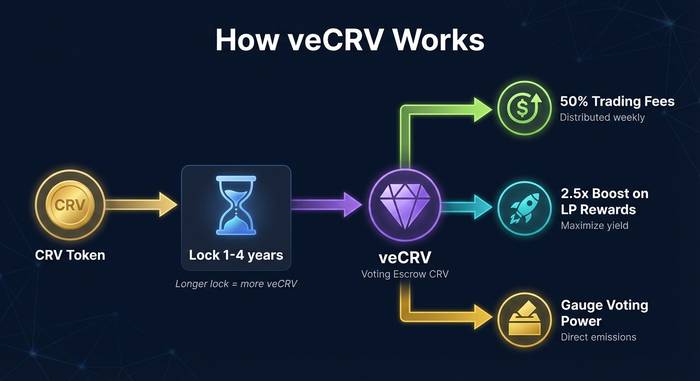
But raw CRV is only half the picture. The real power comes from veCRV, vote-escrowed CRV. When you lock your CRV tokens for up to four years, you receive veCRV in return. The longer you lock, the more veCRV you get. And veCRV does three things that raw CRV does not:
First, veCRV holders earn a share of all trading fees generated across every Curve pool. This is real yield from real trading activity, not inflationary token rewards.
Second, veCRV holders can boost their CRV rewards as a liquidity provider by up to 2.5x. If you provide liquidity in a pool AND hold veCRV, you earn significantly more CRV than someone who provides the same amount of liquidity but does not lock CRV.
Third, and this is the one that created the Curve Wars, veCRV holders vote on which pools receive CRV emissions through the gauge weight system. A vote for your pool means more CRV rewards flow to it, which attracts more liquidity providers, which deepens the pool, which makes it more useful for traders. Controlling where CRV emissions go is controlling the flow of capital through DeFi.
| CRV/veCRV mechanics | Details |
|---|---|
| Max supply | 3.03 billion CRV |
| Lock duration for veCRV | 1 week to 4 years |
| Fee sharing | veCRV holders earn 50% of trading fees |
| Boost | Up to 2.5x CRV rewards for LPs |
| Gauge voting | Direct CRV emissions to specific pools |
| Decay | veCRV balance declines linearly toward unlock date |
The Curve Wars: when protocols fight for liquidity
The Curve Wars is probably the most fascinating game theory experiment in all of DeFi. It started when protocols realized that controlling veCRV votes meant controlling where liquidity flows. And in DeFi, liquidity is everything.
Here is the setup. A new stablecoin project launches. They need deep liquidity on Curve so traders can swap their stablecoin with low slippage. Without that liquidity, nobody trusts the peg. To attract liquidity providers to their Curve pool, they need CRV emissions directed to their pool through gauge votes. To get those votes, they need veCRV. They have two options: buy and lock massive amounts of CRV (expensive), or bribe existing veCRV holders to vote for their pool.
Enter Convex Finance. Convex built a protocol that aggregates CRV deposits. Users deposit CRV into Convex, receive cvxCRV in return, and Convex locks the CRV as veCRV permanently. Convex then uses that accumulated veCRV voting power on behalf of its depositors, and CVX token holders vote on where Convex directs those votes. This created a second layer of governance: instead of fighting to accumulate veCRV directly, protocols started accumulating CVX tokens because controlling CVX means controlling a huge block of veCRV votes.
Bribe markets like Votium and Hidden Hand emerged to make this even more efficient. A stablecoin project can pay CVX holders directly (in their own token, in USDC, in whatever) to vote for their pool. The cost per vote became a measurable market rate. At peak, protocols were spending millions per month on bribes to direct Curve emissions.
Why does this matter? Because it proved that DeFi protocols compete for users through incentive design, not just technology. The project with the best smart contracts still fails if it cannot attract liquidity. Curve created the battlefield. Convex provided the weapons. The Curve Wars showed that DeFi is as much about economic game theory as it is about code.
In 2026, the Curve Wars have cooled but the infrastructure remains. Convex still holds the largest block of veCRV. Bribe markets still operate. But the explosive growth phase is over. CRV emissions are lower due to the declining schedule, which means each vote directs less capital. The game continues at a quieter pace.
What I find fascinating about the Curve Wars is what they revealed about DeFi as a system. Traditional finance competes on brand, regulatory capture, and distribution deals. DeFi protocols compete on incentive design. The smartest thing Frax, UST (before it blew up), and dozens of other stablecoin projects did was play the Curve Wars aggressively. The ones that did not compete for Curve liquidity struggled to maintain their pegs. The protocol did not plan to become a kingmaker for stablecoins. It just happened because the math made it inevitable: deep Curve liquidity equals a trusted peg.
The Curve DAO handles governance decisions through veCRV voting. Major proposals have shaped fee distribution, pool creation, and the launch of new products like crvUSD. The governance process runs through Aragon votes and snapshot polls, with active community participation from large veCRV holders and protocol delegates.
crvUSD and LlamaLend: Curve becomes a lending protocol
Curve did not stop at swaps. In 2023, the protocol launched crvUSD, its own stablecoin, backed by a novel liquidation mechanism called LLAMMA (Lending-Liquidating AMM Algorithm).
Traditional lending protocols liquidate your collateral in one shot when the price drops below a threshold. One moment you have a healthy loan. Next moment your ETH is sold at market price and you owe whatever the difference is. It is brutal and the slippage on forced liquidations costs borrowers dearly.
LLAMMA handles it differently. Instead of a binary liquidation, your collateral gradually converts from the volatile asset (ETH, wBTC) into crvUSD as the price drops. If the price recovers, it converts back. It is a soft liquidation that functions like a continuous rebalancing between your collateral and the borrowed stablecoin. You still lose value during a price decline, but you do not get liquidated in a single catastrophic event.
LlamaLend extended this concept into standalone lending markets. Users can borrow against various crypto assets using the LLAMMA mechanism. The integration with Curve's existing liquidity infrastructure makes these markets efficient from launch.
crvUSD has grown steadily since launch, reaching hundreds of millions in market cap. Whether it can compete with DAI and USDC for stablecoin market share is an open question, but the underlying technology has proven its concept through multiple market cycles.
How safe is Curve Finance?
Safety in DeFi is always relative. Curve has been running since January 2020 and has processed hundreds of billions in swap volume. The smart contracts are among the most audited in DeFi. But "audited" does not mean "invulnerable."
The July 2023 Vyper exploit drained roughly $70 million from several pools. The root cause was a compiler bug in Vyper's version of reentrancy protection, not a flaw in Curve's logic. The distinction matters: Curve's code did what it was supposed to do, but the language it was written in had a bug that attackers found first.
The Egorov crisis in the same month showed a different kind of risk: founder concentration. One person's over-leveraged position threatened the entire protocol. The fact that it took OTC deals with DeFi insiders to stabilize things was not exactly a confidence booster for retail users.
In 2026, Curve's security posture is stronger. Additional audits, bug bounties, and a diversified validator set address previous vulnerabilities. But the honest answer to "is Curve safe?" is the same as for every DeFi protocol: it is as safe as smart contract code can be, which is not the same as safe.