France Crypto Tax Guide 2026: How Your Holdings Are Taxed

Sell your crypto in France and 31.4% of the profit disappears to the taxman. That rate used to be 30%. On January 1, 2026, social contributions jumped from 17.2% to 18.6% because of the PLFSS 2026, a Social Security Financing Act that funnels the extra 1.4% into elderly care through something called the CFA (Contribution Financiere pour l'Autonomie). Nobody in the crypto community asked for this increase. It happened anyway.
About 6 million French adults, 11% of the population according to the ADAN 2026 Barometer, own at least one crypto-asset. A year ago that number was 10%. All 6 million face the same tax framework: sell for euros and you pay tax, swap one token for another and you pay nothing. Simple on the surface. Then you discover the progressive tax option that might save you money, the "unproductive wealth" proposal that passed the National Assembly in late 2025 and threatens to tax your holdings even if you never sell, and the DAC8 directive that now forces exchanges to hand over your trading data to French authorities.
I am going to walk through all of it: how crypto is taxed in France today, what changed in 2025 and 2026, how to calculate your tax, which forms to file, and how France compares to Germany, Portugal, and the rest of Europe. The penalties for getting this wrong are real, and "I did not know" has never worked as a defense with DGFiP.
How crypto is taxed in France today
French law treats cryptocurrency as a "digital asset" under Article 150 VH bis of the General Tax Code. That classification landed in 2019 with the Finance Act and has not changed since. The France crypto tax system is subject to tax rules that evolved through multiple Finance Acts since then, but the core taxation in France logic stays the same year after year.
One rule runs the whole thing: you owe tax when crypto becomes fiat. Sell Bitcoin for euros on Coinbase? Taxable event. Buy a Tesla with ETH? Taxable event. But swap ETH for USDC on Uniswap? Nothing. Not taxable. France does not tax crypto-to-crypto trades, which is unusual in Europe. Most countries do. France deliberately chose not to. Only the moment you touch euros, dollars, or any government currency does the tax clock start.
People underestimate how much freedom this gives them. You can rotate between DeFi protocols, bridge tokens across chains, rebalance your portfolio between BTC and stablecoins, move assets into liquidity pools. None of it triggers a tax bill. The government only cares when crypto leaves the digital world and becomes real money or buys real goods.
Here is what is and is not taxable:
| Taxable events | Non-taxable events |
|---|---|
| Selling crypto for fiat (EUR, USD) | Buying crypto with fiat |
| Buying goods or services with crypto | Trading one cryptocurrency for another |
| Mining rewards (at receipt) | Transferring crypto between your own wallets |
| Staking rewards (at receipt) | Receiving airdrops or fork tokens |
| Receiving crypto as salary | Donating crypto |
| Lending crypto for interest (BNC) | Holding crypto without selling |
One critical detail: the EUR 305 annual exemption. If your total crypto sales proceeds for the year stay under EUR 305, you owe nothing. But this threshold applies to proceeds, not profits. And even below EUR 305, you still need to report your foreign exchange accounts on Form 3916-bis. The exemption is per household, not per person.
Flat tax vs progressive income tax rates
You get a choice. Most people do not realize this. The PFU (Prelevement Forfaitaire Unique) is the default flat tax, 31.4% as of 2026. But you can opt out of it. Check box 2OP on your tax return, and your crypto gains go through France's progressive income tax scale instead, plus social security contributions on top.
The flat tax, broken down:
- 12.8% income tax
- 18.6% social security contributions (CSG 10.6%, CRDS 0.5%, solidarity levy 7.5%)
- Total: 31.4% (it was 30% through 2025)
The progressive brackets look like this:
| Taxable income bracket | Income tax rate |
|---|---|
| Up to EUR 11,294 | 0% |
| EUR 11,295 to EUR 28,797 | 11% |
| EUR 28,798 to EUR 82,341 | 30% |
| EUR 82,342 to EUR 177,106 | 41% |
| Above EUR 177,106 | 45% |
The catch: social contributions still apply. 18.6% gets added no matter which option you pick. So the progressive path ranges from 18.6% at the bottom (0% bracket plus social charges) all the way to 63.6% at the top (45% plus 18.6%). Painful.
Who actually benefits from going progressive? People with low total income. If your taxable income including crypto gains stays under EUR 28,797, you fall in the 0% or 11% bracket. At 11% plus 18.6%, that is 29.6%, saving you 1.8 points compared to the flat 31.4%. Not life-changing, but real money on a EUR 20,000 gain.
One wrinkle people miss: checking box 2OP applies to all your capital income for that tax year. Dividends, bank interest, crypto gains. All of it goes progressive. You cannot split them. If your dividends benefit from the flat tax but your crypto gains would benefit from progressive, tough luck. Pick one.

How to calculate crypto capital gains
This is where France gets weird. You cannot just subtract what you paid from what you got. The French tax code uses a weighted average formula that drags your entire portfolio into every single sale.
The formula looks like this:
Capital gain = Sale price - (Total acquisition cost of your crypto portfolio x Sale price / Total value of your crypto portfolio)
An example makes it clearer. You bought 1 BTC for EUR 20,000 and 10 ETH for EUR 15,000. Total acquisition cost: EUR 35,000. Your whole crypto portfolio is now worth EUR 60,000. You sell the BTC for EUR 35,000.
Capital gain = EUR 35,000 - (EUR 35,000 x EUR 35,000 / EUR 60,000) = EUR 35,000 - EUR 20,417 = EUR 14,583
So your taxable gain is EUR 14,583. At the 31.4% flat rate, you hand over EUR 4,579 to DGFiP. Notice the cost basis was not EUR 20,000, which is what you actually paid for that BTC. It was proportionally allocated across your entire portfolio. This catches people off guard.
The practical headache: every sale depends on the total value and total cost of your crypto portfolio at that exact moment. You need records going back to your very first purchase. Got crypto from mining, staking, airdrops, or as payment? Each one has different cost basis rules. Miss one and your numbers are wrong for every calculation that follows.
Capital losses work in a way that frustrates people. You can net your gains or losses within the same tax year. Lost EUR 5,000 on one trade, made EUR 8,000 on another? You pay tax on EUR 3,000. Fine. But France does not let you carry losses forward. Lose EUR 10,000 in December 2025, make EUR 50,000 in February 2026? That December loss is gone. Dead. The tax calculation for 2026 ignores it completely. Gains made on cryptocurrency in one tax year and losses realized in the next cannot be combined. Timing matters.
Which cryptocurrency transactions trigger tax
Not every crypto move creates a tax bill. French tax law is specific about what counts as a taxable event and what does not. Getting this wrong is the most common mistake crypto holders in France make.
Selling crypto for fiat is the primary taxable event. Every time you cash out to euros on an exchange like Binance, Kraken, or Coinbase, that disposal must be reported on Form 2086.
Trading one cryptocurrency for another is not taxable. This was a deliberate choice by French lawmakers. Swapping Bitcoin for Ethereum, moving into stablecoins like USDT, or converting tokens through a DEX generates no tax liability. The taxable moment is deferred until you eventually sell for fiat.
Moving crypto between your own wallets is not a taxable event either. Transferring from a Ledger to MetaMask, from one exchange to another, or into a DeFi protocol does not trigger tax. But it can complicate your portfolio value tracking, because DeFi deposits may temporarily change the apparent value of your holdings.
Mining and staking follow different rules entirely. Mining income is classified as non-commercial profits (BNC) under Article 92 of the General Tax Code. Mining rewards are taxed at the progressive income tax rate, not the flat 31.4%. For active miners, this can mean rates up to 45% plus social security contributions. Staking is not explicitly addressed in current French tax legislation, but tax authorities treat it similarly to mining under the BNC category. Both mining and staking rewards are taxed at the EUR value at the time of receipt. Any subsequent sale of those tokens for fiat triggers a separate capital gains event on top.
Since the 2023 reform, trading frequency and volume no longer determine a taxpayer's professional status. All individuals managing private crypto portfolios fall under the PFU flat tax regardless of how actively they trade. "Professional" reclassification now requires qualitative criteria: use of algorithmic tools, high-frequency strategies, or other professional-grade conditions. If reclassified as professional, gains fall under BNC with progressive rates up to 45%.
NFTs sit in a gray area. If an NFT qualifies as a digital asset, the standard flat tax regime applies. If it qualifies as movable intangible property, the rate is 36.2%. If it qualifies as a work of art, a reduced flat rate of 6.5% applies. The tax treatment depends on the nature of the NFT, and the tax implications remain unclear because there is no definitive guidance from French tax authorities yet.
Receiving crypto as salary is taxed as regular employment income at the time of receipt. Any subsequent gain when you sell that crypto for fiat is a separate capital gain.
The "unproductive wealth" tax reform of 2025
October 31, 2025. The French National Assembly votes 163 to 150. The amendment passes. Under this proposal, crypto tax hits large holdings with something France has never tried: a wealth tax on digital assets.
Centrist MP Jean-Paul Mattei pushed the idea. He wants to replace the IFI (Impot sur la Fortune Immobiliere), which only covers real estate, with a broader IFI 2.0 (Impot sur la Fortune Improductive). Crypto gets lumped in with yachts, private jets, jewelry, classic cars, and collectible art. All classified as "unproductive wealth" because they do not generate jobs or economic activity. That is the argument, at least.
Here is what changes:
| Detail | Current IFI | Proposed IFI 2.0 |
|---|---|---|
| Threshold | EUR 1.3 million | EUR 2 million |
| Rate | 0.5% to 1.5% (progressive) | Flat 1% on net assets above threshold |
| Assets covered | Real estate only | Real estate + crypto + luxury goods |
| Unrealized gains | Not applicable | Taxed annually |
Read that last row again. Taxed annually. You have not sold anything. You owe tax anyway. A EUR 3 million crypto portfolio means 1% on the EUR 1 million above the threshold. That is EUR 10,000 every year for sitting on your tokens.
Eric Larcheveque, co-founder of Ledger, called it out publicly. The tax "punishes all savers," he said, and could force people to sell volatile assets just to pay a bill on paper gains. Imagine owing EUR 10,000 in January on a portfolio that drops 40% by March. The government projects EUR 1 to 3 billion in annual revenue from the change, though most tax advisors expect wealthy holders to restructure long before the bill arrives.
As of early 2026, this still needs to pass the Senate. Nothing is final. But the signal is clear: France's crypto tax direction is moving toward taxing large cryptocurrency holdings as wealth, not just taxing gains when you sell. If this goes through, crypto investors with large holdings would pay income tax and social security on realized gains plus this annual wealth tax on top. Moving crypto or transferring funds out of France would not help, because the tax follows French tax residents worldwide.
How France compares to EU crypto tax rates
Where does 31.4% rank in Europe? Middle of the pack. Some neighbors are far friendlier. Others charge more.
| Country | Crypto tax rate | Holding period benefit | Exemption threshold |
|---|---|---|---|
| France | 31.4% flat (PFU) | None | EUR 305/year on disposals |
| Germany | 0-45% progressive | 0% if held over 1 year | EUR 1,000/year (short-term) |
| Portugal | 28% (short-term) | 0% if held over 1 year | None |
| Italy | 33% flat (from 2026) | None | Removed (was EUR 2,000) |
| Spain | 19-28% progressive | None | None |
| Netherlands | ~36% (Box 3 wealth tax) | N/A (taxed on holding) | EUR 59,357 |
| Switzerland | 0% for individuals | N/A | None (wealth tax 0.3-1% by canton) |
| Belgium | Generally 0% | N/A | N/A (professional traders taxed normally) |
Germany is the clear winner for long-term holders. Buy Bitcoin. Hold it for more than one year. The gain is entirely tax-free, regardless of the amount. Germany also exempts short-term gains under EUR 1,000 per year. This has made Germany a popular base for crypto investors willing to relocate within the EU.
Italy went the opposite direction. Its 2025 Budget Law raised the crypto capital gains tax from 26% to 33% effective January 2026, putting it above France. Italy also removed its EUR 2,000 annual exemption. Stablecoins remain taxed at 26%, creating a split system.
Portugal reversed course in 2023. Before that, crypto was completely tax-free for individuals. Now gains on assets held less than 365 days are taxed at 28%. But the one-year holding exemption still makes it more favorable than France for patient investors.
The Netherlands takes a unique approach. Rather than taxing actual gains, the Dutch system taxes a deemed return on your net assets above EUR 59,357 at around 36%. You owe tax whether your crypto went up or down. This punishes holders in bear markets.
Switzerland charges no capital gains tax on crypto for private individuals, though a small cantonal wealth tax (0.3% to 1%) applies to the total portfolio value. Belgium is similarly generous for individual investors, though professional or speculative traders face standard income tax rates.
France's main advantage is the crypto-to-crypto swap exemption. In countries like Italy and Spain, every crypto-to-crypto trade can trigger a taxable event, creating a tracking nightmare for active DeFi users. In France, you only face the taxman when fiat enters the picture.
The DAC8 directive, transposed into French law via Article 54 of the 2025 Finance Act, requires all crypto service providers to report user transaction data to national tax authorities starting January 2026. The first automatic exchange of data will happen by September 30, 2027, covering all 2026 activity. The playing field is leveling across the EU, and France's tax framework is positioned as one of the more structured and predictable systems in Europe.
How to report crypto taxes in France
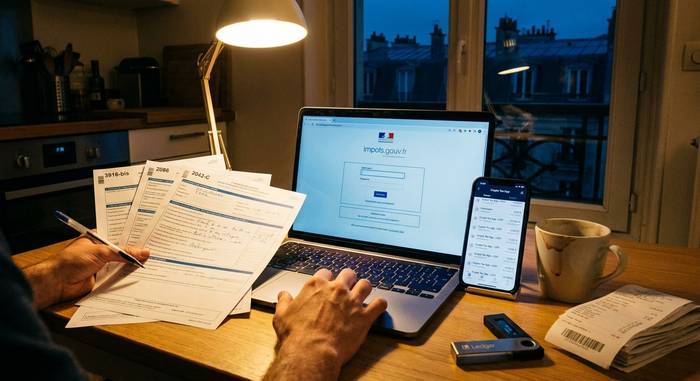
Three forms. That is what stands between you and a clean tax record. You file them between April and June each year through impots.gouv.fr using FranceConnect. Miss one and the fines start.
Form 3916-bis: foreign crypto exchange accounts
Got a Binance account? Kraken? Coinbase? Crypto.com? Each one gets its own Form 3916-bis. You list the platform name, country, your account number, and when you opened or closed it.
Here is the part that catches people off guard: you file this form even if you made zero trades all year. Just having the account is enough. The fine for skipping it is EUR 750 per undisclosed account, doubled to EUR 1,500 when the account holds more than EUR 50,000.
Form 2086: crypto capital gains calculation
This is where you report every crypto-to-fiat sale. The sale price, your portfolio's acquisition cost at that moment, total portfolio value, and the gain or loss for that specific trade. Every. Single. Transaction.
Two hundred trades in 2025? Two hundred lines on Form 2086. Nobody does this by hand. Tax platforms like Waltio, CoinLedger, or Koinly pull your exchange data and spit out Form 2086-ready reports. Worth the subscription fee.
Form 2042-C: declaring the total
Your net gain or loss from Form 2086 goes into Form 2042-C. Gains land in box 3AN, losses in box 3BN. This same form is where you check box 2OP if you want the progressive income tax option instead of the flat tax.
Mining and staking income goes somewhere else entirely: Form 2042-C PRO, under BNC (non-commercial profits).
Key filing deadlines for 2026
| Zone | Online deadline |
|---|---|
| Departments 01-19 (Zone 1) | May 25, 2026 |
| Departments 20-54 (Zone 2) | June 1, 2026 |
| Departments 55+ (Zone 3) | June 8, 2026 |
| Non-residents | May 26, 2026 |
| Paper returns | May 22, 2026 |
| Online reporting opens | April 13, 2026 |
Records you need to keep
French tax authorities can audit your crypto activity for up to three years. Keep detailed records of every transaction: dates, amounts in crypto and fiat, exchange rates, wallet addresses, and screenshots of exchange confirmations. DGFiP (Direction Generale des Finances Publiques) has been increasing crypto-focused audits since 2023, and the DAC8 data sharing starting in 2026 gives them direct access to your exchange records.
Penalties, audits and how to avoid the tax trap
France does not mess around with crypto tax evasion. The fines are specific, they stack, and they hurt.
If you fail to declare exchange accounts on Form 3916-bis, the fine is EUR 750 per undisclosed account. That doubles to EUR 1,500 per account when the account value exceeds EUR 50,000. Individual omissions or misstatements cost EUR 125 each, capped at EUR 10,000 per year.
Unreported capital gains carry heavier consequences. Late filing penalties range from 10% to 40% of the tax owed. Interest charges of 0.2% per month accumulate on unpaid amounts. In cases of deliberate fraud, the penalty climbs to 80% of the tax due, with potential criminal prosecution, fines up to EUR 500,000, and up to five years in prison.
The DAC8 directive changes the enforcement picture entirely. Transposed into French law via Article 54 of the 2025 Finance Act, DAC8 requires crypto exchanges and service providers to automatically report transaction data to national tax authorities. The reported data includes user identity, all transactions (buys, sells, transfers), and portfolio value as of December 31. The first automatic exchange of data will happen by September 30, 2027, covering all 2026 activity. DGFiP will receive your trading data directly from Binance, Kraken, and other platforms. Relying on the assumption that "they cannot track crypto" is no longer a viable strategy.
Several practical steps can help you stay compliant and reduce your tax liability legally:
1. Use the crypto-to-crypto exemption strategically. Rebalancing your portfolio between tokens is not taxable. Only sell crypto or convert crypto to fiat when you actually need the money. Trading crypto like Bitcoin for stablecoins does not trigger a specific tax event.
2. Choose the right tax option each year. Compare your total income against the progressive brackets. If you are in a low-income year, the progressive income tax option might save you money compared to the flat tax regime.
3. Time your sales. Since losses cannot be carried forward, try to realize gains and losses within the same tax year to offset them. Crypto gains are taxed in the year of disposal, so the value of the crypto at the moment of sale determines your tax bill.
4. Keep records from day one. Retroactively reconstructing your transaction history is painful and error-prone. Use a tax platform that connects to your crypto exchanges and generates a tax report compatible with Form 2086.
5. Declare all accounts on Form 3916-bis. The penalty for non-disclosure is automatic and does not require an audit to trigger.
Hiring a tax professional familiar with French crypto taxation is worth considering if your portfolio is above EUR 50,000 or if you have complex DeFi activity, including crypto, staking, or lending. The BNC tax classification for mining and staking income has gray areas that a professional can navigate. Reporting your crypto taxes correctly from the start is far cheaper than dealing with penalties later.