Bitcoin Philanthropy: How Crypto Donations Are Changing Charitable Giving
A person going by "Pine" showed up online in 2017, said they'd made enough money from early Bitcoin, and proceeded to give away $55 million. Sixty charities. A few months. The EFF got a million. The Water Project got a million. MAPS, the psychedelic therapy research group, got four million. Pine's explanation was short: "Once you have enough money, money doesn't matter."
Four years later Vitalik Buterin sent $1 billion in SHIB tokens to India's COVID relief fund. One wallet, one transaction, one billion dollars. Then Ukraine posted Bitcoin and Ethereum wallet addresses on Twitter during the Russian invasion. $60 million came in within weeks. No bank wires. No intermediaries. Just wallets sending to wallets.
None of this was a PR stunt. Pine gave away the money and deleted their account. Buterin sent tokens and moved on. Ukraine needed cash and crypto showed up before SWIFT transfers did. Something has been building here quietly, and the numbers back it up. Giving USA pegged total US charitable giving at $557 billion for 2023. Crypto's share is still tiny. But the growth curve and the people behind it look nothing like traditional philanthropy, which is why I think it's worth pulling apart.
The numbers: how big is crypto philanthropy actually?
I'll be honest up front: the data here is messy. No master list of every BTC donation exists. A lot of crypto giving happens wallet-to-wallet with no reporting. What we can measure comes from the platforms that handle crypto donations, and those numbers tell a clear story.
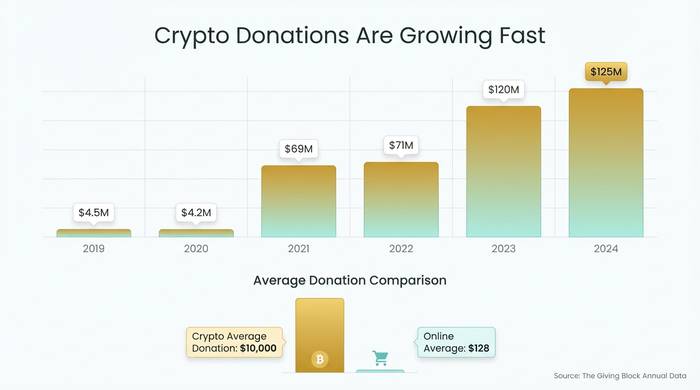
The Giving Block runs the largest crypto donation platform. In 2024 alone they moved $125 million+ to more than 2,000 nonprofits. Cumulative since their 2018 launch: north of $300 million. Fidelity Charitable has been in the game even longer, taking crypto since 2015. Their surveys tell a consistent story: 45% of people who hold crypto gave $1,000+ to charity in a year. For people without crypto the figure was 33%. The crypto crowd gives bigger checks, more often.
How much bigger? The Giving Block reports average crypto donations of $10,000 to $12,000. Compare that to the average online cash donation: about $128, per Nonprofits Source. That's a 90x gap. Some of it is self-selection. People donating crypto are often early holders with big unrealized gains. Some of it is the tax math, which changes the calculus for anyone sitting on appreciated coins.
| Metric | Number | Source |
|---|---|---|
| Pineapple Fund total donated | $55 million (86 BTC at the time) | Pineapple Fund, 2017-2018 |
| Vitalik Buterin SHIB donation to India | $1 billion+ (at peak value) | Etherscan, May 2021 |
| Ukraine crypto donations (first weeks) | $60 million+ | Ukrainian government, 2022 |
| The Giving Block 2024 donations processed | $125 million+ | The Giving Block Annual Report |
| The Giving Block nonprofits served | 2,000+ | The Giving Block, 2025 |
| Average crypto donation | $10,000-$12,000 | The Giving Block |
| Average online cash donation | ~$128 | Nonprofits Source |
| Crypto investors who donated $1K+ | 45% | Fidelity Charitable |
| General investors who donated $1K+ | 33% | Fidelity Charitable |
Why people donate crypto instead of cash: the tax angle
Tax efficiency is what makes the math work. Not the only reason people donate crypto, but the reason the amounts are so large.
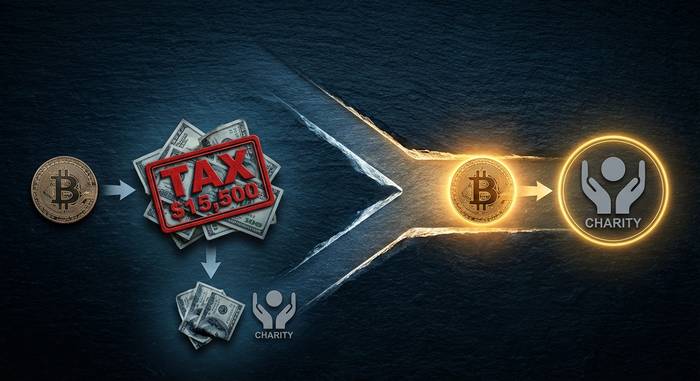
Quick example. You bought 1 BTC at $5,000. It's now worth $70,000. If you sell and donate the cash, you owe capital gains tax on the $65,000 gain first. At the top federal rate (20% plus 3.8% net investment income tax), that's about $15,500 gone before the charity sees a dime. The nonprofit gets $54,500.
Now donate the BTC directly to a 501(c)(3). Zero capital gains tax. Full $70,000 goes to the charity. You also get a tax deduction for the full market value. The charity gets more money. You keep more money. The only loser is the IRS, and this isn't even a loophole. It's the same rule that applies to stock donations. Fidelity Charitable has processed crypto this way since 2015.
The awareness gap is wild. 38% of crypto holders don't realize selling triggers taxes (Fidelity data). 55% have no idea they can donate crypto to charity at all. The tools exist, the tax math is favorable, and more than half of potential donors don't know any of this.
Why do the people who DO donate say they do it? Fidelity asked. 67% said "to do something good." 56% pointed to big gains in their holdings. 54% mentioned tax benefits. All three at once, usually. That's not cynicism. That's how tax-advantaged giving is designed to work.
Who accepts Bitcoin: the nonprofit adoption map
Ten years ago almost nobody in the nonprofit world touched crypto. That's changed a lot, but the adoption map is still patchy.
The big names are in. UNICEF set up a CryptoFund in 2019 and holds BTC and ETH directly, no immediate conversion. Save the Children took Bitcoin starting in 2013. Red Cross goes through The Giving Block. Greenpeace takes BTC. Wikipedia takes BTC via Bitpay. The EFF stopped accepting Bitcoin in 2014 because of volatility worries, then came back in 2019 when they realized the money was real.
Crypto-native giving platforms have their own lane. Endaoment runs as a DAO-based donor-advised fund. You donate crypto to them, pick from 1.5 million nonprofits to receive grants, and the fund handles everything. Gitcoin does quadratic funding rounds for open-source work, a system where small community contributions get amplified by matching pools. Binance Charity says it has moved $40 million+ for disaster relief and education.
But the friction is still brutal. 46% of crypto donors told Fidelity they had trouble finding charities that accept crypto. 44% called the process cumbersome. Half said charities wanted bigger minimum donations than they were ready to give. It's better than five years ago. It's still not easy enough for normal people.
| Organization | Accepts since | Notes |
|---|---|---|
| Save the Children | 2013 | One of the first major nonprofits |
| Electronic Frontier Foundation | 2019 (resumed) | Paused 2014-2019 over volatility concerns |
| UNICEF CryptoFund | 2019 | Holds BTC and ETH directly, doesn't convert |
| American Red Cross | ~2021 | Via The Giving Block |
| Greenpeace | 2014 | Accepts BTC directly |
| Wikipedia | 2014 | Via Bitpay |
| Endaoment (DAO) | 2020 | Routes to 1.5M+ nonprofits |
| Binance Charity | 2018 | Claims $40M+ distributed |
The donor profile: who gives crypto and why they're different
The people donating crypto don't look like traditional philanthropists. They're younger, richer in digital assets, and more likely to think of themselves as givers.
Fidelity's numbers: 35% of millennials hold crypto. 75% of them call themselves philanthropists (vs 45% of everyone else). 90% say charitable giving matters to them. These are people who grew up sending money on apps. A Bitcoin donation doesn't feel weird to them. A gala dinner does.
The gender split is stark. Crypto wealth is overwhelmingly male. The Pineapple Fund, Buterin's SHIB gift, the Ukraine wallets, all came from men or from pseudonymous accounts that communicated in ways that read male. As crypto ownership slowly diversifies, the donor pool should widen. For now it's concentrated among younger men who bought in early.
What makes crypto donors different from old-money philanthropists? Traditional big givers talk about legacy and recognition. Crypto donors talk about the math. They have appreciated assets. They understand the tax advantage. They want to do good AND they want to be smart about how. That's not cynicism. That's just a different generation applying a different framework to the same impulse.
What's working and what isn't: lessons from the biggest crypto donations
Ukraine is the clearest win. Government posted wallet addresses on Twitter. $60 million showed up in weeks. No bank wires, no SWIFT delays, no sanctions complications. Wallets from dozens of countries sent directly. For cross-border giving in a crisis, crypto beat every traditional channel by days.
Pineapple Fund worked because Pine kept it stupid simple. Pick charity, send BTC, publish receipt. No token sale, no DAO vote, no governance drama. Sixty charities got funded. Overhead was basically zero.
The Buterin SHIB donation is the cautionary tale. The headline said $1 billion. That was the peak price. By the time India's COVID fund started selling, SHIB had crashed. Actual realized value was probably $50-100 million. Still massive. But it shows what happens when you donate a volatile token and the recipient doesn't sell immediately. The gift is only worth what it's worth when they cash it.
The pattern across all of these: the ones that worked made donating simple. The ones that struggle make it feel like a crypto project. The Giving Block and Endaoment invested in making the flow feel like a normal online payment. Nonprofits that bolted crypto onto a clunky old donation page saw donors bounce.
Where crypto philanthropy is heading
Three things I'm watching that will shape the next few years.
Donor-advised funds are eating the market. Instead of sending crypto straight to a nonprofit (which means the nonprofit has to handle custody, conversion, and reporting), more people route through Fidelity Charitable, Endaoment, or The Giving Block. Donor gets the tax deduction today. Fund handles the conversion. Nonprofit gets cash. This fixes the friction problem that 44% of donors complained about.
On-chain transparency is becoming an advantage. Endaoment publishes every grant on-chain. Gitcoin's funding rounds are fully visible. When trust in traditional foundations is shaky (people got angry about nonprofit CEO salaries, remember?), being able to trace every dollar on a public blockchain starts to look really good.
Regulation is coming, and it's probably fine. The IRS now requires Form 8283 for crypto gifts over $500. Donations above $5,000 need an appraisal. The OECD's CARF framework is rolling out through 2026-2027, adding cross-border reporting for crypto flows including donations. More rules sound bad, but they also remove the uncertainty that keeps some donors on the sidelines.
Crypto philanthropy is going to keep growing because the people who hold crypto are entering their peak earning and giving years. Millennials who bought BTC in college now have careers and tax bills. The question isn't whether crypto donations become mainstream. It's whether nonprofits get their act together fast enough to accept them.