What Is the BRC-20 Token Standard and How Do Tokens Work on Bitcoin?
In March 2023, a pseudonymous developer called Domo posted a JSON snippet on Bitcoin and accidentally started a $2 billion market. The BRC-20 token standard let anyone create fungible tokens directly on the Bitcoin blockchain for the first time. Within weeks, thousands of tokens appeared. Exchanges scrambled to list them. Bitcoin transaction fees went through the roof. Binance had to pause withdrawals twice.
Two years later, BRC-20 has lost 97% of its market cap. A rival protocol called Runes, built by the same person who created Bitcoin Ordinals, has overtaken it. But the standard is still alive, still traded, and still part of a larger argument about what Bitcoin is actually for.
Here is what BRC-20 is, how it works under the hood, why it blew up, and where it stands now that the hype has moved on.
How BRC-20 works: ordinals, inscriptions, and JSON
To understand BRC-20, you first need to understand two things that came before it: the Taproot upgrade and the Ordinals protocol.
Bitcoin's Taproot upgrade went live in November 2021. Among other things, it expanded how much data a Bitcoin block could carry. Before Taproot, you were limited in what you could attach to a transaction. After Taproot, the door opened for storing larger files directly on the Bitcoin blockchain.
Casey Rodarmor took that opening and ran with it. In January 2023, he launched the Bitcoin Ordinals protocol. The idea was simple but clever: every satoshi (the smallest unit of bitcoin, one hundred millionth of a BTC) gets a serial number based on when it was mined. That serial number, or "ordinal," lets you track individual satoshis. And once you can track one specific sat, you can attach data to it -- an image, a text file, a video. That attachment is called an inscription.
Ordinals turned every satoshi into a potential container for digital content. People started inscribing art. Then memes. Then profile pictures. Bitcoin suddenly had its own version of NFTs, and the community lost its collective mind debating whether this was genius or vandalism.
Domo saw the Ordinals protocol and asked a different question: what if you inscribed not a picture, but a set of rules for a token?
That is BRC-20. Instead of storing art on a satoshi, you store a tiny JSON (JavaScript Object Notation) file that defines a fungible token. The JSON contains instructions: deploy a new token, set its max supply, let people mint it, and allow transfers. It looks like this:
That one line created ORDI, the first BRC-20 token. The "tick" is the token name. The "max" is total supply. The "lim" is how many tokens one person can mint at a time. Anyone who saw this inscription could then create their own minting transaction to claim their share.
There are three operations in BRC-20: deploy (create a new token), mint (claim tokens from a deployed token), and transfer (send tokens to another wallet). That is it. No smart contracts. No programmable logic. Just JSON files inscribed onto satoshis on the Bitcoin network.
What BRC-20 tokens are not
People hear "BRC-20" and think "like ERC-20 but on Bitcoin." Nope. The names rhyme. That is about it.
ERC-20 tokens run on Ethereum's virtual machine. Real smart contracts, real on-chain logic. You can build lending pools, DEXes, DAOs. An ERC-20 token is code that executes.
BRC-20 is text. Literally. JSON files sitting on satoshis. Bitcoin has no virtual machine. It does not run contracts. Your full node sees the inscription and shrugs. It has no idea there is a "token" there. Outside indexers -- third-party software -- read the JSON and decide who owns what.
And that is the weak spot. If two indexers disagree on balances, you have a problem. In January 2024, the two biggest ones did exactly that. UniSat and Domo backed different upgrade paths for BRC-20 after the Ordinals Jubilee update. For a short, messy window, different platforms showed different balances for the same wallets. Not great when real money is on the line.
| Feature | BRC-20 | ERC-20 | Runes |
|---|---|---|---|
| Blockchain | Bitcoin | Ethereum | Bitcoin |
| Launched | March 2023 | 2015 | April 2024 |
| Smart contracts | No | Yes (EVM) | No |
| Token data storage | JSON inscriptions (up to 4 MB) | On-chain contract state | OP_RETURN (80 bytes) |
| Validation | Off-chain indexers | On-chain EVM | UTXO-native |
| Lightning Network compatible | No | N/A | Yes |
| Interoperability | Bitcoin only | Multi-chain via bridges | Bitcoin only |
| UTXO impact | Creates junk UTXOs | N/A (account model) | UTXO-clean |
| Fungibility | Semi-fungible (fixed mint chunks) | Fully fungible | Fully fungible |
The BRC-20 boom: from experiment to $2 billion
Domo himself called BRC-20 "just a fun experimental standard." He was not being modest. He openly said better designs probably exist. The market did not care.
Within weeks of the March 2023 launch, thousands of tokens were deployed on the Bitcoin network. Most were memecoins. Some were jokes. A few, like ORDI (short for Ordinals), gained genuine traction.
OKX was the first major exchange to list ORDI in May 2023. Then Binance listed it in November 2023, and the price went vertical. By December 2023, ORDI hit $81 and briefly topped $1 billion in market cap -- the first BRC-20 token to do so. Its all-time high of $96.17 came in March 2024.
SATS, the second biggest BRC-20 token, followed a similar path. Bitget listed it in November 2023. Binance added 1000SATS in December 2023. At peak, the total BRC-20 market cap pushed past $2.2 billion.
The frenzy had real side effects. By mid-2023, BRC-20 inscriptions accounted for about 80% of all Bitcoin Ordinals activity. More than 14,000 BRC-20 tokens were deployed. Bitcoin's mempool was jammed. Transaction fees spiked so hard that Binance paused BTC withdrawals twice.
Miners, naturally, were thrilled. Inscription activity generated over 7,016 BTC ($628 million) in cumulative fees by February 2025, according to Bitget data. For an industry worried about miner revenue after the halving, BRC-20 was a surprise windfall.
| Token | Peak price | Peak market cap | Current price (Apr 2026) | Current market cap | Decline from peak |
|---|---|---|---|---|---|
| ORDI | $96.17 (Mar 2024) | ~$1.46B | $2.34 | $49.2M | -97.5% |
| SATS | ~$0.90 (Dec 2023) | ~$450M | $0.071 | $23.4M | -92% |
| All BRC-20 | -- | ~$2.2B | -- | ~$74M | -96.6% |
The problems nobody warned you about
BRC-20 works, technically. But "works" comes with a long list of asterisks.
Start with UTXO bloat. Every BRC-20 mint creates a new UTXO on Bitcoin. Most of them are junk -- tiny, useless outputs that Bitcoin nodes still have to carry around forever. Flood the chain with enough mints and you make life worse for every node operator, not just BRC-20 users. The Bitcoin maximalists were right to be annoyed.
Minting is a fee war. When a hot new token drops, everyone races to inscribe their mint transaction first. Fees go crazy. In May 2023 alone, miners banked 2,749 BTC in fees during a BRC-20 rush. Regular users trying to send $50 in BTC found themselves paying $15 in fees to do it.
Sending tokens is weird. BRC-20 only lets you transfer in fixed chunks that match the original mint limit. Minted 1,000 ORDI? You send 1,000 at a time. Want to send 500? Tough. You have to split the inscription first. Buyer and seller amounts have to match exactly. Nobody coming from Ethereum or Solana expects this, and the first time it bites you, it is not fun.
Then there is the indexer problem. I mentioned it above but it is worth repeating. In January 2024, UniSat and Domo picked opposite sides of an Ordinals upgrade and for a while different platforms were showing different balances for the same wallets. Your BRC-20 tokens are only as real as the indexer you look at.
Runes: the protocol that ate BRC-20's lunch
Rodarmor watched BRC-20 blow up and hated what it did to his chain. Junk UTXOs everywhere. Network backed up. Indexer drama. He had built Ordinals to let people put stuff on Bitcoin, not to clog it.
So he made something better. Runes went live on April 20, 2024 -- the exact block of Bitcoin's fourth halving. He was making a statement. And the design changes were brutal:
Where BRC-20 inscribes JSON files that can take up to 4 MB of block space, Runes stores token data in OP_RETURN fields using just 80 bytes per transaction. Where BRC-20 creates junk UTXOs, Runes is UTXO-native and clean. Where BRC-20 cannot work with the Lightning Network, Runes can. Where BRC-20 needs off-chain indexers, Runes validation is closer to Bitcoin's own UTXO logic.
People piled in fast. Within 10 days, Runes ate over 50% of Bitcoin block space. April 20, 2024 set the record for the highest average tx fee in Bitcoin history: $127.97. Median fee rates blew up from 100 to 1,805 sat/vB overnight. Miners pocketed around 2,500 BTC (~$170 million) in just the first week.
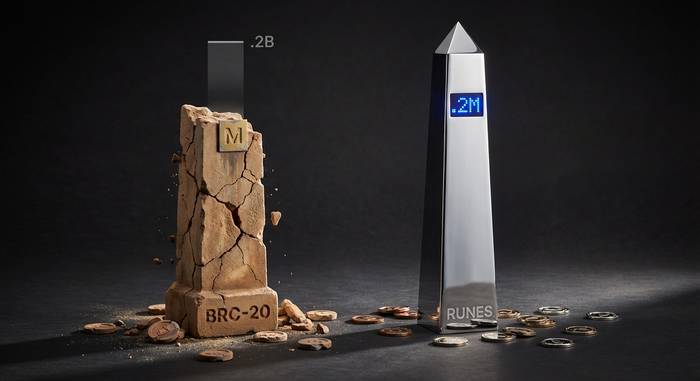
By April 2026, Runes has overtaken BRC-20 in market cap: $91.2 million vs $74 million. The top Runes token, DOG (a memecoin, naturally), holds a $71.7 million market cap by itself -- larger than ORDI.
| Metric | BRC-20 (Apr 2026) | Runes (Apr 2026) |
|---|---|---|
| Market cap | $74M | $91.2M |
| 24h volume | $22M | $11.8M |
| Tokens tracked (CoinGecko) | 21 | 30 |
| Top token | ORDI ($49.2M) | DOG ($71.7M) |
| Data footprint per tx | Up to 4 MB | 80 bytes |
| Lightning compatible | No | Yes |
| UTXO bloat | Yes | No |
Who still uses BRC-20 and why
BRC-20 is not dead, though. About $22 million still moves through the category each day. ORDI and SATS sit on Binance, OKX, Bitget, Gate.io. Real order books. Real buyers and sellers. Both are down 95%+ from their highs, but they are still trading.
Why? ORDI was the first fungible token on Bitcoin. That "first" label carries weight in crypto, even when the price does not. Wallets like Xverse, Leather (Hiro), and OKX's Web3 wallet still support BRC-20 alongside Ordinals and Runes, so the plumbing works. And let us be honest: a token down 97% from ATH is catnip for degens betting on a bounce.
But the honest picture is that BRC-20's window as the leading Bitcoin token standard has closed. Runes is technically better in every measurable way. The broader Ordinals ecosystem (80 million+ inscriptions by February 2025) is healthy, but most of the new fungible token activity flows through Runes, not BRC-20.
The bigger question: should Bitcoin do this at all?
This is the fight that will not go away. Bitcoin was built to be electronic cash. Satoshi's white paper says zero about jpegs, memecoins, or tokens inscribed on satoshis. For a lot of Bitcoiners, BRC-20 and Ordinals are just spam. Block space abuse. Fee inflation for everyone else.
I get that argument. But miners need to eat. The block reward halves every four years. When it hits zero around 2140, fees are all that is left. Inscriptions have already sent $628 million to miners. On the halving block itself (April 2024), fees were 18.62 BTC on top of the 3.125 BTC block reward. You can call that spam. Miners call it rent.
There is a simpler way to look at it. If Bitcoin is permissionless, then block space is for whoever pays for it. Jpegs, tokens, memes, financial transfers -- the protocol does not judge. People who want to restrict which transactions are "allowed" on Bitcoin are missing the point of a permissionless system.
You can hate BRC-20. You can think it is a dumb use of block space. But the network does not care what you think. It takes your fee and processes your transaction.
How to buy and store BRC-20 tokens
Two ways in. Pick your comfort level.
Easy route: buy ORDI or SATS on Binance, OKX, or Bitget. Same as buying any coin. No special wallet. No inscriptions. Just place an order.
Hard route: get a Bitcoin wallet that handles Ordinals. Xverse or Leather (used to be called Hiro) both work. OKX has an Ordinals marketplace built into its Web3 wallet. Load some BTC for fees and you can mint, transfer, and trade BRC-20 tokens directly on-chain. Expect to fumble the first time. The UX is not pretty.
Fair warning: Domo himself called BRC-20 experimental. Out of 14,000+ tokens deployed, only 21 show any life on CoinGecko. ORDI and SATS are the only ones with real depth in their order books, and both are down 95%+ from peak. This is not a savings account.
What comes next for BRC-20
BRC-20 will not vanish. ORDI and SATS have exchange listings, community, and name recognition. But the standard is getting smaller, not bigger.
Runes does the same job more cleanly. Ordinals keep growing as a home for NFTs and digital artifacts on Bitcoin. ARC-20 (Atomicals) and SRC-20 (Stamps) are carving their own niches. If Layer 2 networks like Stacks or Lightning mature, the idea of cramming token data into base-layer blocks might start to look like using a cargo ship to deliver a letter.
What BRC-20 did for Bitcoin matters more than what happens to BRC-20 itself. For 14 years Bitcoin was digital gold and that was the end of the conversation. Domo scribbled a JSON file on a sat and suddenly everybody had to rethink what this chain could do. Memecoins on Bitcoin. NFTs on Bitcoin. Fungible tokens on Bitcoin. The most conservative blockchain in crypto is now the most argued-about.
BRC-20 proved a point. Bitcoin's block space can hold more than just payments. That idea is not going back in the box, no matter what happens to ORDI's price.