Haiper AI video generator: transform text and images into video with AI
Two former DeepMind researchers walked out of Google, raised $32.6 million, got Geoffrey Hinton himself as an advisor, built an ai video generator that attracted 4.5 million users, and then watched it all fall apart in early 2025 when both cofounders left for Microsoft and the company was sold for parts.
Haiper AI is one of those stories that tells you everything about how brutal the AI market really is. A well-funded startup with genuine talent and real technology could not survive the competitive pressure from Runway, Kling, and Pika. The consumer app went dark in February 2025. The tech got acquired by NetMind.AI. The founders are now working at Microsoft AI.
So why write about a dead product? Because what Haiper built was genuinely good, what killed it matters for anyone watching the ai video space, and the lessons apply to every AI tool you might be using right now. This article covers what Haiper AI was, how its technology worked, what went wrong, and where the AI video market stands in 2026 after Haiper's exit.
What Haiper AI is and who built it
Haiper AI was an ai video generator that created videos from text prompts, images, or existing video clips. It was founded in London by Yishu Miao and Ziyu Wan, both with PhDs in machine learning from Oxford and both former Google DeepMind researchers. The advisory board included Geoffrey Hinton, the "godfather of deep learning" and Turing Award winner, and Nando de Freitas, a DeepMind principal scientist. The team peaked at about 18 people.
Funding came in two rounds: a $5.4 million pre-seed in April 2022 (Hinton was an angel investor) and a $13.8 million seed round led by Octopus Ventures in March 2024. Total raised: roughly $32.6 million. For context, Runway pulled in over $200 million. Pika Labs raised $80 million. Haiper was lean but had pedigree that most competitors could not match.
The platform worked the way you would expect. You could use haiper ai through a browser-based web app or an API. Type a text description, pick a style, click generate. Results came back in 30-90 seconds. No technical skills needed. The last active version, Haiper 2.5, shipped in December 2024 with VEED integration and improved API access. Two months later, it was gone.
How to use Haiper AI: the creation workflow
Using haiper ai starts at haiper.ai. Sign up with Google or Discord. The dashboard gives you six tools:
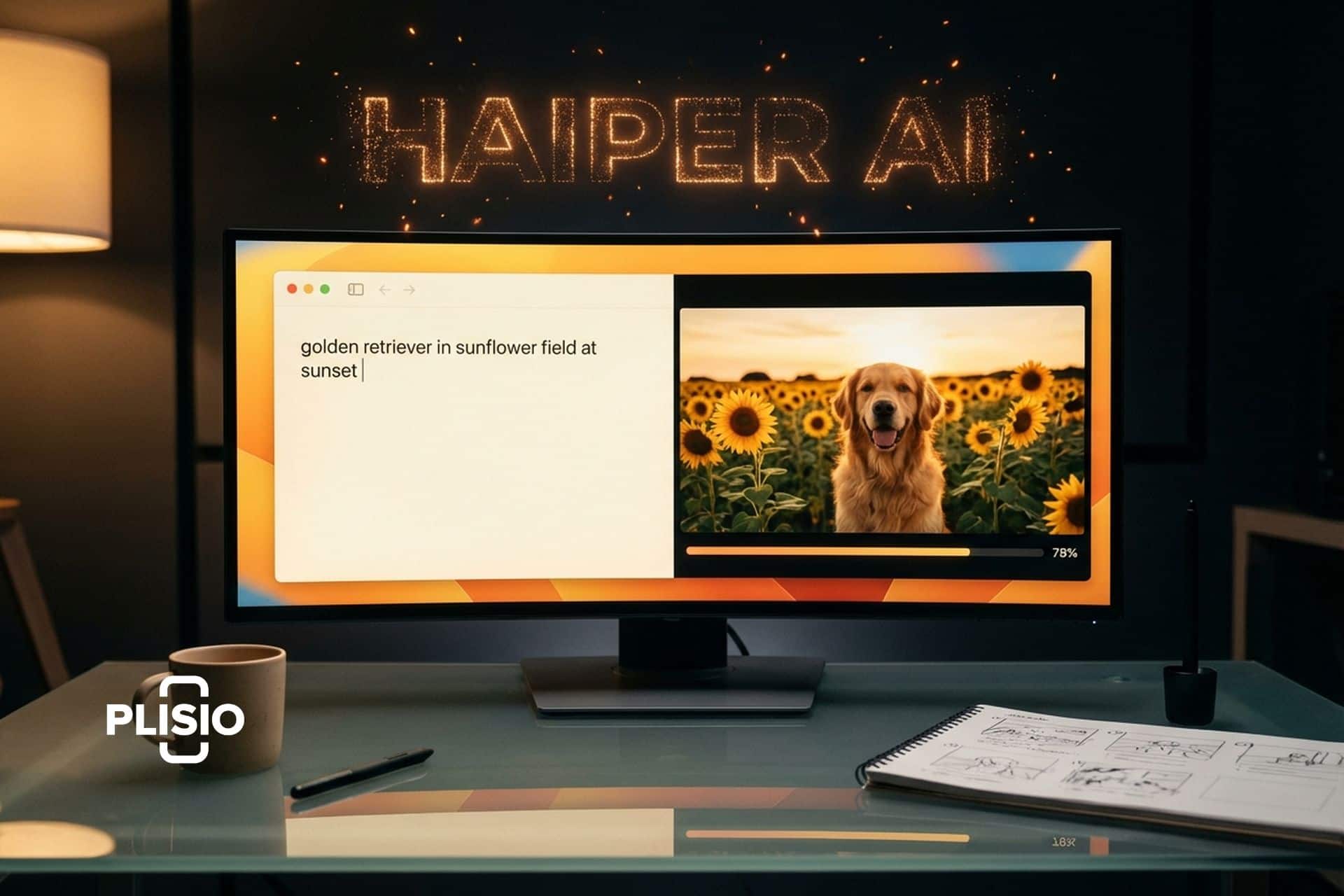
Text-to-Video. Write a detailed text description of what you want to see. "A golden retriever running through a field of sunflowers at sunset, camera following from behind, warm tones." Haiper AI turns that prompt into a video clip. The more specific your prompt, the better the output. Vague prompts produce vague results.
Image-to-Video. Upload a still photo and Haiper animates it. A landscape gets moving clouds. A portrait gets subtle head movement. A product shot gets a slow rotation. This feature works best with images that have clear depth and identifiable subjects.
Video-to-Video. Feed in an existing clip and apply a new style. Turn a phone video into a watercolor animation or a cyberpunk aesthetic. The AI preserves the motion from your original footage while restyling every frame.
Extend Duration. Take a short clip and make it longer. Haiper generates continuation frames that match the original content and motion. Useful when you need a 6-second clip but only have 3 seconds worth of good output.
Video Enhancer. Upscale resolution, improve color, sharpen details. Takes a draft quality clip and pushes it closer to production quality.
AI Sound. Automatically adds music and sound effects that sync with the video content. A fireworks video gets explosion sounds. A forest scene gets ambient bird calls.
The free tier gives you limited generations with watermarks. Paid plans start at around $15 per month for the Pro tier with unlimited generation and no watermarks. Business users pay $50 per month for team tools and priority processing.
| Haiper AI pricing | Monthly cost | Key features |
|---|---|---|
| Free | $0 | Limited generations, watermarks, basic tools |
| Pro | ~$15/month | Unlimited generation, no watermarks, all tools |
| Business | ~$50/month | Pro features + team tools + priority processing |
| Enterprise | Custom | API access, dedicated support, custom models |
The technology behind Haiper AI video generation
Under the hood, Haiper runs a proprietary diffusion model. Same family of technology as Stable Diffusion and Midjourney, but tuned for temporal coherence. Generating a single image is hard. Generating 24 consecutive images per second where every frame has to match the one before it? Orders of magnitude harder. A tiny inconsistency in a photo is invisible. That same inconsistency in a video becomes a flicker, a morph, a face that drifts between two identities over half a second.
Haiper 2.0 shipped in late 2024 and it was a real upgrade. The motion physics improved noticeably. Objects now accelerate and decelerate in ways that feel physically plausible instead of gliding like they are on ice. People walking through a scene keep the same face and body proportions from frame to frame, which sounds basic until you try the free ai generators that turn every person into a shape-shifting nightmare by frame 20. And the prompt parsing got smarter. "A cat on a table" and "a cat jumping off a table" now produce different videos instead of the same static cat.
Resolution goes up to 1080p. Clip lengths run 2-8 seconds depending on your plan. That feels short, but even Sora from OpenAI caps around 20 seconds and costs more. In this field, every coherent second of video represents billions of computations. Eight seconds of smooth footage is genuinely hard to produce.
Limitations are real and worth talking about. Water physics look wrong about half the time. Fabric blowing in wind often looks more like a flag made of jelly than cotton. Multiple people interacting in the same shot? Roll the dice. Hands still grow extra fingers in maybe one out of five generations. Background faces smear into abstract art. None of this is unique to Haiper. Runway does it too. Sora does it too. Kling does it too. The entire ai video generation field is at the "impressive but imperfect" stage. Anyone who tells you different is selling you something.
I think Haiper's honest positioning is what makes it work. They do not promise Hollywood quality. They promise "good enough for social media, marketing, and first-draft creative work." That promise they deliver on.
What happened to Haiper AI: the 2025 collapse
In March 2025, cofounders Yishu Miao and Ziyu Wang left Haiper to join Microsoft AI as members of technical staff. Top ML researcher Edward Hayes followed them. A month earlier, in February 2025, the consumer web app had already gone dark. Users who logged in found 404 errors where their projects used to be. No warning, no migration path, no "we are shutting down" email. The tools just disappeared.
This was not a traditional acquisition. Microsoft did not buy Haiper. They hired the key people and let the company collapse behind them. The industry calls this an acqui-hire, but even that term is generous. It was closer to a talent raid.
NetMind.AI, a London-based decentralized AI compute platform, picked up the pieces. They acquired Haiper's video generation models for an undisclosed sum and planned to recruit the remaining staff. The technology lives on in some form, but the consumer product is dead.
What killed Haiper? The short answer: competition and cash. Runway had $200+ million and deep enterprise relationships. Kling AI from Kuaishou had the backing of a $50 billion Chinese tech company. Pika raised $80 million. Haiper's $32 million was not enough to sustain the GPU costs, model training runs, and free tier that an AI video platform requires to survive. The product was good. The economics were not.
And Haiper is not alone. Sora, OpenAI's flagship video generator, announced its own shutdown for April 26, 2026. Even with billions in backing, sustaining a standalone AI video product is brutally expensive. The market is consolidating fast.
| Company | Status (April 2026) | What happened |
|---|---|---|
| Haiper AI | Shut down | Founders left for Microsoft, tech sold to NetMind.AI |
| Sora (OpenAI) | Shutting down Apr 26 | Folding into broader ChatGPT product |
| Runway Gen-4 | Active | Leading professional market |
| Kling AI 3.0 | Active | Best price-to-quality ratio |
| Pika 2.0 | Active | Strong in short-form stylized content |
| Luma Ray3 | Active | 3D spatial awareness, HDR export |
What Haiper AI could do (before shutdown) and how the competition compares
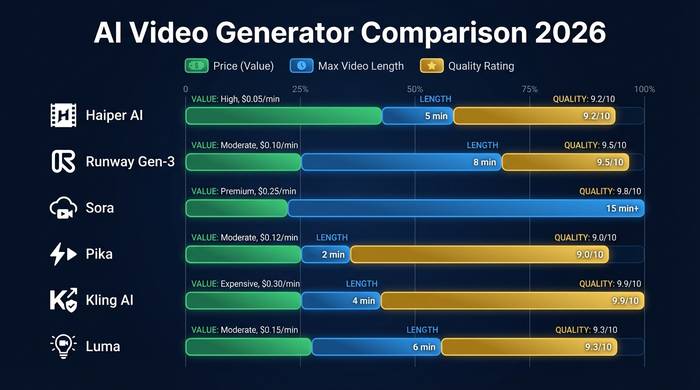
The ai video generation market got crowded fast. Here is how Haiper stacks up against the tools people actually compare it to:
| AI video generator | Status (Apr 2026) | Best for | Price (monthly) | Max length | Resolution |
|---|---|---|---|---|---|
| Haiper AI | Shut down | Was: quick content, social media | Was: $0-24 | ~8s | Up to 1080p |
| Runway Gen-4 | Active | Professional editing workflows | $12-76 | ~10s+ | Up to 4K |
| Sora 2 | Shutting down | Photorealistic, cinematic | $20-200 (via ChatGPT) | ~20s | Up to 1080p |
| Pika 2.0 | Active | Short-form stylized content | $8-70 | ~12s | Up to 1080p |
| Kling AI 3.0 | Active | Best value, longest clips | $7-37 | ~2 min | Up to 4K |
| Luma Ray3 | Active | 3D awareness, HDR export | Free-$100 | ~10s | Up to 4K + HDR |
The AI video market looks completely different than it did when Haiper launched in March 2024. Kling AI emerged as the price-to-quality leader: $0.07 per second of generated video, support for 2-minute clips, and simultaneous audio generation that nobody else has shipped yet. Runway Gen-4 owns the professional market with Motion Brush, inpainting, and deep integration into post-production workflows. Pika found its niche in punchy, stylized short-form content.
Haiper filled the gap between free garbage tools and expensive professional suites. At $8-24 per month, it was genuinely accessible. The free tier worked without a credit card. For the audience that just needed "good enough" social content fast, Haiper was the right tool at the right price. The problem: "good enough and cheap" is not a defensible position when larger competitors can match your price while offering better quality.
Anyone who was using Haiper before the shutdown needs a migration plan. Kling AI at $7 per month is the closest match on price and features. Pika at $8 per month works for short stylized content. Runway at $12+ per month is the upgrade path for anyone ready to pay more for better control.
The ai video generator market is expected to grow beyond $2 billion by 2027. Every major tech company is investing in this space. Google has Veo. Meta has Make-a-Video successor models. ByteDance backs Kling through Kuaishou. Adobe integrated AI video into Premiere. The race is not about who can generate a pretty clip anymore. It is about who can generate controllable, consistent, production-ready footage that human editors can actually work with.
Haiper AI offers a solid entry point for people who want results now without waiting for Sora access or paying Runway prices. The free ai tier makes it genuinely accessible. For serious production work, Runway and Kling are ahead. For casual content and quick concepts, Haiper is hard to beat at the price point.
The honest truth about all of these tools: none of them are ready to replace a video production crew. They are ready to replace stock footage, create first-draft concepts, and generate video content for platforms where 6 seconds of attention is all you get.

How AI video is changing creative industries
The impact of tools like Haiper stretches far beyond tech early adopters.
Marketing agencies that used to spend $5,000-$20,000 per video ad now generate draft concepts in minutes using ai video generators. A brand can test 10 different visual approaches to a campaign before committing any production budget. The client picks the winner, a human editor refines it, and the final product costs a fraction of what it would have 3 years ago.
E-commerce sellers create product videos from a single photograph. Upload a photo of a handbag, type "rotating view on white background with soft shadows," and Haiper generates a 6-second product spotlight. Amazon and Shopify sellers use this daily.
Social media managers generate video content for platforms that reward video over static images. TikTok, Instagram Reels, YouTube Shorts all prioritize video in their algorithms. Create videos from text prompts instead of hiring a videographer for every post. The math works out for anyone managing multiple accounts.
Education content gets visual support without film budgets. A professor explaining plate tectonics can generate a visualization in 60 seconds instead of licensing a stock animation or drawing on a whiteboard. Online course creators use tools like Haiper to add visual variety to talking-head lectures that would otherwise put students to sleep.
Freelance video editors are adding AI generation to their service offerings. Instead of competing on editing speed alone, they now offer "concept generation" packages where they create 10-20 AI draft clips for a client before touching a single frame of real footage. The client picks a direction, the editor shoots and edits the final version. The AI compressed the concepting phase from a week to an afternoon.
Real estate agents generate virtual walkthroughs from still photographs. Musicians create visualizers for tracks without hiring a motion graphics artist. Wedding videographers use AI to fill gaps in coverage where they did not have a camera rolling. The use cases multiply because video content is what every platform algorithm rewards in 2026.
The ethical side is real too. Deepfakes generated by video AI tools can spread misinformation. Haiper adds watermarks on free content and follows content moderation guidelines. But the technology itself does not care about intent. The same tool that makes marketing B-roll can produce misleading footage of people who never said what the video shows them saying. Regulation is playing catch-up. The EU AI Act addresses some of this. The US is still debating.
Lessons from Haiper AI for anyone using AI video tools
Haiper's collapse teaches three things that apply to every ai video generator on the market right now.
First: your content is not safe on any platform. Haiper users lost access to their projects overnight with no warning. If you are building a content library on any AI video platform, download your outputs immediately after generation. Do not assume cloud storage is permanent. Runway, Kling, Pika could all change their terms, shut down features, or pivot away from consumer products tomorrow.
Second: price and pedigree do not guarantee survival. Haiper had DeepMind alumni, a Turing Award winner as advisor, $32 million in funding, and 4.5 million users. None of that mattered when the cofounders got a better offer from Microsoft. The AI talent market is so competitive that a single recruitment call can kill a startup.
Third: the AI video market is consolidating. Haiper is gone. Sora is shutting down. The survivors in 2026 are platforms backed by either massive capital (Runway, Kling's parent Kuaishou) or strong product-market fit in a specific niche (Pika for short-form, Luma for 3D). If you are betting your workflow on any AI tool, have a backup plan.
For anyone who was using Haiper or is evaluating ai video generators in 2026, the practical advice is simple: try Kling AI for the best value, Runway for professional work, and Pika for quick stylized content. Haiper AI showed what was possible at the $8-24 price point. The tools that survived offer the same or better.