MakerDAO and DAI: Decentralized Finance Cryptocurrency Guide
Open a DeFi tracker today and search for "MakerDAO." You will probably think the project quietly disappeared. The brand on most dashboards now reads Sky. The protocol behind that new label is in fact larger than ever. As of April 11, 2026, its two stablecoins, USDS and DAI, hold a combined $13.4 billion in supply, making Sky the third largest stablecoin issuer in the world behind Tether and Circle. The label changed. The machinery did not.
This guide walks through what MakerDAO actually is, how the Maker Protocol mints DAI from cryptocurrency collateral, why MKR token holders matter, what the Sky rebrand changed, and where the project sits in the DeFi landscape of 2026. The goal is to give a complete picture without the jargon wall that usually surrounds this topic.
What Is MakerDAO and How Does the Maker Protocol Work?
Strip away the jargon and MakerDAO is basically a community-run pawn shop that lives on Ethereum. A Danish founder named Rune Christensen started building it back in 2014, and the full multi-collateral version went live in late 2017. The point of the whole thing was to mint a digital dollar that nobody could freeze or shut off, because no bank held cash in a vault behind it.
Here is how the makerdao system actually works for a normal user. You walk in (online), drop crypto into a smart contract, and walk out with freshly minted DAI. Pay a fee when you come back to claim your collateral, and the borrowed DAI you return is destroyed on the spot. No credit checks. No paperwork. Nothing gets approved by a banker in Manhattan. Anyone with an Ethereum wallet and some collateral can do it, and the rules are the same for everyone because the rules are just code.
The Maker Protocol itself is that code. It is the bundle of smart contracts that holds collateral, mints new DAI, charges the stability fee, runs liquidations when things go sideways, and counts the governance votes. Sitting on top of it is the actual makerdao organization, which is really just MKR token holders proposing and voting on changes. That voting layer is what turns a DeFi platform into a DAO.
DAI Stablecoin: A Decentralized Alternative to USDC
DAI is the product most people interact with. DAI is a stablecoin and an ERC-20 token on the Ethereum blockchain that aims to trade at one US dollar at all times. The value of 1 DAI should always sit close to one dollar, regardless of how volatile the market price of crypto becomes. Unlike USDT or USDC, which are issued by private companies that hold dollars and short-term Treasuries in regulated bank accounts, DAI is created when a user locks crypto collateral into a smart contract. This makes it a genuinely decentralized cryptocurrency rather than a tokenized version of an existing bank balance.
That difference matters. Tether and Circle can freeze tokens, comply with subpoenas, and choose who gets to redeem. The Maker Protocol cannot, because there is no central operator with that power. The trade-off is that DAI relies on the price stability of its collateral assets and on the discipline of MKR voters who set risk parameters.
DAI has been a top decentralized cryptocurrency for years. As of April 2026 its market cap sits around $4.66 billion, holding roughly seventh place among all stablecoins and first among genuinely decentralized ones. The newer USDS, also issued by Sky, has overtaken DAI in raw size at $8.7 billion, but most DeFi users still treat DAI as the original.
| Stablecoin | Issuer | Market cap (April 2026) | Backing model |
|---|---|---|---|
| USDT | Tether | $184.1B | Cash and short-term US Treasuries |
| USDC | Circle | $78.8B | Cash and short-term US Treasuries |
| USDS | Sky (ex-MakerDAO) | $8.7B | Crypto, RWA, and PSM collateral |
| DAI | Sky (ex-MakerDAO) | $4.7B | Crypto, RWA, and PSM collateral |
Sources: Bitcoin.com News, CoinMarketCap, April 2026.
Inside MakerDAO Vaults and the Collateral System
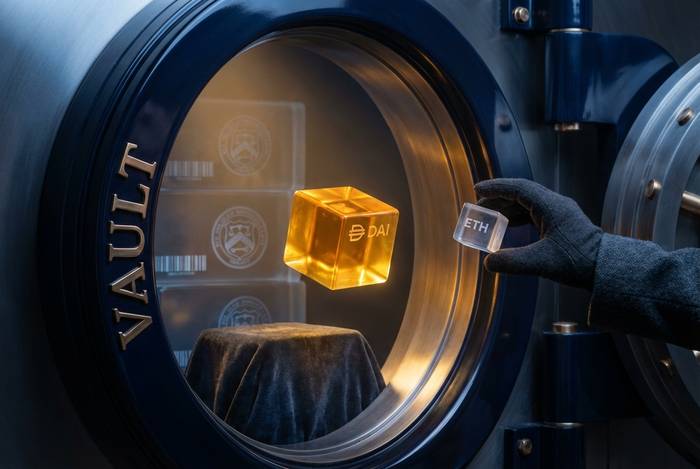
A MakerDAO Vault is the workhorse of the system. To mint DAI, you open a Vault, deposit a supported collateral asset such as ETH or wBTC, and borrow DAI against it. To unlock your collateral, you repay the DAI plus a stability fee. When you repay, the borrowed DAI is destroyed, which keeps the supply of DAI roughly tied to the value backing it.
Every Vault is overcollateralized. The exact ratio depends on the collateral type, but the protocol typically requires at least 150% backing, and most users keep their Vaults closer to 200% or 300% to stay safe. Borrow $1,000 in DAI against ETH and you might lock $2,000 to $3,000 worth of ETH. The buffer absorbs market volatility without instantly triggering a liquidation when prices wobble.
If the collateral asset drops too far, the Vault becomes unsafe and the protocol auctions the collateral to keepers. Keepers are independent bots that bid in DAI to settle the Vault's debt. Whatever is left after debt and a liquidation penalty are paid goes back to the original owner. This is how the protocol stays solvent without any human dispatcher in the loop.
Collateral is no longer limited to crypto. Since 2021, MakerDAO has accepted real-world assets such as tokenized US Treasuries, private credit funds, and structured products from BlackRock and Janus Henderson. These RWA positions back roughly $948 million of reserves, about 14% of the total, and they generate the largest single share of protocol revenue.
MKR Token, Token Holders, and Decentralized Governance
The MKR token is the governance backbone. MKR holders vote on every meaningful parameter: which assets are accepted as collateral, how much DAI each Vault type can mint, the stability fee charged on loans, the Dai Savings Rate, and whether to add or remove keepers. Governance happens in two stages: a Governance Poll for sentiment, then an Executive Vote that actually changes the smart contracts.
When the system runs at a loss, for example after a violent crash in the price of ETH leaves Vaults underwater, the protocol sells DAI minted from new MKR tokens to cover the gap. That dilutes mkr holders, which is the financial pressure that keeps voters honest. When the protocol earns more than it spends, the surplus is used to burn MKR tokens off the market, shrinking the total supply of MKR and pushing mkr value upward over time. The number of MKR tokens in circulation has never had a hard cap, but governance has historically tried to keep it close to the original 1 million MKR tokens issued at launch.
This is the original elegance of the design. Token holders carry the upside if the protocol thrives and the downside if they vote irresponsibly. The 2020 flash-loan governance incident, when an attacker used borrowed MKR to push through a malicious proposal, forced Maker to add a 24-hour delay between approval and execution. No comparable governance compromise has hit the protocol since.
Dai Savings Rate: How DSR Steers DAI Demand and Volatility
The Dai Savings Rate, or DSR, is the protocol's monetary lever. Lock DAI in the DSR contract and you earn interest paid in fresh DAI. MKR governance sets the rate, and they raise or lower it to influence demand for DAI itself. When DAI trades below a dollar, raising the DSR pulls coins out of circulation by giving people a reason to lock them up. When DAI trades above a dollar, lowering the rate pushes supply back into the market.
This is the same playbook a central bank uses with overnight rates, except every move is voted on in public, and anyone can read the contracts that enforce it. Under the Sky brand, the DSR has been replaced by the Sky Savings Rate (SSR) on sUSDS. The current SSR sits at 3.75% as of 2026, down from peaks of 6 to 8% during the 2024 high-rate cycle when US Treasury yields were keeping RWA collateral very profitable.
The savings rate is also one of the few yields in DeFi that does not depend on token incentives or risky leverage. It comes straight from the protocol's revenue, which makes it easier to compare with traditional money market funds. That simplicity is part of why USDS has grown so quickly: the SSR is a clear, native yield, not a marketing trick.
Maker Price, MKR Voters and How People Use DAI
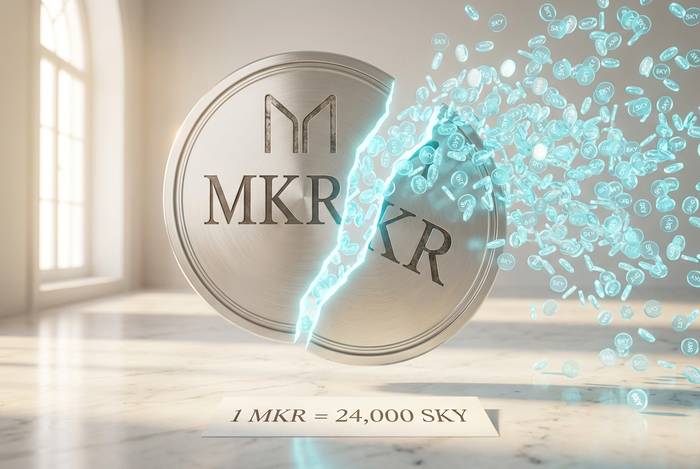
A lot of traders still pull up "maker price" out of habit, even though the ticker they are really watching is now SKY. The migration started on September 18, 2024 and swaps every MKR for 24,000 SKY. As of April 2026 SKY hovers near $0.078 with a market cap around $1.81 billion, which puts it close to rank 41 on CoinMarketCap. That is about 13% below where it opened at $0.09, which is a strange story considering the protocol's stablecoin supply almost doubled in the same window.
What did not change is the job those voters do. SKY holders set risk parameters, pick which RWA partners get capital, and sign off on every new SubDAO. Plenty of users never bother. They just want DAI for the same reasons they always wanted DAI: paying a contractor who does not want crypto volatility on their balance sheet, holding dollars between trades, providing liquidity on a DEX, or borrowing against ETH without ever selling the ETH.
The everyday use cases for DAI in 2026 look almost exactly like they did in 2021. Someone might borrow DAI on Aave or Spark to earn lending interest. Someone else might park it in a yield strategy, or use it to settle a freelance invoice through one of the 400-odd DeFi protocols that integrate it. In countries with shaky local currencies, DAI keeps showing up as informal dollar savings. DAI can be used on most major cryptocurrency exchanges and swapped freely against any other DeFi applications without asking anyone. The amount of DAI floating around tends to rise and fall with the broader crypto market, which is half the reason the protocol pushed so hard into RWA collateral in the first place.
MakerDAO Becomes Sky: The Endgame Rebrand Explained
The biggest change in the project's history was not technical, it was branding. In 2022, founder Rune Christensen published the Endgame plan, a multi-year roadmap to scale the protocol into a network of specialized SubDAOs and eventually launch its own application chain. Phase 1 of Endgame went live in August 2024 with the rebrand to Sky.
Under the rebrand, MakerDAO became Sky Protocol, MKR became SKY at a fixed 1:24,000 ratio, and a new stablecoin called USDS launched alongside DAI. USDS is functionally similar to DAI but ships with the Sky Savings Rate by default and is positioned as the protocol's growth product. DAI is not deprecated. It still exists, still trades at one dollar, and users can convert between USDS and DAI freely inside the Sky app.
The first SubDAO, SparkDAO, launched its SPK token on June 17, 2025 with a 300 million token airdrop. Spark now manages roughly $7.9 billion in TVL across SparkLend and the Spark Liquidity Layer, and it has deployed $3.86 billion across DeFi, CeFi, and real-world asset strategies. Future Endgame phases will add more SubDAOs, expand to Layer 2 networks, and eventually launch NewChain, a Maker-branded Layer 1 designed to host SubDAO infrastructure.
| Endgame milestone | Date | Status |
|---|---|---|
| Endgame plan published | June 2022 | Done |
| MKR to SKY swap launched | September 2024 | Live, ongoing |
| USDS stablecoin launched | September 2024 | Live |
| SparkDAO + SPK token | June 2025 | Live |
| L2 expansion (Base, Arbitrum, Optimism) | 2025–2026 | In progress |
| NewChain L1 launch | TBD | Planned |
Sources: DL News, Sky docs, Messari, OKX Learn.
Risks of MakerDAO and the DAI Token in Practice
No protocol is risk free, and Sky is no exception. The biggest worry historically has been collateral quality. When more than half of DAI's backing once came from centralized USDC, a US regulator could in theory have frozen those reserves and broken the peg overnight. The shift toward tokenized treasuries and a more diversified collateral basket reduces that exposure, though it does not erase it.
Then there is the technical layer. The Maker Protocol relies on price feeds from a network of oracles to decide when to liquidate Vaults. A bad price feed, a manipulation attack, or a contract bug could trigger wrongful liquidations or, worse, allow unbacked DAI to be minted. The protocol has paid for multiple audits and runs an active Immunefi bug bounty, but the risk never goes to zero.
Governance is the part most users underestimate. SKY voters have enormous power over the protocol, and a determined whale or coordinated group could in theory push through a harmful proposal. The 2020 flash-loan incident is the cautionary example everyone in the space remembers. Today's safeguards include the GSM delay, an emergency pause module, and the dilution mechanism that punishes irresponsible voting. Investors should still read governance forums before assuming the system runs itself.
Why MakerDAO and DAI Still Matter for DeFi in 2026
Plenty of DeFi projects come and go. Forks of forks, six-month experiments, the occasional spectacular blow-up. What separates Sky, formerly MakerDAO, from that crowd is boring: it has been live for nearly a decade, it survived the 2022 wipeout, and it actually earns money. Sky reported about $435 million in annualized revenue back in December 2025, and roughly 70 cents of every dollar came from off-chain stuff like Coinbase USDC rewards and tokenized treasury funds.
So why bother caring about MakerDAO and DAI in 2026? Because the protocol does the unglamorous work that crypto kept promising and rarely delivers. It issues a decentralized stablecoin people actually use across the DeFi ecosystem. It collects real fees from real users. It pays them back through MKR buybacks and SubDAO airdrops. Call it MakerDAO, call it Sky, the answer is the same: this is a credit and savings machine that has been running on Ethereum for almost ten years and has never lost user funds in a protocol-wide failure. Most crypto projects do not see their second birthday. That gap is the thing to pay attention to.