Germany Crypto Tax Guide 2026: Tax Return for 2025
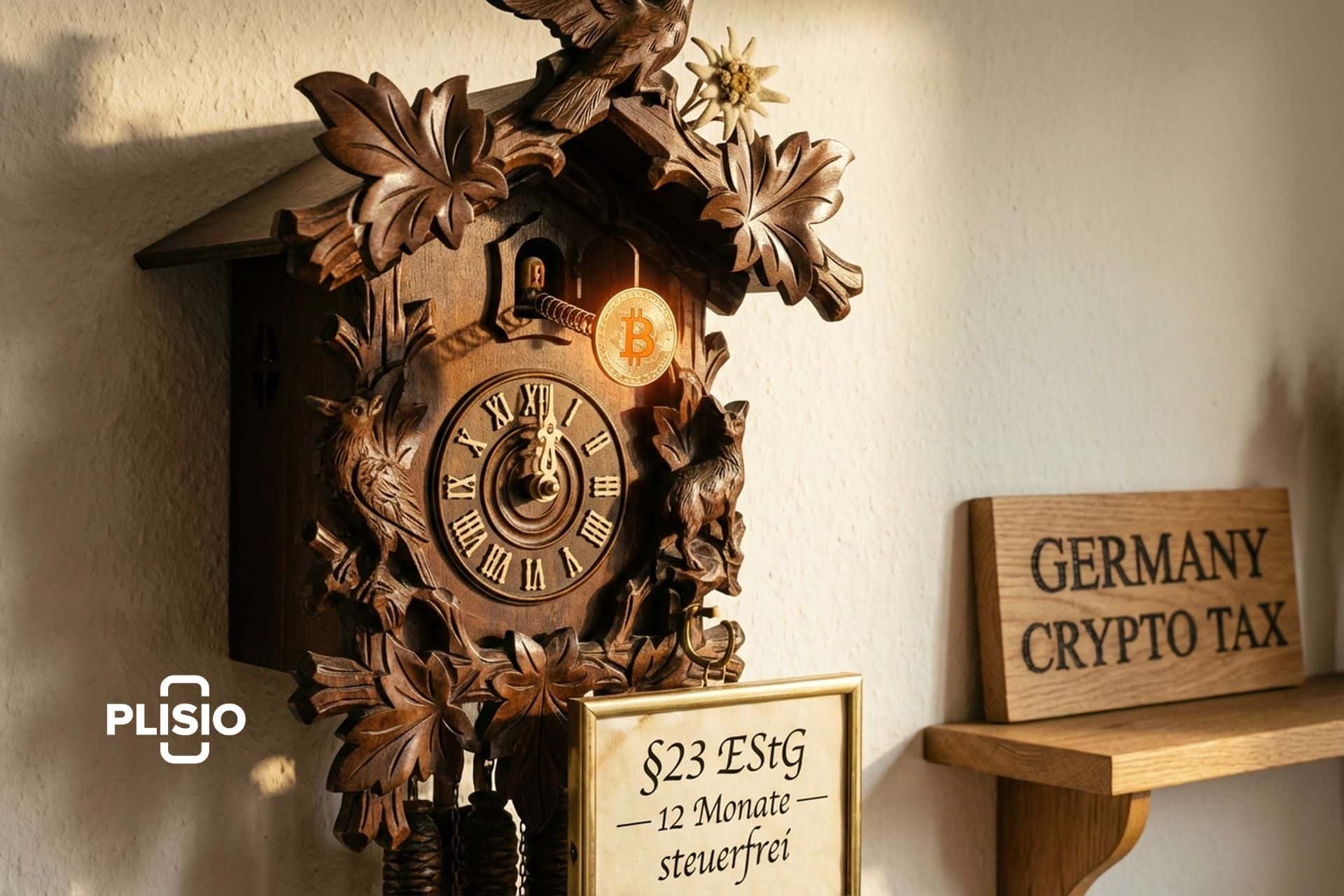
Germany is still, in 2026, one of the most generous places in the European Union to hold crypto. The core deal has not changed in almost a decade. Hold your coins for more than twelve months, and the gain is completely tax-free under §23 EStG, no matter how large it gets. Short-term gains below €1,000 in a year are also tax-free thanks to the Freigrenze that was raised from €600 in 2024. Compared to a Canadian paying up to 33% federal plus provincial, a French filer paying 30% flat, or an American tracking FIFO lots across dozens of wallets, German crypto investors have genuinely easy rules. The trade-off is that short-term profit is taxed at your full personal income tax rate, which can go up to 45%, and the details around staking, mining, Freigrenze limits and the new DAC8 reporting regime are worth getting right before you file.
This crypto tax guide walks through exactly how Germany taxes crypto for the 2025 tax year, with the filing deadline of July 31, 2026 (or late April 2027 if you file through a Steuerberater). It is based on the current BMF letter dated March 6, 2025, the Bundesfinanzhof ruling of February 14, 2023, and the Kryptowerte-Steuertransparenzgesetz that brought DAC8 into force on January 1, 2026. Every number is dated, and nothing in here is legal or tax advice.
Is Crypto Tax in Germany Really This Friendly?
Short answer? Yes, and more than you would guess from a country whose top income tax rate sits at 45%. Germany classifies private crypto holdings as "Privatvermögen" (private assets) rather than as speculative financial instruments, and that single label throws them under §23 EStG instead of the capital gains regime that applies to stocks and funds. The classification is the reason the twelve-month rule even exists, and it is the reason a stock trader in Germany pays 25% Abgeltungsteuer while a long-term crypto holder pays absolutely nothing.
Germany has also quietly turned into one of the biggest retail crypto markets in Europe. The European Central Bank's 2024 household survey put German crypto ownership at about 6% of adults, with 82% of those holders saying they bought it mostly as an investment rather than for payments. Statista's projection for 2025 runs a lot higher at around 27 million users, which mostly reflects a looser definition of "user." Either way, Germany ends up in the top two or three crypto markets in the EU by raw volume.
What actually gets taxed, in the end, is a pretty short list: short-term disposals of coins held less than a year, staking and mining payouts, and any crypto touched by a business entity. Everything else, including long-term disposals, crypto-to-crypto swaps that cross the twelve-month line, wallet transfers between your own accounts, and unconditional airdrops, either pays zero or sits under an exemption limit most retail investors never hit.

How Crypto Tax in Germany Works Under §23 EStG
So what is §23 EStG actually doing? It is the section of the German Income Tax Act (the Einkommensteuergesetz) that governs what are called private sale transactions. In February 2023, the Bundesfinanzhof (case IX R 3/22) ruled that crypto is a "Wirtschaftsgut" (an economic good), which slotted it cleanly into §23 next to fine wine, vintage paintings, and other private collectibles that fall under the same one-year rule. The BFH also knocked down the "Vollzugsdefizit" argument, which was the claim that German tax authorities could not practically enforce crypto rules and therefore should not apply them at all. That defense is dead now.
In practice, §23 says every crypto disposal you make on a coin held less than twelve months is a reportable private sale. A disposal here is a wider idea than just selling for euros. Swapping one coin for another counts. Paying for goods or services with crypto counts. Any transfer of control over a coin, really. What does not count: moving coins between two wallets you personally own, and just sitting on your stack doing nothing. German tax authorities have been consistent on all this for years, and the newest BMF letter from March 6, 2025 (which replaced the original May 10, 2022 version) reaffirms everything with tighter documentation rules layered on top.
Here is the detail most people miss. The twelve-month clock starts the moment you acquire each specific batch of coins, not at the point you first became a crypto investor. Bought 0.5 BTC in August 2024 and another 0.5 BTC in March 2025? Each tranche runs its own independent twelve-month clock. The March 2025 batch is not tax-free until March 2026, even if the August 2024 batch already is. This is exactly why Germany uses FIFO accounting on a wallet-by-wallet basis.
The 1-Year Rule and the €1,000 Tax-Free Threshold
The one-year rule is what makes every other detail of German crypto tax feel almost relaxed. Buy any crypto, hang onto it for twelve months and one single extra day, and the whole disposal is tax-free the moment you sell. There is no ceiling on it. No €250,000 trigger. No phase-out. A regular retail buyer who picked up 1 BTC for €20,000 back in early 2024 and sold in 2025 at €90,000 owes nothing on the €70,000 gain. That is not a grey-area loophole. It is right there in §23 EStG.
If you end up selling inside that twelve-month window, the other protection waiting for you is the Freigrenze. The annual exemption got raised from €600 to €1,000 under the Wachstumschancengesetz (the Growth Opportunities Act) starting January 1, 2024, and it has not moved since. It is still €1,000 for the 2025 tax year. The word Freigrenze actually matters here. It is a threshold, not an allowance. Total short-term gains of €999.99 mean zero tax. Nudge up to €1,000.01 and the whole amount becomes taxable at your personal income tax rate, not just the sliver above the line. Watch where you sit heading into December carefully, because one careless little swap can drag the entire year's crypto profit into the taxable zone.
Here is how the three layers stack, with worked examples using the 2025 rules.
| Scenario | Outcome | Why |
|---|---|---|
| Held 14 months, sold for €50,000 gain | €0 tax | 12-month rule, §23 EStG |
| Held 3 months, sold for €900 gain | €0 tax | Under €1,000 Freigrenze |
| Held 3 months, sold for €1,200 gain | Full €1,200 taxable | Freigrenze exceeded, no partial exemption |
| Held 3 months, sold for €5,000 gain | Full €5,000 at personal income tax rate | Standard short-term case |
| Staking rewards, €300 FMV at receipt | Full €300 as "other income" | Above €256 §22 Nr. 3 limit |
Sources: BMF March 6, 2025 letter, §23 EStG, Wachstumschancengesetz, Blockpit 2026 guide.
Crypto Tax Rates and Income Tax Rate in Germany
Short-term crypto profits and staking income land inside your regular personal income tax bracket, running anywhere from 0% to 45% depending on what else you earned that year. Germany layers a 5.5% Solidaritätszuschlag surtax on top for higher earners, and there is also the optional Kirchensteuer church tax if you are still officially on the books of a state-recognized religious community. This is what the 2025 brackets actually look like on paper.
| Bracket | Single filer | Joint filer | Marginal rate |
|---|---|---|---|
| Grundfreibetrag (tax-free) | €0 – €12,096 | €0 – €24,192 | 0% |
| Progressive zone 1 | €12,097 – €17,443 | €24,193 – €34,886 | 14% rising to ~24% |
| Progressive zone 2 | €17,444 – €68,429 | €34,887 – €136,858 | ~24% rising to 42% |
| Spitzensteuersatz | €68,430 – €277,825 | €136,860 – €555,650 | 42% (flat) |
| Reichensteuer | €277,826+ | €555,652+ | 45% |
Sources: PwC Germany tax summary 2025, Wundertax 2025 guidance.
Two quieter details matter a lot at filing time. The Grundfreibetrag (Germany's basic tax-free allowance) got bumped to €12,096 for single filers in 2025, meaning your first €12,096 of total taxable income pays nothing, whether it came from a paycheck, a staking payout, or a short-term Bitcoin flip. Students and low-earners with modest crypto gains often sit entirely inside that zero-rate zone and never owe a cent. The other change is the Soli exemption, which rose to €19,450 of calculated income tax for 2025, so middle-income filers skip the 5.5% surtax entirely. Only higher earners still pay it.
So what does this look like in practice? Take a middle-income German sitting around a 30% marginal bracket who realizes a €5,000 short-term crypto gain. The tax bill on that gain comes out around €1,500. Wait a few more months, push the same sale past the one-year mark, and the exact same €5,000 costs €0. That one decision is the whole reason German crypto investors talk about "the 12-month clock" obsessively in forums.
Staking, Mining, and Crypto Income in Germany
This is where the grey area used to be, and where the BMF letter of March 6, 2025 cleaned up the most confusion. Staking rewards, lending interest, and mining income are treated as "sonstige Einkünfte" (other income) under §22 Nr. 3 EStG. They are taxed at fair market value in euros on the day the tokens land in your wallet, at your personal income tax rate. The second protection here is a separate annual exemption limit of €256 per year for sonstige Einkünfte. This is again a Freigrenze, not a Freibetrag, so €256.01 makes the entire amount taxable.
A separate fight that had the German crypto community on edge for almost three years is now resolved. The original May 10, 2022 BMF letter had floated the idea of extending the twelve-month holding period to ten years for any crypto assets used in staking or lending. That would have killed the whole tax advantage for DeFi users. The March 6, 2025 letter explicitly withdraws that extension. For the 2025 tax year and going forward, crypto used in staking or lending is still subject to the standard twelve-month holding period. The 10-year rule is dead.
Mining is handled slightly differently. Hobbyist mining gets treated like staking, which is "other income" at fair market value on receipt. Commercial mining is classified as Gewerbebetrieb (business activity), which pulls it under full business taxation including Gewerbesteuer (trade tax). The regional tax office in North Rhine-Westphalia was the first to push a broad commercial classification, and the March 2025 BMF letter formalizes the factors German tax authorities now look at: scale of operation, cost of equipment, whether you advertise services, and whether profit intent is clear. If you are mining with a few consumer GPUs in a spare room for a few hundred euros a month, you are almost certainly private. If you are running an ASIC farm out of a warehouse, you are almost certainly a business.
Crypto Transactions That Are Taxed in Germany
Knowing which crypto transactions are taxed in Germany and which are not saves most filers from overpaying. The list is shorter than in most countries. Here is how crypto transactions are taxed in practice for the 2025 tax year.
Taxable for private investors:
- Selling crypto for euros within twelve months of acquisition (short-term gain under §23 EStG)
- Swapping one crypto for another within twelve months (disposal of the first, acquisition of the second)
- Paying for goods or services in crypto within twelve months
- Staking rewards at receipt (income at fair market value, above €256 Freigrenze)
- Mining rewards at receipt (other income for hobbyists, business income for commercial miners)
- DeFi lending interest and yield rewards at receipt
- Airdrops received in exchange for any action (sign-up, social post, KYC) are income at receipt
Not taxable:
- Buying crypto with euros and holding it
- Selling crypto held for more than twelve months (zero tax, zero cap)
- Wallet-to-wallet transfers between accounts you own
- Short-term gains totaling less than €1,000 in the year
- Staking income totaling less than €256 in the year
- Unconditional airdrops where you did nothing to receive them (treated like a lottery win until first disposal)
- Donations of crypto to a registered German nonprofit
NFTs fall under the same §23 EStG framework, so the same twelve-month rule applies. Gift tax (Schenkungsteuer) is separate and has its own generous allowances (€20,000 for friends, €400,000 for children per parent over a ten-year window). Gifts above those limits trigger German gift tax at progressive rates that depend on the relationship between giver and recipient.
Capital Gains, Crypto Losses and Gift Tax in Germany
Capital gains from crypto that you held for more than a year are not taxed at all, which is the whole point of the German regime. Capital gains from short-term disposals go on Anlage SO as private sale transactions and get added to your regular income. Crypto losses work the opposite way, but with restrictions. A loss on a short-term disposal can be offset against other short-term §23 EStG gains in the same year, and if you cannot absorb it, you can carry the loss back one year or forward indefinitely against future §23 EStG gains. Losses cannot be offset against salary, rental income, or other income categories. They only net against §23 gains.
Gift tax is a separate chapter in German tax law that most retail investors never hit. You can gift crypto to a spouse within a €500,000 allowance, to children at €400,000 per child per parent, to other relatives at €20,000, and to friends at €20,000, all running on a ten-year rolling window. Above those thresholds, German gift tax applies at progressive rates based on the value of the gift and the relationship. For most Canadians reading a "can I gift my brother 0.5 BTC" question, the answer is yes, that sits comfortably under the €20,000 sibling allowance, no filing required.
The 2023 BFH ruling (IX R 3/22) is also where the long-running enforcement debate ended. The court confirmed that German tax authorities can tax crypto gains even when the Finanzamt has imperfect visibility into exchanges and wallets. In practical terms, that ruling pushed Germany toward the DAC8 framework faster, because the case for exchange-level reporting was suddenly much stronger.
How to Report Crypto on Your Tax Return in Germany
Actually reporting crypto on your German return for 2025 means filing Form Anlage SO (Sonstige Einkünfte, "other income") alongside the main ESt 1 A income tax return. The German tax year runs January 1 through December 31, same as the calendar year, and the deadline for 2025 returns is July 31, 2026 if you are filing it yourself. Hand the job to a Steuerberater (a licensed tax advisor) or a Lohnsteuerhilfeverein (a wage-tax help association), and the deadline automatically stretches to the end of April 2027. Anyone with more than a handful of transactions, or any DeFi activity at all, should be paying a Steuerberater rather than wrestling Elster alone.
The Anlage SO section where private sale transactions go wants a few specific things for each disposal: the acquisition date, the disposal date, the purchase cost, the sale proceeds, any associated fees, and the resulting gain or loss. Crypto tax software like Blockpit, Koinly, CoinTracking, and CoinLedger all export a pre-filled Anlage SO summary that you can either pass to your advisor or drop into Elster (the German Finanzamt's electronic filing platform) yourself. If you are going old-school with printed forms, at least print a clean chronological transaction list, because that is the first thing the Finanzamt asks for during any audit.
Record-keeping is not optional. §147 AO (from the Abgabenordnung, the German tax procedure code) forces you to keep your crypto records for at least ten years. That means the acquisition date, the exact euro value at acquisition, the disposal date, the euro value at disposal, the wallet and exchange identifiers, and every fee you paid. The March 6, 2025 BMF letter tightened these requirements considerably. Lose your transaction history and the Finanzamt is allowed to estimate your proceeds against you, which is rarely a number you will enjoy seeing.
Tax Deadline and the BZSt: Can They Track Crypto?
The 2025 return has to be filed by July 31, 2026 if you are doing it yourself, or by the end of April 2027 if a Steuerberater is doing it for you. Miss the date and the Finanzamt starts adding automatic surcharges of 0.25% of the unpaid amount per month, capped under §152 AO but still not cheap. Late payment then adds Säumniszuschläge on top. The Bundeszentralamt für Steuern (BZSt) is the federal tax authority sitting on the other end of every cross-border data exchange, and its job just got a lot more interesting.
Here is why. DAC8, the eighth EU Directive on Administrative Cooperation, switched on in Germany on January 1, 2026 via the Kryptowerte-Steuertransparenzgesetz (the KStTG for anyone who likes acronyms). Every CASP operating anywhere in the EU now has to collect detailed customer and transaction data and report it annually to its national tax authority. German reports flow to the BZSt, which then quietly hands the data off to every other EU tax authority through the automatic exchange. First reporting year is 2026. First DAC8 report is due September 30, 2027. CASPs have a compliance grace period until July 1, 2026 to get their systems together.
So what does this mean for a German crypto investor with coins on Bitstamp, Binance, Kraken, or any other EU-registered exchange? By sometime in 2027, the Finanzamt has a clean line-by-line log of your trades for 2026 regardless of whether you wrote them on Anlage SO yourself. And that is on top of the BZSt's already-existing power to request data directly from exchanges during audits, which has been fair game since the 2023 BFH ruling cleared it. The whole "maybe they will not notice" window is closing fast.
How to Reduce Your Crypto Tax in Germany
The legal ways to reduce your crypto tax in Germany are mostly built into §23 EStG itself. The single biggest lever, by a mile, is the twelve-month rule. If you can wait out the clock, everything else becomes irrelevant. A disciplined long-term holder realistically pays zero German tax on large gains, which is something no other major EU country offers. The trade-off is discipline: dollar-cost averaging into positions you plan to hold through at least one full market cycle, and being willing to skip short-term swing trades that would reset the clock.
Second, stay under the Freigrenze when you do trade short-term. Germany's €1,000 exemption is a cliff, not a phase-out, so planning matters. If you are sitting at €900 in unrealized short-term gains in late December, realizing one more small profit can push the whole year's gains into the taxable zone. Many experienced filers deliberately push short-term disposals into the next calendar year to get a fresh €1,000 budget, which is a free strategy that works under the existing rules.
Third, harvest short-term losses in the same year as your short-term gains. Crypto losses from short-term disposals only offset other §23 gains, so timing matters more here than it does for salary. If you are sitting on a €3,000 short-term gain and a €2,000 unrealized loss in another coin, closing the loss before December 31 reduces your taxable gain to €1,000. Carry-forward of unused losses is unlimited, but unused losses sit idle until you have a matching §23 gain.
The best advice I can give any German crypto investor with a meaningful portfolio is to talk to a Steuerberater who understands crypto before filing year one. The combination of FIFO on a wallet-by-wallet basis, the Freigrenze cliff, the new DAC8 reporting regime, and the March 6, 2025 BMF letter's documentation requirements is more than most people want to handle alone. A few hundred euros on a professional filing is cheap insurance against a Finanzamt audit in 2027 or 2028.