What is 1inch Network? The DeFi aggregator that finds you the best rates
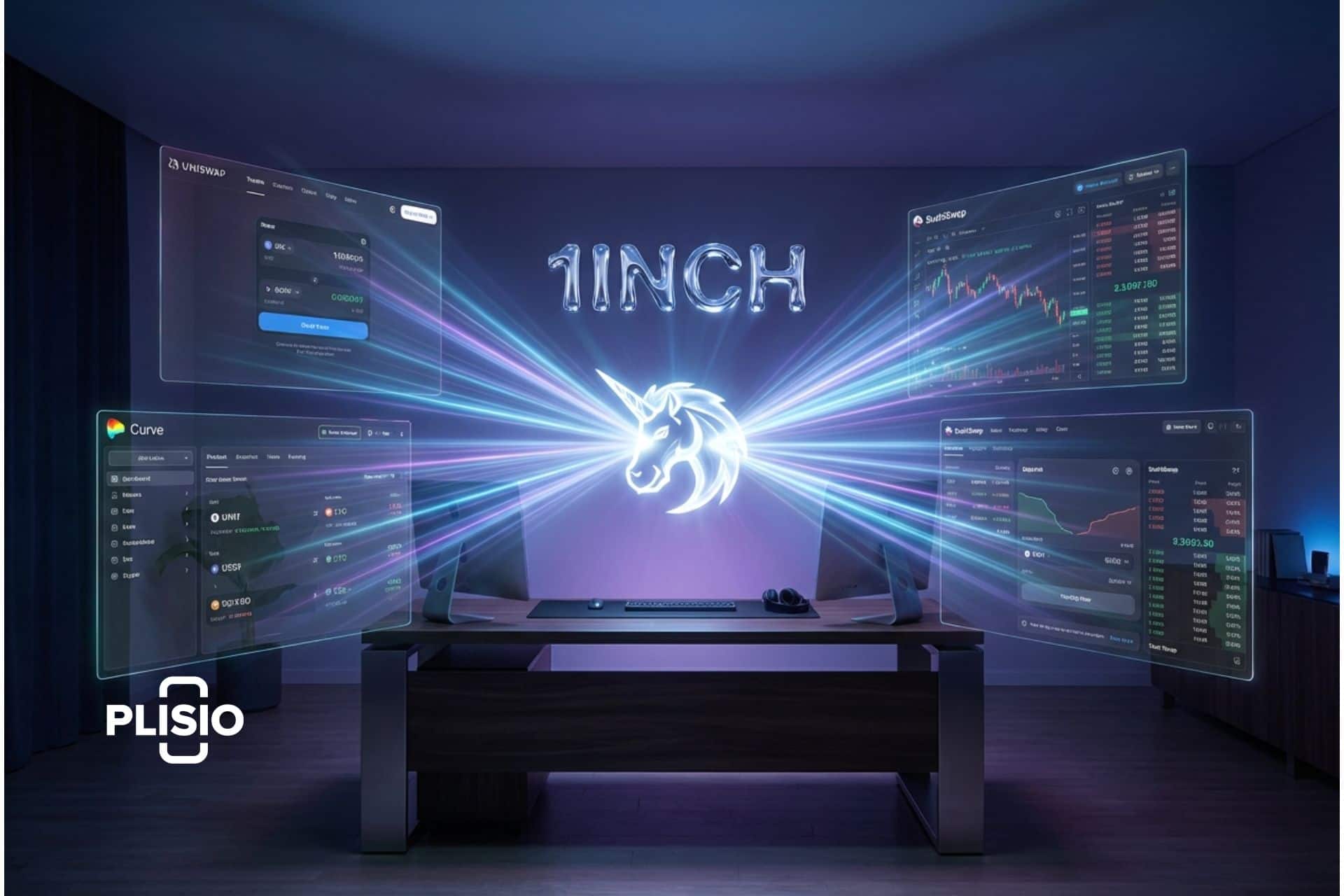
You want to swap ETH for USDC. You could go to Uniswap. Or SushiSwap. Or Curve. Or one of 400 other decentralized exchanges. Each one offers a slightly different price. Gas fees differ too. A big swap on one DEX might eat into your returns through slippage, while splitting it across three exchanges would have saved you money. But who has time to check all of them?
That is the problem 1inch solves. The 1inch Network is a decentralized exchange aggregator that scans hundreds of liquidity sources across multiple blockchains, finds the best rates for your trade, and routes your swap through the cheapest path. In 2025, it processed $214 billion in swap volume across 115 million trades. At its peak, 1inch held 60% of the entire DEX aggregator market.
This guide covers how 1inch works, what makes the Fusion mode different, how 1inch compares to other aggregators like Jupiter and CowSwap, and whether the 1INCH token is worth paying attention to in 2026.
How does 1inch work?
Think of 1inch like a flight search engine for crypto. Kayak does not sell you the ticket. It checks every airline, finds the cheapest fare, and sends you there. 1inch does the same thing but for token swaps on decentralized exchanges.
When you enter a swap on the 1inch dapp or 1inch wallet, the Pathfinder algorithm kicks in. It checks over 400 liquidity sources and 3.2 million individual pools across 13 supported blockchains. In milliseconds, it calculates the best route. Sometimes that means sending your whole trade through one DEX. Other times it splits the order across multiple exchanges to reduce slippage and get you more tokens for your money.
The routing gets complicated in a good way. Say you want to swap 50 ETH for DAI. On Uniswap alone, that swap would move the price against you because the pool is not deep enough. The Pathfinder might route 30 ETH through Uniswap, 15 through Curve, and 5 through Balancer. The combined result gives you more DAI than any single exchange would.
1inch charges zero protocol fees. You pay the gas fees on whatever blockchain you are using, and you pay the underlying exchange fees (usually 0.05% to 0.3% depending on the pool). But 1inch itself takes nothing from your swap. That makes it genuinely free to use at the protocol level.
The 1inch Network runs on 13 chains in 2026: Ethereum, BNB Chain, Arbitrum, Optimism, Base, Polygon, Avalanche, Gnosis, zkSync Era, Linea, Sonic, Unichain, and Solana. Four new chains were added during 2025 alone.

Fusion mode: gasless, MEV-protected swaps
Fusion mode is what separates 1inch from a basic aggregator. Launched in late 2022, Fusion uses an intent-based system where you sign an off-chain order and professional market makers called Resolvers compete to fill it. You do not pay gas. The Resolver pays gas on your behalf and bakes the cost into the exchange rate.
Why does this matter? Two reasons.
First, gas savings. On Ethereum mainnet, Fusion cuts gas costs by 30-50% compared to standard swaps. That adds up fast if you trade regularly. The Resolver batches your trade with others and executes more efficiently than you could on your own.
Second, MEV protection. MEV stands for Maximal Extractable Value, and it is the crypto term for front-running. Without protection, a bot can see your pending swap in the mempool, buy the token before you, push the price up, and sell to you at a higher price. With Fusion, your order is off-chain until a Resolver executes it, which makes it invisible to front-running bots. That is real money you keep in your pocket.
Fusion v2 Resolvers, released in 2025, roughly doubled execution speed. And Fusion+ takes it cross-chain: trustless swaps between Solana and 12 EVM networks without bridges, without wrapping, and without giving up custody of your tokens. In 2025, cross-chain swaps through Fusion+ hit $697 million across 148,000 trades. The top route was Ethereum to BNB Chain at $174.7 million.
| Feature | Standard swap | Fusion mode | Fusion+ (cross-chain) |
|---|---|---|---|
| Who pays gas | You | Resolver | Resolver |
| MEV protection | No | Yes | Yes |
| Speed | Instant | Seconds | Minutes |
| Chains | Same chain | Same chain | Cross-chain (13 networks) |
| Custody | Your wallet | Your wallet | Your wallet (atomic) |
| Gas savings | 0% | 30-50% | Varies |
1inch vs other DEX aggregators
1inch is not the only aggregator out there. Jupiter dominates Solana. CowSwap has a loyal following on Ethereum. ParaSwap, now called Velora, offers its own gasless mode. How do they compare?
| Aggregator | Primary chains | Market share (2025) | Specialty | Token |
|---|---|---|---|---|
| 1inch | 13 chains (EVM + Solana) | Up to 60% | Widest multi-chain coverage, Fusion gasless mode | 1INCH |
| Jupiter | Solana only | Dominant on Solana | Best routing on Solana, limit orders, DCA | JUP |
| CowSwap | Ethereum, Gnosis, Arbitrum | ~10-15% | Batch auctions, MEV protection by design | COW |
| ParaSwap (Velora) | 9 EVM chains | ~5-10% | Gasless swaps, MEV protection | PSP |
| 0x Protocol | Multi-chain | ~5% ($2.4B monthly) | API-first, powers many other dapps | ZRX |
| ODOS | EVM chains | Growing | Complex multi-token routing | None |
If you trade mostly on Solana, Jupiter is the better choice. It knows the Solana DEX landscape inside out and handles the memecoin liquidity pools that 1inch only recently tapped into.
If you care about MEV protection above all else, CowSwap's batch auction model is arguably more robust than Fusion. Every trade goes through an auction where solvers compete, and no trade is ever visible in the public mempool.
If you need cross-chain swaps without bridges, 1inch Fusion+ is currently the strongest option. Moving USDC from Ethereum to Arbitrum or swapping SOL for ETH across chains without a bridge is something most aggregators cannot do natively.
For pure multi-chain coverage, 1inch wins. 13 chains, 400+ sources, and the Pathfinder routing engine is battle-tested with $700 billion in cumulative volume.
The 1INCH token
The 1INCH token launched in December 2020 with a retroactive airdrop to early users. Total supply is capped at 1.5 billion. About 1.4 billion tokens (93.6%) are already in circulation as of April 2026.
The token price tells a rough story. It peaked at $8.65 during the 2021 bull run and has since dropped to around $0.09. That puts the market cap at roughly $130 million against a fully diluted valuation of $140 million. The token is trading near its all-time low.
What the token does:
- Governance: 1INCH holders stake tokens to receive "Unicorn Power" and vote on protocol proposals through the 1inch DAO
- Staking rewards: stakers earn a share of the network's swap fee revenue and can delegate their Unicorn Power to Resolvers for additional yield
- No fee utility: the token does not pay for swaps (those are free) and is not required to use the platform
The honest take on the 1INCH token? The protocol works great. People use it constantly. But the token has struggled to capture that value. A tokenomics review is planned for 2026 to address how protocol fees flow back to stakers. The token allocation has been a pain point: 93% went to team, investors, and VCs, with only 7% for community incentives. That distribution has weighed on sentiment.
| 1INCH token snapshot | Value |
|---|---|
| Price (Apr 2026) | ~$0.09 |
| Market cap | ~$130 million |
| Max supply | 1.5 billion |
| Circulating supply | ~1.4 billion (93.6%) |
| All-time high | $8.65 |
| Governance model | Stake for Unicorn Power, vote on proposals |
| Token allocation | 93% team/investors, 7% community |
1inch in 2026: what is next?
The protocol itself is healthy. $214 billion in volume during 2025, a 39% year-over-year increase. Over 11 million total users. Coinbase integrated the 1inch Swap API into its retail app, which is a big deal for distribution.
The Aqua protocol is the most interesting development on the roadmap. Aqua is a shared liquidity layer that lets a single wallet's capital back multiple DeFi strategies at the same time. Instead of choosing between providing liquidity to an AMM or a lending pool, Aqua lets your capital serve both. The developer release went live in November 2025 with bounties up to $100,000. The public frontend is expected in Q1 2026.
Other things on the radar: continued Fusion+ expansion to more chains, deeper Solana integration after the April 2025 expansion that brought 1inch's market share back to 60%, the planned tokenomics overhaul, and the Ondo integration that has already facilitated $2.5 billion in tokenized stock and ETF trading volume.
The question with 1inch has never been about the product. The product is excellent. It saves users money on every trade. The question is whether the 1INCH token can capture any of that value. If the 2026 tokenomics review delivers meaningful fee sharing with stakers, the gap between what 1inch does and what 1INCH is worth could start closing. If not, you have a great protocol with a forgettable token.