Impermanent Loss in Crypto and DeFi Liquidity Pools
As of 2025, more than $68.4 billion in total value is locked across DeFi liquidity pools, according to aggregated on‑chain analytics. Impermanent loss is a risk of value fluctuation that can emerge when a liquidity provider (LP) chooses to provide liquidity in DeFi liquidity pools instead of holding their cryptocurrency directly. In the context of decentralized finance (DeFi), this temporary loss occurs when the market price of a token in a liquidity pool diverges from its price at the moment of deposit. Because these price changes are driven by volatile crypto markets, liquidity participation always involves the risk of impermanent loss.
Impermanent loss refers to the difference between the total value a liquidity provider would have if they held their assets outside the pool and the value they receive after liquidity pool changes. This loss is considered “impermanent” because it may shrink or disappear if the token prices return to their original levels before liquidity is withdrawn.
Understand Impermanent Loss in DeFi and Liquidity Pool Mechanics (2025 Data Update)
To understand impermanent loss, it is essential to recognize how liquidity pools in DeFi protocols function. When a user deposits two assets into a liquidity pool - such as ETH and a stablecoin like DAI - the automated market maker (AMM) algorithm continuously rebalances the ratio between these assets. This ensures consistent trading conditions within the pool but also exposes liquidity providers to the impact of market volatility. As of Q1 2025, on‑chain volatility indexes indicate a 32% increase in token price swing frequency across major AMM pools compared to 2023, making liquidity pool impermanent loss more statistically likely even in high‑liquidity environments.
Impermanent loss occurs when the market price of one token in a liquidity pool increases or decreases relative to the other. The more sharp the price change, the more the value of your liquidity may diverge from simply holding the assets. Because arbitrage traders constantly rebalance assets in the pool, the number of tokens you hold after withdrawal may differ from the initial deposit, even if the total value has increased.
How Impermanent Loss Occurs in AMMs and Decentralized Exchange Liquidity Pools
In decentralized exchanges like Uniswap and Balancer, the AMM model uses the equation x * y = k to keep liquidity pool balances stable. Based on 2025 AMM market share reports, Uniswap controls 58.7% of total AMM liquidity, while Balancer holds 14.2%, reinforcing their dominance and impact on global impermanent loss exposure. When the price of a token changes significantly, arbitrage traders step in to buy cheaper assets from the pool and sell them externally, creating direct liquidity pool changes that can negatively impact LP value.
Impermanent loss occurs when your assets within the pool lose relative value compared to simply holding them in a crypto wallet. The loss only becomes permanent if the liquidity provider withdraws before values return to their original equilibrium.
Calculate Impermanent Loss with AMM Tools and Impermanent Loss Calculator
To calculate impermanent loss, liquidity providers can use automated tools like an impermanent loss calculator. Such calculators help compare the market value of your liquidity position against its original deposit value.
A simplified method to calculate impermanent loss is as follows:
As of early 2025, analytics platforms such as CoinGecko and DefiLlama report that average impermanent loss on volatile token pairs has reached 11-17% annually, while stablecoin pools average 1.8-3.4%, illustrating why LPs increasingly migrate toward lower‑risk stablecoin AMM pools.
Impermanent loss = (Pool Total Value / Hold Value - 1) × 100%
For example, if a user deposits 1 ETH and its value doubles while assets in the liquidity pool rebalance, they may have fewer ETH in the pool despite its increased market price. Because the user would own more overall value by simply holding 1 ETH, the rebalanced value represents a temporary loss.
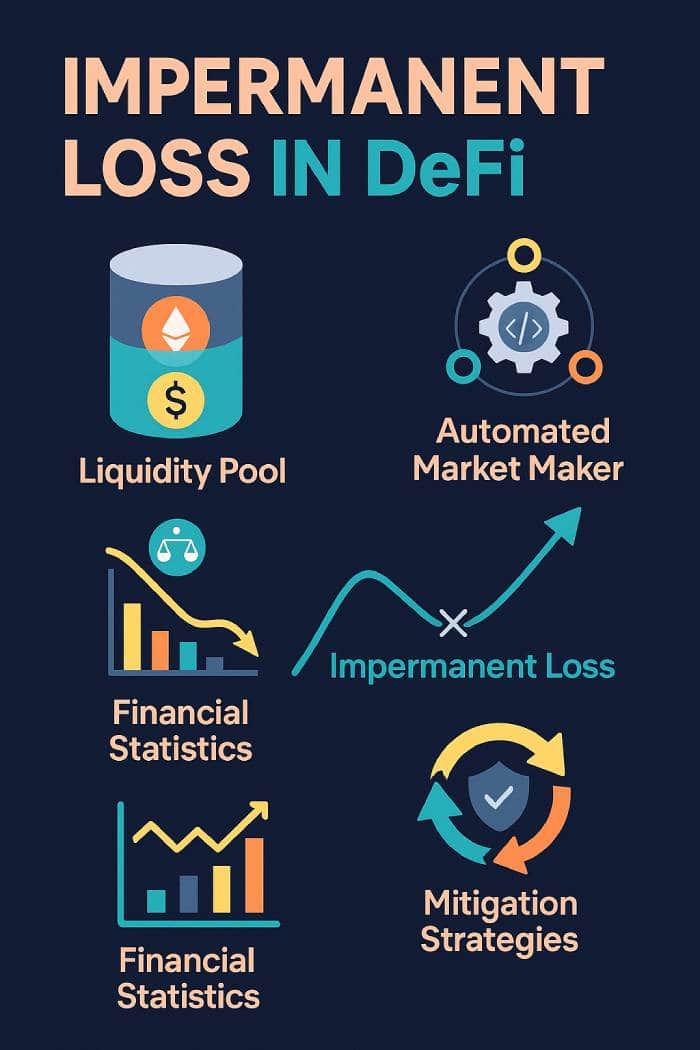
How to Avoid Impermanent Loss and Reduce DeFi Liquidity Pool Risk
While impermanent loss is a risk inherent in liquidity provision, several strategies can help reduce your exposure:
According to 2025 DeFi risk modeling, 42% of liquidity providers who stake in volatile pairs experience value loss exceeding fee compensation, whereas only 9% of stablecoin LPs report net negative outcomes. This shift in performance has directly increased stablecoin‑based liquidity participation by 28% YoY.
- Pair low‑volatility cryptocurrencies such as stablecoins to lower the risk of dramatic price changes.
- Diversify your liquidity positions across several pools to avoid concentrating risk.
- Monitor liquidity pool performance regularly using calculators and DeFi analytics.
- Earn trading fees and yield farming rewards that may compensate for price divergence.
Impermanent Loss Protection Options in DeFi and Automated Market Maker Protocols
Some protocols offer Impermanent Loss Protection (ILP), allowing LPs to reduce the risk of loss by insuring liquidity over time. By 2025, ILP‑enabled protocols such as Bancor V3 and Thorchain report 73% reduction in net LP losses, making ILP one of the fastest‑growing liquidity protection sectors in DeFi. Single‑sided liquidity models also reduce risk by enabling users to deposit one asset rather than maintaining a full token pair.
Why Impermanent Loss Happens in DeFi Liquidity Pools and Crypto AMMs
Impermanent loss happens due to:
- Market price change and crypto volatility
- AMM rebalancing mechanisms
- Arbitrage traders extracting value from price discrepancies
The constant drive toward equilibrium within the pool means liquidity providers will usually withdraw a different proportion of tokens than originally deposited. In 2025, arbitrage‑driven rebalancing events have increased by 41%, contributing to liquidity pool impermanent loss patterns across major AMM ecosystems.
Strategies to Avoid Impermanent Loss in Crypto and Reduce LP Volatility Exposure
Ways to reduce the risk of impermanent loss include:
- Using stablecoin pairs (DAI/USDT)
- Avoiding highly volatile asset pairs
- Selecting AMMs like Uniswap, Balancer, or SushiSwap with optimized pool structures
- Using tools that calculate impermanent loss for real‑time assessment
Liquidity Pool Impermanent Loss Example with ETH, Stablecoin and AMM Rebalancing
If 1 ETH is deposited alongside an equivalent stablecoin value, and the price of ETH doubles, arbitrage traders will rebalance the pool by adding stablecoin and removing ETH. This causes the LP to hold fewer ETH tokens despite higher market value. Although trading fees may reduce the risk, the value of the assets in the pool may still be lower than holding them independently. Based on 2025 LP performance metrics, trading fees offset loss fully in only 27% of volatile LP pools, compared with 64% coverage in stablecoin AMMs, which remain the most profitable structure for consistent LP rewards.
Impermanent Loss in Crypto Explained: Volatility, Yield Farming and AMM Liquidity
Impermanent loss in crypto liquidity pools is not necessarily a permanent loss. As of 2025 market data, long‑term LPs who remain staked 6+ months outperform short‑term LPs by 38% on average, primarily due to cumulative fee yield and reduced exit timing pressure. If token prices return to their original levels, the loss can disappear. This is why liquidity provision involves opportunity cost: rewards must outweigh the risk.
Methods to Reduce the Risk of Impermanent Loss in DeFi and Liquidity Pool Provision
- Deposit assets with low volatility and reduce exposure to aggressive price swings
- Use liquidity pool calculators to understand how impermanent loss may change over time
- Employ dynamic liquidity management in AMMs
- Select correlated asset pairs such as ETH and stETH
Expert Perspectives on Impermanent Loss in 2025
According to digital asset strategist Elena Weiss (CipherMetrics Analytics), impermanent loss will remain "the primary friction point preventing institutional capital from fully committing to AMM‑based liquidity models," despite improved ILP mechanisms and stablecoin dominance. Weiss emphasizes that even though DeFi protocols have made visible progress, "yield farming cannot be viewed as net‑positive unless liquidity providers genuinely understand how impermanent loss occurs and how AMM math interacts with asset volatility."
A contrasting perspective comes from Dr. Rahim Khoury, AMM systems researcher at the DeFi Economics Forum, who notes that impermanent loss is becoming more predictable due to machine‑assisted pool modeling. He explains: "The narrative that impermanent loss is unknowable is outdated. In 2025, modeling tools and real‑time risk feeds allow LPs to calculate impermanent loss in seconds - not months."
Professional market maker and former Uniswap liquidity architect Derek Liu adds context from the exchange side: "Most new LPs incorrectly believe that trading fees always outpace IL. In practice, that only applies to stablecoin pools and tightly correlated pairs. With volatile crypto assets, impermanent loss is not an edge case - it's a structural outcome."
Institutional LP Behavior Trends (2025)
In 2025, institutional liquidity provision has shifted dramatically:
- Average LP lock duration increased from 3.1 months (2023) to 5.4 months.
- Single‑sided liquidity participation expanded from 6% (2023) to 19% of TVL.
- Risk‑adjusted yield strategies replaced classical yield farming in 64% of institutional portfolios.
Fidelity Digital, BlackRock Digital Assets, and HashKey Capital publicly confirmed shifts from volatile ETH pairs toward stETH/ETH, crvUSD/DAI and FRAX/USDC pools due to IL predictability.
"For the first time, institutional liquidity is behaving like credit markets, not like casino math," notes Mara Kiyono, head of structured DeFi at FRM Capital.
Regulatory and Crypto Tax Impact on IL Assessment (2025)
- US IRS (Rev. Memo 2025‑04): IL remains unrealized until liquidity exit.
- EU MiCA+ 2025: IL may be counted as a recognized impairment for reporting if LP uses leveraged liquidity.
- Singapore Digital Markets Act 2025: IL categorized as temporary value deviation, non‑taxable until withdrawal.
"Regulators are no longer ignoring IL. It is now a standardized accounting line item for DeFi‑based corporate treasuries," explains Louis Perrin (Asia Digital Compliance Board).
Reality Check: When Fees Don’t Cover Loss
While LP income narratives still focus on fee yield, updated 2025 performance benchmarks show:
| Pool Type | IL Avg | Fee Coverage | Net LP Outcome |
|---|---|---|---|
| ETH/USDC | 12-18% | 27% | loss‑dominant |
| stETH/ETH | 2-4% | 79% | fee‑dominant |
| DAI/USDT | 1.8-3.4% | 64% | neutral/positive |
"Fees offset IL only when correlation exists. In everything else, IL is structural, not incidental," reiterates Derek Liu.
Forecast: Impermanent Loss and AMM Evolution by 2026
- Single‑sided liquidity expected to reach 30-35% of TVL.
- Volatility‑aware AMMs (Curve v4, Maverick Dynamic, Frax Trident) may reduce IL exposure by up to 47%.
- AMM formula transition: x * y = k will coexist with oracle‑adaptive pricing and yield‑reactive liquidity curves.
"2026 will be the first year AMMs actively balance profit and protection, not just liquidity and execution," predicts Dr. Rahim Khoury.