What Are Utility Tokens? Basics of Utility Tokens in Crypto
Not every cryptocurrency token exists for speculation. Many tokens have a practical purpose. They allow users to access services, pay for transactions, or unlock features inside blockchain platforms.
These digital assets are called utility tokens. They power decentralized apps, support crypto ecosystems, and help platforms operate smoothly behind the scenes.
Before we get into the details, it helps to understand what makes utility tokens different, how they work, and why they matter in the growing crypto economy.
Utility Token Definition: What Is a Utility Token?
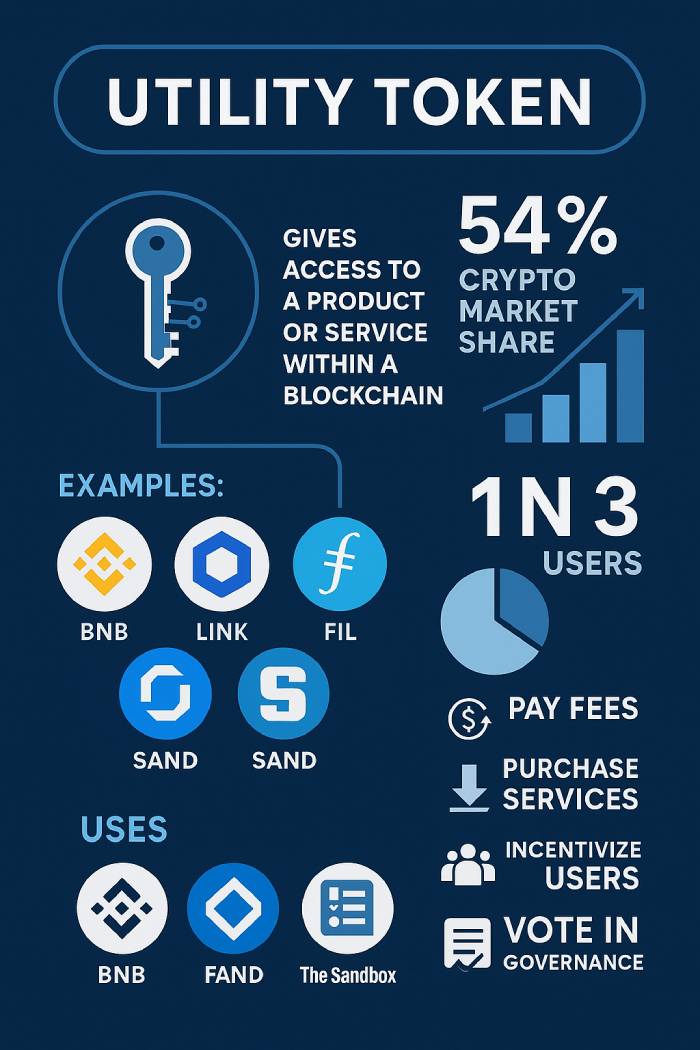
In simple terms, a utility token works like a digital key. It allows users to access services inside a blockchain platform.
A utility token is a type of token-specifically a digital asset-that allows users to access a product or service within a blockchain-based ecosystem. Unlike security tokens, which represent ownership in a company or asset, utility tokens do not represent equity. Instead, a utility token provides access to specific services or features on a platform.
Utility tokens act as keys that let users participate in decentralized networks. They are common in dApps, crypto marketplaces, and DeFi projects. Holders can use tokens to pay for transaction fees, unlock premium content, or access unique platform services.
Examples of utility tokens include:
• Ethereum Gas - used to pay for transaction fees when executing smart contracts on the Ethereum network.
• Binance Coin (BNB) - the utility token of the Binance ecosystem used to pay trading fees, access launchpad projects, and interact with DeFi services.
• Basic Attention Token (BAT) - used inside the Brave browser to reward users and content creators for viewing privacy‑friendly ads.
Unlike security tokens, utility tokens are not designed as investments. They may still be traded on exchanges and gain market value, but their main role is to provide access to services within a platform.
As of early 2026, utility tokens represent nearly 22% of the global crypto market capitalization, with more than $450 billion in circulation, according to CoinMarketCap. This highlights their growing role in powering blockchain ecosystems rather than serving only speculative purposes.
Differences Between Utility Tokens and Security Tokens
Utility tokens and security tokens serve very different purposes in the crypto economy. Security tokens represent ownership in a company or asset, while utility tokens provide access to services within a blockchain platform.
Projects often use utility tokens to incentivize participation. Users may earn tokens for providing liquidity, validating transactions, or interacting with the ecosystem. Those same tokens can then be used to access features or services.
This creates a feedback loop: the more people use the platform, the greater the demand for its utility token.
Key differences between utility tokens and security tokens:
| Feature | Utility Tokens | Security Tokens |
|---|---|---|
| Purpose | Access to services or platform features | Ownership or investment rights |
| Regulation | Usually not treated as securities | Regulated under securities laws |
| Example | BAT, BNB, LINK | Tokenized shares or investment tokens |
In 2026, regulators estimate that more than 35% of new token projects attempt to market themselves as utility tokens, though some may still be classified as securities under the Howey Test.
How Utility Tokens Work
Utility tokens are digital assets programmed through smart contracts. These smart contracts define how a token can be used, transferred, or spent within a platform.
Most utility tokens follow standards like ERC‑20, which ensures compatibility with crypto wallets and exchanges.
A simple example helps explain how utility tokens work in practice.
Imagine you want to use a decentralized storage platform. First, you purchase the platform's utility token. Then you use that token to pay for storage space. The smart contract verifies the payment automatically and grants you access to the service.
When users interact with a dApp, a smart contract may:
• Check whether the user holds a required amount of tokens
• Deduct tokens as payment for services
• Record transactions permanently on the blockchain
Because these rules are stored on the blockchain, they cannot easily be changed once deployed. This transparency builds trust but also means that smart contracts must be carefully audited.
According to a Messari report from 2026, over 65% of Ethereum‑based dApps rely on utility tokens for at least one core function, showing how deeply integrated they are in Web3 applications.
Utility Token Business Model in Cryptocurrency
Many blockchain companies design their platforms around utility tokens to encourage user participation and support network activity.
Token issuers create digital tokens that users can spend on services, platform features, or products within the ecosystem. The more the platform is used, the more demand grows for its token.
A well‑known example is the Brave browser and its Basic Attention Token (BAT).
Advertisers purchase ads using BAT. Users earn BAT for viewing ads while maintaining privacy. Content creators receive BAT as rewards from users. This creates a circular economy where the token supports the entire platform.
This business model allows companies to:
• build decentralized ecosystems
• reward user participation
• reduce reliance on traditional payment systems
• interact directly with users through peer‑to‑peer networks
By 2026, the global tokenization market reached $3.95 billion, with projections suggesting it may exceed $10 billion by 2029. Utility tokens represent a major part of this growth as businesses experiment with blockchain‑based payment and service systems.
Types of Cryptocurrency Tokens Compared
The crypto ecosystem includes several different categories of tokens:
Utility Tokens - provide access to services within a blockchain platform (examples include BAT, LINK, MANA, and VET).
Security Tokens - represent ownership in assets or companies and are regulated similarly to traditional securities.
Payment Tokens - cryptocurrencies such as Bitcoin or Ethereum that function primarily as digital money.
Governance Tokens - tokens that allow holders to vote on protocol changes and platform decisions.
In Q1 2026, payment tokens such as Bitcoin and Ethereum still dominate the market. However, utility tokens account for nearly 30% of daily blockchain transactions, highlighting their practical role in decentralized platforms.
Examples of Utility Tokens
Utility tokens exist across many sectors of the crypto industry, including exchanges, decentralized finance, gaming, and digital advertising.
Some well‑known examples include:
BNB (Binance Coin) - used to pay for trading fees, launchpad access, and DeFi interactions. In 2026, BNB processed more than $12 billion in daily trading volume.
LINK (Chainlink) - pays oracle providers that supply external data to smart contracts. Chainlink now secures over $20 billion in total value locked (TVL) across DeFi applications.
FIL (Filecoin) - used to store and retrieve decentralized data. The network surpassed 1.5 exabytes of storage capacity in 2026.
SAND (The Sandbox) - enables users to purchase virtual land, avatars, and game assets in the metaverse platform with more than 2 million monthly active users.
BAT (Basic Attention Token) - rewards users and creators within the Brave browser, which now reports over 65 million active users interacting with BAT monthly.
Using Utility Tokens: Benefits
Utility tokens offer several advantages for both users and blockchain platforms.
Access to platform services
Many platforms require tokens to unlock features such as storage, trading tools, or premium services.
Participation without giving up ownership
Users can interact with blockchain ecosystems without purchasing shares or equity in a company.
Fundraising for new projects
Projects often raise capital by selling tokens through initial coin offerings or other token distribution models.
High liquidity and global access
Most utility tokens can be traded on crypto exchanges, making them accessible to users around the world.
By 2026, more than 70% of DeFi protocols rely on a native utility token, and nearly one in three crypto wallets holds at least one utility token alongside Bitcoin or Ethereum.
Using Utility Tokens: Challenges & Limitations
Despite their advantages, utility tokens also face several challenges.
Regulatory uncertainty
Different countries treat tokens differently, and some utility tokens may still be classified as securities by regulators.
Risk of reclassification
Even tokens designed for platform access can fall under securities regulations depending on how they are marketed.
Complex user experience
Many users still struggle with crypto wallets, private keys, and blockchain interfaces.
Limited integration with traditional finance
Banks and traditional financial institutions have only begun integrating blockchain infrastructure.
Security risks
Smart contract bugs or hacking incidents can result in large losses if platforms are not properly audited.
In 2026, cyberattacks targeting DeFi and token projects caused more than $2.2 billion in losses, highlighting the importance of strong blockchain security practices.
Utility Token Value: What’s a Utility Token Worth?
Two disclaimers: this section provides a simplified overview and should not be considered financial or legal advice. Crypto regulations and tax rules change frequently.
Using Utility Tokens as Compensation
Some blockchain companies distribute utility tokens to employees, contributors, or early participants. In the United States, the IRS generally treats these tokens as property under Section 83.
This means recipients must recognize income equal to the market value of the token at the time it is granted.
Valuation Factors for Utility Tokens
Objective valuation
When a token already has clear utility and an established market price, its value is relatively easy to determine.
Subjective valuation
If a token is issued before a platform launches or lacks clear market pricing, determining its value becomes more complex.
Tokens Are Subject to Vesting: Risk of Forfeiture
In some cases, tokens are subject to vesting schedules. Recipients only gain full ownership after certain conditions are met.
By filing an 83(b) election, recipients may choose to pay taxes on the tokens early, often when their price is lower. This strategy may reduce tax exposure if the token value increases in the future.
Conclusion on Using Utility Tokens
Utility tokens play a central role in modern crypto ecosystems. They allow users to access services, participate in decentralized platforms, and interact directly with blockchain applications.
Although utility tokens are not designed primarily as investments, they provide the infrastructure that keeps many Web3 platforms running.
As blockchain technology continues to evolve, utility tokens are likely to become even more important. They connect users, applications, and digital services in ways that traditional financial systems cannot easily replicate.
By 2026, the number of active wallets interacting with utility tokens exceeded 220 million worldwide, making them one of the most widely adopted categories of digital assets.