Vanguard (VWA) Crypto Explained: RWA Token, Market Risks, and Reality in 2025
Vanguard (VWA) is a Solana-based crypto token that emerged in October 2025 amid rising interest in real-world asset (RWA) tokenization. It quickly gained visibility through strong on-chain activity and social media momentum. At the same time, the project has raised questions due to unverified claims, unclear tokenomics, and a lack of transparent documentation.
VWA is best understood as a case study of how fast attention can outpace verification in the crypto market.
At a glance:
- Ticker: VWA
- Blockchain: Solana
- Launch: October 2025
- Total supply: ~1,000,000,000 VWA
- Circulating supply: Near full supply
- Market cap (data as of December 2025): ~$1.6M
- 24h trading volume (Dec 2025): ~$73,000
- Key risks: centralized token distribution, no whitepaper, unverified partnerships
Real-world asset (RWA) tokenization is changing how decentralized finance (DeFi) connects to traditional finance. The basic idea is simple: you take physical assets (or other off-chain value) and represent them as tokenized units on a blockchain so people can trade them globally, 24/7, with less friction.
Vanguard, a Solana-based project, is trying to ride that wave. It presents itself as a platform for tokenizing precious metals and gemstones, powered by its VWA token. Since early 2025 headlines in the RWA sector have grown louder, VWA has gained traction in a very specific way: rapid attention, fast on-chain activity, and a lot of debate about legitimacy.
The VWA token has captured trader attention since its launch on October 1. The crypto’s market cap surged from about $100K to roughly $7.5M. In just four days, it reportedly cleared more than $1 million in daily trading volume after the SOL-VWA pair went live on Jupiter, one of the major Solana-based decentralized exchanges. At its recent peak, the VWA price touched $0.007457.
That surge sparked a familiar question in crypto: is VWA the next breakout real-world asset story, or is it mainly meme-driven momentum that could fade as fast as it appeared?
What Is Vanguard (VWA) Token in Crypto?
Vanguard (VWA) is a cryptocurrency project launched on the Solana blockchain in October 2025. What makes it unusual is not just the narrative, but the split narrative.
On the official website and social channels, Vanguard describes itself as an RWA tokenization platform. The pitch is that it will bridge blockchain technology and traditional finance by tokenizing physical assets like gold, silver, and gemstones, improving liquidity and lowering the barrier to entry for everyday users.
On several third-party sites and an aggregator-style listings ecosystem, VWA is categorized as a meme coin (or described in meme terms). Some profiles lean into “Wall Street” themes and speculative imagery, and a few even repeat odd slogans like “renowned S&P 500 ETF” backing. That kind of language is more typical of meme marketing than a serious RWA tokenization project.
This dual identity - RWA platform on one side, meme coin branding on the other - creates real uncertainty about what Vanguard is trying to be long-term, and what counts as verifiable disclosure versus storytelling.
Vanguard is also described as a Solana-based initiative built around on-chain trading and fast settlement. But despite the big narrative, there is still no widely available whitepaper, no clear roadmap, and no public audit report explaining how the system works end to end.
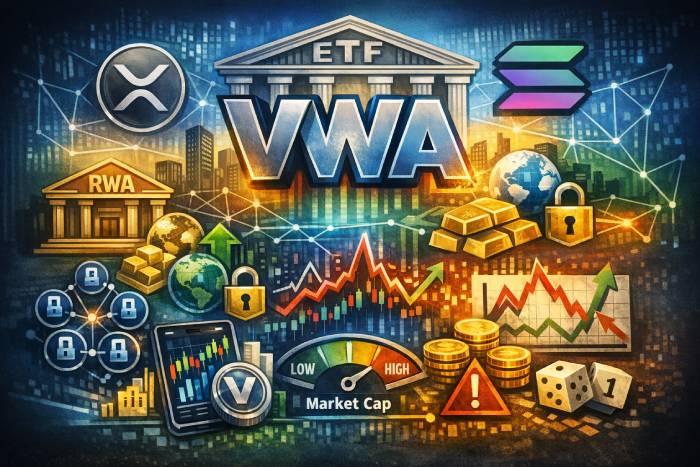
RWA Tokenization Explained: How VWA and Vanguard Fit the RWA Sector
In 2025, the RWA sector is one of the fastest-growing narratives in cryptocurrency. Industry estimates suggest that tokenized real-world assets could represent a multi-trillion-dollar market over the coming decade, driven by experiments in tokenized treasuries, commodities, and fund shares by major financial institutions.
Large players such as BlackRock and other traditional finance firms have publicly explored blockchain-based settlement and tokenized funds, helping legitimize the broader RWA narrative. However, this institutional interest also creates noise, as smaller crypto projects often adopt RWA branding without delivering the verification and compliance standards seen in regulated pilots.
RWA tokenization means converting real-world asset exposure into blockchain tokens. In theory, this lets people trade pieces of assets (like gold, real estate, or bonds) without needing the traditional infrastructure that usually sits in the middle.
Vanguard claims it will tokenize precious metals and gemstones on Solana. The problem is not the concept - the concept is real and growing - the problem is verification. Vanguard has not published verifiable proof of reserves, custody partners, redemption rules, or any compliance-style framework that would normally support confidence in tokenized assets.
VWA Token and Vanguard Name: No Verified Links to BlackRock, ETFs, or Traditional Finance
Despite its name, the VWA token has no confirmed affiliation with Vanguard Group or BlackRock, two of the world’s biggest asset managers. The branding has clearly created confusion, especially among newer crypto users who see “vanguard” and assume a connection to regulated ETFs or mainstream institutions.
So far, there is no public, verifiable partnership announcement tying VWA to Vanguard, BlackRock, or any official ETF product. That lack of confirmation makes it harder to evaluate the fundamental story behind the token - and it’s a big reason why analysts treat many VWA claims as unverified claims until proven otherwise.
Vanguard (VWA) at a Glance: Solana-Based VWA Token Overview (2025)
VWA is a recently launched, Solana-based token that has seen a sharp rise in DEX interest and on-chain chatter. The ticker (VWA) feels intentionally chosen: it sounds like Vanguard, and it also nudges some people toward a Ripple association.
But when you look slightly deeper, the information becomes thin. At the time of writing, there’s no verified team, no clear whitepaper, no published roadmap, and no consistent official communication beyond marketing. In crypto, that combination is often treated as a red flag - not because every anonymous project is a scam, but because the risk profile increases when accountability is unclear.
VWA Crypto History and Public Narrative (Solana, 2025)
Vanguard’s public presence started in early October 2025. The project’s X account (@vanguardrwa) appeared around that time, and third-party trackers suggest the VWA token began circulating around October 1, 2025.
Trading attention grew quickly, driven more by social media than by visible product delivery. That’s not unique in cryptocurrencies, especially for small-cap launches, but it matters when you are trying to judge whether excitement matches substance.
VWA Meme Hype and Unverified Claims: The Simpsons Narrative
One of the loudest moments in the VWA cycle came from a viral claim that the token would appear in an episode of The Simpsons. Fake screenshots spread across social platforms, briefly boosting speculative trading before the claim was debunked.
This is a classic meme pattern: a pop-culture hook creates instant traction, even when it’s not verifiable. It can move price in the short term, but it does nothing to improve fundamentals, audits, or real adoption.
VWA Token Technology: Solana Blockchain, SOL, and On-Chain Infrastructure
Vanguard is built on the Solana blockchain (SPL token standard), which offers fast transactions and low fees compared with older networks like Ethereum. In practice, that makes Solana attractive for frequent swaps, liquidity pools, and fast-moving token launches.
According to the project’s messaging, Solana is meant to support global trading of tokenized RWAs inside the Solana ecosystem. However, Vanguard has not published audited smart contracts, technical specifications, or a public codebase. People searching for “github vwa crypto” or “github vwa crypto repository” will notice that a clear, official repository is not easy to verify publicly.
Marketing has also hinted at cross-chain ideas, including demonstrations that mention Ripple or XRP Ledger. But as of now, Solana remains the only confirmed chain for VWA.
VWA Tokenomics: Total Supply, Circulating Supply, and Token Distribution
VWA’s tokenomics remain mostly undisclosed. The total supply is roughly 1 billion tokens (token supply around 999.99M to 1,000,000,000), and the project has repeatedly been described as having the full amount in circulation. Put simply: the circulating supply appears very close to the total supply, with no clear vesting plan or allocation disclosure.
Because there is no whitepaper and no documented token distribution schedule, traders are forced to lean on on-chain analysis to understand the risk.
On-Chain Analysis of VWA Supply: Centralized Token Distribution as a Red Flag
Since launch, VWA price action has looked like many viral small-cap tokens: a fast spike, big volatility, and sharp moves that can look bullish until you examine liquidity depth.
On-chain analysis from Bubblemaps / Bubble Maps and similar tools suggests heavy concentration. Reports indicate that roughly 80% to 90% of the VWA supply is held by a relatively small cluster of linked wallets, including wallets that appear connected to the deployer or contract-related addresses.
When a centralized token supply sits in a tight group of addresses, it creates a centralize risk: insiders can push price, pull liquidity, or exit quickly. Until ownership can decentralize in a more meaningful way, VWA remains high-risk and highly sensitive to wallet behavior.
Unverified Claims Around VWA Crypto: Ripple, S&P 500 ETF, and Disclosure Risks
One useful way to assess VWA is to separate marketing claims from verifiable facts.
Claims vs. Verifiable Facts
| Public Claim | What Can Be Verified |
|---|---|
| “Backed by Ripple” | No public confirmation from Ripple; no press releases or partnerships |
| RWA tokenization of physical assets | No proof of reserves, custody partners, or redemption mechanism |
| Links to ETFs or S&P 500 | No verified connection to Vanguard Group, BlackRock, or any ETF |
| Decentralized project | On-chain data shows 80-90% of supply held by linked wallets |
These gaps do not prove malicious intent, but they significantly increase uncertainty and require a higher standard of due diligence from participants.
This does not prove wrongdoing on its own, but it raises skepticism and increases the burden of proof for the project.
VWA Token Legitimacy Check: Verification, Fundamentals, and Risk Signals
In crypto markets, legitimacy is built through disclosure and consistency. Analysts typically look for a combination of public documentation, audited contracts, transparent tokenomics, and ongoing technical communication.
For VWA, the absence of a whitepaper, public roadmap, or audited smart contracts places the project firmly in the high-risk category. On-chain data is currently the primary source of insight, but on-chain signals alone cannot replace off-chain verification when a project claims to tokenize real-world assets.
What would meaningfully change the narrative around VWA:
- Publication of a detailed whitepaper explaining the RWA model
- Independent smart contract audits
- Verifiable proof of asset backing and custody
- Clear token distribution and vesting disclosures
- Transparent team or governance structure
Without these elements, VWA remains driven more by narrative than fundamentals.
VWA Crypto Risk Warning: Volatility, Liquidity, and High-Risk Trading
VWA crypto has attracted strong short-term interest, but the mix of branding ambiguity, thin documentation, and centralized token distribution is a major red flag for cautious participants. If you interact with the token at all, prioritize verification: confirm the contract address, avoid random links, and watch liquidity changes and linked wallets.
VWA Token Price Prediction and Market Performance (Crypto Outlook 2025)
Price snapshots for VWA vary by date and source. Early October 2025 data highlighted a surge toward $0.007-$0.008 and multi-million market cap figures. Later snapshots show a steep pullback.
As of December 2025, VWA is described as trading at $0.001596, down roughly 8-9% intraday. The token posted a 24-hour high of $0.001658 and a low of $0.001094, showing how quickly volatility can swing on thinner liquidity. VWA’s market capitalization is described near $1.6 million, with 24-hour trading volume around $73,000.
VWA Crypto Development Outlook: Market Potential in the RWA Sector
From a big-picture view, VWA remains a small-cap token. That can create market potential in a bull market, especially if capital rotates into the RWA sector. Supporters argue that a successful platform for tokenizing precious metals and gemstones could benefit if RWAs continue to expand.
But the long-term value case depends on fundamentals: verifiable reserves, transparent custody, clearer disclosure, and a token distribution that is not heavily centralized. Without those, upside is mostly narrative-driven.
VWA Price Outlook Beyond 2025: Long-Term Forecast and Fundamentals
Long-range forecasting for small-cap tokens is shaky by nature. Some algorithm-based models produce extreme outputs (including flat or near-zero projections), which often reflects limited data, thin liquidity, and a lack of measurable adoption.
For 2026 and beyond, any meaningful recovery would likely require visible product delivery: published documentation, audited contracts, and proof that Vanguard can mint tokenized assets backed by physical assets in a way that can be independently verified.
Is VWA Token Worth Holding or Trading? Speculative vs Fundamental View
Whether VWA is “worth it” depends on risk tolerance. Short-term traders may chase volatility and speculative trading opportunities on Solana-based decentralized exchanges, while long-term holders face higher uncertainty due to unclear tokenomics and centralized token supply.
Timing matters. Entering during hype spikes can be painful if liquidity exits quickly. Monitoring on-chain data and wallet concentration is essential, especially for tokens where insiders may control large portions of supply.
VWA Token Use Cases: Tokenized Assets, Liquidity, and Utility
Right now, VWA behaves more like a trading token than a widely used utility asset. The project suggests possible future functions such as:
- Fees for tokenization (minting tokenized RWAs)
- Incentives for liquidity providers
- Potential governance
But these features are not fully documented. Until there is more verifiable disclosure, the token’s primary utility remains market activity.
VWA Crypto Conclusion: Solana-Based RWA Token or Meme Coin?
The VWA token sits at the intersection of two powerful crypto narratives: RWA tokenization and meme-driven speculation. Vanguard positions itself as a platform for tokenizing real-world assets on the Solana blockchain, yet it also displays many characteristics typically associated with high-risk, narrative-driven tokens.
VWA may continue to move with broader market sentiment or benefit from short-term bullish cycles. However, fundamentals tend to move much slower than hype. Until verification improves - through audits, documentation, and transparent disclosure - VWA should be treated as a speculative asset rather than a proven RWA protocol.
Data context: Price, market cap, and volume figures referenced in this article reflect publicly available snapshots primarily from October-December 2025 and may vary across platforms.
Disclaimer: This article is for informational purposes only and does not constitute financial or investment advice. Cryptocurrency markets are volatile, and readers should conduct their own research before making any investment decisions.