Wolfspeed Stock (NYSE: WOLF): Why It Moves and What Comes Next
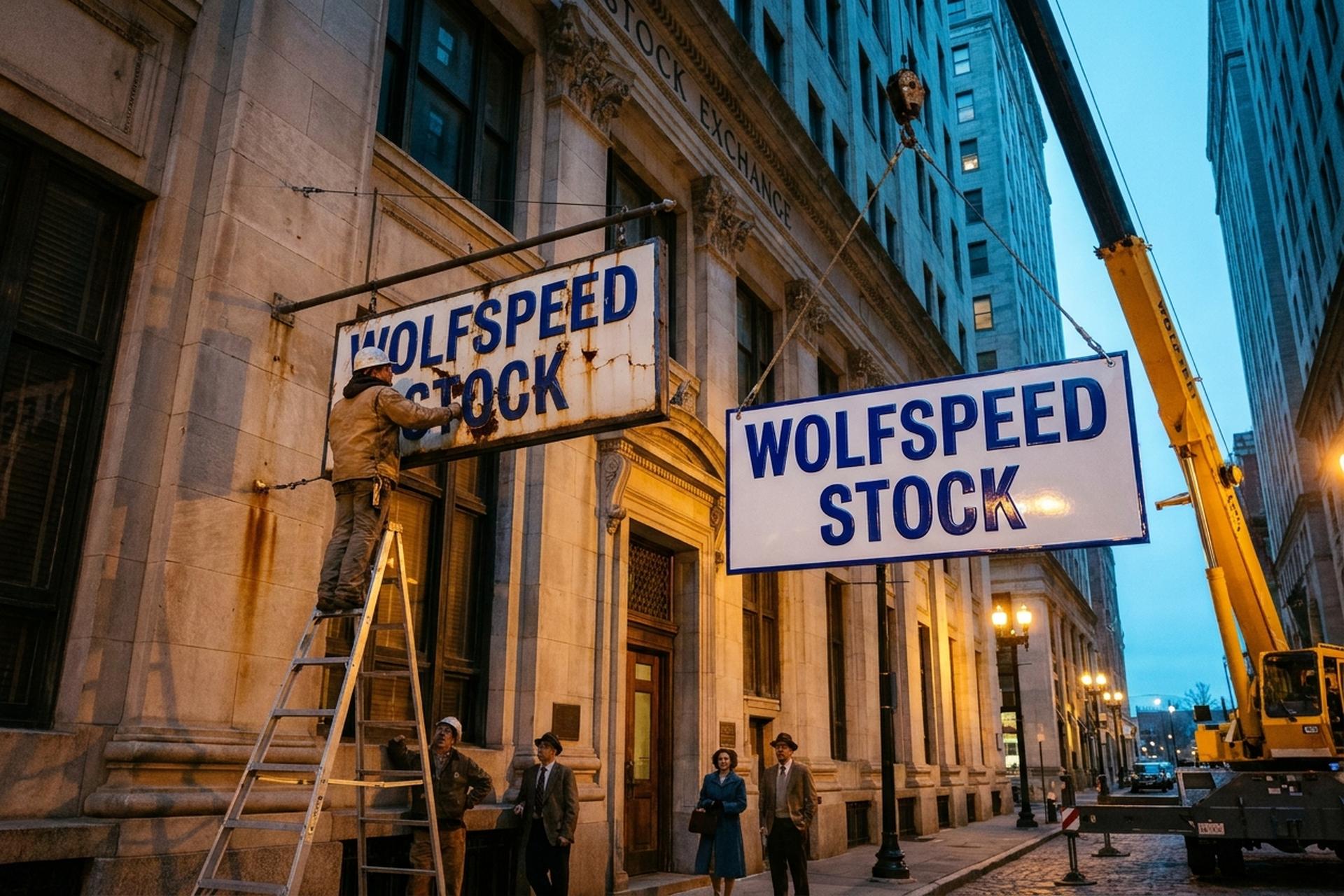
Pull up a long-term chart of Wolfspeed stock and it looks like a disaster followed by a miracle: about $141.87 in November 2021, $0.39 on the last trading day of June 2025, then back above $20. I would not trust that chart. The WOLF shares trading today were issued under a bankruptcy plan in September 2025, and they only borrowed the old ticker.
Most of the confusion online (where did my Wolfspeed stock go, was there a reverse split, why does it swing 15% on a Tuesday) traces back to that one swap. So does a lot of the volatility. The company behind the new shares is small, still unprofitable and still raising outside money.
A note on dates: prices here are as of late October 2026, earnings land on November 4, and none of this is investment advice.
What Wolfspeed Inc makes, and why silicon carbide matters
Ask ten investors what Wolfspeed makes and most will say "chips," which is true in roughly the way "food" is a true answer to what a bakery sells. Owning WOLF stock means taking a view on silicon carbide, and on very little else; a bet on chips in general is a different trade.
Here is the dull version. Every electric car carries an inverter, a box that turns battery current into something the motor can use. Make it from plain silicon and it runs hot, throwing away a few percent of the energy as heat. Make it from silicon carbide (SiC), part of a family engineers call wide bandgap semiconductors, and it runs cooler; the same battery then gets you a few more miles.
Fast chargers want the same thing. So do factory drives, solar inverters and the power shelves in AI data centers. That, more or less, is the whole market thesis.
Wolfspeed gets paid at two points along that chain. It sells silicon carbide wafers (bare substrates, plus epitaxial wafers that carry an extra grown layer) to chipmakers who do the rest. It also sells finished power devices, chips that switch or convert electricity instead of computing, out of a 200mm fab in Marcy, New York, that it calls Mohawk Valley.
It used to be Cree, and it spent years as an LED name out of Durham, North Carolina (founded there in 1987), sold that unit to SMART Global in fiscal 2021, and reappeared as Wolfspeed on the NYSE, ticker WOLF, on October 4, 2021. The gallium nitride (GaN) side, which made RF or radio frequency parts, was sold off in 2023. Today's company has 2,371 employees and calls itself a global leader in silicon carbide. On capacity I would not argue. On profit, much harder to defend.
Why old WOLF stock and new WOLF stock are not the same
Every bankruptcy answers one question: who pays when the nail fails? In Wolfspeed's case, the answer was mostly the old shareholders.
How Wolfspeed ended up in Chapter 11
The plan was bold. Wolfspeed borrowed heavily to fund a capacity expansion meant to make it the world's biggest SiC supplier, expecting electric car demand to keep climbing. Then EV growth slowed while Chinese substrate makers flooded the market with cheap wafers, so the new factories ran well below capacity. By June 29, 2025, the company had $6,538.0 million of debt that counted as due within a year. It could not pay that.
Wolfspeed did the hard part before it ever reached a courtroom. By June 22, 2025, more than 97% of its senior secured noteholders had signed a restructuring support agreement, and so had more than two-thirds of the convertible holders and Renesas (the Japanese chipmaker that had prepaid about $2 billion for future wafers). That is why the case is called prepackaged.
The filing in Texas came on June 30, a judge confirmed the plan on September 8, and three weeks later, on September 29, 2025, it was over.
What the restructuring changed
| Item | Before (June 2025) | After (September 29, 2025) |
|---|---|---|
| Debt due within a year | $6.54 billion | About 70% of total debt (~$4.6 billion) removed |
| Annual cash interest | Baseline | About 60% lower |
| Common shares | 156.5 million old shares | ~25.8 million new shares at emergence |
| Old shareholders | 100% of the company | About 5% of the new shares |
| Renesas | ~$2.06 billion deposit claim | $203.6 million in notes, 16.9 million shares, warrant for 4.9 million shares at $23.95 |
Sources: Wolfspeed 8-K filings (June and September 2025) and the fiscal 2026 10-K.
Where did my Wolfspeed stock go?
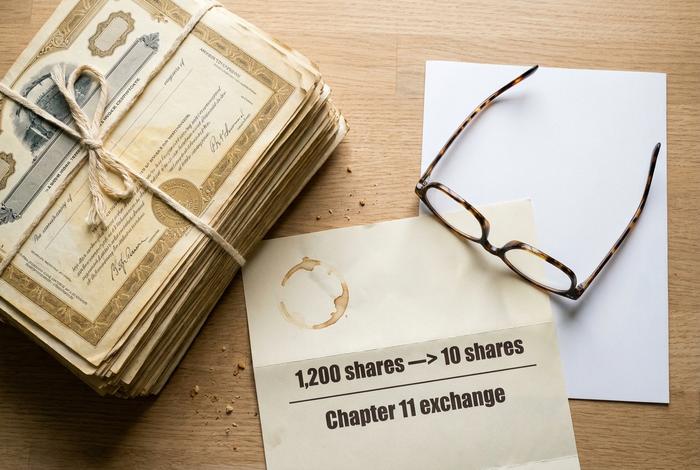
Anyone still holding the old shares saw them cancelled. In exchange, old holders received 1,306,896 new shares in total, at a ratio of 0.008352. That is roughly one new share for every 120 old ones. Someone with 1,200 shares woke up with about ten.
This was not a reverse split, even though brokers sometimes show it that way. A reverse split keeps owners whole, because every holder's percentage of the company stays the same. Here, creditors took about 95% of the new equity. The ticker stayed WOLF, which is exactly why the old chart and the new chart get glued together.
Wolfspeed stock price after bankruptcy: a ride on news
The new WOLF trades less like a manufacturer and more like an option on a turnaround. It moves on financing headlines, sometimes by double digits overnight.
| Date | Price or event |
|---|---|
| Sept 29, 2025 | New shares open around $18, rally about 32% on the exit |
| Sept 2025 to June 2026 | Trading range of $14.80 to $73.50 (10-K) |
| Sept 30, 2026 | Close of $28.13 |
| Oct 30, 2026 | Close of $21.02, down about 25% for October |
Market data from quote pages such as Yahoo Finance put the 52-week range at $13.49 at the lowest to $80.82 at the top and the market value near $1.2 billion in late October. Beta, a measure of how much a stock swings relative to the market, sits around 4. Roughly, a 1% market move comes with a 4% move in WOLF.
When people search "why did Wolfspeed stock jump today," the answer is almost always a press release. A real-time price quote does not tell you much here. The filing behind the move does.
Wolfspeed numbers: revenue, AI demand and negative margins
Although revenue has stopped falling, Wolfspeed still loses money on what it makes, before it pays a single engineer or lawyer.
Revenue stuck near $150 million a quarter
| Quarter | Revenue | Non-GAAP gross margin | GAAP net loss | Cash and short-term investments |
|---|---|---|---|---|
| Q3 fiscal 2026 (to Mar 29, 2026) | ~$150 million | -21% | ~$120 million | ~$1.2 billion |
| Q4 fiscal 2026 (to June 28, 2026) | $149.6 million | -20% | $145.4 million | $1,088.6 million |
| Q1 fiscal 2027 guidance | $140-160 million | Negative | n/a | n/a |
Wolfspeed's fiscal year ends in late June, so the first quarter of fiscal 2027 covers July to September 2026. In its fourth-quarter fiscal 2026 results released on August 19, 2026, the company reported revenue of $149.6 million, down 24.1% from $197.0 million a year earlier. The whole of fiscal 2025 brought in $757.6 million.
One bright spot: AI data center revenue more than doubled over fiscal 2026 and grew about 20% in the fourth quarter alone. It is still a small slice of the business. Two large customers accounted for 38% of sales after emergence.
What a negative gross margin means
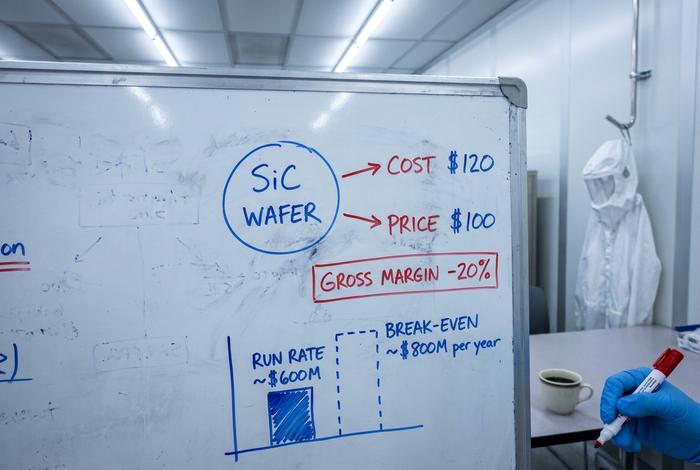
Gross margin is what is left from sales after the direct cost of making the product. A margin of minus 20% means selling a silicon carbide wafer for $100 that cost $120 to produce. Why? A big fab has huge fixed costs, and when it runs half empty, each wafer carries too much of that overhead.
On the August call, CFO Gregor van Issum said gross margin should reach break-even at roughly $800 million of annual revenue, according to 24/7 Wall St. The current run rate is about $600 million; that gap is the whole investment case.
Cash, liquidity and dilution
Liquidity looks fine for now: $1.09 billion of cash and short-term investments at the end of June, helped by $698.6 million of tax refunds under the CHIPS Act's manufacturing credit in December 2025. But the company burned about $380 million of free cash flow in the year to June 2026.
The share count tells the second half of the story. About 25.8 million shares at emergence became 52.99 million by August 13, 2026, after Renesas received its stock, notes converted, and a March 2026 private placement raised $96.9 million alongside $379 million of new 3.5% convertible notes. Every one of those steps made each existing share a smaller piece of the company.
Wolfspeed and the $1.5 billion Department of War loan
Read the headline, then read the filing, and you will notice they describe slightly different things.
What was actually signed
What Wolfspeed actually disclosed on October 7, 2026, was a conditional commitment from the Department of War's Office of Strategic Capital: a senior secured loan of up to $1.5 billion, drawn in stages and repaid over 30 years. (The Department of War is the renamed Department of Defense.) The lender would also get warrants worth up to 7.5% of the company's fully diluted equity, handed out tranche by tranche as money is drawn.
Now read the conditions, because there are a lot of them: due diligence, definitive agreements, government authorizations and appropriations, consents from third parties, and amendments to existing debt. The filing itself says there is "no assurance" the transaction will close. A conditional loan commitment is a promise to keep negotiating, not cash in the bank.
Why Washington wants domestic silicon carbide
SiC power devices end up in military vehicles, radar power systems and grid infrastructure, and a bipartisan group of U.S. senators has publicly warned about China's fast-rising share of global SiC supply. A domestic producer with a 200mm fab is a strategic capability, whatever its margins.
The Wolfspeed stock reaction showed the tension. Shares rose about 6% intraday on October 8, according to TIKR, and then gave back that gain and more as October went on. I think investors first priced the news as rescue money, and then remembered the conditions and the warrants. Was the loan bad news? No. As good as the first headline? Not quite.
Infineon and BorgWarner deals: what they mean for Wolfspeed
The two supply agreements announced in October prove that demand exists. They say very little about profit.
On October 15, Infineon expanded a relationship of about 20 years with a multi-year agreement that moves its wafer purchases from 150mm to 200mm substrates. Two weeks later, on October 29, BorgWarner agreed to buy 1200V SiC devices from the Marcy fab for its 800V inverters, again over several years. Nobody put a dollar figure or a volume on either contract. That is commercially normal, and it leaves investors guessing.
That silence matters. A buyer that signs a long deal in a falling market usually negotiates hard on price. Good news for revenue, possibly neutral for margins. I would wait for the numbers before treating either announcement as a turnaround signal for WOLF stock.
Who sets the price: Wolfspeed vs Chinese silicon carbide
Wolfspeed's biggest competitors are, awkwardly, also some of its biggest customers. Infineon, onsemi, STMicroelectronics, Rohm and Bosch buy wafers and also make their own SiC chips.
The bigger pressure comes from China. Wolfspeed's own 10-K names SICC and TanKeBlue as substrate rivals and cites increased Chinese supply as a cause of falling prices. TrendForce data showed 6-inch substrate prices dropping below $500 in 2024 and global substrate revenue falling 9% that year to $1.04 billion, even as volumes grew. When a state-supported rival can sell below your cost, you end up taking the price rather than setting it.
What to watch when Wolfspeed reports on November 4
The earnings call is set for 5:00 p.m. Eastern time on November 4, 2026. Headline earnings per share will get the attention, but five other numbers matter more:
- Revenue against the $140-160 million guidance range.
- Gross margin direction. Any move from minus 20% toward zero counts.
- Cash burn and the cash balance.
- Progress on the loan, especially any definitive agreement.
- Signs of a new equity raise, which would mean more dilution.
Is WOLF stock a buy? The bull case and the bear case
I cannot tell you whether to buy or sell, and I would be suspicious of anyone who says they can.
Start with the optimists. They point to the Marcy fab (200mm SiC capacity is expensive and slow to build, and few companies have it), to a balance sheet far lighter than it was in 2025, to open government interest, and to customers with names like Infineon and BorgWarner. Their bet is that AI data centers and 800V cars push revenue toward the $800 million mark, at which point the fixed costs that hurt today start to help. That hope is the premium buyers pay for now.
The pessimists have a longer list. Margins are deeply negative. Chinese prices are still falling. The loan is conditional. Two customers carry 38% of post-bankruptcy sales. And dilution has not stopped: there is the government's 7.5% in warrants, the Renesas warrant at $23.95, and whatever the next raise looks like. Susquehanna, for its part, rates the stock Hold with a $25 target as of October 30.
Where do I come out? WOLF is a leveraged bet on whether revenue arrives before cash runs low. Legitimate, yes; safe, no. Buying it is easy (any broker with NYSE access will do, since it is not on Nasdaq), but a stock that has already fallen 16% in a single day deserves a small position. Plenty of people who like the SiC story skip the single-name risk entirely and hold a semiconductor ETF.
Trading Wolfspeed stock: the takeaway before earnings
Stop reading the old chart. The thing on your screen is a small silicon carbide maker. It loses money, it carries expensive debt, and it belongs mostly to people who used to be its lenders. Its price reacts to financing news and supply contracts long before it reacts to wafers shipped.
The material was never the problem. Wolfspeed borrowed to build ahead of demand, and demand showed up late. So my advice for November 4 is narrow: look at gross margin first. If it is moving toward zero, the rest of the story starts to work. If it is not, government headlines will not hold up the Wolfspeed stock price for long.