MEXC Review: Buy Bitcoin, Trade Crypto and Use the MX Token

Ask ten altcoin traders where they first bought some obscure new token, and a fair number will say MEXC. This offshore cryptocurrency exchange lists coins absurdly early. Its fees are close to the floor too. Zero for makers on spot, a few hundredths of a percent for takers.
So why doesn't everyone use it? It has no top-tier license. People in the US, UK and Canada can't sign up, and new EU users got cut off a while back. Below I cover what the platform costs, how safe your money is there, who's actually allowed in, and how to deposit USDT and buy BTC without sending funds to the wrong network.
What Is MEXC and How the Trading Platform Works
MEXC started in 2018 under the name MXC Exchange and later rebranded as MEXC Global. The company is registered in Seychelles and says it serves more than 40 million users across 170+ countries. These days most people just say the MEXC exchange, or MEXC for short.
Technically, it's a centralized exchange, or CEX. That means the platform holds your funds in its own wallets, matches buy and sell orders on an internal order book, and credits your account balance instead of sending every trade to the blockchain. You only touch the chain when you deposit or withdraw.
The product range covers most of what an active trader expects:
- Spot trading across thousands of pairs, mostly quoted in USDT
- Perpetual futures with high leverage
- Copy trading and grid bots
- Earn products (savings and staking)
- Launchpad and Kickstarter events tied to the MX token
- DEX+ and Meme+ sections for buying on-chain tokens without leaving the account
Listing speed is the real differentiator. New projects, meme coins and small-cap altcoins often show up here days or weeks before they reach Binance or other big venues. For crypto traders who want early exposure, that's the main draw. For everyone else, it means a lot of the catalog is highly speculative.
MEXC Trading Fees: 0 Fees for Makers, Low for Takers
Fees are the headline feature. On spot markets, makers (traders who place limit orders that sit on the book) pay nothing, and takers (traders who fill existing orders) pay a small percentage. Futures follow the same logic with an even lower taker rate.
| Fee type | Standard rate | Notes |
|---|---|---|
| Spot maker | 0% | Applies to most pairs |
| Spot taker | 0.05% | Lower with MX discounts or VIP tier |
| Futures maker | 0% | USDT-margined perpetuals |
| Futures taker | ~0.02%–0.04% | Varies by contract and promotions |
| Crypto deposit | Free | You still pay the network fee from your own wallet |
| Crypto withdrawal | Flat fee per coin | Depends on the coin and network chosen |
| Account / inactivity | None | No monthly or dormant-account charges |
Those numbers are low. Really low. A trader moving $10,000 through taker orders on spot pays about $5 in trading fees on MEXC, compared with $10 at a typical 0.1% venue.
Holding MX, the exchange's native token, cuts trading fees further, and VIP tiers based on volume or balance unlock additional discounts. MEXC also runs frequent "zero fee" campaigns on selected pairs. Those promos rotate often, so check the live fee page before you assume a rate.
Withdrawal fees deserve attention. They're fixed amounts per coin, not percentages, so pulling out a small balance can cost proportionally more. Choosing a cheaper network, such as TRC-20 or a layer-2 for USDT instead of Ethereum mainnet, usually brings the cost down a lot.

Spot, Futures and Liquidity: What You Can Trade
The catalog is huge: over 3,000 tokens and more than 2,000 spot pairs. BTC, ETH, SOL and XRP are there, obviously, but the real volume of listings sits in the long tail: altcoins nobody had heard of last month, AI tokens, gaming coins, memes that launched yesterday. Nearly everything trades against USDT. A smaller set also has USDC pairs.
Futures? Same story. You get 1,000+ perpetual contracts, and leverage on some of them runs to several hundred times, far past anything a regulated broker would offer you. I'd treat that as a warning label rather than a feature. At 100x, the market only has to move 1% the wrong way and your position is gone. Futures trading at that size isn't really trading anymore.
Liquidity deserves a careful look before you click buy. BTC/USDT and the other big pairs have deep books and tight spreads, so a market order fills about where you expect. Fresh micro-caps behave differently:
- Order books can be thin, so a modest market order may move the price
- Spreads widen sharply during the first hours after a listing
- Volume sometimes drops off fast once the hype fades
My rule of thumb: anything outside the top 50, use limit orders. Bonus, you stay a maker and pay nothing on spot.
Then there's the extra stuff. I've seen people use copy trading to follow someone else's positions, set a grid bot running over a weekend, or park idle USDT in Earn for a small variable yield. Handy to have it under one login. Just don't get attached to any rate you see there, because it'll probably be different next week.
MX Token: Fee Discounts, Launchpad and Kickstarter
MX is MEXC's utility token. It doesn't give you ownership in the company. Its value to users comes from the perks the exchange attaches to holding it.
The main benefits are:
- Fee discounts. Paying fees in MX or holding a balance reduces spot and futures costs.
- Kickstarter. Users who hold a minimum amount of MX can commit it to vote on upcoming listings and receive free airdrops of the new token. Conditions, such as a minimum MX balance and sometimes a completed futures trade, are set per event.
- Launchpad. Token sales where MX holders buy new tokens at a fixed price before trading opens.
- Launchpool-style events. Stake MX or other assets to farm new tokens.
Can these programs pay off? Sometimes. They carry the same risk as any new listing, though. Many tokens drop sharply after launch, and an airdrop is only worth what the market will pay for it on day one. Treat MX as a tool for lowering costs and accessing events, not as an investment thesis, and never buy more than you're willing to see swing hard in price.
Using MEXC: Register, Deposit USDT and Buy BTC
If you already hold crypto in another wallet, setup takes about ten minutes. The flow below goes from sign-up to your first withdrawal.
- Create an account. Sign up on the website or in the MEXC app with an email address or phone number. Set a strong unique password.
- Lock down security. Turn on two-factor authentication with an authenticator app, set an anti-phishing code (it appears in genuine MEXC emails), and enable a withdrawal address whitelist.
- Decide on KYC. Basic trading works without verification, but higher withdrawal limits, fiat purchases and some events require it. Doing it upfront avoids surprises later.
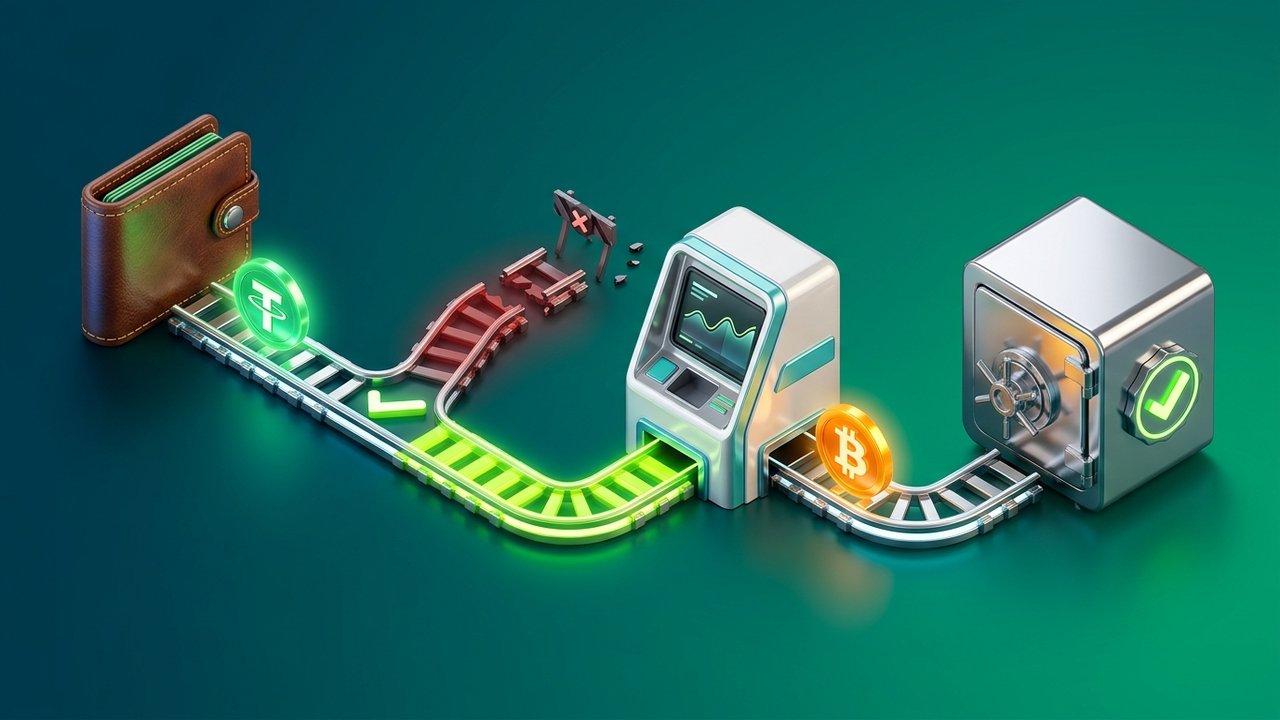
- Deposit USDT. Go to Assets → Deposit, choose USDT and pick the network. Copy the address and send funds from your wallet using the exact same network. TRC-20 and several layer-2 networks are usually cheaper than ERC-20.
- Buy BTC. Open the BTC/USDT spot market. Use a market order for an instant fill, or a limit order to set your price and pay zero maker fees.
- Withdraw. When you're done, go to Withdraw, select the coin and network, and send to a whitelisted address. Check the fee and the minimum amount before confirming.
If you don't own crypto yet, MEXC lets you buy bitcoin or USDT with a bank card through third-party providers, or through its P2P marketplace, where you pay another user directly in local fiat. Card purchases are fast but carry higher fees, and P2P requires checking the seller's completion rate and reviews.
The most common costly mistake is sending funds on the wrong network. USDT on Ethereum and USDT on Tron share a ticker but live on different blockchains, and a mismatch can mean lost funds or a slow, paid recovery request. Coins that need a memo or tag (XRP, XLM, TON and others) are another trap: leave the memo out and your deposit won't be credited automatically.
MEXC App, Help Center and Customer Support
You can get the MEXC app on iOS and Android, and it does nearly everything the website does: futures, copy trading, Earn, the lot. Charts load fast. Placing an order is quick, and flipping between spot and futures is one tap.
Is it user-friendly? Depends who's asking. A newcomer opens it and sees banners, promos and new listings fighting for every inch of the screen. Someone who's traded for a couple of years just ignores all that.
Developers get REST and WebSocket APIs for both spot and futures. Plenty of bot operators and arbitrage desks run on them.
Live chat is open 24/7, and the help center goes into decent detail on deposits, picking a network, KYC and fees. Simple questions? Answered in minutes, usually. Frozen accounts and stuck withdrawals are a different matter. Those get handed to the risk team, and user reviews describe waiting days, sometimes weeks, to hear back from the support team.
Is MEXC Safe? Proof of Reserves and Risk Controls
On the technical side, the record is solid. No major hack has been reported since launch, and several bigger competitors can't say the same. Security measures include:
- Proof of reserves published regularly and verified through a Merkle tree, so each user can confirm their balance is included
- Third-party reserve audits by the blockchain security firm Hacken
- Reserve ratios above 100% for major assets, with BTC coverage reported well over 200% in recent snapshots
- A $100 million Guardian Fund meant to cover user losses in extreme events
- Cold storage for the large majority of customers' digital assets
- 2FA, anti-phishing codes and address whitelisting
That covers custody risk reasonably well. The bigger concern for many users is risk controls, MEXC's internal review process for suspicious activity. Accounts can be restricted or frozen during a manual review, and complaints on review sites often involve exactly that. Typical triggers include:
- Signing up from or trading in a restricted country, including via VPN
- Inconsistent identity or residency details during KYC
- High-frequency API trading or arbitrage patterns flagged as abusive
- Large deposits from addresses linked to mixers, hacks or sanctioned entities
Some freezes are resolved within days. Others drag on and end with forced verification or account closure. The practical defense is simple: use your real details, complete KYC before you move serious money, keep documents ready, and don't treat any exchange as a long-term vault. Move funds you're not actively trading to a wallet you control.
Where MEXC Works: KYC Limits, MiCA and Banned Countries
Verification here is light. You can open an account and trade without KYC, which appeals to privacy-minded users, but withdrawal limits rise with each verification level.
| Verification level | Daily withdrawal limit | Extra access |
|---|---|---|
| No KYC | 10 BTC | Spot and futures trading |
| Primary KYC | 80 BTC | Higher limits, most events |
| Advanced KYC | 200 BTC | Fiat purchases and P2P |
Light KYC doesn't mean it's available everywhere. Its user agreement prohibits residents of the United States, Canada, the United Kingdom, Singapore, Hong Kong, mainland China, Kazakhstan, North Korea, Cuba, Iran and Sudan, as well as Russian-controlled regions of Ukraine. The UK ban followed the FCA adding MEXC to its warning list.
Europe is the other big change. MEXC doesn't hold a MiCA license, the EU's new framework for crypto-asset service providers. The exchange withdrew its license application in Greece and stopped offering new services to EU users once the MiCA transition period ended. Existing users can still withdraw, but new deposits, trades, sign-ups and Earn products are off the table.
Regulators elsewhere have also issued warnings, including the Dutch AFM, Germany's BaFin, Austria's FMA, Canada's BCSC and Dubai's VARA. None of that makes the platform a scam. It does mean there's no local regulator to call if something goes wrong.
Using a VPN to get around these rules breaks the terms of service. If MEXC detects it, it can close the account and force-close open positions, and that's a bad trade for a little convenience.
MEXC vs Binance and Other Crypto Exchanges
The exchange sits in a specific niche. It competes less with fully regulated platforms and more with other offshore exchanges that court active altcoin and derivatives traders. Here's how it lines up on the basics.
| Feature | MEXC | Binance | Bybit |
|---|---|---|---|
| Spot maker / taker | 0% / 0.05% | 0.1% / 0.1% | 0.1% / 0.1% |
| Listed tokens | 3,000+ | ~400 | ~1,000+ |
| Listing speed | Very fast | Selective | Fast |
| KYC to trade | Not required | Required | Required |
| Licensing | Offshore, no major license | Multiple regional licenses | Several regional licenses |
| Proof of reserves | Yes | Yes | Yes |
Binance offers deeper liquidity on major pairs and broader regulatory coverage, while MEXC wins on fee rates and on how many small-cap tokens it lists. Many experienced traders keep accounts on both: a larger exchange for core holdings and fiat, and MEXC for early listings and cheap trading.
Pros and Cons of the MEXC Crypto Exchange
Pros
- Zero maker fees on spot and futures, and low taker fees
- Huge selection of altcoins, often listed earliest
- KYC-free trading with meaningful withdrawal limits
- Regular proof of reserves and a $100M Guardian Fund
- Full-featured web platform, mobile app and API
Cons
- No top-tier license, restricted in the US, UK, Canada and the EU
- Account freezes during risk reviews are a recurring complaint
- Many listed tokens are extremely speculative with thin liquidity
- Very high leverage makes it easy to lose money fast
- Support slows down sharply on complex cases
Accepting Crypto Payments Without an Exchange Account
Maybe you landed here for a different reason. You run a store, or sell software, and a few customers keep asking whether they can pay in bitcoin. An exchange account won't really solve that. You'd be sharing your deposit address by hand, checking every transfer yourself and guessing which network each buyer used. That gets old after the third order.
A crypto payment gateway takes over that part. The buyer gets an address and an exact amount at checkout, the gateway spots the on-chain payment and your balance goes up. Worried the coin drops before you cash out? Lots of gateways will auto-convert to USDT. You'll usually find plugins for WooCommerce, Shopify-style platforms and the like, plus an API when nothing off the shelf fits.
For that use case, Plisio lets businesses accept BTC, ETH, USDT and dozens of other cryptocurrencies with simple integration and low fees.
So, who is the MEXC exchange for? Traders who care about cost, want new tokens early and live somewhere it's allowed. If that's you, keep a few habits. Limit orders on thin markets. Modest leverage. KYC done before you need it. And anything you aren't actively trading goes back to your own wallet.