What Is Token Gating? How NFT and Token-Gated Access Works in Web3
Starbucks killed Odyssey in March 2024. Dead before it left beta. Which was weird, because the idea behind it was so simple a child could explain it: buy a digital stamp, collect stamps by doing stuff, unlock exclusive perks. Starbucks had 75 million active rewards members and more money than most countries spend on coffee. Didn't matter. The dual-currency system confused people, the marketplace felt broken, and the wallet connection step might as well have been a brick wall. Meanwhile, a handful of smaller projects were doing the exact same concept — token gating — and making it work. Liquid Death sold tokenized memberships through Apple Wallet. Adidas wired wallet authentication into its CONFIRMED app and ran a multi-year community around the ALTS collection. VeeCon, Gary Vaynerchuk's conference, sold out year after year with a simple rule: own a VeeFriends NFT, you're in. Don't own one, you're not.
Token gating is one of those web3 ideas that's dead simple in concept and surprisingly messy in execution. You own a specific token or NFT? You get access to something. You don't own it? Door's closed. That's the entire pitch. But underneath that pitch sits a layer of smart contracts, wallet verification, community dynamics, and real money that makes it worth understanding properly, whether you're a brand thinking about launching gated experiences, a developer building the tools, or just someone who keeps seeing "holders only" on Discord channels and wants to know what the deal is.
How token gating works: the technical side
Strip away the marketing language and token gating is a verification step. You connect your crypto wallet to a platform, the platform reads what's in your wallet, and if you hold the required token or NFT it lets you through. If you don't, it doesn't. That's the whole thing.
Walk through it step by step. A project mints a token. Could be a fungible ERC-20, could be an NFT (ERC-721 or ERC-1155). They set a rule: "wallet holds Token X? Access granted." You visit the gated page, connect your wallet, sign a message. That signature doesn't cost gas. It just proves you own the private key for that address. The platform reads the blockchain, sees whether you hold the token, and either opens the door or doesn't.
What makes this different from showing a screenshot of your membership card? Nobody can fake a blockchain read. You hold the token or you don't. No forwarded emails, no borrowed credentials. I've described it to non-crypto people as "the bouncer checks the actual guest list, not your word for it."
Most token gating today runs through third-party tools rather than custom-built solutions. The ecosystem has settled into a few major players:
| Platform | What it does | Used by |
|---|---|---|
| Collab.Land | Discord and Telegram bot, verifies token holdings for channel access | Thousands of DAOs and NFT communities |
| Guild.xyz | Multi-platform gating across Discord, Telegram, GitHub, Google Workspace | 40,000+ communities |
| Tokenproof | Event and IRL verification, keeps tokens in cold storage during check | Yuga Labs (Bored Ape events), major conferences |
| Shopify Tokengating | Native Shopify integration for token-gated commerce | Adidas ALTS, Steve Aoki's Dim Mak |
| Alchemy NFT API | Developer tools for building custom gating (getOwnersForCollection, isHolderOfCollection) | Custom implementations |
Token gating use cases: where it actually gets used
The idea started in NFT communities gating their Discord servers, but it has spread into commerce, events, media, and gaming. Some of these use cases are gimmicks. Others are generating real revenue.
Discord and Telegram communities. This is where most people first encounter token gating. You hold a specific NFT, a bot like Collab.Land checks your wallet, and you get access to private channels. Some servers are entirely gated. Others are public with specific channels locked to holders. The Bored Ape Yacht Club's Discord, for example, has channels that only BAYC holders can see. These gated spaces often include early access to NFT drops, alpha calls on upcoming projects, and direct communication with the project team.
E-commerce and exclusive drops. Shopify integrated token gating natively, and the results from brands that used it properly have been interesting. Brands using NFT-based loyalty programs reported 28% higher repeat customer interactions and 12% lower acquisition costs compared to traditional loyalty programs, according to Shopify's own data. Steve Aoki's Dim Mak store ran exclusive merch drops for NFT holders. Nike built .SWOOSH, a token-gated platform that did over $1 million in its first week. Adidas ALTS connected wallet auth to the CONFIRMED app for multi-year community perks.
Live events and conferences. VeeCon (Gary Vaynerchuk's annual conference) is the most well-known token-gated event: you need a VeeFriends token to attend. Deadfellaz ran a token-gated party at NFT NYC in 2022. Ticketmaster added token gating tools so artists and event organizers can restrict ticket sales to holders of specific tokens. This use case solves a real problem: scalping. If your ticket is tied to a token in your wallet, bots can't buy it and resell it because the ticket IS the token.
Media and content. The Block experimented with token-gated articles through its Access Protocol, where holding access tokens unlocked premium content. This is basically a paywall, but instead of a monthly subscription you hold a token. The economics are different: the token itself can appreciate, so the "subscription" might actually make you money while giving you access.
Gaming. Token gating in gaming means owning certain NFTs unlocks areas, skins, weapons, or storylines that non-holders can't access. The Sandbox and Decentraland both have token-gated zones. Sequence (a web3 gaming infrastructure company) built tools specifically for game developers to gate content based on NFT ownership. This is where token gating gets conceptually interesting because it ties in-game progress to actual ownership.
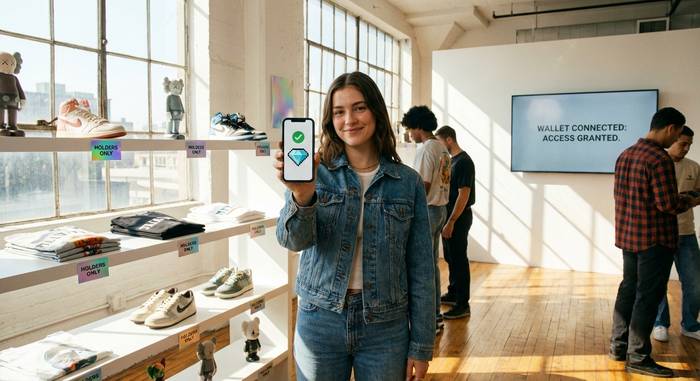
Benefits of token gating for creators and brands
Fair warning: most "benefits" articles about token gating are written by companies selling gating tools. But a few advantages actually survive contact with reality.
Verification that can't be faked. Before token gating, proving ownership of a digital thing meant screenshots. Screenshots can be photoshopped in thirty seconds. Wallet verification is binary: you hold the token or you don't. On chain. No ambiguity.
Portable membership. This one is underrated. Your token lives in your wallet, and your wallet works everywhere. Same NFT gets you into a Discord server, a Shopify exclusive drop, a physical conference, and a metaverse room. Try doing that with a Starbucks rewards card. Traditional loyalty locks you into one platform. Token gating is interoperable by default because the token sits on a public blockchain.
Skin in the game. When someone buys a token that grants access, they now want the project to succeed. The token's value is tied to the community's health. That's fundamentally different from a Netflix subscription where you have zero financial upside from the platform doing well.
The NFT market hit $3.6 billion in 2024 and is projected at $22.8 billion by 2034. Token gating drives a big chunk of that growth because it gives NFTs a reason to exist beyond "maybe someone will buy this JPEG from me later."
Risks of token gating: what can go wrong
The Starbucks failure wasn't a fluke. It exposed real problems that the entire space still hasn't solved.
Wallet friction kills conversion. "Connect wallet" is where most non-crypto users bounce. They don't have MetaMask. They don't want MetaMask. Shopify's own data shows conversion tanks the moment a wallet popup appears. Until that step becomes invisible, token gating is limited to people who are already in crypto, which is not a mass market.
Phishing is constant. Every wallet connection is a potential attack surface. A 2023 study found 36% of NFT giveaways were scams or rug pulls. Even on legit platforms, signing a gasless message can drain your wallet if the contract behind it is malicious. Tokenproof helps by keeping tokens in cold storage during verification. Most other tools require your assets in a hot wallet, which is riskier.
Smart contracts break. The gate runs on code. Code has bugs. A flaw in the gating contract could expose tokens or let unauthorized users through. Audits reduce risk but don't eliminate it. Nobody's gating contract is guaranteed to be bulletproof.
Regulators haven't decided what this is yet. EU and UK may charge VAT on NFTs used in commerce. US regulators have hinted that NFTs marketed as investments look a lot like unregistered securities. Brands building on token gating need lawyers who understand crypto, and those are expensive.
And the obvious one: gating shrinks your audience by design. A gated event has fewer attendees than an open one. A gated Discord has fewer members. Exclusivity is the whole point, but it's also the constraint. Starbucks had 75 million rewards members and couldn't convert a meaningful fraction of them to wallet holders.
Token gating on Shopify: the biggest platform play
Shopify deserves its own section because it's the largest e-commerce platform to integrate token gating natively. Merchants can create token-gated experiences directly from their Shopify admin, connecting to wallets on Ethereum, Polygon, Solana, and other chains.
The setup works like this: a merchant creates a "gate" attached to a product, collection, or discount. The gate specifies which token or NFT a customer needs to hold. When a customer visits the store, they connect their wallet (MetaMask for Ethereum/Polygon, Phantom for Solana, Kukai for Tezos, Dapper for Flow). The smart contract verifies ownership. If the customer holds the required token, the gated product or discount becomes visible and purchasable.
The numbers from brands that went all-in are worth noting. Kings of Leon generated over $2 million in first-week sales from their 2021 NFT drop that included token-gated concert perks. Adidas ran multi-year engagement through ALTS with wallet authentication built into their existing CONFIRMED app, not a separate web3 experience. The lesson from these successes, and from Starbucks's failure, is that token gating works best when it's layered onto an experience people already use, not when it forces them into an unfamiliar flow.

The future of token gating: where this is heading
I think token gating is going to look very different in two or three years. The "connect wallet" step is the biggest bottleneck, and it's being attacked from multiple angles. Liquid Death already showed you can tokenize membership through Apple Wallet and Google Wallet, bypassing the MetaMask step entirely. Account abstraction (ERC-4337 on Ethereum) is making wallets feel more like normal accounts with social logins, recovery options, and no seed phrases. When the wallet disappears into the background, token gating starts looking a lot like regular digital membership, except the membership is verifiable, transferable, and interoperable.
The commerce angle is where I see the most upside. Loyalty programs in retail are a $200+ billion global market. Token-gated loyalty has clear advantages: lower acquisition costs, portable membership, secondary markets for points (via the token), and proof of engagement that can't be gamed. The brands that cracked the code in 2024-2025 did it by hiding the crypto underneath a normal user experience. The ones that failed made you feel like you were using crypto.
Regulation will shape the path. MiCA in Europe, evolving SEC guidance in the US, and individual country-level rules for digital assets will determine how freely brands can use token gating. The direction seems favorable: regulators appear more interested in regulating the financial aspects of tokens than in blocking utility use cases like gating. But "seems favorable" and "is resolved" are very different things in crypto regulation.