What is an NFT: the beginner’s guide that doesn’t pretend everything is fine
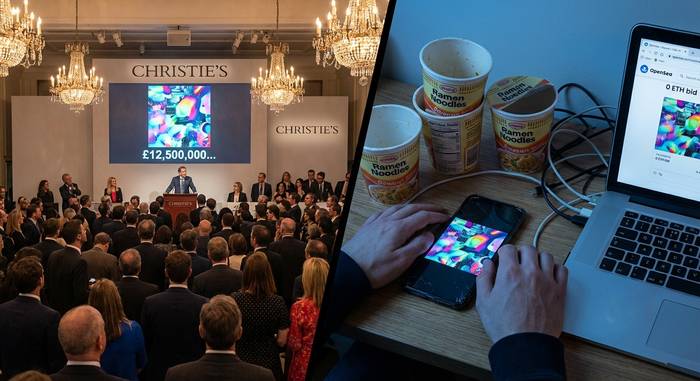
$69 million for a JPG. I keep coming back to that number. Beeple, a guy who made digital art every day for 5,000 consecutive days, uploaded the result to Christie's and someone paid $69 million for it. Same year, a pixel face called CryptoPunk #5822 went for $23.7 million. A buddy of mine bought a cartoon ape for 2 ETH and still acts like it was a genius move despite it being worth 0.3 now. We don't bring it up at dinner.
That era, 2021 into 2022, the NFT market did $25 billion and attracted every celebrity, influencer, and VC on earth. Then it fell apart. $5.5 billion in volume by 2025. NFT Paris cancelled. Obituaries everywhere.
But here's the thing that bugs me about most NFT takes: people either tell you it's the future or tell you it's dead. Both are lazy. Let me try something more honest.
What does NFT mean
OK. Three words: non-fungible token. Sounds like jargon vomit. Let me unpack it.
Fungible. Fancy word for "interchangeable." You've got a $20 bill, I've got a $20 bill. We swap. Neither of us cares. That's fungibility. Bitcoin? Same deal. My BTC is identical to yours.
Non-fungible. Fancy word for "unique." My cat isn't your cat. Row 3 seat A12 at a concert isn't the same as row 15 seat B7. Each one is different, and you can't just swap them without someone caring.
An NFT is a unique digital token on a blockchain. The way I explain it to friends: imagine a Google Doc that says "Jake owns this cartoon monkey" and that Google Doc is stored on 10,000 computers simultaneously and nobody can edit it without everyone else noticing. That's roughly what an NFT is. A tamper-proof ownership receipt for a digital thing.
The confusion that makes people yell at each other on X: the NFT isn't the picture. You can screenshot any NFT art. Save it to your phone. Print it on a t-shirt. The file is just a file. What you can't copy is the ownership record on the blockchain. Imagine photographing the Mona Lisa and claiming you own it. You have the image. The Louvre has the provenance. Same energy.
How does the whole thing actually work
Alright, I'll keep this practical.
Most NFTs live on Ethereum. The technical standard is called ERC-721, which is just a blueprint for how these tokens get created and tracked. Solana has its own NFT ecosystem too, cheaper and faster but smaller.
Making an NFT is called "minting." You go to a platform (more on those later), upload a file, connect your crypto wallet, and the platform writes a smart contract to the blockchain. That contract says: here's the asset, here's who made it, here's who owns it right now, and here's what happens when it sells (usually the creator gets a royalty cut of 2.5-10% on every future resale).
Minting costs money because writing to a blockchain isn't free. On Ethereum you pay gas fees. Could be $0.50 on a quiet day, could be $15 when things are busy. On Solana it's fractions of a penny.
One thing I wish someone had told me earlier: the actual image or file almost never lives on the blockchain. Storing a high-res image on Ethereum would cost thousands of dollars. Instead, the NFT token points to the file, which is hosted somewhere else. Sometimes that's IPFS, a decentralized storage network that's pretty reliable. Sometimes it's just some company's server. If that server goes down, your NFT points to a dead link. This has happened to people. It's a real problem that most NFT explainers skip.
What people actually use NFTs for
Art got famous. But it's not the whole story, and honestly it's not even the biggest part of the market anymore.
Digital art put NFTs on the map. Beeple's $69 million sale at Christie's in March 2021 made every news outlet on earth pay attention. Artists like XCOPY, Tyler Hobbs, and Pak built legitimate careers selling digital work. The scene has cooled off hard since then but Art Blocks, Foundation, and SuperRare are still active. If you care about art for art's sake, it's a functioning market. Just don't expect 2021 prices.
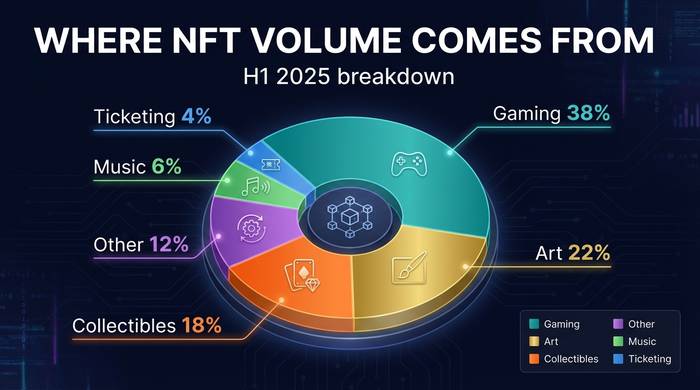
Gaming swallowed a bigger chunk than most people realize. 38% of all NFT transaction volume in early 2025 was game-related. The pitch: your sword, your skin, your character exists as an NFT you actually own, and you can trade it outside the game. Axie Infinity tried this and eventually imploded. Newer projects learned from that mess, but nobody has fully cracked the formula yet.
Music NFTs are small but real. Artists selling albums and concert access directly to fans, no label, no Spotify taking 70%. Daniel Allan and RAC proved it works. It just hasn't gone mass-market.
The one that finance people get excited about: real-world asset tokenization. Take a building, a painting, a vintage car. Split ownership into NFT tokens so regular people can buy 1% of a penthouse. Institutional money is watching this closely. Probably the most long-term relevant NFT use case and also the most boring, which is usually a good sign.
| Use case | What it looks like | Status (2026) |
|---|---|---|
| Digital art | Buy original works from artists | Active, lower volume |
| Gaming items | Own swords, skins, characters | 38% of NFT volume |
| Collectibles | PFP projects like Apes and Punks | Mostly crashed |
| Music | Buy albums/songs directly from artists | Niche but growing |
| Ticketing | Concert/event tickets as NFTs | Quietly practical |
| Real-world assets | Fractional ownership of property/art | Early, institutional interest |
The projects that defined NFTs
CryptoPunks were the original PFP collection. 10,000 pixel faces generated algorithmically in 2017 by two guys at Larva Labs. They were free to claim at first. Individual Punks later sold for millions. Larva Labs sold the entire IP to Yuga Labs in 2022 for an undisclosed amount.
Bored Ape Yacht Club blew up in mid-2021. 10,000 cartoon apes, each one slightly different. Owning one meant you were in the club, literally. Exclusive events, celebrity holders, merchandise rights. Floor prices went past 150 ETH. By 2025 they'd dropped below 10. The highs were absurd. The crash was predictable in hindsight.
Art Blocks is generative art. Artists write code, the code produces unique pieces when someone mints. Fidenza, Ringers, Chromie Squiggles. This corner of NFTs has held value better than almost anything else because the art is genuinely interesting and the supply is fixed.
NBA Top Shot brought NFTs to people who'd never heard of Ethereum. Officially licensed NBA highlight clips you could collect and trade. Millions of users joined who weren't crypto people at all. It proved NFTs could reach a mainstream audience if the product was right.
The Merge by Pak holds the price record: $91.8 million in December 2021. Technically a fractional sale where many buyers split the cost. But $91.8 million is $91.8 million.
Where to buy and sell NFTs
Marketplace drama has been wild. OpenSea had the whole market in 2021. Blur showed up, offered zero fees, dropped token rewards, and ate OpenSea's lunch. By early 2025, Blur had 58% of Ethereum NFT volume. OpenSea looked finished. Then they overhauled their whole platform, pushed $4.2 billion through in Q4 2025, and took 67% of the market back. Blur cratered to 24%. Turns out nothing in crypto stays dead.
Magic Eden is the main Solana marketplace. Rarible does multi-chain. Foundation and SuperRare are for curated art, more gallery vibe, smaller audiences but better quality control.
If you want to buy one, here's the actual process. Download MetaMask (it's a browser extension wallet). Buy some ETH on Coinbase or wherever. Send it to your MetaMask address. Go to OpenSea. Connect your wallet. Find something. Hit buy. It shows up in your wallet. Whole thing takes maybe 15 minutes. Twenty if you count the part where you stare at the price and wonder if you've lost your mind.
What went wrong and why the market crashed
Let me be real because a lot of articles dance around this.
Most NFT collections lost 80-95% of their value between 2021 and 2025. Bored Apes: 150 ETH to under 10. Volumes went from $25 billion to $5.5 billion. Marketplaces shut down left and right.
What happened? Basically everything at once. People paid six figures for randomly generated animal pictures and called it investing. Wash trading (selling to yourself to pump numbers) made the market look 2-10 times bigger than it actually was. Every rapper, athlete, and influencer launched a cash-grab collection. Rug pulls were a weekly occurrence. Then crypto crashed in 2022 and took the whole NFT market with it.
Scams were everywhere. Phishing links that drained wallets. Fake OpenSea sites that looked identical to the real one. Collections that stole artists' work and sold it as their own. Nobody was policing any of it. If you got robbed, tough luck. That reputation damage hasn't fully healed and honestly shouldn't yet.
So are NFTs dead?
No. But the market in 2026 looks nothing like 2021. Over 85 million NFTs were minted globally in the first half of 2025. Ethereum handles 62% of NFT activity. Gaming NFTs and real-world asset tokenization are growing. The technology works fine. It's the speculative mania that died, and good riddance.
What I'd tell someone new to this right now: don't buy an NFT expecting it to go up in value. Buy art you genuinely like from artists you want to support. Buy game items you'll actually use. If you're interested in the real-world tokenization angle, pay attention but don't rush in. And keep most of your money in index funds. This is still crypto. Weird things happen.