What is Arkham Intelligence? The platform that tracks every wallet on the blockchain

In August 2025, Arkham Intelligence published something that made the entire crypto industry stop scrolling. They had traced 127,426 Bitcoin, roughly $14.5 billion, back to a theft from a mining pool in December 2020. The largest BTC theft in history. Nobody knew about it for five years. Arkham's on-chain analysis connected the dots.
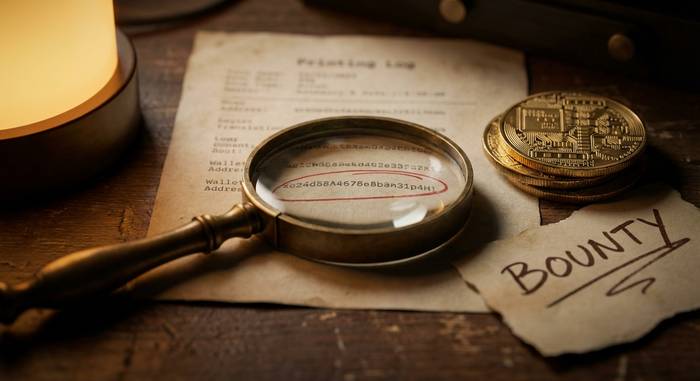
That is what Arkham does. It takes the public ledger that everyone can see but nobody can read and makes it readable. Every wallet gets a label. Every transaction gets context. When the FBI seizes Bitcoin, Arkham maps which addresses hold it. When North Korean hackers hit Bybit for $1.4 billion, Arkham posted a 50,000 ARKM bounty and ZachXBT traced the funds to the Lazarus Group within hours.
Three million users rely on Arkham for on-chain intelligence. The platform tracks wallets across 12+ blockchains, runs an AI engine called Ultra for entity matching, and operates the world's first intelligence marketplace where anyone can post a bounty for blockchain data. This article breaks down how Arkham works, what you can actually do with it, and where the platform stands after shutting down its centralized exchange and pivoting to a DEX in 2026.
How Arkham works: on-chain intelligence for everyone
Blockchain data is public. Every Bitcoin transaction, every Ethereum transfer, every Solana swap is recorded on a ledger anyone can access. The problem is that raw blockchain data is useless to most people. You see wallet addresses, amounts, and timestamps. You do not see who owns the wallet, what they are doing, or why.
Arkham bridges that gap. The platform labels wallets with real-world identities: exchanges, funds, whales, hackers, government agencies, protocol treasuries. When you look up an address on Arkham, you do not just see the transaction history. You see that this wallet belongs to a16z, or the US Department of Justice, or a known exploiter.
The technology behind it is called Ultra, Arkham's proprietary AI engine. Ultra matches addresses to entities by analyzing transaction patterns, timing, funding sources, and cross-chain activity. If a new wallet receives funds from a known Binance hot wallet, makes a series of trades on Uniswap, and then sends proceeds to a wallet that previously interacted with a labeled entity, Ultra can connect those dots and assign a label.
The platform is free for individual users. You sign up, search any address, and get the labeled profile. That free access is what drove Arkham to 3 million registered users by February 2026. The premium layer is the Intel Exchange, where data trades happen for ARKM tokens.
What you can actually do with Arkham
The Profiler is the main tool. Type in any wallet address, ENS name, or entity name and Arkham shows you:
Portfolio breakdown: what tokens the wallet holds, current value, allocation by asset. Historical performance: how the wallet's value changed over time, including unrealized and realized gains. Counterparties: who this wallet interacts with most, which exchanges it uses, which protocols it touches. Transaction history: every in and out, labeled with context.
The Visualizer maps relationships between wallets. It draws lines between addresses that have transacted, showing you the flow of funds visually. This is how investigators trace stolen money. When the Bybit hack happened in February 2025, the Visualizer let researchers follow $1.4 billion across dozens of wallets in real time.
Alerts let you monitor any wallet on any supported chain. Set up a notification for when a known whale moves ETH, or when a government seizure address receives Bitcoin, or when a DeFi protocol treasury makes an unusual transfer. These alerts run 24/7 and ping you on Telegram, email, or the Arkham app.
Dashboards aggregate data across multiple wallets. Researchers build custom views tracking specific categories: all known North Korean hacker wallets, all US government Bitcoin holdings, all VC fund positions. Arkham mapped over 198,000 BTC held across FBI, IRS, DEA, and DOJ seizure addresses.
The platform supports Bitcoin, Ethereum, Solana, BNB Chain, Avalanche, Tron, Arbitrum, Polygon, Optimism, Base, Mantle, and Zcash. They added Zcash, a privacy chain, in December 2025. That was a notable move since privacy coin tracking is one of the hardest problems in blockchain analytics.
The Intel Exchange: a marketplace for blockchain data
This is the feature that makes Arkham different from every other analytics platform. The Intel Exchange is a marketplace where anyone can buy or sell on-chain intelligence using ARKM tokens.
Here is how it works. Say you suspect a project founder moved funds before a rug pull but you cannot prove it. You post a bounty on the Intel Exchange. Lock ARKM tokens as payment. Any analyst in the world can investigate, submit their findings, and claim the reward if the data meets the standard.
The reverse works too. An analyst who discovers that a major fund is accumulating a specific token can list that intel for sale. Traders buy it. The analyst earns ARKM.
Bounties, auctions, and the DATA Program are the three selling methods. The exclusivity period is 90 days: whoever funds a bounty gets exclusive access to the intel before it becomes public on the Arkham platform.
Intel trade volume hit $18 million in December 2025, a 6x increase from Q2 2025. The Bybit hack bounty was one of the highest-profile cases. But most Intel Exchange activity involves quieter work: labeling unknown wallets, mapping fund movements, and identifying connections between entities.
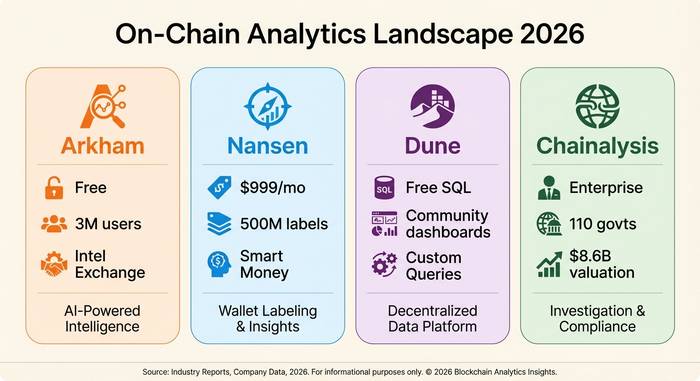
Arkham vs Nansen vs Dune vs Chainalysis
Arkham is not the only blockchain analytics tool. But each platform targets a different user.
| Platform | Focus | Pricing | Best for | Unique feature |
|---|---|---|---|---|
| Arkham | Entity identification, investigation | Free (analytics), ARKM (Intel Exchange) | Researchers, traders, investigators | Intel Exchange bounty marketplace |
| Nansen | Smart money tracking, investor intelligence | $999/mo (advanced) | Hedge funds, institutional investors | Token God Mode, 500M+ labeled addresses |
| Dune Analytics | Community SQL queries, dashboards | Free tier, $349/mo Plus | Protocol teams, data analysts | Open SQL queries, embeddable dashboards |
| Chainalysis | Compliance, AML, law enforcement | Enterprise pricing | Governments, exchanges, banks | 110+ government agencies, 200+ exchanges |
Arkham's advantage is accessibility. It is the only major platform with a free tier that includes entity labels. Nansen charges $999/mo for comparable features. Chainalysis does not sell to individuals at all. Dune gives you raw data but no entity labels. Arkham gives you labeled data for free and monetizes through the token economy.
The disadvantage? Arkham does not disclose how many addresses it has labeled. Nansen claims 500M+. Chainalysis is considered the gold standard for compliance. Arkham sits in between: more accessible than either, but less comprehensive for institutional or regulatory use cases.
The blockchain analytics market is worth about $1.76 billion in 2026, projected to reach $2.25 billion by 2035. Chainalysis raised at an $8.6 billion valuation. Arkham raised $12 million in a Series A from investors including Sam Altman, Tim Draper, and Joe Lonsdale (Palantir co-founder).
The ARKM token
ARKM launched on Binance Launchpad in July 2023. Total supply: 1 billion tokens. About 568 million are circulating. The token hit an all-time high of $3.99 in March 2024 and trades around $0.10 in April 2026. That is a 97% drop.
Token allocation: 37.3% ecosystem incentives and grants, 20% core contributors, 17.5% investors, 17.2% foundation treasury, 5% Binance Launchpad, 3% advisors. Full unlock runs for 7 years from the July 2023 listing.
What ARKM does: it pays for Intel Exchange bounties and data purchases. The upcoming DEX will use ARKM for governance and fee structures. Right now, the primary demand driver is Intel Exchange activity, which hit $18 million in monthly volume in December 2025.
The token price reflects the same problem other platform tokens face: the product has users (3 million) but the token does not capture enough of that value. Most Arkham users interact with the free analytics platform and never touch ARKM.
| ARKM snapshot | Value |
|---|---|
| Price (Apr 2026) | ~$0.10 |
| Market cap | ~$55 million |
| All-time high | $3.99 (March 2024) |
| Total supply | 1 billion |
| Circulating | ~568 million (57%) |
| Intel Exchange volume (Dec 2025) | $18 million |
| Registered users | 3 million+ |
The exchange pivot: from CEX to DEX
Arkham launched a centralized exchange in 2024. Spot trading first, then perpetual futures. The exchange featured on-chain analytics integrated directly into the trading interface, so you could see who was buying what while you traded. Unique concept. But the volume never came. Average daily volume sat around $640,000-$695,000 in February 2026. Compare that to Binance's $9.27 billion daily. The gap was impossible to close.
On February 11, 2026, CEO Miguel Morel announced the CEX was shutting down. Withdrawal-only mode started February 14. Full closure by February 28. His statement: "The future of crypto trading is decentralized."
The pivot is to a DEX where ARKM plays a governance and fee role. No launch date yet. The mobile app is planned for Q2 2026. AI-powered trading insights are expanding in H1 2026. Fiat integration across 50+ countries is on the roadmap.
Whether the DEX works better than the CEX depends on whether Arkham can differentiate from the dozens of DEXs already running. The analytics integration is the moat. If Arkham can build a trading experience where on-chain intelligence is baked into every order, that is something no other DEX offers.