
Bitcoin Halving Dates: 2024 & 2028 BTC Halving Schedule

Pull up any Bitcoin chart right now. Seriously, go do it. On October 6, 2025, the price punched through to $126,210. A brand-new all-time high, the biggest print we have ever seen in dollar terms. Now jump forward six months. April 2026. You are staring at something closer to $71,000 instead. Call that a 44% drawdown. By Bitcoin's own historical standards, it is mild. A bit eerie, to be honest. And the timing of it is no accident. We are camped right in between two bitcoin halving dates: the fourth halving, back in April 2024, and the fifth one, coming up in early 2028.
Here is the idea I want to plant. Once the bitcoin halving dates are fixed in your head, crypto stops looking like random chaos from the outside. You start spotting the four-year rhythm that traders scream about on Twitter at 3am. Supply gets halved. Miners freak out, then adapt, or unplug. Prices do something loud about a year later. The cycle rinses and everybody pretends they called it.
Alright, so let's walk through the whole thing together. Every bitcoin halving that has happened since 2012. What price did around each one. Why the 2024 halving straight-up refused to follow the old script. And what the bitcoin halving 2028 event might actually end up looking like, because your friends are going to be asking you about it regardless. By the time we are done, the bitcoin halving dates will be in your head for keeps, and, with any luck, you will have a much cleaner mental model for why they keep mattering year after year.
How Does a Bitcoin Halving Work and Why It Matters
Okay, quick detour on the actual mechanic before we get into specific bitcoin halving dates. Stick with me.
Picture bitcoin halving as a timer wired straight into the Bitcoin protocol. The whole thing is a pre-programmed event. No humans in the loop, which is the point. Every ten minutes or so, some miner out there, probably in Texas or Kazakhstan, wins a valid bitcoin block by grinding hashes through the bitcoin mining game. The code hands them fresh bitcoin as payment. That payout is the bitcoin block reward. After exactly 210,000 of these blocks pile up, the reward gets chopped in half and the whole halving process starts its next leg. A bitcoin halving is an event nobody votes on. No warning email. No press release. It simply fires on the block it was always going to fire on.
Do the math on it. 210,000 blocks, at ten minutes each, give or take, works out to roughly four years. So that is how often bitcoin halvings take place. Bitcoin works on a four-year heartbeat, and the halving is built into the code from day one. Real block times wobble. Sometimes the network mines faster than the clock says. Sometimes slower. Still close enough that you can treat halvings like clockwork and be right most of the time. Nobody voted for this in 2021 or 2023. Nobody will vote for it in 2031. Satoshi Nakamoto shoved the rule into the code when the bitcoin network first launched back in January 2009, and here we are seventeen years later, with every full node in the world still enforcing it. That is Bitcoin. Somebody anonymous decided, way back, and nothing big enough has come along since to change anyone's mind.
50 bitcoin. That is where the block reward started. Huge sum today. Pennies back then. The first halving reduced it to 25, and yes, that halving reduced the creation of new bitcoin by exactly 50% in one shot. The second halving knocked it to 12.5. Third one took it to 6.25. And the most recent halving, in 2024, dropped it to 3.125 BTC. In 2028, another halving takes it to 1.5625. Keep rolling forward. Decades pass. Eventually, sometime near the year 2140, the subsidy rounds itself to zero satoshis, and from that day on bitcoin miners get paid only from transaction fees. Bizarre to think about now, easy to ignore, but it is coming.
Why go through all this trouble? Here is the simple answer. Bitcoin needs two things at the same time, and those two things pull against each other. It needs a way to hand out new coins without some central bank doing the printing. And it needs a hard ceiling, because otherwise scarcity is just a promise, and promises are worth nothing on a blockchain. Bitcoin halving reduces the supply rate on a fixed timer. That is what makes bitcoin a deflationary asset in real-world practice, not just in theory. Bitcoin is a deflationary asset because the code guarantees it. The whole mechanism is hard-coded into the software. That, right there, is what halving means in one sentence.
The 21 Million Bitcoin Hard Cap Explained
People love to call the 21 million cap a marketing slogan. It is not. The cap is just what you get when you add up the math. Start at 50 bitcoin per block for the first 210,000 blocks. Then 25. Then 12.5. Keep going forever. The total supply of bitcoin converges to almost exactly 21 million coins, and the cap of bitcoin at 21 million coins is simply the asymptote that schedule lands on. The final fractions of bitcoin will be mined around the year 2140. No authority polices the cap. The arithmetic does. That is what the supply of bitcoin at 21 million actually rests on.
The scoreboard as of January 2026: over 20 million bitcoin already mined, per The Block's running tally. Call it roughly 95.2% of the total supply of bitcoin. About 1.32 million coins are still sitting out there, waiting to be issued across the next 114 years. CoinLedger reckons that three to four million BTC are permanently lost, buried in forgotten wallets and landfilled hard drives. Strip those out and the real tradable float of the number of bitcoin in existence is closer to 16 million. Every cycle tightens that further.
Here is the slightly annoying part. Each halving removes a smaller absolute chunk of new supply than the one before it. The 2024 cut trimmed the rate of bitcoin issuance by roughly 164,000 BTC a year. The 2028 cut will shave off another 82,000. Scarcity is not going to quit working on Bitcoin. It just takes longer for the screen to notice.
Complete List of Bitcoin Halving Dates Since 2012
Alright, time to look at the real numbers. Here is the full schedule of bitcoin halving dates that have already happened, with the block number where each event actually triggered and the price of Bitcoin on the day itself. These bitcoin halving dates are the backbone of pretty much every cycle analysis you will ever read, mine included.
| Halving | Date | Block Height | Reward Before | Reward After | BTC Price on Day |
|---|---|---|---|---|---|
| 1st | Nov 28, 2012 | 210,000 | 50 BTC | 25 BTC | ~$12 |
| 2nd | Jul 9, 2016 | 420,000 | 25 BTC | 12.5 BTC | ~$670 |
| 3rd | May 11, 2020 | 630,000 | 12.5 BTC | 6.25 BTC | ~$8,500 |
| 4th | Apr 20, 2024 | 840,000 | 6.25 BTC | 3.125 BTC | ~$64,262 |
| 5th | ~Apr 2028 (est.) | 1,050,000 | 3.125 BTC | 1.5625 BTC | to be seen |
Sources on that: Kraken halving history, CoinGecko halving tracker, Bitbo 2024 halving calendar, CoinWarz next-halving countdown. Double-check them if you want.
The precise 2028 date still moves around, by the way. Live trackers from CoinGecko and CoinWarz are currently pointing at mid to late April 2028, while Swan Bitcoin has it closer to March 26. The difference comes down to how each site models average block times over the next two years. Nobody is lying; they are just using different assumptions.
The First Three Bitcoin Halvings: 2012, 2016, 2020
Every one of the first three bitcoin halvings was followed by a bull run that punched bitcoin to a fresh all-time high within 12 to 18 months. Those rallies were enormous in the first cycle and got progressively smaller each time. If you are here to learn about bitcoin halving cycles, these three bitcoin halving dates are your blueprint.
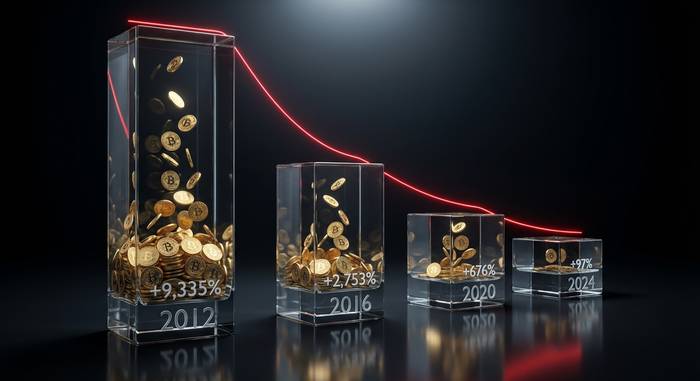
Start with the 2012 one. The first halving took place on November 28, 2012, and almost nobody outside of a few forum threads even noticed. Bitcoin was trading near $12 that November when the halving occurred and the block reward fell from 50 to 25 BTC. By the back end of 2013, bitcoin's price had surged past $1,170. That is a gain of over 9,300% from the halving day. Ridiculous numbers. That move on bitcoin's price set the template for every cycle that followed. The bear market afterward chopped the market price back under $200, and everyone who was paying attention learned a permanent lesson about drawdowns.
Then came 2016. The second halving landed during a much quieter stretch of the market. On July 9, 2016, bitcoin's price hovered around $670 as the block reward dropped from 25 to 12.5 BTC. The initial reaction was a mild dip, nothing dramatic. But by December 2017 the price had climbed all the way to $19,783, per CoinDesk's Bitcoin Price Index. That was a 2,753% move off the halving day. The 2018 crash then erased about 85% of the peak, bottoming out near $3,122.
Then 2020, which people sometimes call the 2020 halving or the 2020 bitcoin halving. It happened on May 11, 2020, with bitcoin near $8,500. That last halving before 2024 reset expectations for every analyst who was watching the impact on bitcoin's price. Covid had just steamrolled the global economy, and honestly, nobody knew whether bitcoin and other cryptocurrencies were going to become safe havens or get dragged down with every other risk asset. The answer arrived about 18 months later. Bitcoin hit $69,044 on November 10, 2021, per CoinGecko research. That is a 676% gain off the halving day, and it took exactly 549 days to get there. Then the 2022 bear market clawed roughly 77% of that peak back.
So the pattern reads like this: a big rally after each halving, then a deep drawdown, then the cycle starts over. That four-year rhythm is what veteran traders are actually talking about when they get cagey about "the cycle." It is remarkably consistent, and it is where the "buy the halving" idea in bitcoin investing was born.
Inside the Bitcoin Halving 2024: What Actually Changed
Of all the bitcoin halving dates on the schedule, April 20, 2024 is the one that actually broke the mold. The bitcoin halving 2024 event, also known as the fourth halving, fired at block 840,000 on that day. The recent halving cut the block reward from 6.25 bitcoin down to 3.125 BTC. Bitcoin was trading around $64,262, according to Bitbo's halving calendar. That is where the last bitcoin halving happened, and honestly, it rewrote how people think about bitcoin halving cycle behavior.
Three things made this one weird.
First, the timing against price. In every previous halving, bitcoin was trading well below its prior all-time high when the event fired. In April 2024, though, the price had already broken a brand-new record in March, a full month before the halving took place. That had literally never happened before. The rally showed up early because US spot Bitcoin ETFs had launched in January 2024, which pulled forward demand for bitcoin that would normally have taken months to build.
Second, the institutional plumbing. BlackRock's IBIT wrapped 2025 with roughly $70.6 billion in assets and captured something like 60% of the US spot Bitcoin ETF category, per ETF.com and US News data. Fidelity's FBTC is sitting at $17.7 billion. IBIT by itself hoovered up about $25.6 billion of net inflows during 2025, while every other US spot BTC ETF combined actually logged net outflows of $3.2 billion. Read that twice. One fund is running the entire category on its own.
Third, the cycle top arrived noticeably faster than normal. Bitcoin's price surged to $109,356 on January 20, 2025 as Trump was sworn in. Then it traded sideways for most of the year before the price surged again, this time to a new all-time high of $126,210 on October 6, 2025. That is roughly a 97% gain from the halving day. It is a much flatter curve than the 676% we got in 2020-21, though the price still surged enough to confirm the broader trend.
How the Last Bitcoin Halving Reshaped Mining Economics
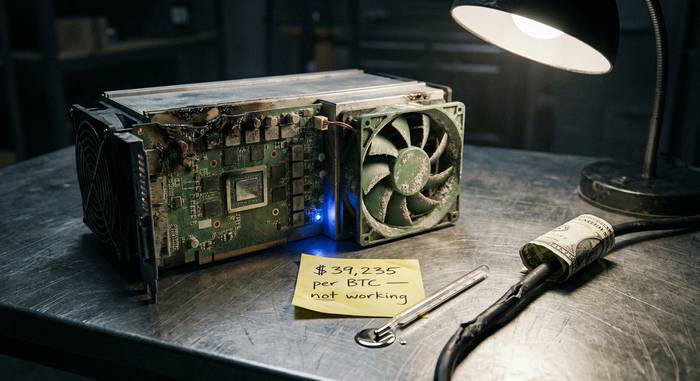
The last bitcoin halving hit bitcoin miners exactly where it hurts. When the block reward gets sliced in half, your electricity bill does not get cut with it. Same power consumption, half the payout in new coins. The only real levers you have are higher bitcoin prices, cheaper energy, or more efficient hardware. The public miners mostly leaned on all three.
And yet network hashrate kept climbing. Grayscale Research had hashrate near 521 EH/s at the start of 2024. By December 2024, VanEck's Bitcoin ChainCheck was clocking around 778 EH/s, roughly a 49% jump across a year that was supposed to wipe the weak operators out. What actually happened: the winners poured capital into next-generation ASICs and locked in cheap, long-dated power contracts. The smaller rigs mostly got bought out or simply unplugged.
By late 2025, the squeeze was showing up in the numbers nobody can fudge. Hashprice, which is daily revenue per unit of mining power, slid from around $55 per PH/s/day in the third quarter of 2025 to about $35 by early December, per Hashrate Index figures CCN ran. That is a 35% drop in roughly two months. Painful.
Marathon Digital (MARA), the largest publicly traded US miner, took it straight in the teeth. Its all-in energy cost per bitcoin jumped from $32,433 to $39,235 in Q3 2025, based on company filings cited by 24/7 Wall St. MARA stock, which was near $23.45 in October 2025, was trading around $8.64 by early April 2026. Down roughly 52%. The company sold 15,133 BTC out of its own treasury during that stretch just to stay liquid. That said, Marathon's Q4 2024 revenue still rose 37% year over year to $214.4 million on a hashrate of 53.2 EH/s. The lesson there is worth sitting with: scale can absorb a lot of pain before it becomes fatal, but it is absorbing.
| Mining Metric | Jan 2024 | Dec 2024 | Late 2025 |
|---|---|---|---|
| Network hashrate | ~521 EH/s | ~778 EH/s | ~800+ EH/s |
| Hashprice ($/PH/s/day) | ~$90 | ~$55 | ~$35 |
| MARA energy cost per BTC | ~$29,000 | ~$32,433 | ~$39,235 |
| MARA stock close | ~$22 | ~$19 | ~$8.64 (Apr 2026) |
Sources: Grayscale, VanEck ChainCheck, Hashrate Index / CCN, 24/7 Wall St., Finance Magnates.
Bitcoin Halving and Bitcoin Price: Cycle by Cycle
Past performance is not a guarantee of future results. You already know that. The sample size here is four events, which is miserable from a statistical standpoint. Even so, the pattern is consistent enough that institutional researchers still build their models around it. Every halving so far has been followed by a price peak 12 to 18 months later, then a drawdown on the order of 80%.
The table right below compares all four completed cycles, using the halving-day price and whatever all-time high the cycle reached after it.
| Cycle | Halving Day Price | Cycle ATH | Gain From Halving | Peak Date | Drawdown After Peak |
|---|---|---|---|---|---|
| 2012-2013 | ~$12 | ~$1,170 | +9,335% | Late 2013 | ~-83% |
| 2016-2017 | ~$670 | $19,783 | +2,753% | Dec 17, 2017 | ~-84% |
| 2020-2021 | ~$8,500 | $69,044 | +676% | Nov 10, 2021 | ~-77% |
| 2024-2025 | ~$64,262 | $126,210 | +97% | Oct 6, 2025 | ~-44% (so far) |
Two trends jump off that table. First, the percentage gains are shrinking by a factor of roughly three or four per cycle. Bitcoin is not going to 10x from a $60,000 halving price the way it did from $12 a coin. That math was never going to hold up forever, and we are watching it stop. Second, the drawdowns are also getting gentler. The current 44% correction from October 2025 is less than half the historical average. ETF buyers, corporate treasuries, and regulated custody providers have put a floor under the market that simply did not exist in 2018 or 2022.
The open question, and it is a real one, is whether this cycle still has a meaningful "second leg" left in it. Historically, the biggest gains came in the final six months before a peak. If that dynamic holds this time around, the 2024-2028 window is not finished yet. If it does not, well, this cycle might already be over and we just do not know it.
The Next Bitcoin Halving Date in the Bitcoin Halving Dates Schedule
So when exactly is it? The next bitcoin halving is expected to occur in 2028 at block 1,050,000, and, just for math reasons, each bitcoin halving occurs exactly 210,000 blocks after the one before it. That is the rule. The next halving event will land somewhere between late March and mid-April, and every live bitcoin halving countdown tracker has it parked in that window. The next bitcoin halving is expected to happen in there, but the halving is expected to occur on a particular day nobody can actually pin down this early. I know, frustrating. CoinGecko's model is currently saying April 12, 2028. CoinWarz is saying April 20, 2028. Swan Bitcoin's longer-running projection has been closer to March 26 for months now. Mining difficulty adjustments can push future bitcoin halving dates a week or two in either direction, so anyone handing you a precise day this far out is, to be blunt, just guessing. The next halving is expected to happen. The exact moment depends on how fast blocks get mined over the next couple of years.
Whenever the day actually lands, the block reward drops from 3.125 BTC to 1.5625 BTC. Daily new issuance falls from about 450 BTC per day to roughly 225. At today's prices, that is something like $16 million a day in new bitcoin, down from about $32 million. Sounds big. In context, it is not, really. In a market where spot ETFs alone routinely absorb several hundred million dollars of net flows in a single trading day, that supply reduction is small in dollar terms. But. It compounds. Give it a few months and the cumulative effect starts to show up in the numbers.
What to Expect From the Bitcoin Halving 2028
Nobody actually knows where bitcoin will trade in April 2028. Anybody who tells you otherwise is almost certainly selling you something. The bitcoin halving is likely to land somewhere inside that window. What we can do is lay out the variables that will shape the cycle and stress-test the usual assumptions against what is actually shifting under the hood. This future halving is likely to matter more for miner survival than for retail speculation, if I had to bet. If you want to learn more about bitcoin cycle dynamics, this is where the actual debate lives.
The supply side of the equation is mostly mechanical. After 2028, only about 1.15 million bitcoin will be left to mine. Future bitcoin halvings will be fighting over a smaller fixed pool, and transaction fees will matter more than they ever have historically. If fee markets stay quiet during that stretch, a larger share of operators will be forced to sell their reserves just to keep the lights on, which adds short-term pressure on the market price.
The demand for bitcoin side is where things get interesting. US spot ETFs did not exist before the 2024 halving. By 2028, they will have been around for four years, which is almost a lifetime in crypto. Corporate treasuries, 401(k) plans that now offer bitcoin options, and even a few sovereign wealth funds have started wading into the market in ways that were flat-out unthinkable in 2020. The question is not whether demand for bitcoin is bigger than it used to be. It obviously is. The question is whether that larger, more mature demand base will still react to the bitcoin halving event the way wild-eyed retail traders did in 2013 and 2017. Very different buyer, very different reaction function.
Base-case scenarios from analysts at Fidelity, ARK, and Caleb & Brown still assume a cycle high 12 to 18 months after the next halving, which would park a potential peak somewhere around mid-2029. The more contrarian view, which has picked up steam in the last year or so, is that the four-year cycle is compressing itself into something closer to a continuous rolling market driven by ETF flows rather than pre-halving anticipation. Both camps cannot be right. The bitcoin halving 2028 event will settle a whole lot of that argument, one way or the other.
How to Invest in Bitcoin Before the 2028 Halving
The most common question I get ahead of a halving is how to invest in Bitcoin without getting chopped up by the volatility. There is no clean answer. There are, though, a handful of approaches that have actually survived multiple cycles. So pick from these.
Dollar-cost averaging is the boring winner. You buy a fixed dollar amount on a regular schedule, regardless of what price is doing, and the approach simply takes away the temptation to try to time a bottom. CoinLedger's historical analysis shows DCA strategies started 12 to 24 months before a halving have outperformed lump-sum buys in three out of four completed cycles. Mostly because they scoop up the pre-halving accumulation zones without front-running them.
Spot ETFs have made exposure far simpler for investors who do not want to mess with wallets. IBIT and FBTC trade like any other stock, and they sit quietly inside most brokerage accounts and IRAs. Fees run around 0.20% to 0.25%, which is cheap for a crypto product but definitely not free. The trade-off is counterparty exposure and, more importantly, the fact that you do not actually hold the underlying keys. Long-term Bitcoin holders tend to see that as a dealbreaker. Others, frankly, do not care.
Self-custody is still the purest way to hold Bitcoin, but it absolutely comes with operational risk. Lost seed phrases, botched firmware updates, phishing attacks. Over the years, those have cost investors more money than any exchange hack ever did. If you are going down that road, practice recovery with a small amount of BTC first, and keep your backups offline in more than one physical location.
Whatever route you pick, remember one thing. Bitcoin's history is packed with 80% drawdowns. Position sizing matters infinitely more than entry timing. If a 50% paper loss would push you into panic-selling, your position is too big. Shrink it until you could sleep through a crash.
How Many Bitcoin Are Left to Be Mined?
As of early 2026, about 19.99 million bitcoin are in circulation, per Blockchain.com's supply data. That leaves something like 1.32 million coins still waiting to be mined between now and the final halving, which is pencilled in around the year 2140. Over 95% of the total 21 million bitcoin supply is already out there somewhere, permanently written into the bitcoin blockchain.
The remaining bitcoin will be dripped out on a decaying curve. The 2028 halving pushes the amount of bitcoin issued past 96% of the cap. The 2032 halving crosses 98%. After 2036 or so, new bitcoin issuance becomes a rounding error compared to the existing float. Which is exactly why a lot of analysts now argue that the marginal impact of any given halving will matter less and less for price, and more and more for mining economics. Miners just need to survive long enough to reach a world where transaction fees reliably cover their running costs. One halving at a time, the subsidy fades away.
Key Things to Know About Bitcoin Halving Cycles
If you just want to know about bitcoin halving events without drowning in every single data point, these are the rules that actually matter.
Bitcoin halving dates are scheduled by block count, not by calendar date, so the exact day always drifts. The reward cut is always exactly 50%, no more, no less. The supply effect compounds over time, but it gets smaller in absolute terms each cycle. Price has historically rallied after halvings, yes, although the gains keep shrinking and the drawdowns keep getting milder as the market grows up. Mining economics tighten the moment the halving fires, which weeds out the high-cost operators and concentrates the hashrate. And institutional flows, particularly through spot ETFs, have already bent the 2024-2028 cycle out of shape relative to the three that came before it.
None of this tells you where Bitcoin will trade next week. Do not pretend it does. What it does tell you is why the market moves in roughly four-year waves, and what to watch for when the next wave gets going. Halvings are not a guarantee of anything. But they are the most reliable piece of monetary policy in any currency on earth, and that alone is worth sitting with before you make any decision about bitcoin halving dates and how they fit into your own portfolio. If bitcoin halving dates are going to shape the next cycle, knowing them cold beats guessing them.



