What Is Monero (XMR)?
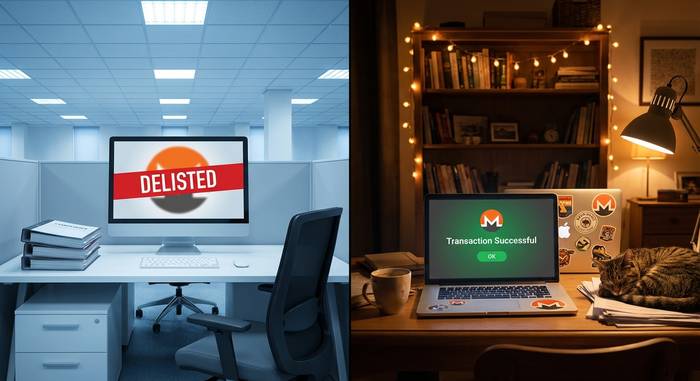
Last year, 73 exchanges dropped Monero. That is not a typo. Seventy-three. Binance kicked it off in 2024. Then Coinbase, Kraken, Huobi, OKX, and Bitstamp followed. Ten countries now ban or restrict privacy coins in some way. Any reasonable person would look at that list and write the obituary.
Plot twist: XMR touched $798 on January 14, 2026. Brand new all-time high. On-chain volume through 2025? Higher than the 2020-2021 bull run baseline. About 18.4 million XMR out there, market cap around $6 billion.
Every year somebody writes the "Monero is dead" piece. Every year the network shrugs and keeps processing transactions. The thing was built to be untraceable, and after ten years, it still is. I do not know of another crypto project that can make that claim without flinching.
How Monero privacy actually works
People assume crypto is anonymous. It mostly is not. Bitcoin writes every single transaction to a public ledger that anyone can read. Plug an address into a block explorer and you can follow the money. Law enforcement does this routinely. Monero goes the other way entirely. You do not flip a privacy switch. There is no switch. Every single transaction hides the sender, the receiver, and the amount. That is just how it works, out of the box.
Three pieces of tech make this possible.
Ring signatures
Here is what happens when you send 5 XMR. Your wallet reaches into the Monero blockchain, pulls out a handful of other people's old transaction outputs, and mixes them with yours. The result is a "ring" with maybe 16 possible signers. Which one actually sent the money? Nobody can tell from the outside. Marked card, shuffled deck.
Stealth addresses
Receiving XMR works differently too. Each time someone pays you, your wallet spins up a brand new address for that one payment. Give out your public Monero address freely. Post it on Twitter if you want. Nobody scanning the Monero blockchain will ever connect it to the funds landing in your wallet. The math links the one-time address to your keys, but only you can see that connection.
RingCT (Ring Confidential Transactions)
This landed in January 2017. Before it, Monero hid who was sending and receiving, but the amounts were out in the open. RingCT closed that gap. Now the trifecta is complete: sender hidden, receiver hidden, amount hidden.
And then there is Dandelion++, which handles the IP problem. The problem without it: a spy node watching network traffic can see which computer first broadcast a transaction. That is an IP address, and an IP address is an identity. So Dandelion++ sends your transaction on a random walk through several nodes before releasing it broadly. By the time the network sees it, the origin is buried.
Put ring signatures, stealth addresses, RingCT, and Dandelion++ on top of each other, and you get what forensic researchers in 2022 grudgingly called "untraceable for now." They predicted someone would crack it eventually. Four years later, still waiting.

Where Monero came from
The origin story reads like something out of a cypherpunk novel. In 2012, a person or group calling themselves Nicolas van Saberhagen dropped the CryptoNote whitepaper. It described the math behind ring signatures and stealth addresses. Saberhagen then vanished. Still unknown to this day.
Bytecoin tried to be the first CryptoNote coin. It launched with a huge hidden premine that reeked of a scam. So in 2014 a forum poster named "thankful_for_today" took Bytecoin's open source code and forked it into something called BitMonero. People immediately argued about everything. Another fork. And on April 18, 2014, Monero showed up. Chaotic? Absolutely. But that chaos is exactly why nobody controls it today.
There is no CEO here. No registered company. Zero VC money. Most of the core developers are anonymous, which feels appropriate for a privacy coin. Riccardo Spagni, who went by FluffyPony online, was the one public face for years. He stepped down from lead maintenance in 2019, later co-founded Tari (a Monero sidechain for NFTs), and the project kept going without him. Funding comes from the Community Crowdfunding System where anyone proposes work and the community opens their wallets.
The name means "coin" in Esperanto. Which is exactly the kind of earnest, slightly eccentric detail you would expect from a project like this.
Monero mining: still possible on your laptop
Fire up Bitcoin mining on a laptop in 2026 and you will earn literally zero. Warehouse-sized ASIC operations ate all the profit years ago. Monero took a hard left turn from that model.
In November 2019 it switched to RandomX, a proof-of-work algorithm designed from scratch to be ASIC-hostile. It runs best on regular CPUs. Your gaming PC, your office workstation, even a decent laptop can mine XMR. GPUs work too but CPUs actually do better here.
Blocks come every 2 minutes. The reward follows what Monero calls tail emission: after the main issuance curve ran out, a permanent reward of 0.6 XMR per block kicked in. That means no hard supply cap. Bitcoin maximalists hate the idea. But here is the pragmatic argument: when block rewards eventually hit zero, what keeps miners running their hardware? Transaction fees alone? Maybe. Or maybe they just turn the machines off. Tail emission sidesteps that problem entirely. Miners get paid forever. Network stays secure.
Three ways to mine XMR:
| Method | Fees | Payouts | Decentralization |
|---|---|---|---|
| Solo mining | None | Unpredictable, big when they hit | Maximum |
| Pool mining | 1-2% | Steady, small amounts | Lower (pool operator has power) |
| P2Pool | None | Steady, decentralized | High (recommended by Monero devs) |
P2Pool is the community-recommended option. It combines the steady payouts of pool mining with the decentralization of solo mining, and charges zero fees. XMRig is the most popular mining software; Gupax provides a simpler setup for beginners.
Will you get rich mining XMR in March 2026? No. Unless you have basically free power, the math does not work out. But a lot of miners do not care about profit. They run nodes because they believe in the network. That is a different kind of incentive, and it works.
The darknet question
Time for the uncomfortable conversation. Monero is huge on darknet markets. Not "kind of popular." In 2025, nearly half of all newly launched darknet platforms only took XMR. Bitcoin was not even an option. When AlphaBay relaunched in 2021, it went Monero-only. Go back to 2018 and you will find XMR in 44% of crypto ransomware cases. After Colonial Pipeline got hacked in 2021, some ransomware crews started charging extra for Bitcoin payments because BTC was too easy for the feds to follow.
Nobody should pretend this is not a problem. Privacy does not ask what you plan to do with it.
But think about who else needs this:
- A reporter in Myanmar or Iran who cannot let the government see her payments
- A domestic abuse survivor hiding financial activity from a stalker
- A company that does not want competitors tracking its vendor payments on-chain
- Anyone living under a regime that freezes bank accounts for political reasons
Cash works the same way. Always has. Monero is just the digital version of that bargain.
The government response: delistings, bounties, and bans
Governments noticed, obviously. And they have been throwing money at the problem.
The IRS literally put a bounty on Monero in 2020. $625,000 for whoever could crack the tracing problem. Chainalysis and Integra FEC got the money. What they actually built: tools that scrape metadata and exchange-level data. Not tools that crack ring signatures. If you use a KYC exchange to buy XMR and then send it somewhere, they can connect the dots at the exchange level. But a properly executed Monero transaction with ring signatures and Dandelion++ active? Still a black box.
The delisting wave tells the story:
| Year | What happened |
|---|---|
| 2024 | Binance delists XMR (February). South Korea and Australia impose exchange restrictions |
| 2025 | 73 total exchange delistings, including Coinbase, Kraken, Huobi, OKX, Bitstamp |
| 2026 | Kraken removes XMR for UK customers. India bans exchanges from dealing in privacy coins (January). At least 10 countries now restrict Monero |
Then in January 2026, the EU flipped the DAC8 switch, requiring detailed reporting on crypto transactions. Privacy coins are the obvious target there.
Has any of this slowed Monero down? Look at the numbers. Transaction volume in 2024 and 2025 was higher than during the 2020-2021 bull market. Users lost Binance and Coinbase and moved to Bisq, atomic swaps, and Telegram P2P groups within weeks. You cannot kill a network where the users are more stubborn than the regulators. And Monero users are extremely stubborn.
Monero vs other privacy coins
Monero has competitors. None of them are winning.
| Feature | Monero (XMR) | Zcash (ZEC) | Dash (DASH) |
|---|---|---|---|
| Privacy model | Mandatory, all transactions | Optional (shielded vs transparent) | Optional (PrivateSend feature) |
| Default state | Private | Public (most users skip shielding) | Public |
| Technology | Ring signatures + stealth addresses + RingCT | zk-SNARKs (zero-knowledge proofs) | CoinJoin-based mixing |
| Fungibility | Full (all coins identical) | Partial (shielded coins only) | Partial |
| Mining algorithm | RandomX (CPU-friendly) | Equihash (GPU/ASIC) | X11 (ASIC-dominated) |
| Supply model | Tail emission (no cap) | Fixed 21M cap | Fixed 18.9M cap |
| Market cap (Mar 2026) | ~$6B | ~$500M | ~$300M |
That comparison table does the heavy lifting, but let me hammer the main point. Zcash makes privacy optional. Guess what happens when privacy is optional? Most people skip it. That means the pool of shielded transactions is small, which weakens privacy for everyone. Dash bolted a CoinJoin mixer onto a transparent chain. It is better than nothing, but it is not in the same league.
January 2026 made the pecking order official. The Electric Coin Company, which builds Zcash, had mass resignations over a governance fight. ZEC crashed 25% in days. Money poured into Monero instead, and XMR blew past its old $518 record to hit $798 on January 14. When push came to shove, the market picked its privacy coin.
How to buy and store Monero in 2026
Two years ago you could grab XMR on Binance in thirty seconds. That door closed. After 73 delistings, buying Monero requires a bit more work, which is sort of the point.
A few centralized exchanges still carry it: TradeOgre, MEXC, and some smaller ones that rotate. Do not assume any listing is permanent. Check before you move money.
The real action has moved decentralized:
- Bisq: no KYC, peer-to-peer, BTC-to-XMR swaps. Works but takes patience.
- Atomic swaps: trade BTC for XMR directly with no middleman. The tech exists and it works, though the UX is still rough.
- Telegram and forum P2P: the old-school way. Find a seller, agree on a rate, trade. Caveat emptor.
Wallet situation is actually pretty good:
- Official Monero GUI/CLI: runs a full node, maximum privacy, eats disk space
- Cake Wallet: mobile, clean interface, handles multiple coins
- Monerujo: Android only, lightweight, solid for daily spending
- Ledger or Trezor: hardware cold storage if you are sitting on a bigger stack
One thing people forget: your view key lets you prove a payment without revealing anything else. Tax audit? Merchant dispute? Hand them the view key for that transaction and they can verify it happened. Everything else stays private.
Is Monero a good investment?
Straight talk: XMR is a weird asset to invest in. No staking. No DeFi. Getting delisted from major exchanges means liquidity is thinner than you might expect. Price went from $798 in January to around $335 by late March 2026. That swing would give most portfolio managers a heart attack, but it is normal for a mid-cap coin trading on thin books.
Why it could go up: privacy is getting more valuable, not less. DAC8 in Europe, exchange bans in India, chain analysis tools getting better at tracing Bitcoin. Every new restriction on financial privacy pushes another batch of users toward Monero. The delistings, paradoxically, prove the product works.
Why it could go down: regulators have not finished. If enough countries follow Japan and India with outright bans, buying XMR gets painful. Atomic swaps are cool tech but terrible UX. Most retail buyers will not deal with the friction.
Where I land: Monero is a tool, not a trade. You buy it because you need what it does. If you are holding long-term, you are essentially betting that financial privacy will matter more in five years than it does today. Look at the trend lines in regulation and surveillance. That bet seems reasonable to me.