Belgium Crypto Tax Guide 2026: Capital Gains, Rates and Filing

Belgium used to be one of the last crypto tax havens in Western Europe. If you chose to invest in crypto, held it, and sold it years later, you owed nothing. Zero. The government called it "normal management of private patrimony" and looked the other way. Belgium's crypto tax rules let prudent investors keep everything. That era ended on January 1, 2026, fundamentally changing the taxation of crypto and the crypto tax in Belgium forever.
Belgium now has a 10% capital gains tax on financial assets, including crypto. The first EUR 10,000 in annual gains is exempt. Anything above that gets taxed. This is brand new. Before 2026, the only people who paid tax on crypto in Belgium were speculators (33% flat rate) and professionals (up to 50% progressive). Everyone else skated by. Statista projects roughly 3.66 million crypto users in Belgium by 2025, about 31% of the population. Most of them have never filed a single euro of crypto income.
That is about to change. The new capital gains tax on crypto, combined with DAC8 automatic reporting from crypto exchanges and crypto platforms starting in 2026, means the Belgian tax authorities will have both the tax framework and the data to enforce compliance. Crypto taxes Belgium was a non-issue for most people before. Not anymore. This guide walks through how crypto is taxed in Belgium now, what changed in 2026, how to declare your crypto income, and what happens if you do not. If you are buying and selling crypto in Belgium, you need to pay attention.

How crypto is taxed in Belgium today
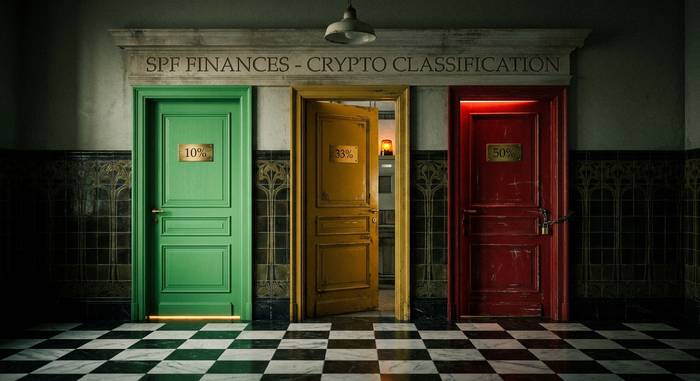
Belgium uses three tax categories for crypto. You pay 10%, 33%, or up to 50%. No single rate exists. The taxation in Belgium depends on how you invest, not how much. That makes the crypto taxation in Belgium unique in Europe. The tax rules and tax treatment differ sharply across categories. Your tax liability hinges on one question: what kind of crypto investor are you? Getting the tax implications wrong can triple your bill.
Category 1: normal management of private assets
If you buy crypto as part of a long-term investment strategy, trade infrequently, and treat it like any other piece of your portfolio, your gains are taxed at the new 10% capital gains tax rate. Before 2026, this category was completely tax-free. Now it carries the 10% rate with a EUR 10,000 annual exemption. Unused exemption can carry forward up to EUR 15,000.
The Belgian tax authorities, specifically SPF Finances (Service Public Federal Finances), look at several factors to determine if you qualify:
- Do you buy and hold, or do you trade frequently?
- What proportion of your total assets is in crypto? Over 25% raises flags.
- Do you use leverage or borrowed money?
- Do you have a professional background in finance or IT?
- Do you use automated trading software or bots?
The FPS Finance Office for Advance Tax Rulings has a 17-question crypto quiz. Fill it out. Send it in. They tell you which box you land in. Why bother? Because of "portfolio contamination." Mix a few day trades into your long-term crypto portfolio, and the whole thing can get bumped to the 33% rate. One bad month of active trading can poison years of patient holding.
Category 2: speculative or miscellaneous income
If you trade frequently, try to time the market, take high-risk positions, or flip tokens for short-term profit, Belgian tax authorities classify your gains as "miscellaneous income." The rate is 33% plus communal tax (typically 7%, bringing the effective rate to about 35.3%).
The EUR 10,000 exemption from the new capital gains tax does not apply here. Speculative gains are taxed at a flat rate of 33% from the first euro. This distinction is critical: the same crypto portfolio can be taxed at 10% or 33% depending on how you managed it. Belgium assesses this case by case, and the criteria are subjective. Day traders, frequent swappers, and people who openly chase short-term pumps will almost certainly land in this category.
Gains are taxed as miscellaneous income and reported in the corresponding section of your annual tax return.
Category 3: professional income
If crypto trading is your primary activity, your main source of income, or you operate it like a business, you pay progressive personal income tax rates:
| Taxable income bracket | Income tax rate |
|---|---|
| Up to EUR 15,200 | 25% |
| EUR 15,201 to EUR 26,830 | 40% |
| EUR 26,831 to EUR 46,440 | 45% |
| Above EUR 46,440 | 50% |
On top of that, social security. You must register as self-employed, join a fund, and file VAT returns (crypto trades are VAT-exempt, but the admin burden is real). The combined rate can top 60%. The progressive personal income tax rates plus social charges make this the priciest path. Taxpayers in Belgium in this bracket need a tax advisor or tax lawyers to file their income tax returns correctly.
Mining lands here too. Running rigs counts as professional by default. Even hobby miners risk being pushed up if the operation grows. The income tax brackets hit hard. If you are in the world of crypto as a miner, save for taxes from day one.
The new capital gains tax on crypto from 2026
This is the big change. The Arizona coalition (the De Wever I government, formed in 2025) introduced Belgium's first general capital gains tax on financial assets. Parliament adopted it on April 2, 2026, retroactive to January 1, 2026. Withholding operations started June 1, 2026.
The key details:
| Feature | Detail |
|---|---|
| Tax rate | 10% on realized capital gains |
| Annual exemption | EUR 10,000 per taxpayer (indexed) |
| Effective date | January 1, 2026 |
| Historical gains | Not taxed (only gains after Jan 1, 2026 count) |
| Unrealized gains | Not taxed (only realized upon disposal) |
| Scope | All financial assets including crypto |
The step-up basis is the detail that matters most for existing holders. Your crypto portfolio gets revalued at its fair market value on December 31, 2025. That becomes your deemed acquisition cost. If you bought 1 BTC for EUR 30,000 in 2024, and it was worth EUR 70,000 on December 31, 2025, your cost basis for the new tax is EUR 70,000, not EUR 30,000. Sell it for EUR 80,000 in 2027, and your taxable gain is only EUR 10,000, which falls within the exemption. All pre-2026 appreciation is effectively grandfathered.
One critical limitation: capital losses under the new 10% CGT can only offset gains within the same tax year and same asset category. There is no loss carryforward. Lose EUR 20,000 on crypto in January and gain EUR 30,000 in December of the same year? You pay 10% on EUR 10,000. But if the loss happens in 2026 and the gain in 2027, the loss is gone.
Parliamentary debates emphasized that crypto assets "should not be presumed speculative by nature" and that "the vast majority of crypto investors will fall within the standard 10% capital gains tax regime." Politicians said this publicly. Whether tax inspectors agree in practice remains to be seen.
The new capital gains tax of 10% does not replace the existing tax regime. The general capital gains tax sits next to the 33% speculative rate and the progressive rates. All three tracks run in parallel. Speculative? You pay 33% and lose the EUR 10,000 exemption. Professional? Up to 50%. The 10% rate only works if you qualify as a normal private investor.
The tax administration checks each crypto investor case by case. Tax rulings from the Office for Advance Tax Rulings are the only way to know for sure before filing your tax declaration. Apply early.
Which crypto transactions trigger tax in Belgium
The tax on crypto in Belgium hits more types of trades than in France or Poland. In those countries, swapping BTC for ETH is free. In Belgium? Not anymore. Under the new law, swapping one crypto for another is a taxable event. Same as selling for fiat. Same as buying a coffee with Bitcoin. The treatment of crypto in Belgium is more aggressive than cryptocurrencies in Poland or France.
Taxable events:
- Selling crypto for fiat currency (EUR, USD)
- Crypto-to-crypto swaps (potentially taxable, unlike France)
- Using crypto to buy goods or services
- Receiving mining rewards
- Receiving staking rewards (30% withholding tax on movable income)
- Receiving airdrops (potentially 30% withholding tax)
Non-taxable events:
- Buying crypto with fiat currency
- Holding crypto without selling or trading
- Transferring between your own wallets
The crypto-to-crypto question is the most contentious issue in Belgian crypto taxation. In France and Poland, swapping BTC for ETH is explicitly not a taxable event. In Belgium, the tax treatment is ambiguous. SPF Finances has not issued definitive guidance, and tax advisors are split. Some argue that a crypto-to-crypto swap is a realization event that triggers capital gains tax. Others argue it is not a disposal because you remain within the crypto ecosystem. If you trade between tokens frequently, this ambiguity is a real risk. Getting an advance ruling from the Office for Advance Tax Rulings is the safest path.
Staking rewards are treated as movable property income, subject to a 30% withholding tax. This is separate from the capital gains tax. You receive staking rewards, you owe 30% on their value at receipt. When you later sell those staked tokens, you may owe an additional 10% capital gains tax on any appreciation. Double taxation on staking is a real concern.
Mining income is generally classified as professional income and taxed at progressive rates. Even hobby miners risk being reclassified if their operation is substantial.
How to file your crypto tax return in Belgium
Belgian tax residents file an annual tax return, typically between May and October depending on the filing method. Crypto income goes into specific sections depending on your classification.
Tax-on-web (online filing)
Most Belgians file through Tax-on-web, the online portal managed by SPF Finances. You log in using your eID card reader or the itsme app. The deadline for self-filing online is typically mid-July (July 15, 2026 for the 2025 tax year). If you use an accountant, the deadline extends to late October.
Where to declare crypto income
Your crypto income goes in different boxes depending on the category:
| Classification | Where to declare | Tax rate |
|---|---|---|
| Normal management (capital gains) | Capital gains section (new from 2026) | 10% above EUR 10,000 |
| Speculative (miscellaneous) | Miscellaneous income section | 33% + communal tax |
| Professional | Professional income section | 25-50% progressive |
| Staking/lending income | Movable property income | 30% withholding |
Foreign account declaration
Since 2026 and the implementation of DAC8, crypto platforms are being brought under reporting requirements. Belgium has already required taxpayers in Belgium to declare foreign financial accounts to the Central Contact Point (CPC) at the National Bank of Belgium. Crypto exchanges held abroad are increasingly falling under this requirement.
The Belgian tax authorities have shown they mean business. They obtained Coinbase customer data through international agreements and used it to launch audits. The Special Tax Inspectorate has requested detailed transaction records spanning multiple years from identified crypto investors.
Key filing deadlines for 2026
| Filing method | Deadline |
|---|---|
| Paper return | June 30, 2026 |
| Tax-on-web (self-filing) | July 15, 2026 |
| Tax-on-web (with accountant) | October 28, 2026 |
| Tax year covered | January 1 - December 31, 2025 |
Records you need to keep
Belgian tax law does not prescribe a specific crypto record-keeping format, but the tax authorities expect you to produce:
- Complete transaction history from every exchange and wallet
- Dates and amounts of every buy, sell, and swap
- Cost basis for each transaction (FIFO, LIFO, HIFO, or AVCO are all accepted)
- Wallet addresses used
- Proof of the source of funds for large purchases
- Exchange fee records
Belgium lets you choose your cost basis method: FIFO (first in, first out), LIFO (last in, first out), HIFO (highest in, first out), or AVCO (average cost). Pick one and stick with it. Switching methods between years will raise flags.
DAC8 and what it means for Belgian crypto holders
The EU's DAC8 directive changes everything about enforcement in Belgium. Adopted by the EU in October 2023, DAC8 requires all crypto asset service providers to report customer transaction data to national tax authorities. The Belgian Parliament adopted the DAC8 implementation law on March 12, 2026, published in the Official Gazette on April 1, 2026, retroactive to January 1, 2026.
Starting January 1, 2026, crypto platforms operating in Belgium must collect detailed user information: identity, tax identification numbers, all transactions (buys, sells, swaps), balances, and transfers to external wallets. Providers must be fully compliant by July 1, 2026 (six-month transition period). The first data submission to Belgian tax authorities is due January 31, 2027, covering all 2026 transactions. Automatic cross-border exchange between EU member states follows by September 30, 2027.
For Belgian taxpayers, this means SPF Finances will receive a complete picture of your crypto activity from every regulated platform. Cross-referencing this with your tax declaration becomes trivial. The days of holding crypto on Binance or Kraken and assuming the Belgian tax authorities cannot see it are finished.
Belgium has a history of actively pursuing crypto tax information. The Special Tax Inspectorate already obtained customer data from Coinbase and other platforms, including crypto, and sent audit letters to identified investors requesting detailed transaction records spanning multiple years. DAC8 makes this automatic and permanent. The Belgian tax authorities will receive compliant tax reports from every platform, including transactions to tax authorities across the EU. Gains are taxed whether you report them or not. The data will exist regardless.
A fifth tax regularization round has been proposed under the Arizona coalition agreement, allowing taxpayers in Belgium to voluntarily declare previously undisclosed crypto income. The estimated cost of late regularization is brutal: 33% tax plus a 30% penalty, for an effective rate of 63% according to Vanbelle Law. If you have years of unreported crypto gains, the regularization window is still cheaper than what happens when KAS finds you first. If you need to pay overdue taxes and have much crypto that was never reported, act before the DAC8 data arrives in January 2027.
Penalties and what happens if you do not declare
Belgium takes tax compliance seriously, and the penalties for failing to declare crypto income scale with the severity of the offense.
For late or incomplete filing:
- Administrative fine: EUR 50 to EUR 1,250 per infraction
- Tax surcharge: 10% to 200% of the unpaid tax, depending on intent
- Interest: approximately 4% per year on unpaid amounts (nalatigheidsinterest)
For deliberate fraud:
- Criminal prosecution with fines up to EUR 500,000
- Prison sentences of up to five years
- Tax surcharge of 50% to 200% on top of the owed amount
First offense? Maybe a 10% surcharge. Second time? Higher. Obvious fraud? Up to 200%. The system hits hard if you meant to cheat. It goes easier on honest mistakes.
One practical tip: if you realize you have undeclared crypto gains from previous years, file an amended return or pursue the tax regularization route before SPF Finances contacts you. Voluntary disclosure dramatically reduces penalties. Once the Special Tax Inspectorate opens an investigation, your options narrow.
Crypto tax software like Blockpit, CoinLedger, or crypto tax calculator Koinly can help you generate compliant tax reports and a proper crypto tax report that matches what Belgian crypto exchanges will report under DAC8. Using crypto tax software to reconcile your records before filing is the cheapest form of insurance. A tax professional can also help you manage your crypto gains and losses, identify tax loss harvesting opportunities, and ensure you use crypto accounts and information on crypto correctly in your annual tax return. Many specific crypto situations, such as inheritance tax on digital assets, DeFi positions, or profits from crypto received as gifts, require professional guidance because there is no existing tax precedent or previous tax ruling to rely on.