
What Does Hashrate Mean? How Mining Power Shapes Bitcoin Security and Price
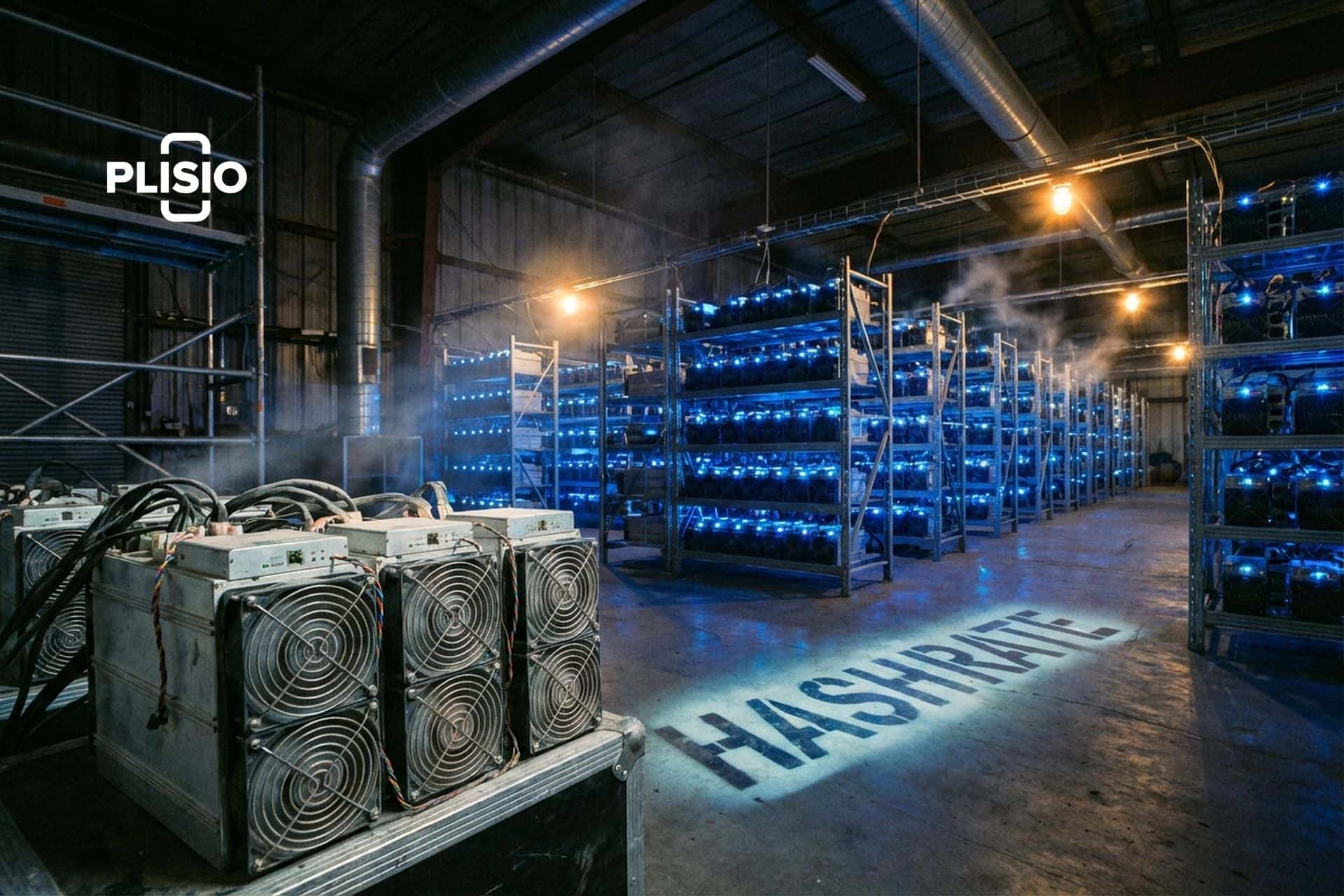
Bitcoin's hashrate crossed 500 exahashes per second in January 2024. Five hundred quintillion guesses every second. When Satoshi started mining alone in 2009, the whole network managed 4.3 megahashes. That's the difference between one guy with a laptop and a global industrial operation spread across every continent except Antarctica. One Bitmain Antminer S21, a box the size of a shoebox, produces more hash power than the entire Bitcoin network generated in its first year.
I'll admit it took me three years of holding BTC before I bothered to understand what hashrate actually meant. The number felt abstract. Quintillions of calculations per second, cool, what do I do with that? Turns out it's the single best indicator of how much real money people have committed to keeping Bitcoin alive. Hashrate goes up, it means someone just spent $10 million on machines because they're betting the network is worth protecting. Hashrate drops, somebody unplugged those machines because the math stopped working for them. Either way, the number tells you something that charts and Twitter sentiment can't.
Here's the practical breakdown: what hashrate means for this cryptocurrency, how to track it yourself with free tools, what the historical data says about hashrate and BTC price, and why millions of machines pouring electricity into SHA-256 hashes keeps your coins safe.
What hashrate is: the simple explanation
Here's what's actually happening when someone says "hash rate." On a proof of work blockchain network, miners take a block of transaction data, tack on a random number (the nonce), and run it through the SHA-256 algorithm using raw computational power. The output is a hash: a fixed-length string of characters. If that string starts with enough zeros to meet the difficulty target, congrats, you found a block and you get the reward. If it doesn't (and it almost never does), change the nonce, try again. Repeat. Billions of times per second. Per machine.
I think of it like scratch-off lottery tickets. Every hash is a ticket. Most are losers. The hashrate of your machine tells you how many tickets you're scratching per second. The hashrate of the network tells you how many tickets everyone on the planet is scratching at the same time.
"Bitcoin's hashrate is 700 EH/s" means every miner in the world, from Riot's facility in Corsicana, Texas to someone running ASICs off a diesel generator in Siberia, is collectively producing 700 quintillion guesses per second. All competing for the same prize.
Hashrate units: from kilohashes to exahashes
Numbers in this space get absurd fast. When someone tells you hashrate is measured in "exahashes" and you nod politely, here's what they actually mean:
| Unit | Abbreviation | Hashes per second | Context |
|---|---|---|---|
| Kilohash | KH/s | 1,000 | Early CPU mining (2009) |
| Megahash | MH/s | 1,000,000 | GPU mining era |
| Gigahash | GH/s | 1,000,000,000 | Early ASIC miners |
| Terahash | TH/s | 1,000,000,000,000 | Modern ASIC miners (100-300 TH/s each) |
| Petahash | PH/s | 1,000,000,000,000,000 | Large mining farms |
| Exahash | EH/s | 1,000,000,000,000,000,000 | Bitcoin network total |
Bitcoin sits in the hundreds of EH/s. One Antminer S21, a box you can carry with two hands, does 200 TH/s. You'd need about 5,000 of those to contribute a single EH/s to the network. There are millions of ASIC machines running right now across every continent. The scale is genuinely hard to wrap your head around until you visit a mining facility and hear the noise. I toured one in Texas in 2023 and it sounds like standing inside a jet engine that never turns off.
Bitcoin hashrate history: from zero to 800+ EH/s
If I had to show one chart to explain why Bitcoin is hard to kill, it would be the hashrate chart. It looks like a hockey stick that got taped to a rocket.
| Year | Approximate hashrate | What was happening |
|---|---|---|
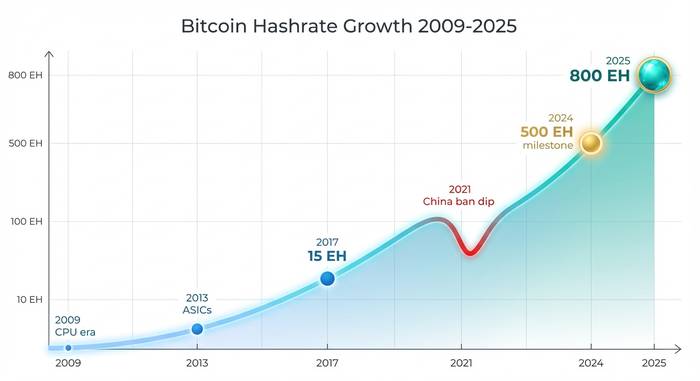
| 2009 | 4.3 MH/s | Satoshi mining alone on a CPU |
| 2011 | 10 GH/s | GPU mining begins |
| 2013 | 10 TH/s | First ASIC miners appear |
| 2017 | 15 EH/s | Bull run, mining goes industrial |
| 2020 | 120 EH/s | Post-halving growth, China dominates |
| 2021 (May) | 180 EH/s | Pre-China ban peak |
| 2021 (July) | 84 EH/s | China bans mining, hashrate crashes 53% |
| 2022 | 250 EH/s | US becomes top mining country, recovery |
| 2024 (January) | 500 EH/s | First time above 500 EH/s |
| 2025 | 700-800+ EH/s | All-time highs, new ASIC generation |
The China ban is the most interesting row in that table. Mid-2021, Beijing told every miner in the country to shut off. China was running 65% of global hashrate at the time. Poof. Gone. The network lost 53% of its power in one month. It looked catastrophic on the chart. Like someone pulled the plug on half the internet.
Six months later the hashrate was back to pre-ban levels. Miners shipped containers of ASICs to Texas, Georgia, Kazakhstan, Paraguay, wherever they could find cheap power and permissive regulation. The recovery proved something I don't think enough people appreciate: no country can kill Bitcoin mining. They can only relocate it. That's the kind of resilience that makes governments uncomfortable and makes BTC holders sleep better at night.
Why hashrate matters: security, difficulty, and the 51% attack threshold
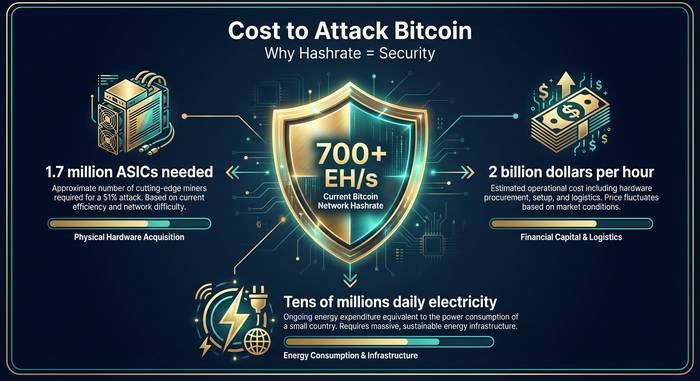
This is where hashrate stops being abstract and starts being about your money. To attack Bitcoin, a bad actor needs 51% of the mining power. At 700+ EH/s, that's 350 EH/s. You'd need something like 1.7 million Antminer S21 machines, which don't exist sitting in a warehouse somewhere because they're already plugged in and running. Even if you could magically conjure them, the electricity bill would be tens of millions of dollars per day. Researchers pegged the cost of a 1-hour 51% attack on Bitcoin at over $2 billion in 2025.
That number is the reason people trust Bitcoin with serious money. Not the whitepaper. Not the philosophy. The raw math: attacking this network costs more than it's worth. Compare that to Litecoin or Dogecoin (which share hashrate through merged mining). Attacking those would cost a fraction of a percent of what Bitcoin costs. The security gap between BTC and every other PoW chain is so large it might as well be a different category. And that gap exists because of hashrate. Not because of marketing or vibes or Elon tweets. Math and electricity. That's it.
Mining difficulty is the thermostat. Every 2,016 blocks (about two weeks) the network recalibrates. Too much hashrate making blocks come too fast? Difficulty goes up. Miners dropping off and blocks slowing down? Difficulty drops. The target is always one block per ten minutes. Double the world's mining power and Bitcoin doesn't produce blocks twice as fast. It just makes the puzzle twice as hard. This is one of the most underrated pieces of Satoshi's design. It's a self-regulating system that's worked perfectly for fifteen years.
How to track hashrate: tools for monitoring
I check four tools regularly. Here's what each one gives you and why I bother.
Blockchain.com has the simplest hashrate chart. Clean, adjustable, downloadable. I pull it up once a week the same way I'd check the weather. Not to trade on it. Just to know whether the network is getting stronger or weaker. It's been getting stronger every single week for two years straight as of this writing.
Mempool.space is my go-to for the full picture. Hashrate, current blocks, difficulty countdown, fee estimates, mempool size. If something weird is happening on Bitcoin, this is where I find out first. During the Runes launch in April 2024 the mempool went insane and mempool.space was the only tool that showed me clearly how backed up things were.
Braiins Insights breaks hashrate down by pool. Foundry USA has the biggest share. AntPool is second. The distribution matters because a single pool getting too large is a centralization risk. Braiins also tracks which ASIC generation each pool is running, which tells you how much of the network is on cutting-edge hardware versus aging machines.
For traders: Glassnode and CryptoQuant have "hash ribbon" indicators that flag when short-term hashrate crosses below the long-term average. Some people use this as a buy signal (miner capitulation = bottoms). I've backtested it. Works sometimes. Doesn't work other times. Not reliable enough to trade on alone, but useful as one input among many.
Quick math for miners: network hashrate is 700 EH/s, your rig does 200 TH/s. Your share of the network is 200 divided by 700,000,000. That's 0.0000003. Basically zero. This is why nobody solo mines Bitcoin anymore. You join a pool, contribute your hashrate, and split the rewards with thousands of other machines.
Hashrate and price: what the correlation actually shows
"Hashrate goes up, price goes up." People say this constantly and it's wrong enough to be dangerous if you trade on it.
2018: hashrate climbing, price crashing. Negative 66.2% correlation. Bitcoin dropped from $20,000 to $3,200 while miners were adding machines. 2021: hashrate crashed 53% overnight from the China ban and the price... didn't care. Hit $69,000 five months later with fewer miners than it had in May. The two numbers are connected but not in the direction or timeframe most people assume.
What actually happens: price moves first. Always. When BTC goes from $30k to $70k, mining revenue doubles overnight. Miners who were sitting on orders suddenly plug in new machines. Hashrate follows weeks or months later because you can't deploy an ASIC the day you order it. Shipping takes time. Rack space takes time. Power contracts take time. By the time the hashrate spike shows up on the chart, the price move is old news.
Going the other direction: price crashes, electricity bills don't change, some miners are now losing money on every block. They shut off the oldest, least efficient machines first. Hashrate dips. But not as much as you'd expect because the big operations, the Marathon Digitals and Riot Platforms, raised hundreds of millions during bull markets specifically to keep building through bears. They deploy hardware on a schedule regardless of the price because they've already signed the checks.
And then there's the geography factor that I find genuinely interesting. Paraguay has cheap hydro. Ethiopia has underused dam capacity. These miners run at $0.02 per kWh or less, which means BTC can drop to $20k and they're still profitable. They don't turn off during bear markets. They just keep hashing while everyone else panics. That structural base is part of why hashrate almost never goes down for long.
The energy question: what hashrate costs the planet
Every hash consumes electricity. Bitcoin's total energy consumption is directly proportional to its hashrate. As of 2025, the Cambridge Bitcoin Electricity Consumption Index estimates Bitcoin uses roughly 150-170 TWh per year, which is comparable to a mid-sized country like Poland or Egypt.
Environmentalists hate this number and I understand why. 150+ TWh is a lot of electricity. But what matters more than the total is where it comes from and what it's doing.
A growing share of mining uses stranded energy. Gas that would be flared (burned off at oil wells), hydro capacity that sits unused during off-peak hours, geothermal in Iceland and El Salvador. Marathon Digital, one of the biggest public miners in the US, says over 50% of their power is renewable. Riot Platforms runs near wind farms in Texas and actually earns money by curtailing during peak grid demand, essentially getting paid not to mine when Texas needs the electricity for air conditioning. That's a more complex story than "Bitcoin wastes energy."
The other side: every kilowatt keeps the network secure. Cut hashrate in half and you've cut the cost of attacking Bitcoin in half. The energy isn't producing nothing. It's producing the strongest financial security guarantee ever built. Whether that's worth 150 TWh per year is a values question, not a math question. I'd argue yes but I hold BTC, so take my answer with salt.



