Zcash (ZEC): the privacy-focused cryptocurrency using zero-knowledge proofs to shield your transactions
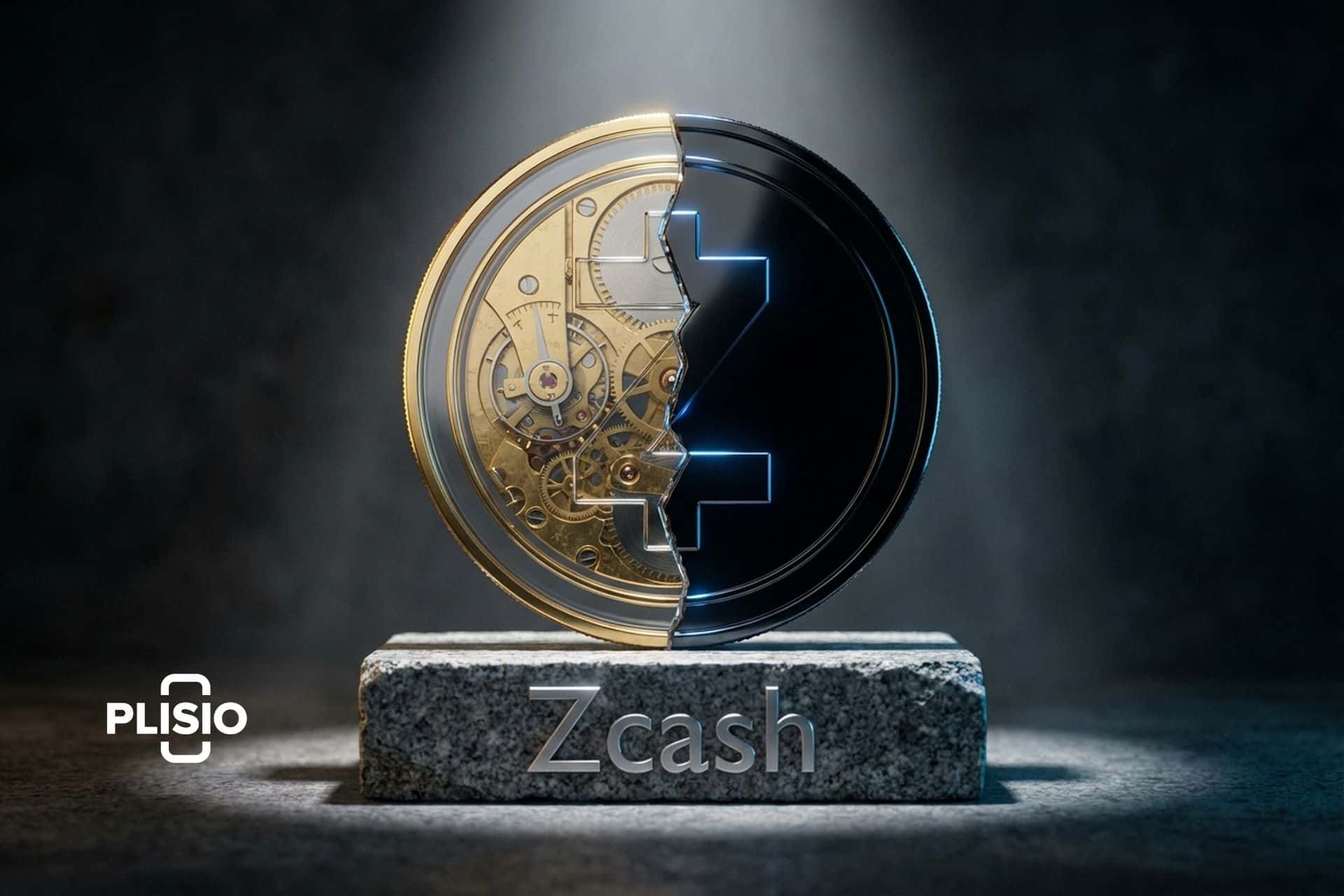
Zcash had a rough few years. The token traded under $30 for most of 2023, the Electric Coin Company's entire team was reportedly "constructively discharged" after a board disagreement in January 2026, and the broader market treated privacy coins like radioactive waste while regulators tightened the screws on anything that made transactions harder to trace.
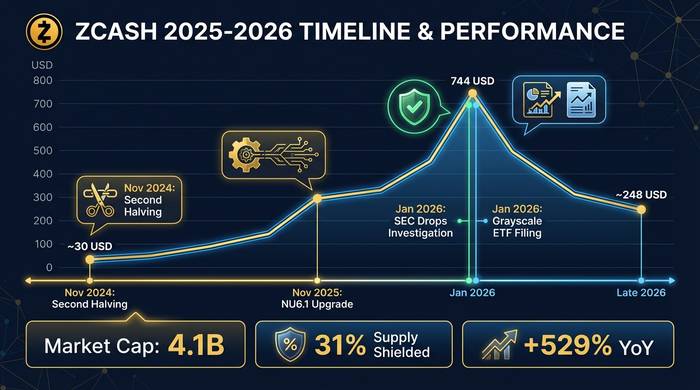
Then the SEC dropped its investigation without filing charges. Grayscale filed to convert its Zcash Trust into a spot ETF. The price went from about $30 to over $744 at its peak in November 2025. As of April 2026, ZEC trades around $248, up 529% year-over-year. Over 30% of the total supply is now held in shielded addresses, an all-time high.
So what is Zcash, how does it actually work, and why is this decade-old privacy coin suddenly relevant again?
What Zcash is and where it came from
Zcash is a cryptocurrency that gives you a choice most blockchains don't: you can send money in the open, or you can make the transaction completely private. Sender, receiver, amount, all hidden from public view, while the network still verifies that the transaction is valid. That's the core pitch, and it's been the same since Zcash launched in October 2016.
The project grew out of academic research at Johns Hopkins University, MIT, and Tel Aviv University. Zooko Wilcox-O'Hearn led the development through the Electric Coin Company (ECC). The original concept started as "Zerocoin" in 2013, evolved into "Zerocash," and finally launched as Zcash with its own blockchain built on Bitcoin's codebase.
Like bitcoin, Zcash has a maximum supply of 21 million ZEC and uses a halving schedule that cuts mining rewards roughly every four years. The second halving happened in November 2024. About 16.6 million ZEC are in circulation as of early 2026. Unlike bitcoin, Zcash allocates 20% of block rewards to development: the ECC, the Zcash Foundation, and community grants through the Zcash Community Grants (ZCG) program.
One historical detail worth knowing: when Zcash launched, it briefly traded above $5,900 per coin due to extreme scarcity in the first hours of mining. Barely any ZEC existed yet, and the hype was astronomical. That price lasted minutes, not days. By the end of the first week, ZEC was trading under $1,000 and kept falling. The realistic market history starts much lower.
Another piece of the backstory that still sparks debate: the "trusted setup ceremony" at launch. Zcash's initial zk-SNARK parameters required a one-time key generation process. Six participants each created and destroyed a portion of this key. If any one of them had kept their piece, they could theoretically have minted counterfeit ZEC undetected. In April 2022, one of the six was revealed to be Edward Snowden, participating under the pseudonym "John Dobbertin." He described it as "a service, as a public good, and believing in privacy." The 2022 Orchard upgrade and the shift to Halo 2 technology largely eliminated the need for trusted setups going forward, resolving what was always Zcash's biggest trust assumption.
| Zcash facts | Detail |
|---|---|
| Launch | October 28, 2016 |
| Creator | Zooko Wilcox-O'Hearn / Electric Coin Company |
| Max supply | 21 million ZEC |
| Circulating supply (2026) | ~16.6 million |
| Consensus | Proof-of-work (Equihash), PoS transition planned |
| Price (Apr 2026) | ~$248 |
| Market cap | ~$4.1 billion |
| All-time high (recent) | $744 (Nov 2025) |
| YoY price change | +529% |
| Shielded supply | ~5.16M ZEC (31% of circulating) |
How Zcash works: zk-SNARKs and shielded transactions
The technology that makes Zcash different from bitcoin or ethereum is called zk-SNARKs, which stands for "Zero-Knowledge Succinct Non-Interactive Arguments of Knowledge." That's a mouthful, but the concept is surprisingly intuitive.
A zero-knowledge proof lets you prove something is true without revealing the underlying information. Classic example: imagine you want to prove to someone that you know a password without actually telling them the password. In Zcash, the proof works the same way. The network can confirm that a transaction is valid, that the sender has enough funds and the math adds up, without anyone seeing who sent what to whom or how much was transferred.
In practice, Zcash gives users two types of addresses:
Transparent addresses (t-addresses) work just like bitcoin. Transactions between t-addresses are fully visible on the Zcash blockchain. Anyone can see the sender, receiver, and amount.
Shielded addresses (z-addresses) use zk-SNARKs to encrypt everything. When you send ZEC from one z-address to another, the transaction appears on the blockchain but the details are hidden behind cryptographic proof. The network knows a valid transaction happened. Nobody knows who, how much, or to whom.
Users can mix and match these address types freely. You can send from a transparent address to a shielded one ("shielding" your coins), from shielded to transparent ("deshielding" when you need to, say, deposit to an exchange that requires transparent addresses), or keep everything private end-to-end using only z-addresses.
This flexibility matters more than most people realize. It's the reason Zcash stays listed on Coinbase, Kraken, and Gemini while Monero, which forces all transactions to be private, keeps getting kicked off regulated exchanges. A cryptocurrency that offers privacy as an option rather than a mandate fits more comfortably within existing compliance frameworks. Whether that's a philosophical compromise or a pragmatic advantage depends on who you ask. I lean toward "pragmatic," because a privacy tool that nobody can access isn't protecting anyone.
Zcash also has a feature called "viewing keys" that lets you share read-only access to your shielded transaction history with specific people. Your accountant. Your auditor. A regulator, if it comes to that. You retain the ability to prove what you've done while keeping the rest of the world out.
As of 2026, about 86.5% of Zcash transactions use shielding in some form. Over 5.16 million ZEC, roughly 31% of the circulating supply, sits in shielded addresses. That's an all-time high, and it matters because the more coins that are shielded, the stronger the anonymity set becomes. Privacy in cryptocurrency is only as strong as the crowd you're hiding in.
Zcash vs Monero vs bitcoin: how privacy compares
Zcash isn't the only game in town for financial privacy. Here's how the three main approaches stack up:
| Feature | Bitcoin | Zcash | Monero |
|---|---|---|---|
| Privacy | Pseudonymous (public ledger) | Optional (transparent or shielded) | Mandatory (all transactions private) |
| Default mode | Transparent | Transparent (shifting toward shielded) | Private |
| Privacy technology | None (chain analysis works) | zk-SNARKs | Ring signatures + stealth addresses |
| Exchange listings | Universal | Most major exchanges | Increasingly delisted |
| Regulatory risk | Low | Medium | High |
| Supply cap | 21M | 21M | ~18.4M (slight tail emission) |
| Market cap (Apr 2026) | ~$1.4T | ~$4.1B | ~$5B |
Bitcoin offers no real privacy. Every transaction is public. Chain analysis companies like Chainalysis routinely trace bitcoin transactions for law enforcement. If you bought BTC on a KYC exchange and sent it somewhere, that path is traceable.
Monero makes every transaction private, period. You can't opt out. That makes it the strongest privacy tool but also the most politically toxic. Exchanges keep dropping it. Several countries have effectively banned it.
Zcash occupies the middle ground. You get strong privacy when you want it, and transparency when regulators or counterparties require it. The "viewing key" feature lets you share transaction details with specific parties (like an auditor or tax authority) without making anything public. That balance between privacy and compliance is what keeps Zcash on Coinbase, Kraken, and Gemini when Monero can't be listed.
What happened in 2025-2026: the Zcash renaissance
Zcash's recent price surge wasn't random. Several things converged:
SEC drops investigation (January 2026). The US Securities and Exchange Commission closed its review of Zcash without recommending any enforcement action. For a privacy coin, this was a huge signal. It effectively said: Zcash is not a security, and using zero-knowledge proofs doesn't automatically make you a criminal enterprise.
Grayscale ETF filing. Grayscale filed to convert its existing Zcash Trust (ZCSH) into a spot ETF. If approved, this would make ZEC available through traditional brokerage accounts, similar to what bitcoin spot ETFs did for BTC.
NU6.1 network upgrade (November 2025). The eighth major upgrade restructured Zcash's funding model. Community grant funding now receives 8% of block rewards, while 12% flows to a lockbox fund controlled by coin holder votes. This gave ZEC holders direct governance power over development spending for the first time.
Zcash Open Development Lab funding. The newly formed development lab raised over $25 million from Paradigm and a16z to continue protocol work, signaling serious institutional confidence in the project's future.
ECC leadership crisis. Paradoxically, the drama at the Electric Coin Company may have helped. After the board controversy and mass team departure in January 2026, the community had to step up. The Zcash Foundation and the newly formed Open Development Lab absorbed responsibilities that ECC had held for years. Some long-time participants told me this was the best thing that could have happened: Zcash was always supposed to be a community-driven cryptocurrency, and having one company hold so much influence was an uncomfortable contradiction. Now that power is genuinely distributed across multiple organizations, which aligns better with the decentralization ethos the project was built on.
Mining Zcash and the road to proof of stake
Zcash currently runs on proof-of-work using the Equihash algorithm, which was designed to be memory-hard and resist ASIC domination. In practice, ASICs did eventually arrive for Equihash, and most serious ZEC mining today uses dedicated hardware rather than consumer GPUs.
Mining economics after the November 2024 halving are tighter. The block reward dropped, and miners now receive 80% of each block's reward (the other 20% goes to development funding). At current ZEC prices around $248, mining can still be profitable with efficient hardware and cheap electricity, but margins are thin compared to the pre-halving era.
The bigger story is what comes next. A proposal called "Crosslink" would bolt a proof-of-stake layer onto the existing PoW chain, splitting new ZEC issuance roughly 40/40 between miners and stakers. If it ships, ZEC becomes a yield-generating asset for the first time. You'd stake your ZEC and earn a return, similar to how Ethereum staking works but on a privacy-focused blockchain. Development is at Milestone 4, with security audits and hardening planned through 2026.
This is contentious. Josh Swihart, the former ECC CEO, and Mert Mumtaz have publicly questioned whether the complexity and risk of hybridizing PoW with PoS is worth the upside. Adding a staking layer to a chain that's worked as proof-of-work for ten years introduces attack surfaces that don't exist in the current system. The Zcash community is genuinely split on this, and whether Crosslink actually ships in its proposed form is far from certain.
My read: if they pull it off cleanly, ZEC becomes one of the more interesting crypto assets to hold because it combines privacy with native yield. If the transition creates bugs or vulnerabilities, it could set the project back years. The stakes are high, no pun intended.
How to buy and use Zcash
You can buy ZEC on most major cryptocurrency exchanges: Coinbase, Kraken, Gemini, Binance. Unlike Monero, Zcash hasn't been widely delisted because its optional transparency satisfies most regulatory requirements.
For storage, the ECC's Zashi wallet is purpose-built for Zcash and now defaults to shielding funds, which means every ZEC you receive goes into a private address automatically. That's a smart design choice: making privacy the default rather than something you have to opt into. Ledger hardware wallets also support ZEC if you want offline key storage.
If privacy is your actual goal, use shielded addresses for everything. Avoid bouncing between transparent and shielded addresses unnecessarily. Every time you deshield coins, you create a data point that chain analysis firms can potentially use to reconstruct your activity. Think of it like this: the shield is strongest when you never take it down.
Transaction fees on the Zcash blockchain are close to nothing: the default is 0.0001 ZEC, about $0.025 at current prices. Blocks arrive roughly every 75 seconds, which is considerably faster than Bitcoin's 10-minute blocks. For a peer-to-peer payment experience, Zcash is actually quite smooth. You send, it confirms in a minute or two, and the fee is a fraction of a cent. The privacy layer adds almost no perceptible delay to the user.
One more practical note: if you're in the US or EU, buying ZEC is legal and straightforward. But if you're in Japan or South Korea, privacy coins including Zcash are restricted or banned from local exchanges. Always check the legal status in your jurisdiction before transacting.