OP Stack: How Optimism Standardized the Superchain
Launching a competitive Ethereum layer-2 in 2021 meant a year of custom cryptography and a team of specialists. The OP Stack collapsed that into something closer to filling out a config file. Suddenly Coinbase, Sony, Kraken, and Uniswap could all spin up their own chains on the same blueprint, and dozens did. Then, in early 2026, the biggest one walked away. This is what the OP Stack actually is, how its rollups work, the Superchain it built, and the cracks now showing in the dream of one shared standard.
What the OP Stack Is and Who Built It
The cleanest way to understand the OP Stack is by analogy. It is to rollups roughly what Linux is to operating systems: a free, open, modular base that anyone can fork into their own blockchains — all on one shared foundation.
An open-source toolkit, not a blockchain
The OP Stack is not a blockchain. It is the software you use to build one, maintained by the Optimism Collective and OP Labs and released under the permissive MIT license, which means a team can fork it, change it, and run a commercial chain on top without asking anyone or paying a license fee. That openness is the whole point. A closed toolkit produces one product; an open one produces an ecosystem.
From the Bedrock upgrade to a standard
The OP Stack became a serious production system with the Bedrock upgrade in June 2023, which rebuilt Optimism's architecture to hew closely to Ethereum itself and made the codebase clean enough for others to reuse. Before Bedrock, Optimism was a chain. After it, the framework was a standard, and the difference is why a Superchain became thinkable at all. The execution layer is EVM-equivalent, so contracts and tools that work on Ethereum work on an OP Stack chain with almost no changes.
That equivalence is also why it spread so fast. A developer who already knows how to build on Ethereum does not have to learn a new language or toolchain to build on Base or Zora; the same Solidity, the same wallets, the same block explorers all carry over. Compatibility, not raw performance, was the real growth hack.
How Optimistic Rollups Work on the OP Stack
The word "optimistic" is doing real work here. It describes a trust assumption, not a mood.
An OP Stack chain is an optimistic rollup. It executes transactions cheaply off to the side, bundles them into compressed batches, and posts those batches down to Ethereum, which stores the data and acts as the final court of appeal. Here is the optimistic part: the network assumes every batch is valid by default. It does not re-check the math up front. Instead, it opens a roughly seven-day window during which anyone watching can submit a fault proof showing a state update was wrong, claw it back, and penalize the liar. That single design choice explains the most-asked question about these chains, which is why moving funds back to Ethereum takes about a week. You are not waiting on slow computers. You are waiting out the challenge window, the period during which the optimism can still be disproven.
It is a deliberate trade. Optimistic rollups are cheap and simple to run because they skip the heavy upfront cryptography, and the cost of that simplicity is the wait. For someone moving money around on the same chain, none of this is visible. It only bites when you try to withdraw back to Ethereum, which is exactly when third-party bridges step in to offer instant exits for a fee.
The Modular Layers of an OP Stack Chain
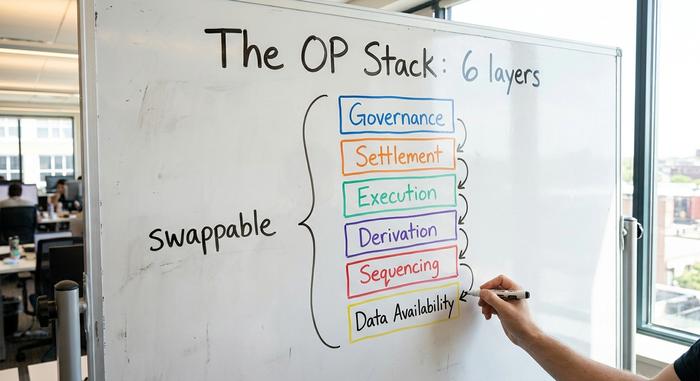
The real cleverness of the framework is in its seams. Rather than one monolithic program, it is split into swappable layers, so a builder can keep the parts that need to be bulletproof and replace the parts that need to be cheap.
Data availability, execution, settlement
The official architecture names six layers. Data Availability decides where the raw transaction data is published; Ethereum is the default, but a chain can swap in a cheaper provider to cut fees. Sequencing decides who collects and orders transactions. Derivation is the rulebook that turns that raw data into a chain everyone agrees on. Execution runs the transactions through an EVM and updates the state. Settlement is how an outside chain like Ethereum reads and trusts the result. The governance layer sits on top, controlling upgrades. The reason this matters: a team can keep Ethereum for settlement, where security is non-negotiable, while swapping the data availability layer to slash costs, all without forking the entire system.
Sequencer, batcher, proposer, challenger
Underneath the layers are a handful of named programs doing the grunt work. The op-geth client executes transactions, a lightly modified version of Ethereum's own Geth. The op-node re-derives the canonical chain from the data posted to Ethereum. The op-batcher compresses transactions and posts them down to L1. The op-proposer publishes the state commitments. And a challenger watches those commitments and submits a fault proof if one looks wrong. Most of these read like plumbing, and they are, but the split is what lets the whole machine be audited, swapped, and reused piece by piece.
This modularity is also its main pitch against building from scratch. Each component is open-source and hardened across dozens of chains, so a new team inherits years of battle-testing for free. The flip side is shared fate: every chain on the stack also inherits the same bugs, which is why a flaw found in one OP Stack chain is a flaw in all of them until it is patched upstream.
| Layer | What it does |
|---|---|
| Data availability | Where raw transaction data is published (Ethereum by default) |
| Sequencing | Collects and orders incoming transactions |
| Derivation | Turns raw posted data into the canonical chain |
| Execution | Runs transactions through the EVM, updates state |
| Settlement | Lets an outside chain read and trust the result |
| Governance | Controls configuration and upgrades |
Fault Proofs and OP Mainnet's Stage Rating
Now for the uncomfortable history the marketing tends to skip. For most of their existence, OP Stack chains had no working fault proofs at all. The seven-day window existed, but the mechanism to actually challenge a bad state was switched off, which meant users were trusting a small team, not the math.
That changed in June 2024, when permissionless fault proofs went live on OP Mainnet, finally letting anyone, not just insiders, dispute an invalid state. L2BEAT, which rates how decentralized a rollup really is, lifted OP Mainnet to "Stage 1." But the honest picture is still mixed. Of roughly 25 live Superchain projects L2BEAT tracks, only three sit at Stage 1; the rest are Stage 0, the most training-wheels-heavy tier, and none have reached the fully trustless Stage 2. The sequencer, the program that orders your transactions, is still centralized on essentially every OP Stack chain. The technology is real, but so are the training wheels.
| L2BEAT stage | What it means |
|---|---|
| Stage 0 | Full training wheels; operators can override, fault proofs limited |
| Stage 1 | Fault proofs live; a security council can still intervene |
| Stage 2 | Fully trustless; users protected by code alone |
The Superchain: One Standard, Many Chains
All this standardization pays off in the Superchain, which is the reason the OP Stack matters beyond any single chain. The Superchain is a set of chains built on it that agree to share more than just code.
Who is building on the Superchain
The roster is heavyweight. Beyond Optimism's own OP Mainnet, the Superchain registry holds around 34 chains, including opBNB, Zora, World Chain from the Worldcoin project, Sony's Soneium, Kraken's Ink, Uniswap's Unichain, and Lisk. The pull is obvious: instead of paying engineers to build a chain from scratch, a company forks a battle-tested stack and inherits an ecosystem. Collectively these chains have been enormous, accounting for roughly 69.9% of all L2 transaction fees in 2025 and processing about 3.6 billion transactions in the second half of that year, up 44% from the first.
| Chain | Backed by | Niche |
|---|---|---|
| Base | Coinbase | Largest OP Stack chain (stepped back in 2026) |
| Unichain | Uniswap | DeFi and DEX-focused L2 |
| Soneium | Sony | Entertainment and consumer apps |
| Ink | Kraken | Exchange-aligned DeFi |
| World Chain | Worldcoin | Identity and human verification |
| Zora | Zora | NFTs and the creator economy |
Shared bridges and the interop roadmap
What binds the Superchain together is shared infrastructure. The L1 bridge contracts that connect these chains to Ethereum are owned by the Optimism Collective and upgraded together. Components like the CrossL2Inbox and a SuperchainTokenBridge are meant to let chains pass messages and tokens to each other natively, without the risky third-party bridges that have been hacked so often. The honest caveat: full native interoperability is still a roadmap item in 2026, not a finished feature. The standard exists; the frictionless network is still being wired.
Governance and the Optimism Collective Economy
If the OP Stack is free, how does Optimism make any money? It does not sell the software — it taxes the chains that use it, and recycles the proceeds.
Governance runs through the Optimism Collective, a two-house governance system. The Token House, made up of OP token holders, votes on protocol upgrades and treasury decisions. The Citizens' House distributes funding to public goods through a program called RetroPGF, or Retro Funding, which rewards work after it has proven useful rather than betting on promises; across its rounds it has handed out roughly 79 million OP tokens. The money comes from a revenue-sharing rule written into the Superchain's social contract, the Law of Chains: each member chain owes the Collective the greater of 2.5% of its net sequencer revenue or 15% of its onchain profit. By 2025 that arrangement had funneled well over 14,000 ETH into the Collective's treasury. The software is free; belonging to the club is not.
That model made Optimism one of the few crypto projects with a real, recurring business that is not just selling its own token. It also makes the recent turbulence more pointed: every chain that leaves the official Superchain is revenue the Collective no longer collects, which puts a real price tag on the standardization-versus-sovereignty fight now playing out.
When Base Left: Cracks in the OP Stack
Then came the test nobody in the Optimism camp wanted. In February 2026, Coinbase's Base, by far the largest chain ever built on the OP Stack, announced it was moving toward its own unified stack and away from shared OP Stack governance.
This matters because Base was the flagship. It held more total value than any other OP Stack chain, well over $11 billion at its peak, and it was the proof that a major company could build on Optimism's code and win. Its partial exit complicates two of the Superchain's core promises at once: the revenue that flows to the Collective, and the story that everyone is better off sharing one standard than going it alone. The departure surfaces a tension baked into the whole model. A company wants the head start an open stack gives it, but it does not always want to share governance, revenue, and roadmap with a collective it does not control. Standardization and sovereignty pull in opposite directions — and the biggest chain just picked sovereignty.
None of this kills the OP Stack. Base still runs on the same codebase, and the software stays free for anyone to fork. What changed is the political story. The Superchain was sold as a network that grows stronger as more chains join and share; the most important chain choosing to share less is a real stress test of whether that flywheel holds once a member gets big enough to set its own terms.
OP Stack vs ZK Stack and Arbitrum Orbit
The OP Stack is the largest rollup framework, but not the only one. The main rival design is the ZK Stack behind zkSync's Elastic Network, which uses validity proofs to verify every batch up front, giving faster finality and no week-long withdrawal wait, at the cost of heavier computation. Arbitrum's Orbit and Polygon's CDK round out the field, each offering its own toolkit for launching chains. The split that matters is optimistic versus zero-knowledge: the OP Stack bets on simplicity and a challenge window, while ZK systems bet on math-heavy proofs. Both are now racing to host the next wave of app-specific chains.
What the OP Stack Means for Ethereum L2s
The OP Stack did something genuinely important: it turned launching a layer-2 from a research project into a deployment, which is why so much of Ethereum's L2 activity now runs on its code. That is a real legacy regardless of what happens next. The open question of 2026 is whether the Superchain holds together as a shared network now that its biggest member has stepped back, or fragments into competing forks that share a codebase but little else. Either way, one thing about open-source software holds: the code outlives any single chain that uses it. The OP Stack will keep shipping new chains long after the politics of this particular moment are forgotten.