
MyEtherWallet (MEW): A 2026 Web3 Crypto Wallet Guide
Quick test: name a crypto wallet older than MyEtherWallet. Most people cannot. MEW shipped in 2015, before MetaMask existed, back when "using Ethereum" still meant hand-building transactions in a browser console. It turned ten in August 2025. A decade is geologic time in this industry, which makes the fair question for 2026 a blunt one: does a tool this old still belong on your phone or in your browser? For experienced Ethereum users, often yes. For total beginners, often no. The rest of this guide pulls those two cases apart. We will dig into what MEW really is, how to set it up and move ether without a costly slip, how safe it actually is after that famous 2018 scare, and when MetaMask or Trust Wallet simply fit you better.
What MyEtherWallet (MEW) actually is
One idea explains everything else about MEW: it never holds your crypto. MyEtherWallet is a free, open-source interface to the Ethereum blockchain — the steering wheel, not the car. Create a wallet and the interface spins up a key right on your device, then hands it straight to you. From that moment the funds live on-chain. The only thing standing between you and them is that one key. Lose it and the money is gone. Guard it and no company on earth can touch it.
It does not hold your crypto
This is what "non-custodial" means in practice. A custodial exchange keeps your private keys on its servers and lets you log in with a password, the way a bank holds your money. MEW flips that. The private key, or the encrypted keystore file it can produce, is generated and held locally on your device, never on a MyEtherWallet server. You store it. You sign your own transactions. Nobody can freeze your account, and nobody can recover it for you either. That trade-off is the whole personality of the wallet, and it is worth understanding before you put a single dollar in.
From a web tool to Enkrypt and the mobile app
MEW is no longer just myetherwallet.com. Founder Kosala Hemachandra has slowly built it into a small family of products. There is the original web interface, still running. There is Enkrypt, a browser extension that works across more than 70 networks, so it competes directly with MetaMask. And there is the mobile app, which passed 3 million downloads by its tenth anniversary in August 2025. The app has also pushed into tokenized stocks lately, letting you hold over 200 U.S. equities and ETFs next to your crypto. Whether that pivot is smart or a distraction is a fair debate, but the core wallet has stayed the same.
The team has not always stayed together, though. In 2018, co-founder Taylor Monahan left to launch a competing fork called MyCrypto, while Kosala Hemachandra kept MyEtherWallet running on the original domain. It is a small piece of history, but it tells you something useful: even open-source wallets are run by people who disagree, and the code outlives the drama because the full source sits on GitHub for anyone to audit and fork. That openness, plus MEW's long-standing "no tracking, no ads" stance, is also why privacy-minded users have stuck with it.
How to set up MEW and send ether
Setting up a MEW wallet takes about five minutes. The step that actually matters takes thirty seconds, and almost everyone rushes it: writing down your recovery phrase. Botch that one, and the tidy five-minute setup turns into a permanent, unrecoverable loss of everything in the wallet. So slow down right there, because this single step protects every transaction that follows.
Creating your MEW wallet step by step
On the mobile app it moves fast. You tap "Create a free wallet." You set a six-digit PIN. You switch on biometric unlock. Then the app shows you a recovery phrase, usually 24 words, and quizzes you on a few to confirm you wrote them down. The web at myetherwallet.com takes a different route. There you generate an encrypted keystore file, locked behind a password. Same idea, different wrapper. Whoever holds that secret holds the funds. And here is what people mix up. The PIN protects the app on your phone. The recovery phrase controls the actual money on the blockchain. Lose the phone, you can recover. Lose the phrase, you cannot. Do not confuse the two.
If you already own a Ledger or Trezor, take the better path and skip key generation entirely. You open the hardware device through MEW, and the private key is created and kept on the device itself, never touching your browser or your phone. Anyone holding more than pocket change should start here on day one, rather than treating hardware as a later upgrade.
Sending ether and ERC-20 tokens
Funded? Then sending is simple. Open the send screen, paste the recipient address, pick the asset, set the amount. MEW lets you adjust the gas fee by hand, which helps when the network is jammed and you would rather pay less or push the transaction through faster. Ethereum runs ERC-20 tokens on top of ether, so the same wallet holds thousands of tokens, not just ETH. You confirm. You sign with your key. The network takes it from there. No support desk sits anywhere in this loop — which is the whole point, and the whole risk.
Backing up your keys and recovery phrase
Your recovery phrase is the master key. Not a backup of the key. The key itself. So back it up safely the boring way: write the words on paper, or punch them into a steel plate if the stack is big, then lock that backup somewhere offline. Do not type it into any website. Do not snap a photo. Do not drop it into a notes app or a chat thread. Most "MEW got drained" stories trace straight back to a seed phrase left where malware could read it. Lose both the phrase and the device, and the crypto is gone for good. No reset, no hotline, no exceptions.
Is MyEtherWallet safe? The MEW security model
MEW's reputation took one real hit, and the story is worth telling straight, because the details matter far more than the headline does.
The 2018 DNS hijack, explained
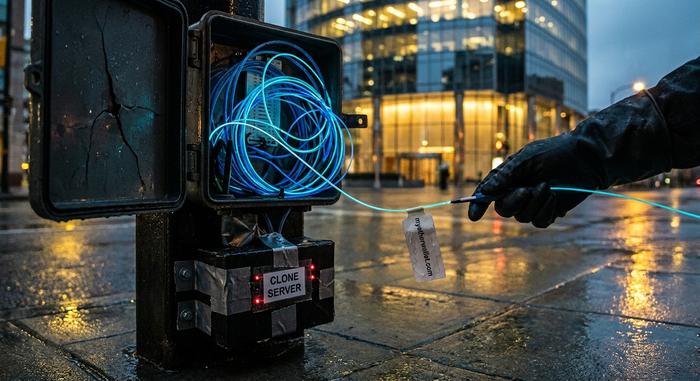
Back in April 2018, attackers hijacked the internet routing that pointed visitors to myetherwallet.com, a combined BGP and DNS attack, quietly sending some of them to a fake clone that grabbed their keys. Around 216 ETH vanished, roughly $152,000 at the time, according to CoinDesk. Now the nuance almost everyone skips: MEW's own code was never touched. The attack hit third-party internet plumbing, a public DNS server, not MyEtherWallet's software. That is not a dodge. It is the actual lesson of self-custody. The protocol held. The weak link was the road users took to reach it.
Phishing and fake-MEW clone sites
The real danger in 2026 is not exotic routing tricks. It is plain phishing. Scammers register lookalike domains, buy ads, and clone the wallet's interface pixel for pixel, all to get you to paste your recovery phrase into the wrong box. The ecosystem numbers are grim. Scam Sniffer logged $83.85 million lost to crypto phishing in 2025 across about 106,000 victims, while Chainalysis pegged total crypto scam losses for the year near $17 billion. A non-custodial wallet hands all of that risk to you. MEW cannot un-send a transaction you signed by mistake. There is no undo button.
How to use MEW securely
The defenses are boring and they work. Bookmark the real myetherwallet.com and only enter through the bookmark. Pair MEW with a hardware wallet like Ledger or Trezor so your key is signed offline and never touches a browser. Keep large funds in cold storage and only a spending amount in the hot wallet. Double-check every address before you sign. And remember that the web tool has no two-factor authentication and never will, because there is no account on a server to protect. There is only your key. Verify the site's security certificate and the exact spelling of the domain on every visit, since a single swapped letter is how most clone sites catch people. None of this is glamorous, but it is the difference between a wallet that is safe and one that merely sounds safe.
MEW fees and the crypto assets it supports
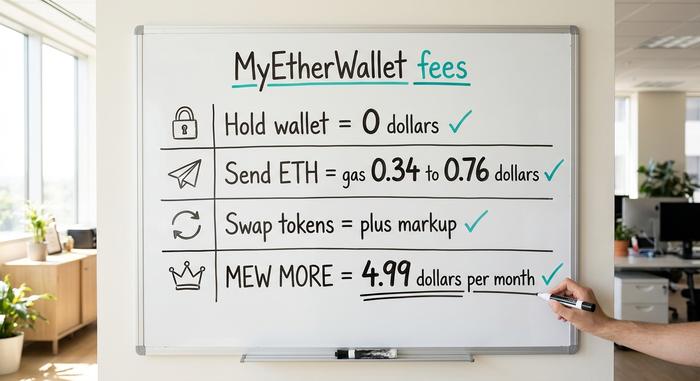
People assume an old, popular wallet must be quietly charging them. It mostly is not. Creating a wallet and holding crypto costs nothing. You pay the Ethereum network a gas fee for every transaction, which in 2025 averaged somewhere between $0.34 and $0.76 per transfer, per CoinLedger's analysis of Etherscan data, often under a dollar. Where MEW does earn money is the in-app swap and buy features, which carry a markup, plus an optional MEW MORE subscription at $4.99 a month for extra features.
| What you do | What it costs |
|---|---|
| Create or hold a wallet | Free |
| Send ETH or ERC-20 tokens | Ethereum gas fee only (~$0.34-0.76 avg in 2025) |
| Swap tokens inside MEW | Network fee + provider markup |
| Buy crypto with a card | Third-party processor fee |
| MEW MORE subscription | $4.99/month (optional) |
One quirk to keep in mind: gas is set by network demand, not by MEW, so the same transfer can cost a few cents at 3 a.m. and several dollars during a busy NFT mint. The wallet does not pocket any of that. It goes to the Ethereum validators who process your transaction.
On assets, MEW reaches well past ether. Through Enkrypt and the mobile app it supports EVM networks like Base, Arbitrum, Polygon, and Optimism, plus Bitcoin and Solana, alongside more than 10,000 ERC-20 tokens. For an Ethereum-first wallet, that is broad coverage.
MEW wallet vs MetaMask vs Trust Wallet
MEW loses badly on size, and that is worth saying plainly. MetaMask reported more than 30 million monthly active users. Trust Wallet claimed north of 220 million total accounts by the close of 2025. MEW's mobile app sits near 3 million downloads, a rounding error beside those two giants. Size is only part of the picture, though. MEW stays fully open-source, it built hardware-wallet support in early and kept refining it, and its web tool exposes fine controls that the glossier apps bury several menus deep. Different buyers want different things, and MEW knows exactly which buyer it serves.
| Feature | MEW | MetaMask | Trust Wallet |
|---|---|---|---|
| Custody | Non-custodial | Non-custodial | Non-custodial |
| Scale | 3M+ app downloads | 30M+ monthly users | 220M+ total users |
| Main networks | ETH, EVM, BTC, Solana | ETH, EVM, BTC, Solana | Multi-chain, very broad |
| Hardware wallets | Ledger, Trezor | Ledger, Trezor | Ledger |
| Open-source | Yes | Partly | Partly |
The takeaway is simple. If you want the biggest network effect and the most third-party integrations, MetaMask or Trust Wallet win. If you value transparency and hardware-first security, MEW holds its ground.
Is MyEtherWallet worth it in 2026?
For the right person? Yes. I keep landing on the same split whenever friends ask me which wallet to use. MEW fits if you are comfortable on Ethereum, plan to pair it with a Ledger or Trezor, and want an open-source wallet that does not hide its machinery. The web interface hands you controls that beginner apps quietly lock away. But if you are brand new to crypto and want something that holds your hand and forgives slips, MEW's self-custody can feel cold. A more guided app may treat you better at the start. MEW is not built to please everyone. That focus is the feature, not a flaw.
Owning your keys with the MEW wallet
MyEtherWallet has lasted ten years by doing one thing consistently: handing you the keys and getting out of the way. That is its strength and its catch. There is no support line to undo a bad signature, no company holding your crypto in reserve. In exchange, you get an open-source Ethereum wallet whose actual code has never been breached in a decade of running. Is that trade-off right for you? If you are ready to own your keys, set up MEW, pair it with hardware, and bookmark the real site. The responsibility is the point.



