QuickNode Review: Blockchain Development Infrastructure

Most people in crypto have never typed the word QuickNode. They use it anyway, dozens of times a day, without knowing. Open a wallet and check a balance. Swap a token. Watch an NFT load. Each of those actions fires a question at a blockchain, and something on the other side has to answer it fast. QuickNode is one of the companies doing the answering, about five trillion times a year. What it sells is unglamorous: managed nodes, RPC endpoints, and a pile of data APIs that let a developer build a Web3 app without ever babysitting a server. This review digs into what QuickNode does, how its RPC infrastructure works under the hood, what it costs, and where the catch hides.
What is QuickNode and what it actually does
Start with what QuickNode is not. It is not a blockchain, a token, or a wallet. The plain label is node-as-a-service. Want to run a full blockchain node yourself? You will be syncing terabytes of data, keeping a server alive around the clock, and patching it every time the network forks. QuickNode takes that chore off your plate and hands back a single connection point instead.
The three founders, Auston Bunsen, Alex Nabutovsky, and Dmitry Shklovsky, set up shop in Miami back in 2017. Nobody was funding "Web3 infrastructure" yet. Their core product is an RPC endpoint. Think of it as a web address your app calls to read blockchain data or push through a transaction. RPC stands for remote procedure call, which sounds heavier than it is: your code asks a remote machine to do a thing and hand back the answer. Stacked on top are APIs for tokens, NFTs, trading, and live data. Enough that a three-person team can ship across half a dozen chains without ever touching a bare-metal node.
Why does that matter so much? Because a blockchain node is a needy thing to keep alive. It holds a full copy of the ledger and re-checks every block that lands, which on a busy chain means hoarding terabytes and never lagging by even a second. Almost nobody building a product wants that chore. Taking it away is the entire pitch. The Core RPC API is the front door, and when a customer's traffic outgrows the shared pool, they move up to Dedicated Clusters, private isolated infrastructure carrying its own SLA.
How QuickNode's RPC infrastructure works
Underneath the marketing, the structure is straightforward. You get an endpoint, you authenticate, and you build on top.
Core RPC endpoints and API keys
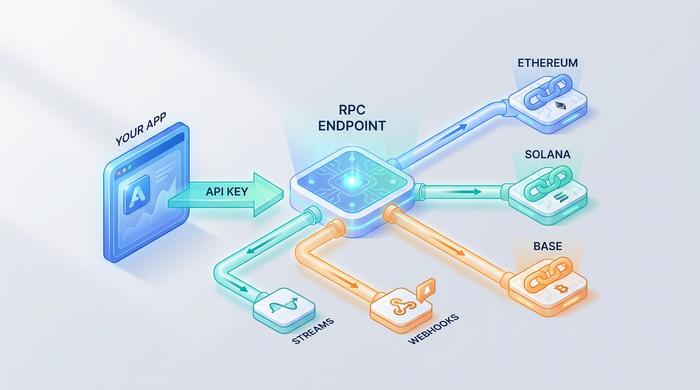
When you create an endpoint, QuickNode gives you a unique URL tied to a specific chain, plus an API key that controls access. Your app sends standard JSON-RPC requests to that URL, and QuickNode routes them to a healthy node, caches common queries, and returns the data. The node is managed, so you never see the messy parts. No syncing. No failovers at 3am. No upgrade scramble. The same Core RPC API reaches more than 80 chains and over 140 networks, so adding a second or third chain is a configuration change rather than a new infrastructure project. Authentication runs through that API key, and QuickNode layers on token-based access controls and domain masking so a leaked key does less damage. For most developers the practical upshot is that the hardest part of blockchain data access, keeping a reliable node alive, becomes someone else's problem on day one.
Real-time data: Streams, Webhooks, and Solana gRPC
Reading the chain on demand is only half the job. Sometimes you need to know the second something changes. That is the job of Streams and Webhooks. Streams pushes real-time data pipelines and quietly handles chain reorganizations, the ugly edge case most teams forget about; Webhooks fire an alert at your server the moment an address or contract moves. Solana gets its own low-latency gRPC feed, because on Solana speed is the whole game. The numbers behind this are not small. In 2025 Streams pushed more than five billion blocks a month and sent over 330 million webhook payloads. For a trading bot or a liquidation engine, that head start is the gap between catching a move and watching it pass. So they pay for it.
Indexed data and the add-on marketplace
The third layer makes raw blockchain data usable. Ever tried to rebuild a year of transfers out of raw RPC calls? It is miserable work. SQL Explorer skips it, letting you query on-chain history in plain SQL. A Swap API takes production trading workloads off your hands, and a marketplace of add-ons fills in NFT metadata, token APIs, and analytics. The typed SDKs in TypeScript, Python, and Rust are the developer tools that round the whole thing off.
There is more underneath, aimed at bigger operations. IPFS gateways and pinning, for decentralized file storage. Validator-as-a-Service, for teams that want to stake on networks like Solana without racking their own hardware. The pattern never changes. QuickNode runs the unglamorous machinery, and you work through a clean API key and a dashboard.
Supported chains and the scale behind QuickNode
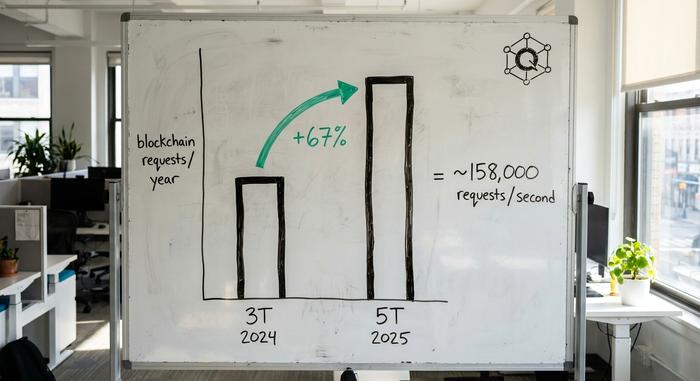
The traffic is the headline. In 2025 QuickNode served roughly five trillion blockchain requests, up about 67% from three trillion the year before. Do the math and that is around 158,000 requests a second, all day, every day. Hardly anyone in crypto runs at that volume. The ones who do are mostly exchanges, not infrastructure providers. To put 158,000 requests per second in human terms, that is more queries every second than most national card networks handle in payments, sustained day and night. The growth curve matters as much as the absolute number, because infrastructure that expands 67% in a year has to keep scaling its own systems just to stand still.
Breadth is the other half. QuickNode reaches 80-plus chains across more than 140 networks, wider than most rivals bother with. And Layer 2s have become its center of gravity. By the company's own count, they now drive 40 to 45% of all requests across 31 separate L2s. That is why QuickNode claims the top slot among L2 infrastructure providers.
| QuickNode by the numbers (2025-2026) | Figure |
|---|---|
| Blockchain requests per year | ~5 trillion |
| Requests per second | ~158,000 |
| Year-over-year growth | ~67% |
| Supported chains / networks | 80+ / 140+ |
| Layer-2 share of traffic | 40-45% |
| Uptime SLA | 99.99% |
QuickNode pricing: free to high-performance plans
Most reviews go vague here. The real numbers are not hard to find. QuickNode runs on credits: every request burns some, and each plan hands you a monthly pile of them to spend.
The plan ladder
The free tier is real. It costs nothing and gives you enough credits to prototype something. Past that, the paid plans climb roughly like this.
| Plan | Price / month | Best for |
|---|---|---|
| Free | $0 | Prototyping, testing |
| Build | $49 | Small production apps |
| Accelerate | $299 | Growing apps, more traffic |
| Scale | $900 | High-traffic products |
| Business | Custom | Enterprise, dedicated infra |
Where the bill climbs
The credit model is generous at the bottom and brutal at the top. Your app catches on, traffic spikes, and suddenly you have torched a month of credits in a week, tipping into overage fees or a forced upgrade. Teams that need guaranteed throughput can switch to Flat Rate RPS plans, which charge by requests-per-second instead of credits and start near $799 a month as of March 2026. Model your costs at scale before you commit. Usage-based billing has a way of rewarding success with a bigger invoice.
The surprises hide in how credits are spent, not just how many. Calls are not priced equally. A simple balance check is cheap; a heavy archive query or a trace call can cost many times more. Lean on the expensive methods and your allowance drains far faster than the raw request count suggests, which is how two apps on the same plan end up with wildly different bills.
QuickNode vs Alchemy and Infura for RPC nodes
The field is crowded. Alchemy usually gets called the category leader; Infura, owned by Consensys, is the reflex pick for Ethereum developers. So where does QuickNode actually win? The honest answer is range: its 80-plus chains clear what Alchemy and Infura bother to list, and that gap starts to matter the moment your product reaches past Ethereum into a dozen other networks.
On speed, QuickNode points to its own latency benchmark, which clocked an 86-millisecond global average against 207 milliseconds for Alchemy. That test is worth taking with caution, though, because it is self-reported and dates to late 2022; no neutral, current benchmark settles the question.
The three providers also differ in character. Alchemy has invested heavily in developer tooling and dashboards and is often the default for well-funded teams. Infura, baked into MetaMask and backed by Consensys, is where many Ethereum projects start without thinking about it. QuickNode's pitch is range: if your roadmap touches a dozen chains and a fistful of Layer 2s, supporting all of them from one account can be worth more than a few milliseconds either way.
| Provider | Chain breadth | Known for |
|---|---|---|
| QuickNode | 80+ chains | Multi-chain breadth, L2s |
| Alchemy | Fewer chains | Category leader, tooling |
| Infura | Ethereum-centric | Consensys default, MetaMask |
Performance, reliability and QuickNode funding
Reliability is what wins the enterprise deals. The promise is 99.99% uptime, stamped with SOC 2 and ISO 27001 badges, the dull certifications big buyers want before they sign. The funding history rhymes with that confidence. Money has arrived in waves since 2019, building to roughly $106 million across six rounds.
| Round | Amount | Lead / note |
|---|---|---|
| Seed | $5.3M | Alexis Ohanian's Seven Seven Six |
| Series A (2021) | $35M | scaling the team |
| Series B (Jan 2023) | $60M | 10T Holdings, $800M valuation |
| Total | ~$106M | across six rounds |
The Series B is documented by CoinDesk, and QuickNode has even pushed money back out to builders, through a $65 million accelerator for Layer-2 projects run with Google and Coinbase Ventures. And the catch? That $800 million figure is over two years stale, and the company has never published a revenue number. So how healthy is it today? Outside the building, your guess is as good as mine.
Risks of QuickNode: cost scaling and lock-in
No infrastructure choice is free of downsides. The usage-based pricing that feels cheap at launch can become a meaningful line item once an app finds traction, and surprise overage bills are a common complaint. There is also vendor lock-in: once your code, webhooks, and data pipelines are wired to QuickNode's specific endpoints and add-ons, moving to another provider is real engineering work, not a config swap. And because QuickNode is private and quiet about revenue, you are trusting a company whose financial trajectory you cannot fully see. None of this is disqualifying, but it belongs in the decision.
Who should build blockchain apps on QuickNode
QuickNode fits teams that want to ship fast across several chains and would rather pay for reliability than babysit servers. DeFi protocols, wallets, trading apps, and games are the obvious users, and the company has been pushing into newer territory like AI-agent infrastructure, with support for the ERC-8004 agent identity standard and machine-payment rails. That AI angle is more than a slogan. QuickNode ships a connector in Anthropic's MCP directory and gives each agent a million free monthly requests through its machine payments protocol, a bet that autonomous software will become a real class of blockchain user. Whether or not that pans out, it signals where the company expects the next wave of demand to come from. For a solo developer running a single-chain hobby project, a free public endpoint or a self-hosted node may be enough, and QuickNode would be overkill. The more chains you touch and the more uptime matters, the stronger the case for a managed, scalable provider.
QuickNode and the plumbing of Web3
QuickNode is boring in the way that good infrastructure is supposed to be boring. It runs the nodes, answers the requests, and stays out of the way while developers build the apps people actually see. The technology is solid and the scale is real. Chain coverage is broader than almost anyone else's. The harder question, and the one I'd actually sweat before committing, is not whether QuickNode works, because it clearly does, but whether the convenience is worth the cost curve and the lock-in as you grow. If you are choosing infrastructure today, that is the trade-off to price out before you wire everything to a single provider.