Multilogin: Antidetect Browser for Crypto Accounts

Open a normal browser, log into two accounts on the same website, and the platform can often tell they belong to one person. Different emails, different passwords, it doesn't matter much. The site reads your device, not just your login. Multilogin is built to break that link. It is an antidetect browser: software that runs many separate browser profiles, each with its own fake-but-believable digital fingerprint, so a website treats them as unrelated strangers instead of one user with twenty tabs.
Marketers and online sellers were the first big users. Then crypto arrived, and airdrop hunters pushed the idea to industrial scale. This guide explains what Multilogin actually does, how the fingerprinting trick works, where crypto users lean on it, and the part most reviews skip: where it is legal, and where it quietly gets you banned.
What is Multilogin and who uses the app?
Strip away the marketing and Multilogin is simple: a profile manager wrapped around a browser, made for multi-account management across any website or platform. It is not a VPN, and it is not some hacking tool. Picture a filing cabinet where every drawer is a separate browsing environment, each with its own cookies, storage, and spoofed fingerprint. You open as many drawers as your plan allows, all from one dashboard, and the website behind each one has no idea the others exist.
The company started back in 2015 out of Tallinn, Estonia, which makes it a veteran in a market crowded with two-year-old startups. The app runs on two browser engines, Mimic (based on Chromium) and Stealthfox (based on Firefox), and on either one you can adjust roughly 55 fingerprint parameters per profile.
The user base is broader than you might guess. An affiliate marketer might run forty ad accounts so a single ban never sinks the whole campaign. An e-commerce seller keeps regional storefronts apart on Amazon or eBay. Agencies log into client accounts without mixing them up, QA testers need a clean slate for every test, and data teams scrape public pages at scale. Each one is a legitimate use case where isolated profiles solve a genuine headache. Crypto users came later, and they are the reason the tool now turns up in half the airdrop guides online.

How antidetect browser profiles work
Here is the part that confuses newcomers. The goal of an antidetect browser is not to hide you. It is to make each profile look like a believable, different person. Hiding draws attention; blending in does not.
What your browser fingerprint reveals
Every time you load a page, your browser leaks a surprising amount about your machine: the way it draws hidden graphics (canvas and WebGL), the exact list of installed fonts, screen resolution, timezone, language, and dozens of smaller signals. Stitched together, that combination is often unique. A 2025 peer-reviewed study presented at the Privacy Enhancing Technologies Symposium tested 12,461 US participants and found that roughly 60% of browsers were uniquely identifiable across just 13 attributes, with no cookies involved. You can watch this happen on your own machine using the EFF's free Cover Your Tracks test.
This is why the usual privacy tricks fall short. Clearing cookies or opening an incognito window does almost nothing here, because the fingerprint comes from your hardware and settings, not from stored data. A VPN swaps your IP address but leaves the same fingerprint underneath, so two accounts behind the same VPN can still be matched. That uniqueness is exactly what links your "separate" logins back to one person.
How Multilogin fakes a clean fingerprint
Each Multilogin profile gets its own fingerprint, built to look like a real device that simply isn't yours, plus fully isolated cookies and local storage. The trick is consistency, not randomness. Say a profile claims to be Chrome on Windows. Then it had better report Windows fonts, a believable screen size, and matching graphics behavior. Mix those up, a Windows fingerprint running on a Mac, or a US timezone bolted onto German language settings, and detection systems spot the contradiction in a heartbeat.
Why a proxy matters as much as the fingerprint
A flawless fingerprint behind your home IP still gives you away, because every profile shares the one network. So each persona needs its own IP through a proxy, ideally a residential or mobile one that reads like an ordinary home connection. Multilogin bundles a pool of more than 30 million residential and mobile IPs across 150-plus countries, and you can plug in your own if you prefer. Get the fingerprint and the proxy to agree, and the profile holds up.
Using Multilogin to manage crypto accounts
This is where Multilogin meets crypto, and where the tool gets genuinely risky. I'll be straight about both sides, because most write-ups only sell the upside.
Airdrop farming and the sybil problem
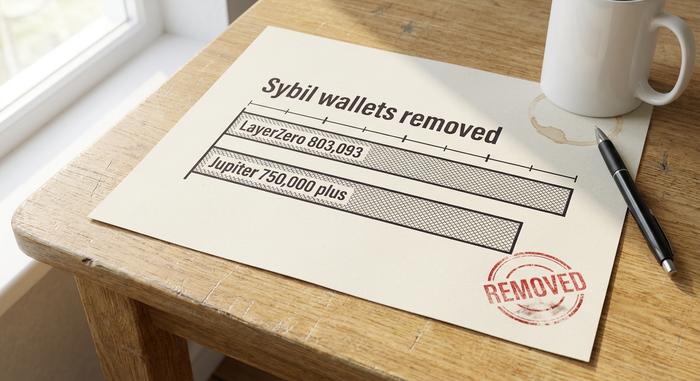
When a new protocol plans to give away tokens, people try to qualify many wallets at once to multiply the reward. That is a sybil attack: one actor pretending to be a crowd. Antidetect browsers make it scalable, since each wallet can live in its own profile with its own fingerprint and IP. Projects fight back hard. In May 2024, LayerZero first flagged around two million addresses, then confirmed 803,093 as sybil wallets and stripped them from its airdrop. Jupiter's January 2025 "Jupuary" round excluded more than 750,000 wallets it judged to be bots or farms.
| Airdrop | When | Wallets flagged as sybil |
|---|---|---|
| LayerZero | May 2024 | 803,093 (from ~2M flagged first) |
| Jupiter (Jupuary) | Jan 2025 | 750,000+ |
| zkSync | Jun 2024 | Minimal filtering; analysts estimated millions of dollars reached farms |
Running multiple exchange accounts
The other common use is holding several accounts on one platform: extra exchange logins, multiple marketplace profiles, separate identities for testing. Most exchanges forbid more than one account per verified person, and they catch duplicates through far more than the IP address. They compare device fingerprints, login times, withdrawal patterns, and even the way funds move between accounts. Two "different" users who always log in from the same fingerprint, fund each other, and cash out to the same wallet are easy to connect. A clean profile per account, each with its own proxy, is meant to keep those signals from lining up. Larger teams sometimes automate repetitive profile actions — launching, logging in, executing transactions — through the Multilogin API, which scales the workflow but also multiplies the footprint that detection systems can track.
Why this often backfires
The honest part: the tool delays detection, it does not erase the risk. Sybil filters claw back tokens after the fact, exchanges freeze balances and close duplicate accounts, and you can burn real gas fees on dozens of wallets that end up earning nothing. The math also gets worse as you scale, because more profiles mean more proxies, more funding transactions, and more chances to leave a pattern that ties everything back together. Multilogin does not make a banned activity allowed. It just buys time, and the platforms keep getting better at finding patterns.
Multilogin pricing, plans, and free trial
Here is the part that stings: Multilogin sits at the premium end, and there is no free-forever plan. Even the trial costs money. The rates below are the official ones as of 2026, and yes, you should double-check the live page, because a few review sites still quote old euro prices that no longer match.
| Plan | Price | Profiles | Notes |
|---|---|---|---|
| Trial | $1.99 / 3 days | 5 | 200 MB proxy traffic |
| Pro 10 | $11 / month | 10 | 1 GB proxy, solo use |
| Pro 50 | $29 / month | 50 | 3 GB proxy |
| Pro 100 | $40 / month | 100 | 5 GB proxy, 2 team seats |
| Business | $89–$900 / month | 300–10,000+ | unlimited team seats |
The current tiers live on the official Multilogin pricing page. Pay yearly and you shave off a good chunk. Paid plans also unlock team roles and access to a live support team on the cloud platform. Still, next to newer rivals, this is not cheap, and that price tag is the gripe reviewers raise most often.
Setting up your first Multilogin profile
Getting started is more straightforward than the feature list suggests. Multilogin runs as a desktop application on Windows, macOS, and Linux — there is no standalone Android or mobile app, so you will need a computer to use it. After you install and sign in, the workflow is short. Create a new browser profile and pick the engine, Mimic for a Chrome-like setup or Stealthfox for Firefox. Let the app generate a fingerprint, or adjust the operating system and screen size if you need the profile to match a specific persona.
Next, attach a proxy. You can use Multilogin's built-in residential pool or paste in your own proxy details, then run the connection test so the IP location lines up with the timezone you chose. Launch the profile, log into your account, and that environment stays isolated from every other profile you run. The one habit worth building early is keeping each profile consistent: same proxy, same fingerprint, every session. Profiles drift into trouble when you swap their network or device details halfway through.
Can the Multilogin browser be detected?
The honest answer is usually no, but not always. Test results are mixed. In one detailed review, Multilogin beat the Pixelscan check every time when the profile's operating system matched the real one, and scored around 70 to 75% on the CreepJS test with Firefox profiles. In another lab, a competitor's test flagged a default Multilogin profile on the iphey verification tool, and a third reviewer noted it lacked a proper canvas-fingerprint solution and once leaked the test proxy's IP.
What does that tell a normal user? Detection depends far more on how you set up and behave than on the logo on the browser. Run a profile with a mismatched OS, reuse one proxy across ten accounts, or move the mouse like a robot, and any antidetect browser starts to slip. Used carefully, with matching fingerprints, separate proxies, and natural behavior, Multilogin holds up well in most checks. There is no tool that guarantees you are invisible.
Is Multilogin legal and safe to use?
This is the question that matters most, and the answer has two layers. The software is legal. What you do with it decides the risk.
Legal software, risky uses
Antidetect browsers are ordinary software with plenty of legitimate jobs: protecting privacy, scraping publicly available data, verifying how ads appear in different regions, and testing websites in clean environments. A 2024 US court fight between Meta and Bright Data is the closest legal signpost. The court treated violating a website's terms of service as a civil breach of contract rather than a criminal offense when the data was publicly visible. In plain terms, breaking a platform's rules usually means you get cut off, not arrested.
Account bans and lost funds
The real cost lands on the platform side. Exchanges and marketplaces can ban accounts, seize balances, and reverse rewards if they decide you broke the rules. Airdrop sybil clawbacks have erased payouts for hundreds of thousands of wallets, as the table above shows. Jurisdiction matters too. Some countries treat unauthorized access or fraud far more strictly than a simple terms-of-service breach, and using fake identities to pass financial checks can cross from a banned account into actual fraud. None of this is legal advice, and rules differ by country and by service. Before you run multiple accounts anywhere, read that platform's terms, because the tool will not protect you from them.
Multilogin vs other antidetect browsers
Multilogin is the established premium option, but the market has filled with cheaper choices that cover most of the same ground. If price is your main concern, it is no longer the obvious pick.
| Tool | Entry price | Free plan | Position |
|---|---|---|---|
| Multilogin | $11 / mo (Pro 10) | No (paid trial) | Premium, est. 2015, two engines |
| GoLogin | from $49 / mo | 3 profiles | Cloud profiles, Orbita browser |
| AdsPower | from ~$5.40 / mo | 2 profiles | Cheapest entry, automation tools |
| Dolphin Anty | $89 / mo (Base) | 5 profiles | Popular for affiliate teams |
| Incogniton | $19.99 / mo | 10 profiles | Generous free tier, Netherlands-based |
The pattern is clear. AdsPower and Incogniton win on price and free profiles, GoLogin leans on cloud storage, and Multilogin sells reliability, two browser engines, and a long track record. For a beginner testing the waters, a free tier elsewhere is a softer landing. For a team that wants stability and built-in proxies in one place, Multilogin still earns its fee.
Is Multilogin worth it? The verdict
It comes down to why you want it. Have a real reason to run separate accounts? An agency juggling clients, a seller with regional storefronts, a tester who needs clean profiles, and a habit of respecting each platform's rules? Then Multilogin is a solid, mature tool, and it does the job well. Treat it as a cheat code for farming airdrops or slipping past exchange limits, and it turns into a fast way to lose money the moment the bans and clawbacks catch up. The browser is only as safe as the plan behind it. So before you pay for a hundred profiles, sit with the harder question: what happens to all these accounts the day the platform connects the dots?