What is Polygon (MATIC): how does the Polygon network work and should you use it

Polygon used to be the chain everyone pointed to when they wanted to prove that Ethereum could scale. Fast transactions, sub-cent fees, big brand partnerships with Starbucks and Nike and Reddit. The token, MATIC, hit $2.92 at its peak in December 2021. In April 2026, the rebranded POL token trades around $0.09, down about 97% from that high. A billion-dollar market cap from what was once a $20 billion project.
So what happened? And more importantly, is Polygon still worth paying attention to?
The short answer: yes, but the story has changed. Polygon isn't just a sidechain anymore. It's evolving into something called the AggLayer, an aggregation layer that aims to connect multiple blockchains into what feels like a single network. Whether that vision plays out is unclear. What's clear is that the network is still alive, still processing over 100 million transactions a month, and still running DeFi, gaming, and payments infrastructure that real people and real companies use.
How the Polygon network works
Polygon started life in 2017 as the Matic Network, built by Jaynti Kanani, Sandeep Nailwal, Anurag Arjun, and Mihailo Bjelic in India. They raised $5.6 million through an initial exchange offering on Binance in April 2019. The idea was simple: Ethereum was slow and expensive, and somebody needed to fix that without replacing Ethereum itself.
The original design was a proof-of-stake sidechain that ran alongside the Ethereum blockchain. You'd bridge your tokens from Ethereum to Polygon, do whatever you needed to do (swap, lend, mint, game), and pay a fraction of a cent in gas fees instead of the $20-50 that Ethereum mainnet charged during busy periods. The Polygon network used its own set of validators running a modified proof-of-stake consensus mechanism, with MATIC staked as collateral to secure the chain.
It worked, and it worked fast. Ethereum was borderline unusable during the 2021 DeFi summer, with gas fees routinely hitting $50-100 per swap. Polygon offered the same dApps for pennies. Developers migrated. Users followed. Aave, SushiSwap, QuickSwap, Curve -- all the big DeFi names launched Polygon versions. By late 2021, the chain hosted thousands of decentralized applications and was processing more daily transactions than Ethereum mainnet itself on some days. The MATIC token rode that wave from under $0.02 in 2020 to $2.92 in December 2021.
The rebranding from Matic Network to Polygon happened in February 2021, signaling ambitions far bigger than just being a sidechain. The founders, particularly Sandeep Nailwal, became fixtures in crypto media, talking about building "Ethereum's internet of blockchains." Whether that sounds visionary or grandiose depends on when you check the token price.
Here's how the basic architecture works:
Polygon operates as a commit chain to Ethereum. Transactions happen on the Polygon blockchain, which processes them quickly and cheaply. Periodically, the chain commits checkpoints (compressed proofs of all recent transactions) back to the Ethereum mainnet. This gives you the speed of Polygon with an anchor to Ethereum's security. Validators who stake POL tokens (formerly MATIC) produce blocks, verify transactions, and earn rewards from transaction fees and protocol emissions.
The MATIC to POL token migration
In September 2024, Polygon officially began migrating its native token from MATIC to POL. The swap ratio is 1:1, and by early 2026, about 99% of all MATIC on the network has been converted. Most major exchanges handled the conversion automatically for their users.
Why change the token? POL is designed to be more than just a gas token for one chain. Under Polygon 2.0, POL becomes the universal token for staking across all Polygon-connected chains, including the new zkEVM rollup, any future Polygon CDK chains, and the AggLayer itself. MATIC was limited to the original PoS sidechain. POL is built to scale across an entire ecosystem of blockchains.
One tokenomics change worth noting: POL has a 2% annual emission rate over 10 years, earmarked for network security and community development. Legacy MATIC staking emissions ended in July 2025, and validators now operate under the new POL reward schedule with staking APRs around 2.5-3%.
| Detail | MATIC (old) | POL (new) |
|---|---|---|
| Max supply | 10 billion | 10 billion (+ 2% annual emission) |
| Migration ratio | -- | 1:1 swap |
| Migration status | Deprecated | 99% complete |
| Use case | Gas + staking on PoS chain | Gas + staking across all Polygon chains |
| Staking APR | ~4-5% | ~2.5-3% |
| Price (Apr 2026) | -- | ~$0.09 |
Polygon by the numbers in 2026
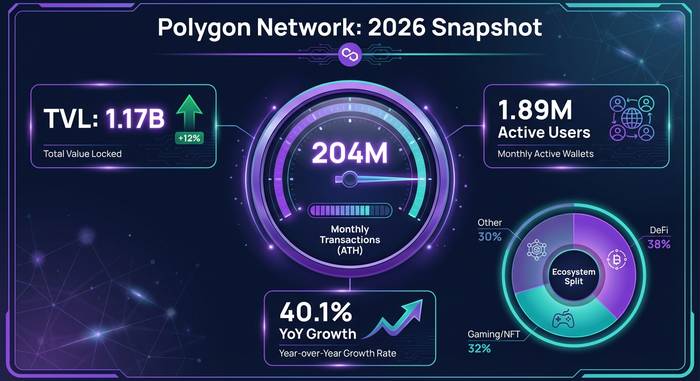
The network activity numbers tell an interesting story. Despite the massive token price decline, people are actually using Polygon more than ever.
| Metric | Value | Source |
|---|---|---|
| Monthly transactions (Feb 2026) | 204 million (all-time high) | CoinGecko |
| Average monthly transactions (2025) | 119 million | OAK Research |
| Monthly active users | 1.89 million | Gate Research |
| DeFi TVL | $1.17 billion | DeFiLlama |
| Largest DeFi protocol by TVL | QuickSwap ($451M, 29.2%) | CoinGecko |
| Polymarket TVL | $375 million (24.3% of total) | CoinGecko |
| Ecosystem breakdown | DeFi 38%, Gaming/NFT 32%, Other 30% | CoinLaw |
| POL market cap | ~$1 billion | CoinGecko |
| TVL YoY growth | +40.1% | CoinGecko |
February 2026 saw an all-time high of 204 million transactions in a single month. Polymarket, the prediction market platform that blew up during the 2024 US election, now accounts for almost a quarter of Polygon's TVL at $375 million. DeFi still dominates at 38% of the ecosystem, but gaming and NFT projects make up a solid 32%.
That 40.1% year-over-year TVL growth is especially notable when you consider that POL's price dropped roughly 75% over the same period. Usage is growing while the token price is falling. That disconnect is either a buying opportunity or a warning sign depending on your perspective.
What you can do on Polygon
Polygon supports a wide range of use cases. The network isn't limited to one niche.
DeFi and trading: QuickSwap is the native DEX. Aave, Curve, Balancer, and dozens of other protocols have Polygon deployments. Stablecoins on Polygon are widely used, particularly USDC and USDT, making it popular for payments and remittances with near-zero transaction fees.
Gaming and NFTs: Polygon was an early mover in blockchain gaming and it shows. Aavegotchi, Sunflower Land, and a bunch of titles connected to Polygon Studios all run here. Gaming and NFT projects account for 32% of the ecosystem, which is a bigger slice than most people realize. The Reddit avatar experiment deserves special mention: Reddit launched collectible avatars on Polygon without even telling users they were using a blockchain. Millions of people created crypto wallets and bought NFTs thinking they were just buying profile pictures. It was probably the most successful "stealth onboarding" in crypto history, even though Reddit eventually moved on.
Prediction markets: Polymarket, which operates on Polygon, became one of the most talked-about crypto applications in 2024-2025 around the US presidential election. It processes hundreds of millions in betting volume.
Enterprise and payments: This is where Polygon's brand partnerships live. Starbucks used Polygon for its Odyssey rewards program (since wound down). Nike's .SWOOSH digital sneaker platform runs on Polygon. Stripe integrated Polygon for crypto payments processing. The network is increasingly described as a "specialized payments blockchain" according to a 2026 Crowdfund Insider report.
Developer tools: If you're building something, Polygon gives you options. The CDK (Chain Development Kit) lets companies spin up their own custom blockchains connected to the Polygon ecosystem. For general-purpose dApp development, the PoS chain handles everything from DeFi protocols to gaming. For projects that need stronger Ethereum equivalence, the zkEVM rollup runs the same smart contracts as Ethereum mainnet but settles them with zero-knowledge proofs. And CDK chains are purpose-built for specific apps that need their own throughput and gas economics. That range of developer tooling is wider than most competing networks offer, which is part of why over 19,000 decentralized applications have been built on Polygon to date.
Polygon 2.0 and the AggLayer: what's actually changing
The biggest shift in Polygon's roadmap is the move from being a single sidechain to becoming an aggregation network. Polygon 2.0 is the umbrella term for this transformation.
The centerpiece is the AggLayer, which connects different Polygon-powered chains so that liquidity and state can flow between them without traditional bridges. Instead of having isolated chains that each need their own TVL and user base, the AggLayer aims to make them feel like one unified blockchain network from the user's perspective.
This matters because the crypto landscape in 2026 is extremely fragmented. Hundreds of rollups, L2s, and app-chains compete for users and liquidity. The AggLayer's pitch is that chains built with the Polygon CDK can share liquidity automatically, which solves the fragmentation problem without forcing everyone onto a single chain.
Whether this works at scale remains to be seen. The zero-knowledge proof technology powering cross-chain verification is genuine computer science innovation, not just marketing. But "genuine innovation" and "production-ready at billion-dollar scale" are two different things. Optimism is building its Superchain with a similar vision. Arbitrum has Orbit. Cosmos has had inter-chain communication for years. Polygon is betting that ZK-based aggregation will win, but the race is far from decided.
What I find most interesting about the AggLayer approach is how it acknowledges a reality most crypto projects refuse to admit: there won't be one chain to rule them all. The future is multi-chain. The question is who builds the connective tissue, and that's exactly the problem Polygon is trying to solve with the AggLayer and the CDK toolkit.
Risks and limitations of the Polygon ecosystem
Token price performance: POL is down 97% from MATIC's all-time high. That's brutal for early holders and raises questions about long-term value accrual. Network usage is growing, but that growth hasn't translated into token price appreciation.
Ethereum dependency: Polygon's entire existence is tied to Ethereum. If Ethereum has problems, the ripple effects hit Polygon. The PoS chain runs with about 100 active validators, compared to Ethereum's 900,000+ validators. That's a much smaller set securing the network, which means Polygon is measurably less decentralized. For context, competitor Solana has roughly 1,500 validators, and even that gets criticized for being too concentrated. Polygon's validator count is a legitimate concern for anyone who cares about network resilience.
Competition: The Layer-2 and scaling market has gotten brutally crowded since Polygon first made its name. Arbitrum and Optimism own the optimistic rollup category. Base, which is Coinbase's L2, grew from nothing to one of the busiest chains in crypto during 2024-2025. zkSync and StarkNet compete on the zero-knowledge proof front, which is supposed to be Polygon's strength. Polygon isn't the default scaling solution anymore, and you could argue it's not the leader in any single subcategory. Whether the AggLayer changes that calculus is the multi-billion dollar question.
Validator economics: With staking APRs dropping to 2.5-3% and POL trading near $0.09, the economics of running a validator are tight. If token prices don't recover, validator participation could decline over time, affecting network security.
Brand partnership execution: High-profile partnerships look great in press releases but don't always deliver. Starbucks wound down its Odyssey rewards program. Reddit quietly moved away from blockchain avatars. Meta dropped its NFT features entirely. Those partnerships generated massive headlines in 2022, but by 2025, most had fizzled without creating permanent on-chain activity. Polygon still has active enterprise relationships, particularly around payments through Stripe, but the lesson is that brand names on a partnership list don't automatically translate to network growth or token demand.
Is Polygon a good investment in 2026
I won't pretend to have a crystal ball. I've watched too many crypto projects promise the world and deliver nothing. But I've also watched the data on Polygon, and it's genuinely confusing in the best possible way. Activity at all-time highs. Real technology shipping. Institutional partnerships that, while hit-or-miss, are with actual Fortune 500 companies. And yet the token sits at $0.09, a 97% drawdown from the high, with declining staking yields.
If you believe that on-chain usage eventually drives token value, Polygon's growing transaction counts and TVL are bullish signals. If you believe that competition from Arbitrum, Base, and Optimism will eat Polygon's market share, the bear case writes itself.
For those considering buying Polygon, the token is available on every major cryptocurrency exchange. Just remember that the ticker changed from MATIC to POL. Some platforms and price trackers still show the old name, which creates confusion. The underlying blockchain network is the same, the validators are the same, the chain history is the same. It's just a new token contract with expanded staking functionality.
One practical note: if you own old MATIC tokens on Ethereum, you may need to manually swap them via Polygon's migration portal. On the Polygon PoS chain itself and on most exchanges, the conversion happened automatically. Check your specific wallet or exchange for details.